- The paper identifies a direct link between TLS defects in Josephson junction tunnel barriers and deterministic qubit readout errors via a qubit-mediated resonator interaction.
- It employs high-resolution multi-photon spectroscopy and controlled strain tuning to reveal avoided crossings and quantify effective coupling strengths exceeding 1.5 MHz.
- The study underscores the impact of TLS-induced decoherence on quantum processor fidelity and emphasizes the need for improved fabrication and real-time diagnostic strategies.
Readout Failures in Superconducting Qubits Induced by TLS Defects in Tunnel Junctions
Introduction
This work presents a comprehensive analysis of readout errors in superconducting transmon qubits attributed to strongly-coupled two-level systems (TLS) localized within tunnel barriers of Josephson junctions. The study systematically demonstrates how a TLS, resonant with the qubit’s readout resonator, generates an effective coupling mediated by virtual qubit excitations, leading to significant dressing of resonator states and a resonance frequency shift that disrupts the dispersive readout scheme. The implications fundamentally link material defects and device-level decoherence to specific readout failures, suggesting constraints for scaling quantum processor architectures and for error-correction protocols.
Device Overview and Experimental Scheme
The device under investigation is a tunable superconducting transmon qubit fabricated on silicon with aluminum Josephson junctions. The transmon is capacitively coupled to a readout resonator for conventional dispersive readout, and its frequency is tuned by an on-chip flux line. A schematic of the circuit topology highlights the interaction pathways between qubit, resonator, and TLS, introducing the relevant coupling terms: qubit-resonator (gr), qubit-TLS transversal (gx), and the qubit-mediated effective resonator-TLS interaction (geff).
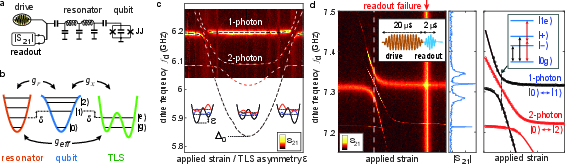
Figure 1: Schematic of the transmon circuit, its discrete energy states, observed multi-photon spectroscopy, and strain-tunable anti-crossings revealing qubit-TLS interactions.
Crucially, an external piezo stack applies a controlled mechanical strain to the device chip, enabling continuous tuning of the TLS asymmetry energy (ε), and hence its transition frequency, via ε=γ⋅E where γ is the strain coupling parameter. Through this strain-tuning protocol, both the identification and manipulation of individual TLS are achieved, allowing direct observation of their spectral features via anti-crossings in qubit spectroscopy.
Spectroscopy of Qubit-Resonator-TLS Coupling
High-resolution multi-photon spectroscopy reveals a complex pattern of avoided crossings, multi-photon transitions, and the emergence of anomalous readout responses. At sufficiently large spectroscopy drive powers, a dense landscape of transitions involving higher-excited states is observed, corresponding to processes such as simultaneous excitation of both the qubit and the resonator by multiple photons.
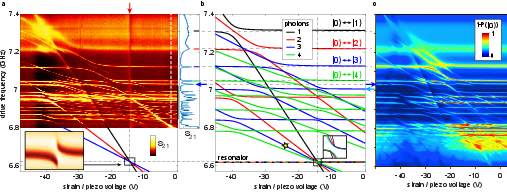
Figure 2: Spectroscopy of the qubit-resonator-TLS system under high drive, simulated eigenstate transitions (color-coded by photon number), and numerical simulations capturing higher-order effects and their agreement with experiment.
Transitions involving the TLS exhibit a distinct strain-dependence with tilted spectral lines whose slope diminishes with growing photon number. Importantly, the intersection of such transitions with the resonator frequency marks the condition where the TLS is resonant with the resonator, triggering pronounced anti-crossings and the distinctive readout failure: a static, parasitic signal insensitive to the applied drive frequency. The signature is confirmed via direct strain-dependent resonator spectroscopy, verifying the presence of a strong, qubit-mediated resonator-TLS interaction.
Quantum simulations using the QuTiP package are employed, both for static eigenvalue calculations and for full time-domain Lindblad master equation integration with decoherence effects. Time-evolution simulations are essential for capturing the observed shifts in higher-order transitions, accounting for AC-Stark effects and further validating the extracted system parameters.
Quantitative Analysis of Cross-Resonant Interaction
The effective resonator-TLS coupling strength, geff, is explicitly measured as a function of qubit-resonator detuning δ=fq−fres. The data are in strong agreement with the theoretical cross-resonance interaction geff=grgx/δ, where both gr and gx0 are independently measured. Up to detunings of 500 MHz, gx1 exceeds 1.5 MHz, comparable in scale to the bare dispersive shift gx2 typically employed for qubit readout.
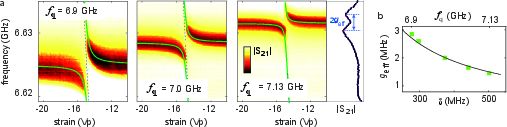
Figure 3: Strain-tuned anti-crossings between resonator and TLS for various qubit detunings, and the measured vs. predicted resonator-TLS coupling as a function of detuning.
In systems where gx3, the resulting dressed resonator frequency shift can be on the order of the native dispersive shift or larger, directly spoiling the fidelity of projective qubit state measurement. The measurements confirm the dominant character of the transversal (dipole) coupling between TLS and qubit, with no detectable longitudinal coupling component gx4 within the experimental resolution, consistent with prior studies using other superconducting qubit modalities.
Microscopic Origin and Density of TLS Defects
The observed TLS possess large, strain-tunable dipole moments and strong coupling strengths (gx5 MHz). These can be traced to charged defects within the amorphous oxide barriers of the Josephson junctions. Statistical densities for such strongly coupled TLS are known to range between 100 and 8000 per GHz per gx6mgx7, in line with this experiment and previous spectroscopic studies.
Secondary TLS-induced readout errors are also documented, indicating that this mechanism is not an isolated occurrence but an inherent risk for any junction-based qubit implementation, especially as device counts scale upward and chip area increases.
Implications for Quantum Processor Reliability
The demonstrated readout failures translate to a significant limitation for quantum information processing, particularly for large-scale quantum error correction, where even rare, persistent readout errors at the level of individual qubits can lead to widespread logical error rates. The effect is distinct from the usual decoherence mechanisms as it specifically manifests as a parasitic measurement signal, outside the standard models of gx8 or gx9 decay. Furthermore, the instability of TLS resonance frequencies, induced by charge and strain dynamics, suggests that such error mechanisms are intermittent and unpredictable, complicating calibration and mitigation strategies.
The cross-resonance interaction of a TLS with the resonator is fundamentally a virtual process mediated by the qubit, analogous to coupler-induced two-qubit gates but here manifesting as a deleterious, uncontrolled effect. Importantly, these findings are applicable not only to standard transmon qubit designs but also extend to bosonic encodings and other qubit-resonator modalities.
Fabrication Considerations and Directions for Mitigation
The results emphasize the pressing requirement for systematic studies and targeted fabrication improvements aimed at reducing TLS densities in tunnel barriers. Large-area junctions, higher-quality oxide layers, and alternative barrier engineering techniques may collectively contribute to mitigating this error channel. Simultaneously, real-time diagnostic protocols for TLS detection may be required for future quantum processor deployments to maintain reliable qubit operation over device lifetimes.

Figure 4: Scanning electron micrograph of the studied qubit device, highlighting the cross-shaped transmon capacitor and Manhattan-style Josephson junctions.
Conclusion
This investigation establishes a direct, quantitative link between strongly-coupled TLS defects in Josephson junction tunnel barriers and deterministic qubit readout failures arising from a cross-resonance interaction with the readout resonator. The measured shifts and the associated parasitic signals highlight a critical error channel for superconducting quantum circuits, especially for architectures employing dispersive readout. Theoretical models and time-resolved quantum simulations reproduce the main experimental observations, reinforcing confidence in the underlying physical picture.
Ongoing work must focus on further elucidation of the microscopic origin and the statistical behavior of TLS, in tandem with process-level advances in Josephson junction fabrication. Such studies will be essential to support the continued advancement of quantum information processors and to ensure robust, high-fidelity measurement as the field approaches the regime of scalable, fault-tolerant quantum computation.

