- The paper introduces an adaptive agent that facilitates integrative decision-making by balancing System 1 and System 2 processes in reflective dialogues.
- It employs a two-phase design with unaided and assisted reflection, using an ε-greedy strategy to dynamically probe underrepresented thought categories.
- Experimental results reveal the agent’s effectiveness in maintaining personalized reasoning profiles while enhancing multi-modal expression and perceived integrative support.
Reflecti-Mate: Adaptive Conversational Decision Support via System 1 and System 2 Thinking
Introduction
"Reflecti-Mate: A Conversational Agent for Adaptive Decision-Making Support Through System 1 and System 2 Thinking" (2605.22509) introduces a novel agent architecture designed to facilitate integrative pre-decisional reflection in high-stakes personal decisions. The agent leverages real-time computational user modeling to diagnose and scaffold the interplay between cognitive, emotional, and intuitive thought processes, operationalizing concepts from dual-process theory. Unlike prior approaches that privilege cognitive reasoning, Reflecti-Mate incorporates both exploratory and exploitative dialog strategies that enable users to elaborate and broaden their reflective language, supporting personalized trajectories while preserving dominant reasoning styles.
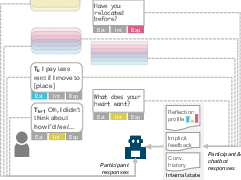
Figure 1: Illustrative interaction showing ReflectiMate's adaptive probing across internal, experiential, and external aspects to encourage integrative reflection.
System Architecture and Methodology
Reflecti-Mate consists of two phases: an unaided reflection phase, where users externalize their thoughts without intervention, followed by an assisted reflection phase mediated by the agent. The agent immediately constructs a computational reflection profile from the user's preliminary text, segmenting thoughts into internal (emotional/intuitive), external (environmental/factual), experiential (past outcomes), and additional categories. Each thought includes elaborative depth, forming a directed acyclic graph anchored by main thoughts and enriched by explanatory child nodes.
The adaptive dialog policy is governed by two indicators: breadth (distinct thoughts per category) and depth (elaborative richness per thought). The agent evaluates fixation (Sk) and reasoning depth (Dˉk) per category, dynamically updating the profile after each turn. Importantly, the agent operationalizes an exploration-exploitation dichotomy via ϵ-greedy decision at each turn: exploration entails probing underrepresented categories with curated prompts, while exploitation targets minimally elaborated thoughts for Socratic follow-ups. The conversational context and implicit feedback factor into the agent's state transitions, with action utility recalibrated online.

Figure 2: Comparative overview of baseline vs. experimental agent architectures, emphasizing profile-driven adaptation in Reflecti-Mate.
Experimental Design
A between-subjects study (N=128) assessed the adaptive agent against a baseline agent that generates prompts based only on conversational history and fixed instructions, omitting explicit modeling of individual reflection patterns. Both agents utilize the same underlying LLM (Phi-4 14B, Q4_K_M quantization), thus isolating the effect of adaptation logic. Participants, currently facing high-stakes life decisions, engaged in web-based dialog with at least ten agent turns, followed by post-hoc questionnaires regarding perceived effectiveness. Reflection content was analyzed using LIWC-22 composites segmented into cognitive, emotional, and intuitive dimensions.
Statistical analysis (MANOVA; Wilks' Λ=0.878, F(3,124)=5.74, p=.001) demonstrated significant differences in reflective language as a function of agent condition. The baseline agent elicited a marked dominance of cognitive linguistic markers (Cohen’s d=−0.51 relative to experimental), suppressing emotional and intuitive modes. Contrastingly, the adaptive agent achieved balanced, multi-modal expression (d=0.35 emotional, d=0.24 intuitive), with no significant inter-dimensional divergence.
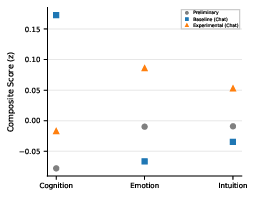
Figure 3: Mean z-scores across cognitive, emotional, and intuitive categories for unaided, baseline, and experimental conditions; experimental agent facilitates diversified participation.
Perceived Support and Integration
Participants rated holistic integration and elaboration depth via 5-point Likert scales. The adaptive agent outperformed the baseline on integration (72% agree/strongly agree vs. 44%, Dˉk0, Dˉk1, Dˉk2), while both conditions achieved comparable high scores for elaboration depth (experimental: 72%, baseline: 79%). Notably, baseline users were more uncertain about integration, suggesting its strategy failed to support personalized trajectories.



Figure 4: Distribution of participant responses for holistic integration (top) and elaboration depth (bottom), revealing superior integrative support by ReflectiMate.
Differential Impact Across Reflective Archetypes
K-means clustering of unaided reflection profiles produced three archetypes: Reserved (low expressiveness), Intuition-dominant, and Emotion-dominant. The baseline agent uniformly amplified cognition and reduced the relative prominence of initial modes, enforcing homogenized post-dialog profiles. Conversely, the experimental agent scaffolded underrepresented modes without suppressing dominant ones; cluster-specific trajectories persisted post-interaction. Cognitive increases were significant only in the baseline agent, indicating the adaptation algorithm avoids one-size-fits-all drift.
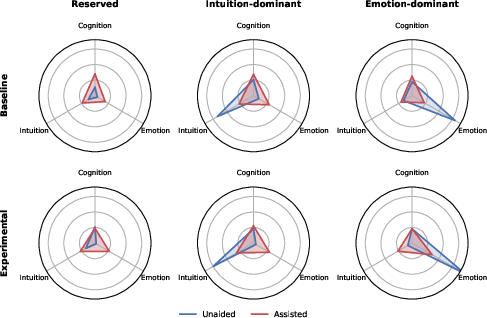
Figure 5: Radar plots showing reflection trajectory transitions by cluster and condition; adaptive agent maintains archetypal structures while expanding multi-modal intensity.
Theoretical and Practical Implications
Reflecti-Mate exemplifies principled computational user modeling for adaptive dialog management, operationalizing dual-process constructs at the linguistic level. The architecture demonstrates that achieving integrative reflection necessitates explicit profiling and real-time adaptation rather than generic prompting or instruction-driven approaches. The agent respects user autonomy and reasoning preferences, avoiding enforced convergence. The findings inform a paradigm for human-AI collaboration in decision support, where LLMs act as inquiry facilitators rather than solution recommenders, preserving agency and avoiding over-reliance, as discussed in critical studies on AI-advised decision making [overreliance].
The practical utility is tangible in domains demanding integrative reasoning: clinical decision support, counseling, and personalized informatics. Expectation management and ethical boundaries remain salient; some users demand directive advice, underscoring the need for explicit role negotiation and flexibility in deployment.
Limitations and Future Directions
While depth-adaptive exploitation was personalized, exploration prompts were scripted for control. Future work should extend prompt adaptation based on user-specific trajectories and integrate domain knowledge and expert input to optimize reflective coverage. LIWC-based language metrics capture only behavioral correlates, not underlying mental systems; multi-modal assessment—behavioral, affective, physiological—should be triangulated. Longitudinal evaluation is imperative to quantify downstream impacts on decision quality and user well-being.
Conclusion
Reflecti-Mate operationalizes adaptive conversational support for integrative pre-decisional reflection, yielding multi-modal language patterns and enhanced perceived effectiveness without sacrificing user autonomy or dominant reasoning styles. The agent’s approach avoids the cognitive homogenization seen in instruction-based LLM systems, suggesting computational modeling and online adaptation are critical for meaningful, personalized decision-support. The work opens new avenues for reflective AI assistance and serves as a foundation for future responsible human-AI reflection systems.