- The paper demonstrates that LOSA and residual eccentricity induce frequency-domain phase corrections that are highly degenerate in GW190814 signals.
- It employs a modified IMRPhenomXPHM model with Bayesian inference via bilby to separately and jointly analyze LOSA and eccentricity effects.
- The study reveals that including higher-order waveform modes is crucial for constraining parameters and setting rigorous limits on tertiary companion claims.
Analysis of Tertiary Compact Object Signatures in GW190814
Introduction and Context
The study examines the possible presence of a tertiary compact object in the GW190814 event through gravitational wave (GW) phase modifications arising from line-of-sight acceleration (LOSA) and residual orbital eccentricity. The LIGO-Virgo-KAGRA (LVK) network's catalog continues to expand, opening novel probes into binary black hole (BBH) formation channels and environmental effects that leave distinct signatures on GW signals. Environmental effects, specifically LOSA induced by a massive companion and residual eccentricity, complicate waveform modeling and parameter estimation by introducing nontrivial phase corrections in the GW inspiral.
The authors employ a modified IMRPhenomXPHM waveform, widely adopted by the LVK for parameter estimation (PE), extending it via additive phase corrections that encode LOSA and residual eccentricity. At leading PN order, LOSA and eccentricity induce frequency-domain phase corrections scaling as f−13/3 and f−34/9, respectively. This structural similarity results in degeneracies when attempting to disentangle LOSA from eccentricity in GW signals. The analytic phasing approach is modular, facilitating hypothesis testing within Bayesian inference.
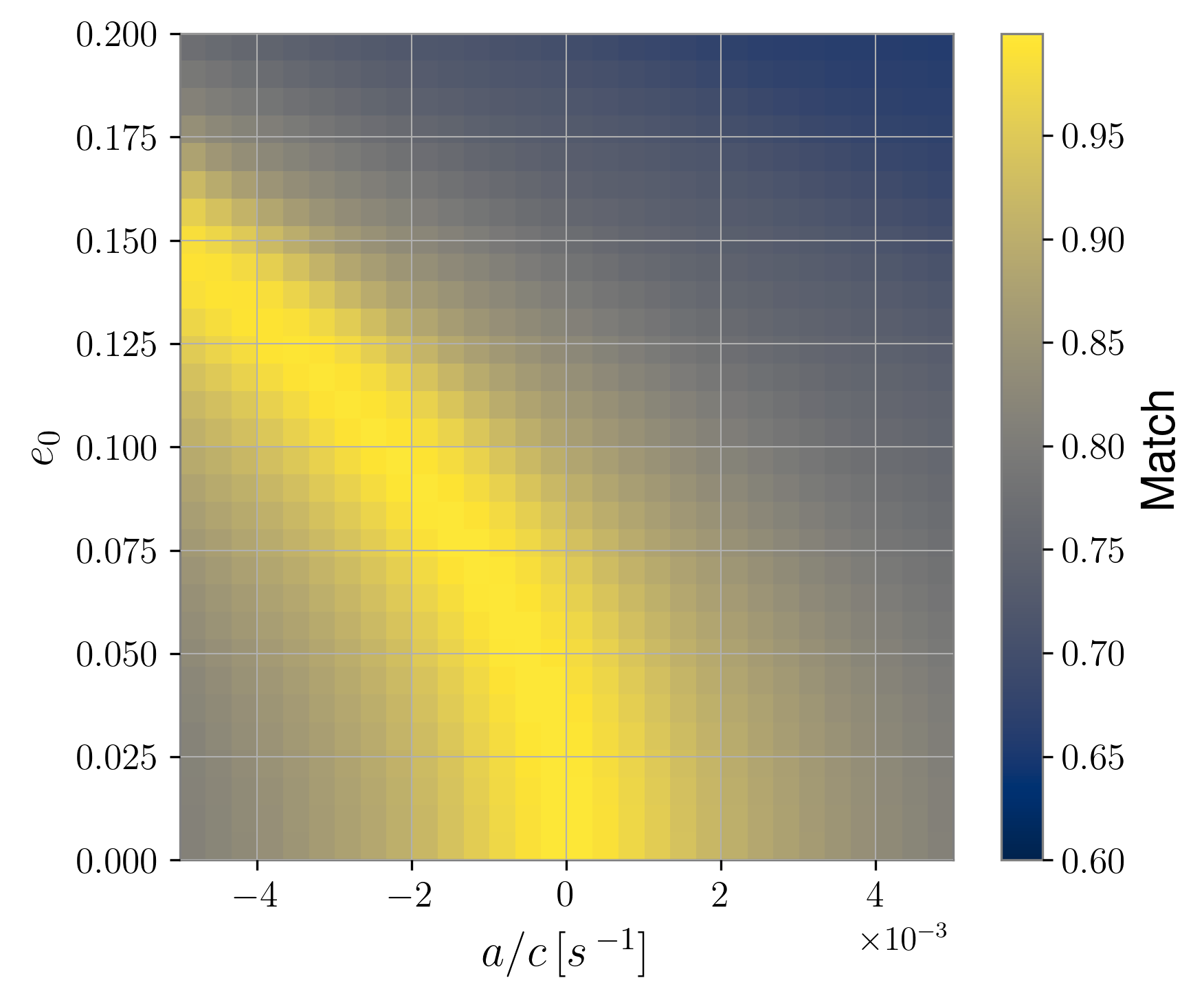
Figure 1: Correlation between LOSA (a/c) and eccentricity (e0) is demonstrated for GW190814-like signals, as high match values cluster along a diagonal ridge, indicating parameter degeneracy.
The match analysis strongly indicates that the GW phase modulation attributed to LOSA can be mimicked by residual eccentricity, underscoring the necessity to jointly model both effects. This degeneracy manifests even under ideal detector sensitivity, motivating rigorous Bayesian inference and careful attention to waveform systematics.
Bayesian Inference Methodology
Bayesian parameter estimation is performed using bilby with nested sampling, considering joint and individual treatments of LOSA and eccentricity. The full PE runs use a conservative 32-second signal duration, consistent with prior critiques of short data segment analyses, and uniform priors for a/c and e0. Both higher-order waveform modes (HOMs) and their exclusion (dominant (2,2) mode only) are considered to assess their effect on parameter constraints and degeneracy resolution.
Results: Inference on GW190814
LOSA-Only Analysis
Using the LOSA-only model with a 32-second signal duration, no evidence is found for non-zero LOSA (Bayes factor ∼0.22 versus the baseline model), corroborating recent work advocating conservative segment lengths (Hendriks et al., 21 Jan 2026). Conversely, using a much shorter 4-second segment yields statistically significant but likely spurious measurements, echoing prior methodological concerns.
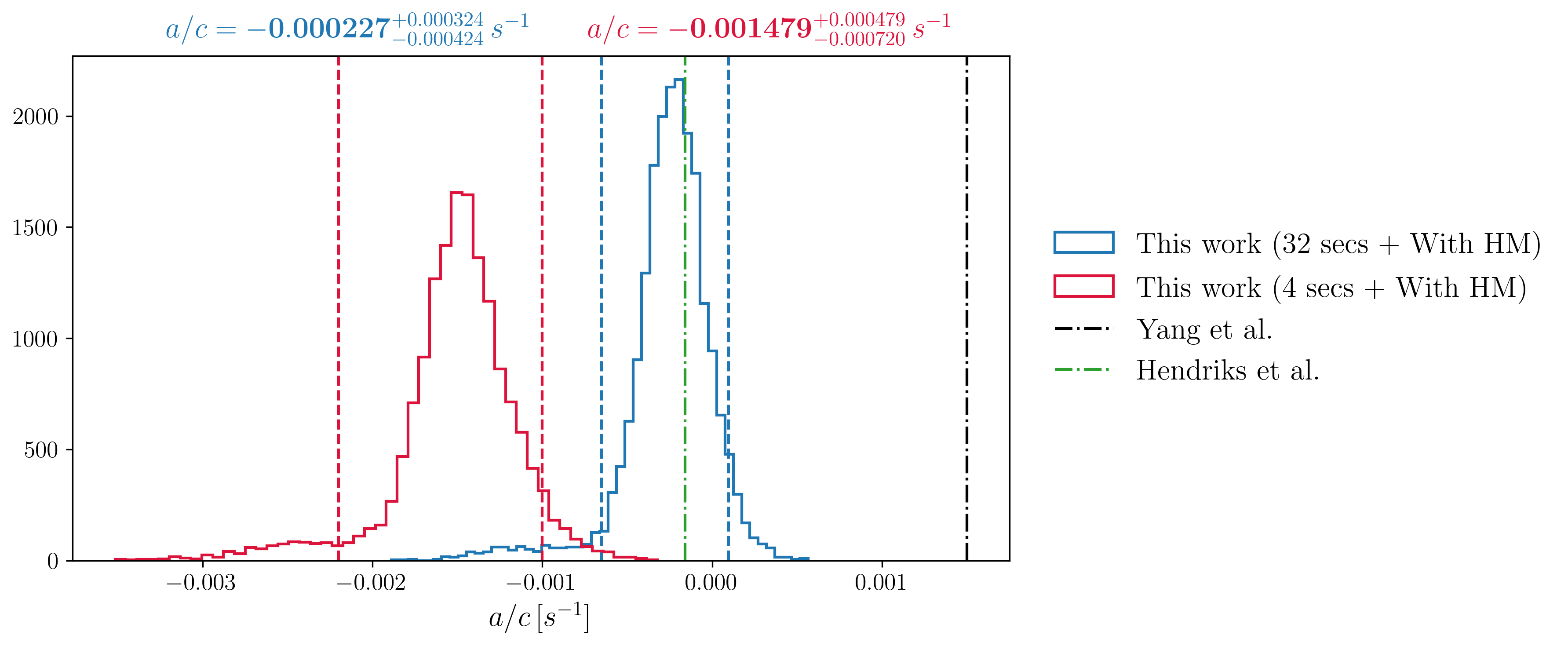
Figure 2: LOSA posteriors for GW190814 using both 32s and 4s signal durations, highlighting the strong dependence on segment length and potential for biased inference in short durations.
Eccentricity-Only Analysis
Eccentricity-only runs yield posterior distributions consistent with zero eccentricity, in agreement with previous analyses of GW190814 [Kacanja_2025]. Inclusion of HOMs is critical; without them, eccentricity posteriors revert to the prior, indicating a lack of constraining power from the dominant mode alone.
Joint LOSA and Eccentricity Analysis
The joint model yields nonzero estimates of both LOSA and eccentricity (a/c∼−2.8×10−3 s−1, f−34/90) with informative posteriors, but the Bayes factor (f−34/91 relative to the baseline) indicates insufficient evidence for either effect. Strong correlation and parameter degeneracy are evident, with the joint posterior distribution showing a marked trade-off between LOSA and f−34/92.
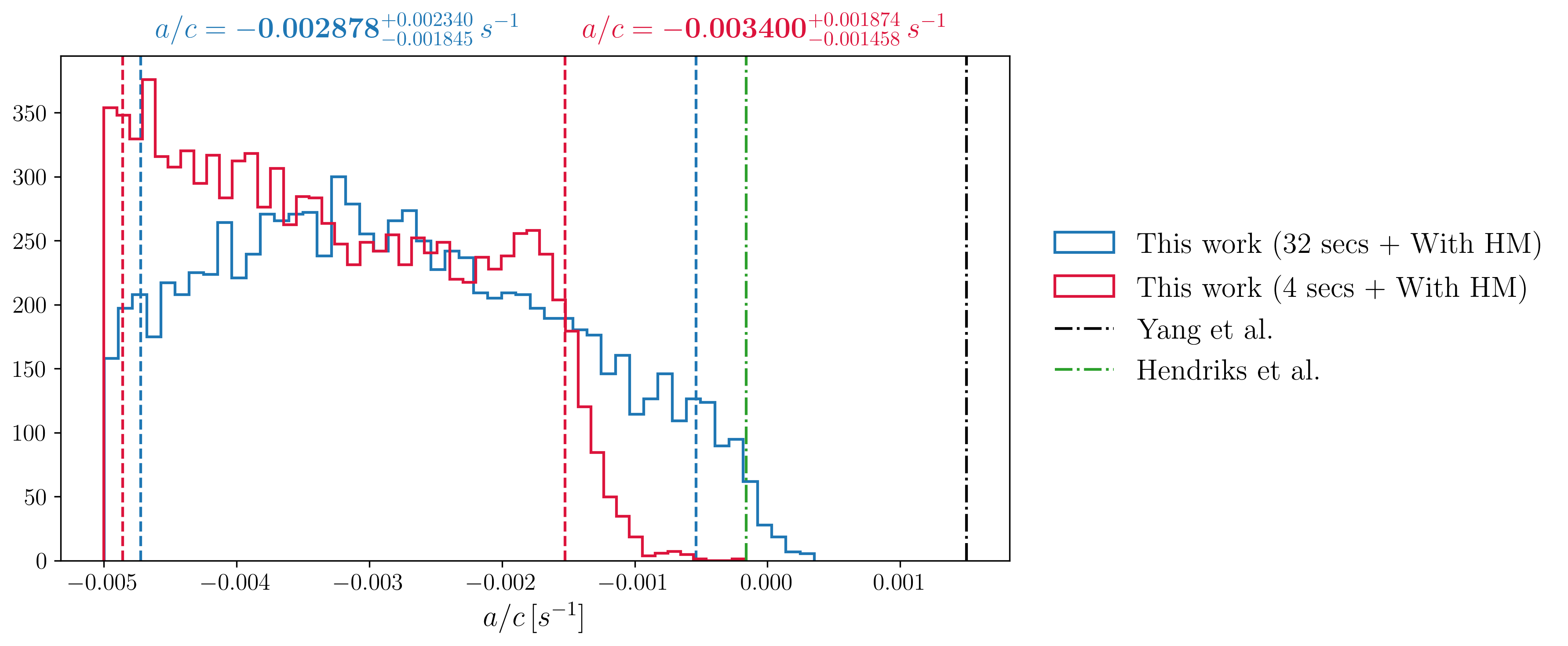
Figure 3: Joint LOSA and eccentricity (f−34/93, f−34/94) posteriors with HOMs and varying signal duration, displaying the shift and broadening induced by joint modeling.
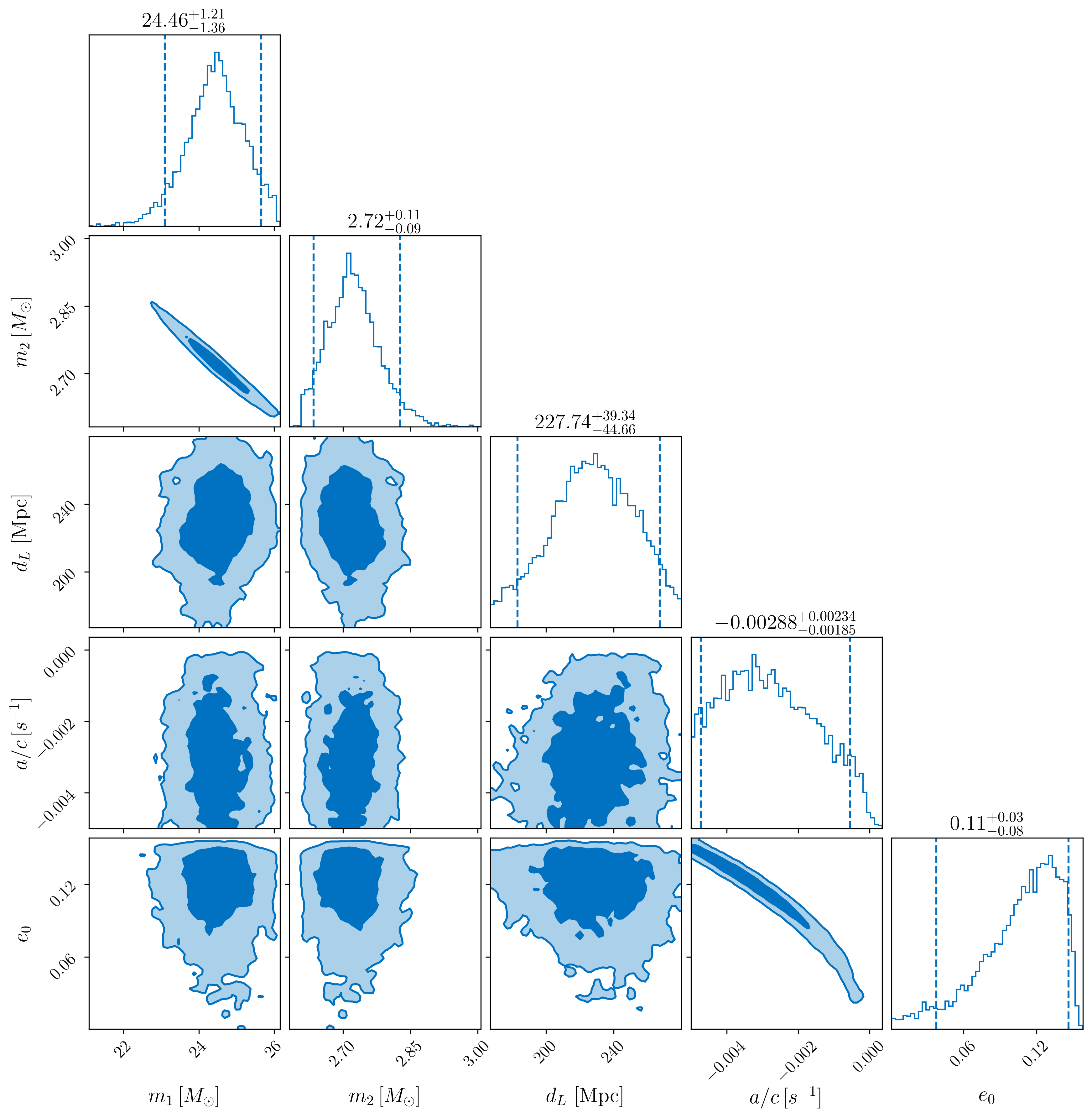
Figure 4: Corner plot for GW190814 joint LOSA-eccentricity analysis, revealing significant degeneracy and correlated posteriors between f−34/95 and f−34/96.
The authors show that HOMs, while only modest contributors to SNR, are essential for constraining LOSA and eccentricity, as analyses without HOMs fail to yield informative posteriors.
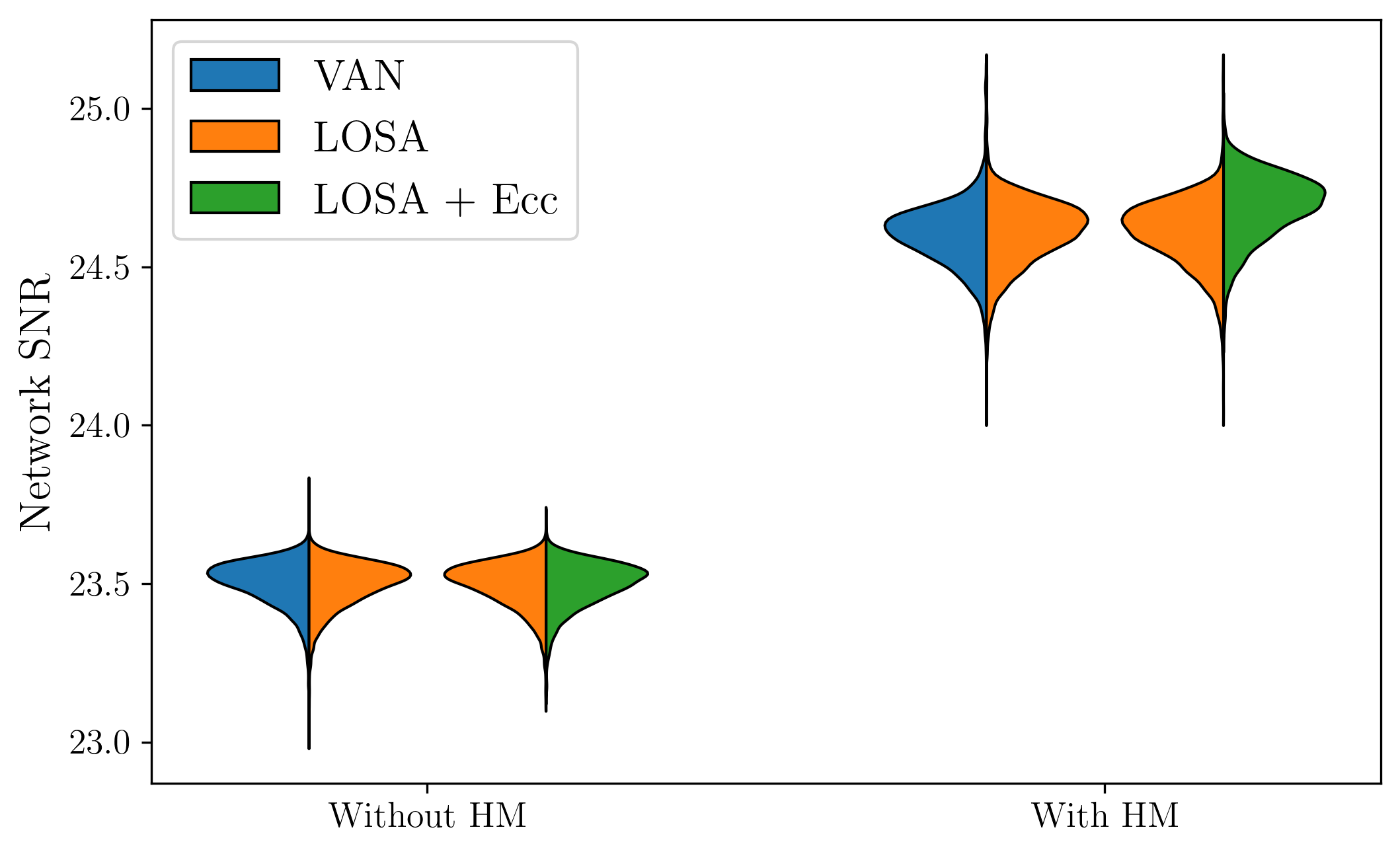
Figure 5: SNR posteriors for joint and individual models of LOSA and eccentricity, with and without higher-order modes, demonstrating SNR enhancement due to mode inclusion.
Discussion and Implications
The principal finding is that LOSA and eccentricity effects are intrinsically degenerate in the GW phase, particularly in asymmetric BBH mergers like GW190814. This degeneracy is robust both theoretically (via frequency-domain phase analysis) and empirically (match estimates, PE results). The absence of compelling statistical evidence for either LOSA or eccentricity in GW190814, when properly accounting for segment duration and waveform modes, places substantial limits on claims of a tertiary companion.
For current-generation detectors, higher-order mode modeling is vital for parameter estimation. However, the dominant degeneracy will likely persist until low-frequency sensitivity is improved and higher-order PN corrections are incorporated. These results directly inform observational strategies for transient GW events, the interpretation of environmental and formation-channel signatures, and the requirements for future waveform systematics modeling.
In anticipation of third-generation GW observatories, such as Cosmic Explorer and the Einstein Telescope, the joint modeling of LOSA and eccentricity will become even more critical as sensitivity to low-frequency phase corrections improves. Mode-dependent amplitude and phasing corrections, along with self-consistent eccentric inspiral modeling, represent promising avenues to break degeneracies and robustly identify environmental effects, including the presence of tertiary compact objects. Space-based detectors may further benefit from these waveform advances, with implications for LISA, Taiji, TianQuin, DECIGO, and IndiGO-D.
Conclusion
The study rigorously shows that LOSA and residual orbital eccentricity induce phase corrections with closely overlapping frequency dependence, resulting in strong parameter degeneracy for GW190814. Bayesian inference with conservative signal durations and HOM-inclusive waveforms finds no robust evidence for either LOSA or eccentricity, despite informative joint posteriors when modeled together. These results establish stringent methodological requirements for claims of tertiary companions in BBH mergers and underscore the necessity of waveform modeling advances for disentangling environmental effects in GW astrophysics. Future detector upgrades and third-generation observatories may provide the sensitivity and waveform modeling precision needed to resolve such degeneracies and definitively constrain the astrophysical environments of compact binary mergers.