- The paper presents a Newtonian plus post-Newtonian model for transient three-body fly-by interactions to assess binary compact object isolation.
- It validates the model against advanced waveform templates and uses residual cross-correlation to rule out significant nearby perturbers.
- The study sets upper bounds on intermediate-mass black holes near binaries and highlights future detector advancements for extended environmental probing.
Isolation and Environmental Probing of Binary Compact Object Mergers in the LVK Catalog
Introduction and Motivation
The paper "How lonely are the Binary Compact Objects Detected by the LIGO-Virgo-KAGRA Collaboration?" (2604.22441) interrogates the widespread assumption of dynamical isolation in Compact Binary Coalescences (CBCs) detected via gravitational waves (GWs). CBC signal models typically neglect environmental perturbations, assuming the binary evolves in vacuum. This work develops and applies a Newtonian plus leading-order post-Newtonian framework to analyze possible transient three-body fly-by interactions, focusing on their imprint on inspiral phase and amplitude — thereby evaluating the degree of isolation, or "loneliness," of the binaries detected in the LIGO-Virgo-KAGRA (LVK) GW catalog.
Theoretical Model for Three-Body Fly-By Perturbations
A physically motivated model is constructed in which a compact binary (composed of non-spinning Schwarzschild black holes or neutron stars) is perturbed by a third compact object passing by on a non-bound trajectory. The dynamics incorporate Newtonian three-body interactions and leading-order ($2.5$-PN) gravitational radiation-reaction in the binary. The binary is parametrized by component masses (m1, m2), initial separation (r0), and the third body by mass (m3) and closest approach distance (R0). Initial configurations sample a range of mass ratios and separations, probing the relevant parameter space for environmental perturbations at GW frequencies in the LVK band.
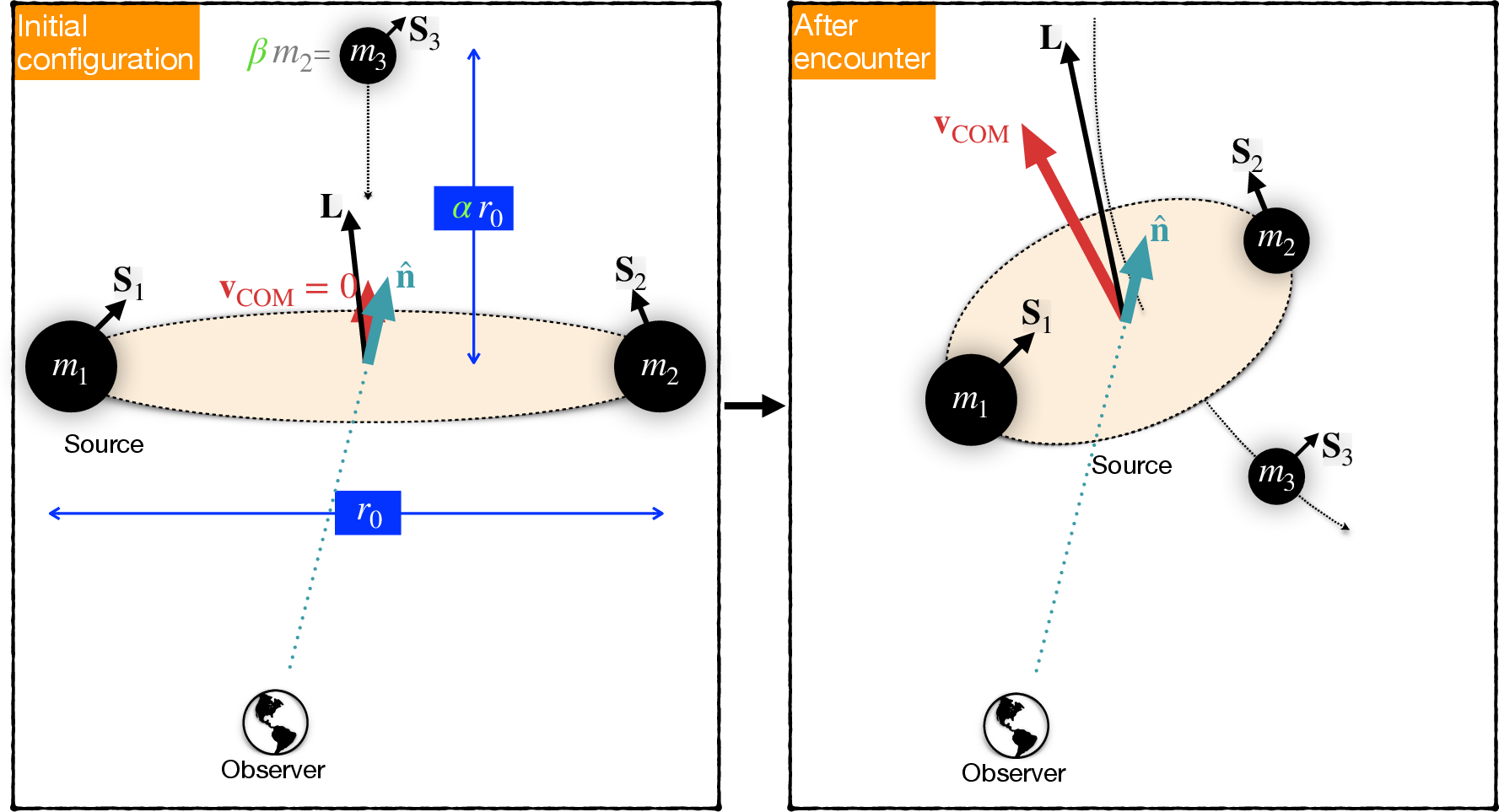
Figure 1: Schematic depiction of the three-body fly-by setup: a circular compact binary is perturbed in its inspiral, potentially inducing center-of-mass motion and waveform modulations.
The model yields perturbed GW waveforms via quadrupolar radiation, including the impact of center-of-mass velocity changes, eccentricity excitation, and cumulative phase/amplitude distortions from tidal and impulsive gravitational kicks.
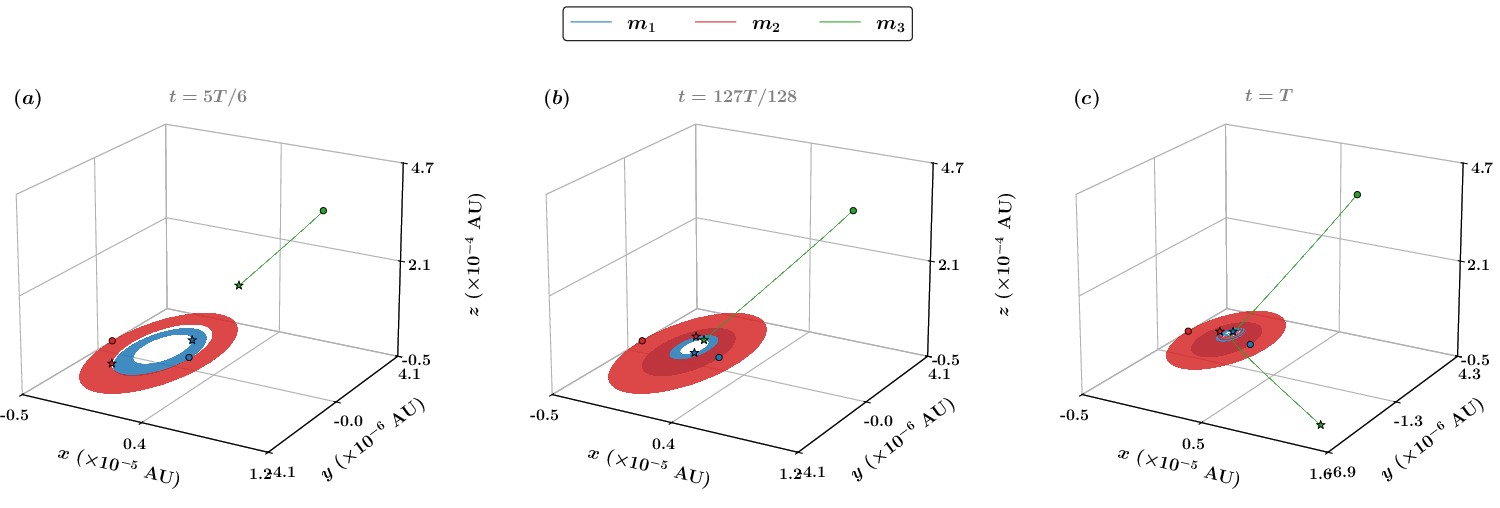
Figure 2: Representative three-body dynamical trajectories, showing binary distortion and induced center-of-mass displacement during a fly-by event.
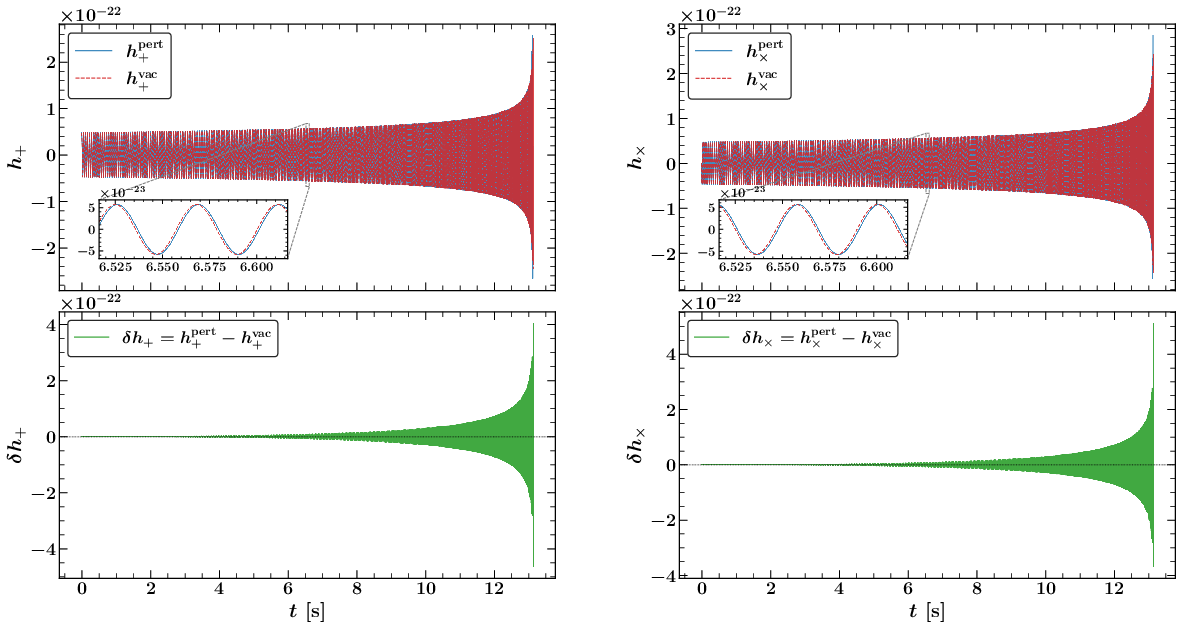
Figure 3: Comparison of perturbed and vacuum GW waveforms, highlighting nontrivial phase deformation and amplitude residuals from a transient tertiary encounter.
Analysis Pipeline: Signal Consistency and Residual Detection
To validate the model, the authors benchmark their unperturbed waveforms against state-of-the-art inspiral-merger-ringdown templates (e.g., IMRPhenomPv2, SEOBNRv5PHM), performing overlap-driven truncation to restrict subsequent residual analysis to regions with M>0.97 (1−M<0.03 mismatch). This ensures the extracted residuals are not contaminated by systematic modeling inaccuracies unrelated to environmental effects.
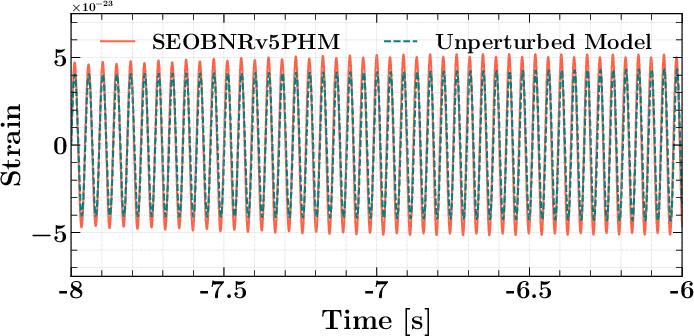
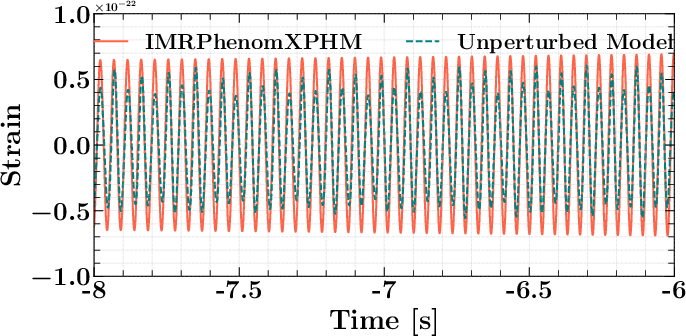
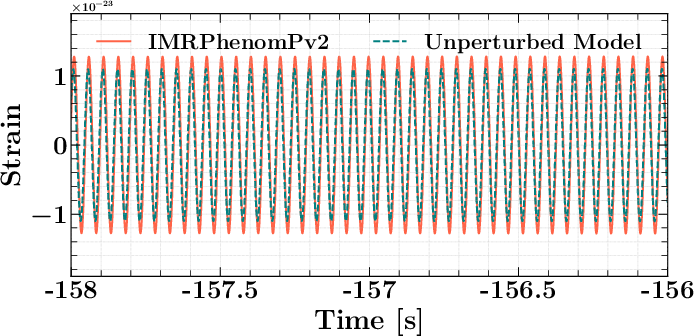
Figure 4: Direct time-domain comparison between reference LVK waveforms and the leading-order, unperturbed model; amplitude mismatches are dominated by neglected PN corrections.
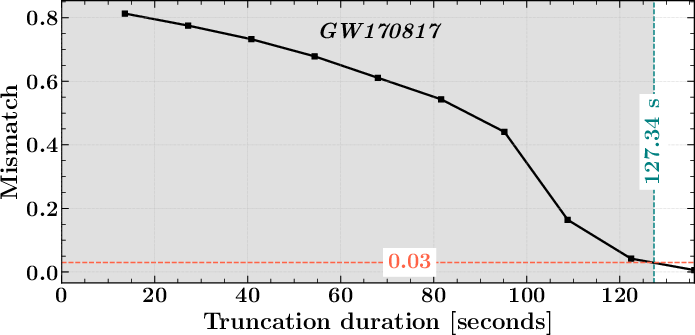
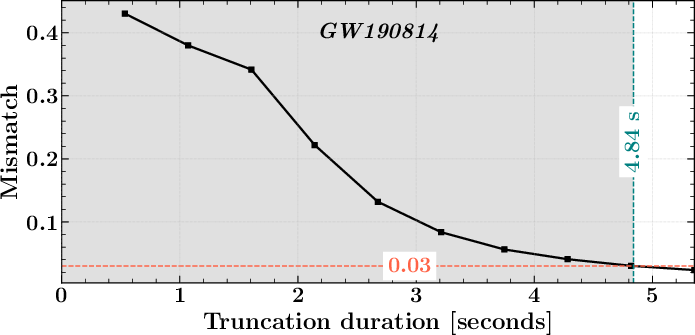
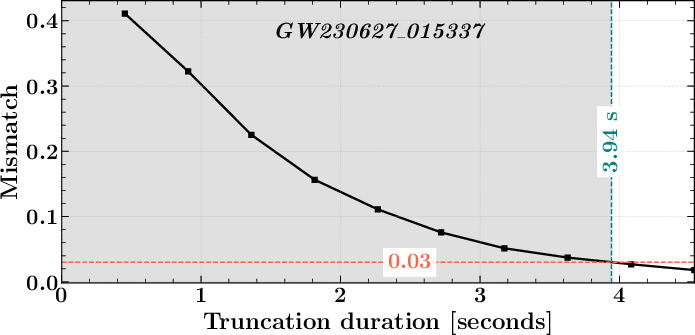
Figure 5: Mismatch evolution as the inspiral is truncated; analysis windows are defined where the unperturbed model remains consistent with reference templates.
Application to GWTC-4 Events and Residual Cross-Correlation
Three high-SNR, long-duration CBC events are selected: GW170817, GW190814, and GW230627_015337. After subtracting maximum-likelihood vacuum templates from the strain data, cumulative cross-correlation between detectors (H1 and L1) is scrutinized for evidence of coherent perturbations. The methodology is robust against model dependencies, focusing solely on empirically detectable residual structure.
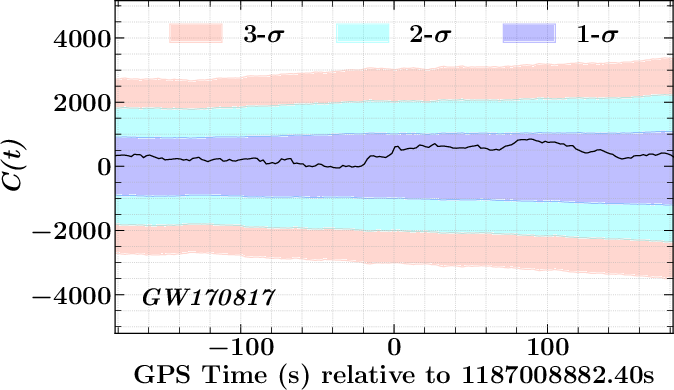
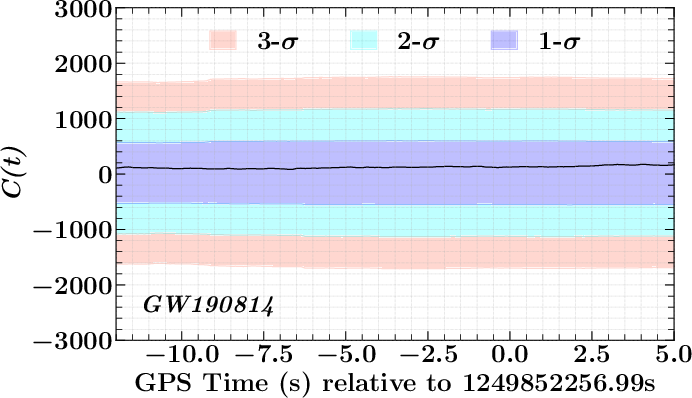
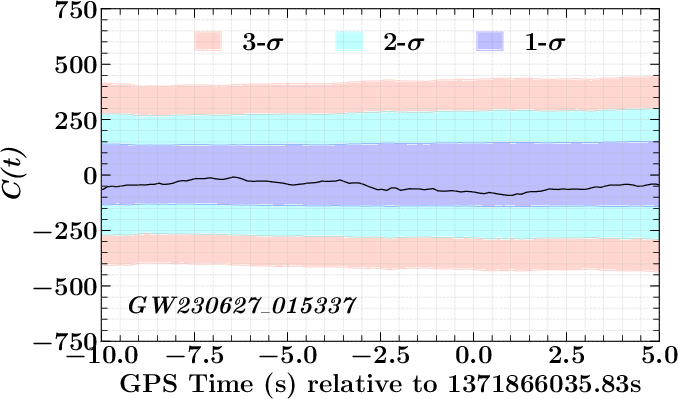
Figure 6: Residual cross-correlation between H1/L1 detectors after template subtraction; all residuals are consistent with the noise-only expectation at 1σ.
Constraints on the Environmental Parameter Space
The analysis yields strict model-independent exclusions: any fly-by interaction capable of dynamically disrupting the binary prior to merger is ruled out simply by the detection of a coalescence. For each event, this eliminates perturbers above ∼102–m10 within m11 AU, with precise bounds set by event-specific orbital parameters.
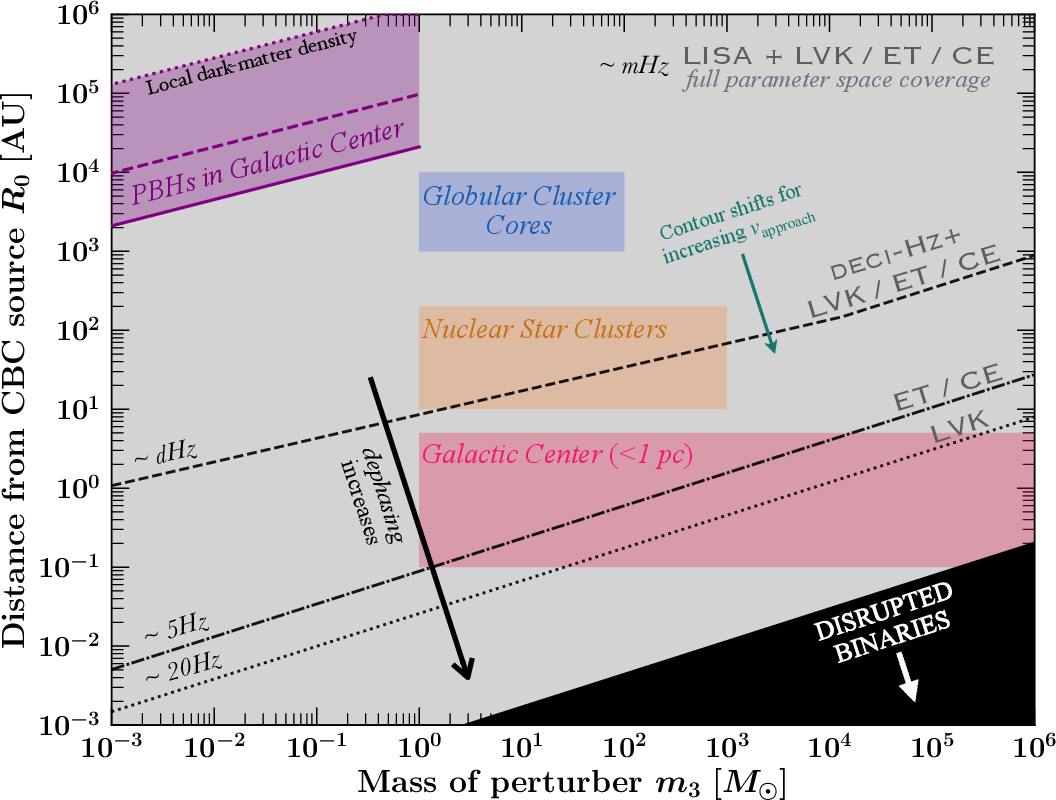
Figure 7: Schematic parameter space: disrupted region (black), detectable waveform perturbation contours (colored), and astrophysically relevant separation/mass bands.
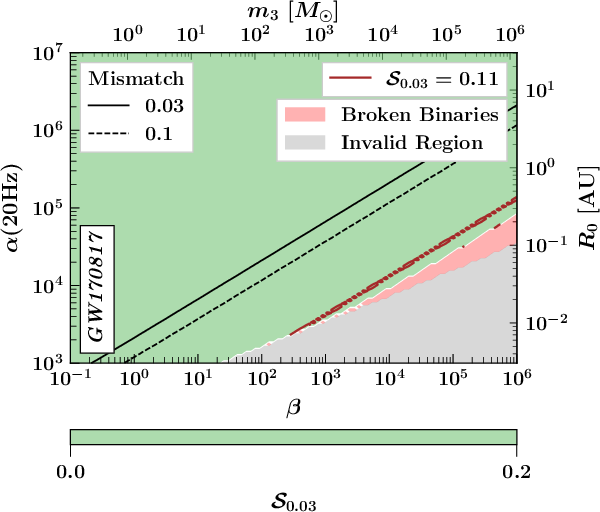
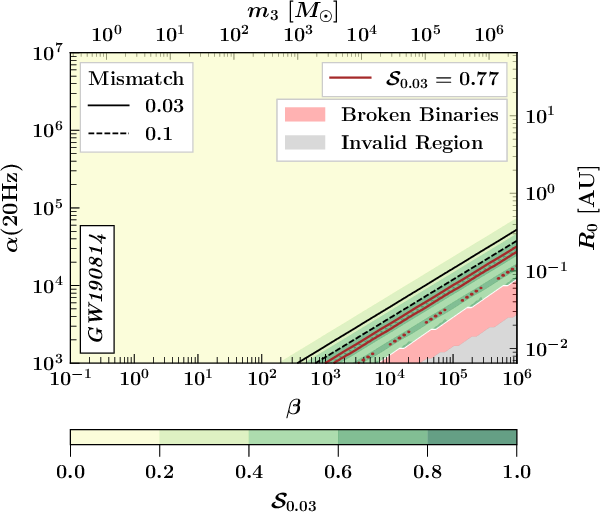
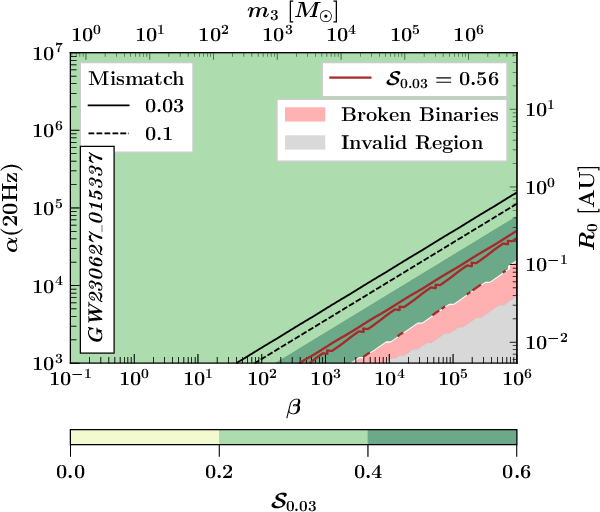
Figure 8: Empirical constraint maps from fly-by simulations: red (disrupted binaries), gray (model breakdown), dashed/solid contours (full waveform mismatch), brown (maximum residual SNR in analysis window).
Despite the residual analysis, no statistically significant deviation from the vacuum signal is identified. Maximum cross-correlation SNR for perturbed scenarios remains below unity, indicating no detectable environmental imprint within current modeling and data window constraints.
Astrophysical Implications and Future Directions
The robust disruption constraints constitute the first direct event-by-event GW-based upper bounds on the presence of intermediate-mass black holes (IMBHs) in close proximity to CBCs, excluding m12–m13 within m14–m15 AU across the observed sample.
Analysis windows imposed by waveform validation, and short in-band durations at m16 Hz, limit the sensitivity to perturbers at AU-scale or larger distances. However, future ground-based detectors (ET/CE) with lower frequency thresholds (m17–m18 Hz), deci-hertz instruments, and multi-band LISA-LVK observations will substantially extend the accessible separation and inspiral duration, enabling robust dynamical exclusion up to characteristic scales of galactic nuclei, cluster cores, and PBH populations.
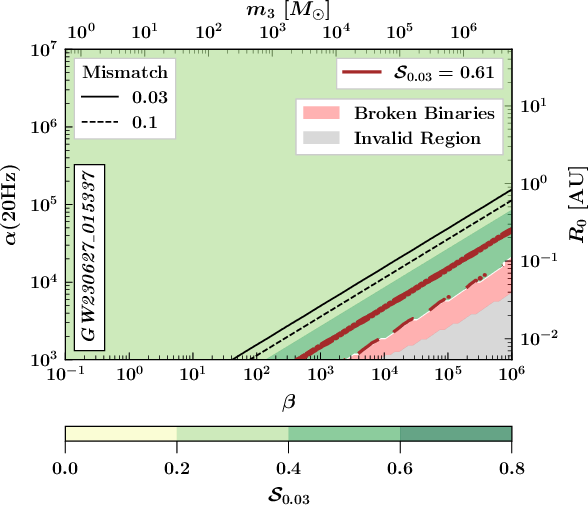
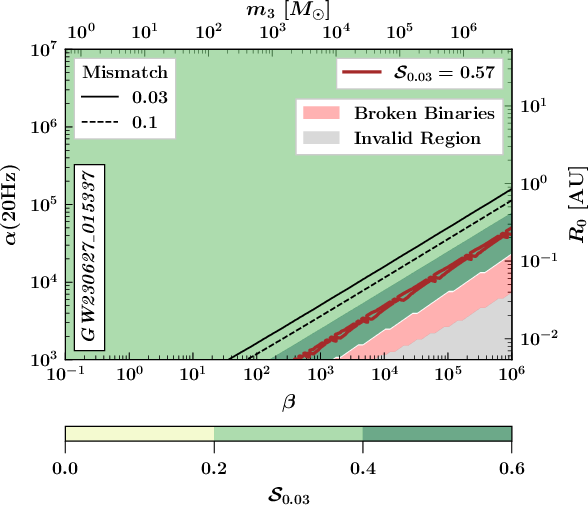
Figure 9: Constraint maps for alternative perturber velocity and trajectory configurations, showing the insensitivity of disruption boundaries to details in the quasi-static tidal regime.
The methodology is extensible to population-level environmental studies, direct PBH probing, and hierarchical triple interactions, contingent on waveform modeling improvements and longer-duration signals.
Conclusion
This paper presents a comprehensive dynamical and waveform-based framework for quantifying the isolation of CBCs observed in the LVK catalog (2604.22441). Null residuals in high-SNR data are translated into robust exclusions on massive perturbers, yielding the first direct GW-based limits on IMBH occupation near CBCs. The results underscore the necessity of advanced waveform modeling and lower-frequency GW detectors to fully probe environmental effects — opening complementary avenues alongside traditional electromagnetic and indirect statistical methods for mapping compact object populations and their assembly environments.