Vacuum breakdown in a misaligned magnetized Kerr spacetime
Published 21 May 2026 in gr-qc | (2605.21910v1)
Abstract: Electron-positron ($e{+}e{-}$) pair creation by vacuum breakdown around compact objects is believed to power high-energy astrophysical transients like gamma-ray bursts (GRBs). In this work, we focus on vacuum breakdown around a Kerr black hole (BH) immersed in an asymptotically uniform magnetic field that is inclined with respect to the BH spin axis. The dyadoregion, the region where the induced electric field exceeds the critical value $E_{\text{c}}=m_{e}{2}c{3}/(e\hbar)$, is identified via the electromagnetic invariants. It is found that the dyadoregion consists of several lobes whose number, size, and orientation vary with the inclination. We also estimate the electromagnetic energy available for pair creation and derive a beaming factor that allows a conversion between the intrinsic dyadoregion energy and the observed isotropic energy. The thermodynamic properties of the resulting electron-positron-photon ($e{+}e{-}γ$) plasma are included, revealing an initial magnetic dominance. The evaluation of the minimum magnetic field required shows that misaligned magnetic fields generally favor pair creation more than aligned ones.
The paper presents an analytical and numerical investigation of electron-positron pair creation via vacuum breakdown near Kerr black holes in misaligned magnetic fields, establishing critical conditions for the process.
It details the dyadoregion morphology, showing how misalignment induces complex multi-lobed structures compared to the axisymmetric case, with quantifiable effects on energy distribution and beaming.
Results indicate that misalignment lowers the threshold magnetic field for breakdown, providing insights into gamma-ray burst energetics and the dynamics of relativistic plasma outflows.
Vacuum Breakdown and Dyadoregion Structure in Misaligned Magnetized Kerr Spacetimes
Introduction
The study investigates electron-positron (e+e−) pair creation via vacuum breakdown in the vicinity of Kerr black holes immersed in asymptotically uniform magnetic fields misaligned with the black hole (BH) spin axis (2605.21910). This mechanism, relevant for astrophysical transients such as gamma-ray bursts (GRBs), contrasts with neutrino annihilation models, offering rapid and efficient conversion of electromagnetic energy into a hot, dense e+e−γ plasma. The focus is a systematic analysis of the "dyadoregion"—the spatial domain where the electric field surpasses the critical Schwinger threshold Ec=me2c3/(eℏ)—for misaligned field configurations, along with associated energetics and plasma thermodynamics.
Electromagnetic Field Configuration in Misaligned Kerr Spacetimes
The electromagnetic field solution, extending Bičák and Dvořák's construction, describes a Kerr BH within a uniform but arbitrarily inclined magnetic field. Unlike the axisymmetric Wald solution, the misalignment (inclination i between field and spin axis) breaks symmetry, yielding non-axisymmetric Maxwell fields. The asymptotic field components B0, B1 encode the parallel and perpendicular projections relative to the spin axis, with B=B02+B12 and B0=Bcosi, B1=Bsini. For observers, the electromagnetic field is characterized using the ZAMO (zero angular momentum observer) tetrad, determining the electric and magnetic field projections relevant for local pair production analysis.
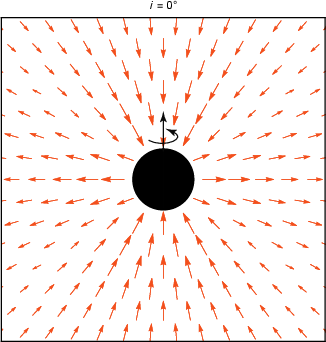
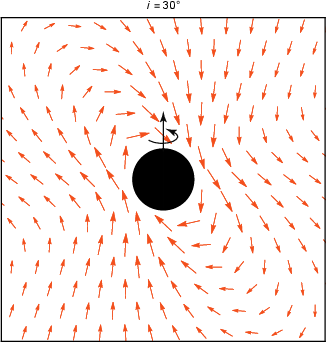
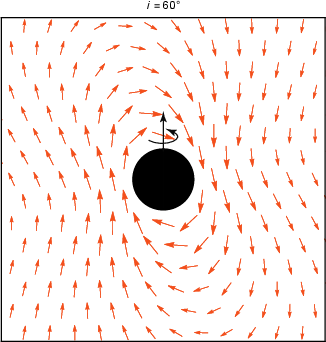
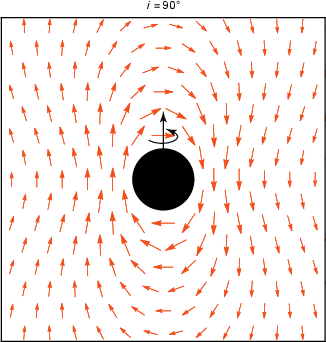
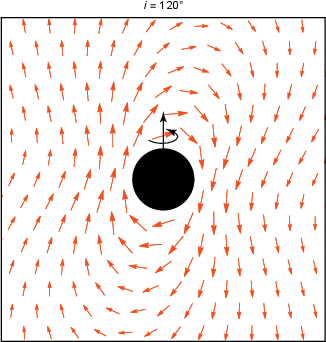
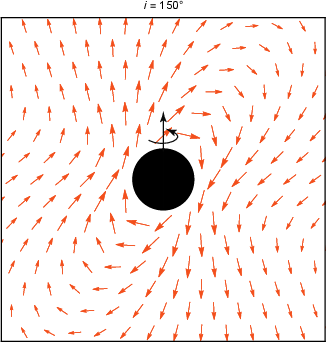
The spatial structure of electric fields for various inclination angles, as measured by ZAMOs, is illustrated in (Figure 1).
Figure 1: Schematic representation of the electric fields measured by ZAMOs for selected inclinations i, with the field strength increasing toward the horizon. Axisymmetry is recovered only at e+e−γ0.
Dyadoregion Identification and Morphology
The dyadoregion's spatial extent, where vacuum breakdown proceeds, is set by the electric field exceeding e+e−γ1 in the frame where the local electric and magnetic fields are parallel. This is computed from electromagnetic invariants, yielding the effective field
e+e−γ2
with e+e−γ3 and e+e−γ4 as the two Lorentz invariants.
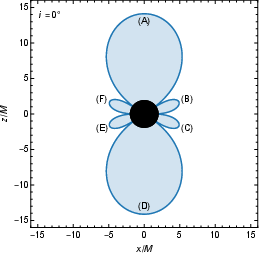
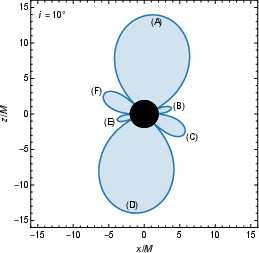
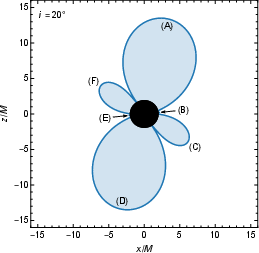
In aligned fields (e+e−γ5), the dyadoregion is axisymmetric, with two dominant polar lobes. For misalignment, the region's morphology becomes complex: several lobes emerge, whose number, size, and orientation evolve nontrivially with e+e−γ6. These features are visualized for a range of inclinations in (Figure 2).
Figure 2: The dyadoregion in the e+e−γ7-e+e−γ8 plane for different inclination angles e+e−γ9, showing lobe number and size variation as Ec=me2c3/(eℏ)0 increases from Ec=me2c3/(eℏ)1. For Ec=me2c3/(eℏ)2, Ec=me2c3/(eℏ)3, the pattern is axisymmetric only for Ec=me2c3/(eℏ)4.
This non-axisymmetric dyadoregion reflects the underlying lack of symmetry in the electromagnetic field, with lobe transitions and disappearances at critical inclination values. An analytic large-distance approximation provides a means to quickly estimate dyadoregion structure as a function of parameters Ec=me2c3/(eℏ)5.
Minimum Magnetic Field for Vacuum Breakdown
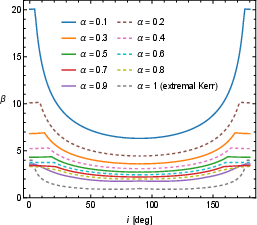
Not all field configurations drive vacuum breakdown outside the horizon. For each spin Ec=me2c3/(eℏ)6 and inclination Ec=me2c3/(eℏ)7, there is a minimum field strength Ec=me2c3/(eℏ)8 such that the maximum induced Ec=me2c3/(eℏ)9 exceeds i0 somewhere outside the BH. In the aligned case (analytically tractable), i1 increases at high spin but is otherwise determined by geometry. When the field is misaligned, i2 generically decreases for most values of i3, indicating that misalignment favors vacuum breakdown.
This dependence is shown in (Figure 3).
Figure 3: The minimum magnetic field i4 as a function of inclination i5, for various BH spins i6. Vacuum breakdown is more readily triggered for a wide range of misalignments, especially near i7.
A noteworthy exception is that, for extremal Kerr BHs, even perfectly aligned fields can permit vacuum breakdown, with a threshold field i8 (in units of i9), unaffected by the classic Meissner expulsion effect for axisymmetric stationary fields.
Dyadoregion Energetics and Beaming
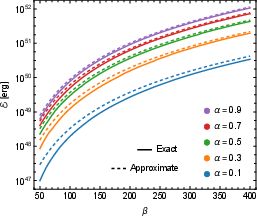
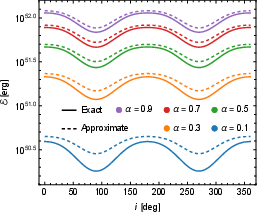
The electromagnetic energy content in the dyadoregion, B00, is computed through the conserved Killing integral restricted to the region where B01. Numerically, B02 grows monotonically with both spin B03 and field strength B04. As a function of inclination, the total energy displays a B05-periodic cosine-like oscillation, with maximum for B06 (alignment) and minimum near B07 (perpendicular).
This parameter dependence is depicted in (Figure 4).
Figure 4: Left: Dyadoregion electromagnetic energy B08 vs. magnetic field strength B09 for B10; Right: B11 vs. inclination B12 for B13, with different curves for spins B14. Dashed lines are analytic approximations valid for strong fields or high spin.
A scaling law
B15
is established, with B16 encoding the inclination dependence; its variation is much less than that due to changes in B17 or B18.
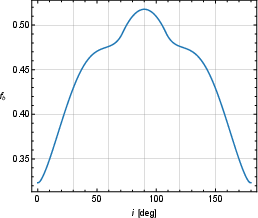
Astrophysically, observed energies are often inferred assuming isotropic emission. The actual beaming can be quantified by calculating the solid angle enclosing, e.g., 90% of the total dyadoregion energy. The "beaming factor" B19, the ratio of this energy region’s solid angle to B=B02+B120, is inclination dependent and generally increases from B=B02+B121 at B=B02+B122 to B=B02+B123 at B=B02+B124, as shown in (Figure 5).
Figure 5: Plot of the beaming factor B=B02+B125 vs. inclination B=B02+B126. The beaming is most concentrated (smallest B=B02+B127) for aligned fields, and most isotropic for perpendicular configurations.
Consequently, misaligned configurations yield more isotropic energy release, directly impacting observable energetics in GRBs and similar phenomena.
Plasma Thermodynamics in the Dyadoregion
Pair creation results in rapid formation of an B=B02+B128 plasma, assumed to quickly thermalize. The temperature and density are obtained by equating the local creation rate (from the Schwinger process in curved spacetime with magnetic fields) to the equilibrium Fermi-Dirac density for B=B02+B129 at zero chemical potential, leading to
B0=Bcosi0
For typical dyadoregion parameters (B0=Bcosi1), the temperature on the boundary is B0=Bcosi2.
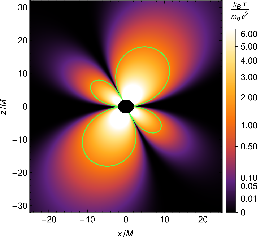
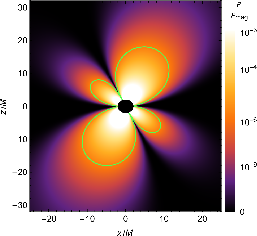
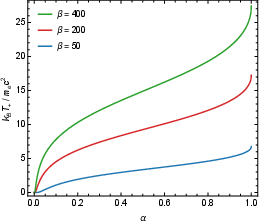
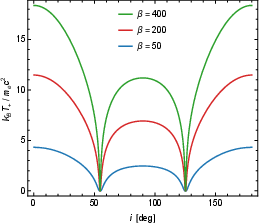
The spatial temperature and pressure profiles closely mirror the dyadoregion shape, with hot, dense plasma predominantly located within the lobe structures. (Figure 6) and (Figure 7) provide further details on temperature and pressure distributions on the horizon and as a function of inclination.
Figure 6: Left panel: Normalized plasma temperature B0=Bcosi3 in the B0=Bcosi4-B0=Bcosi5 plane (B0=Bcosi6, B0=Bcosi7, B0=Bcosi8). Right: Plasma parameter B0=Bcosi9, demonstrating magnetic domination in the dyadoregion.
Figure 7: Left: North-pole horizon temperature B1=Bsini0 vs. spin B1=Bsini1 for selected B1=Bsini2 at B1=Bsini3. Right: B1=Bsini4 vs. inclination B1=Bsini5 for B1=Bsini6.
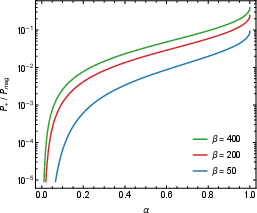
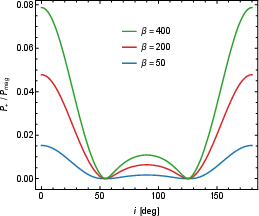
The ratio B1=Bsini7 is everywhere much less than unity (Figure 8), implying dynamics are initially magnetically dominated, favorable for launching highly relativistic outflows through magnetohydrodynamic mechanisms—one of the requirements for GRB engines.
Figure 8: Ratio B1=Bsini8 at the north pole of the horizon across B1=Bsini9 and i0. Behavior tracks that of temperature, confirming low plasma beta in the dyadoregion.
Implications and Prospects
The analysis demonstrates that realistic misaligned magnetized Kerr spacetimes generically enable vacuum breakdown at lower critical field strengths than aligned cases, increasing the likelihood of the process in astrophysical settings with nontrivial magnetic topology. The morphology and energetics of the dyadoregion exhibit rich i1- and i2-dependences, with observable consequences for the angular distribution and apparent luminosity of prompt emissions in transients. The strong initial magnetic dominance supports the development of magnetically driven ultra-relativistic plasma outflows.
Numerical results indicate:
For stellar-mass black holes (i3, i4, i5), the intrinsic energy in the dyadoregion can exceed i6, matching observed GRB energetics after incorporating beaming corrections.
The dyadoregion is most spatially concentrated when the field and spin axis are aligned, but practical systems are likely to favor mild to moderate misalignments, producing more isotropic emission and lowering pair creation thresholds.
Future theoretical developments could address the fully coupled Einstein-Maxwell system without test field approximations, as in the Kerr–Bertotti–Robinson spacetime, or pursue full GRMHD simulations to model the post-thermalization evolution and electromagnetic breakout.
Conclusion
This work extends previous analyses of vacuum breakdown around Kerr black holes to incorporate arbitrary magnetic field orientations. The key findings are that misalignment between the external field and spin axis generally facilitates vacuum breakdown and results in complex, multi-lobed dyadoregion morphologies, whose structure, energetics, and beaming are crucial for understanding the origins and observability of i7 plasma-driven astrophysical transients. Quantitative results connect the theoretical underpinning to plausible GRB scenarios, and the analytic and numerical tools developed enable robust modeling of such environments, setting the stage for refined simulation and observation-based inference in future high-energy astrophysics.