- The paper introduces a detailed framework for electron–positron pair creation via the Schwinger effect in rapidly spinning, highly magnetized newborn magnetars.
- It distinguishes between onset and supercritical regimes using precise approximations, showing that Schwinger-induced flux can exceed classical Goldreich–Julian predictions by several orders of magnitude.
- The analysis reveals that Schwinger losses dominate early energy dissipation, removing up to 90% of rotational energy within milliseconds and impacting magnetospheric evolution.
Schwinger Process-Induced Energy Dissipation in Newborn Magnetars
Physical Basis and Modeling of Pair Creation
The manuscript develops a quantitative framework for electron–positron pair creation in newborn magnetars exhibiting millisecond spin periods and surface dipole fields at or above the QED critical threshold (BQ=4.414×10¹³G). The unscreened, aligned vacuum dipole model is employed, in which rapid rotation and strong magnetization generate a parallel electric field sufficient to activate nonperturbative QED processes. The Schwinger effect, computed via Heisenberg–Euler one-loop effective action and expressed through the Maxwell invariants F and G, is utilized to derive both local and global pair production rates.
The spatial distribution of pair creation is shown to be highly anisotropic, with maximal rates near the magnetic poles due to the orientation and magnitude of the induced fields; this is illustrated by the density map in (Figure 1). The total emission is recast using dimensionless parameters χ=βϵΩ, β=Bp/BQ, and ϵΩ=RΩ/c, facilitating both integral and Padé-approximant solutions.
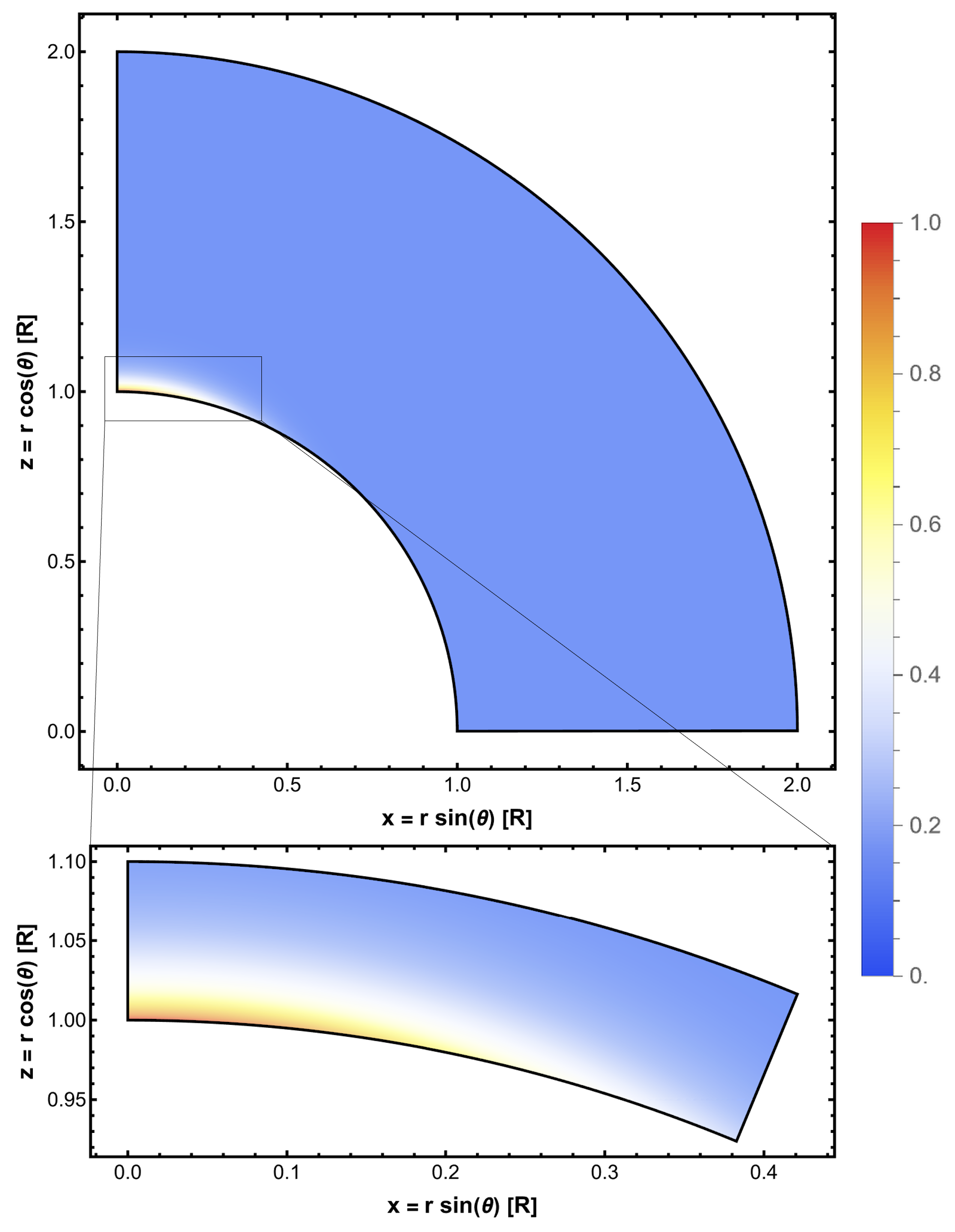
Figure 1: Density map of the pair creation rate via the Schwinger process outside the magnetar surface, highlighting the polar localization of maximal emission.
Regimes of Pair Production and Analytical Results
Two asymptotic regimes are characterized: the onset regime (χ≪1), in which production is exponentially suppressed and confined to narrow polar regions, and the supercritical regime (χ≫1), where pair creation becomes algebraic in nature and occupies a significant fraction of the magnetosphere. The Padé approximation is shown to be accurate to within 0.1% across 10−5≤π/2χ≤105. The most critical dependence is through the tunneling exponential e−π/χ, governing the efficiency and abruptness of discharge onset.
A parameter-space map delineates the threshold behavior and transition between regimes (Figure 2), defining practical boundaries for Schwinger dominance in the F0 plane.
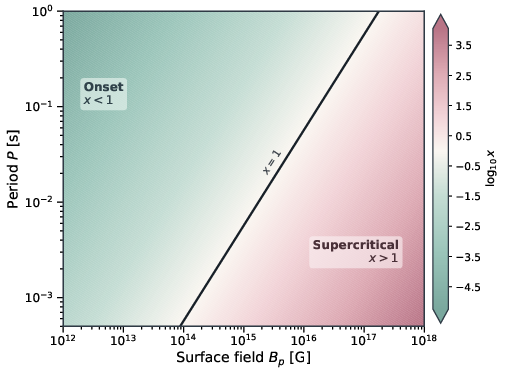
Figure 2: Parameter-space map of the Schwinger field efficiency parameter F1 across the F2 space, with distinct onset and supercritical regions.
Dominance Over Classical Goldreich–Julian Mechanisms
The study rigorously compares the Schwinger pair flux to the classical Goldreich–Julian (GJ) supply, finding F3 up to F4 times larger than F5 in a fiducial F6G, F7ms model. Across the F8 parameter space, the Schwinger channel dominates well before the formal supercritical boundary is reached, as visualized in the birth map (Figure 3). This demonstrates that vacuum discharge is not a small correction but a qualitatively new regime for early magnetospheric evolution.
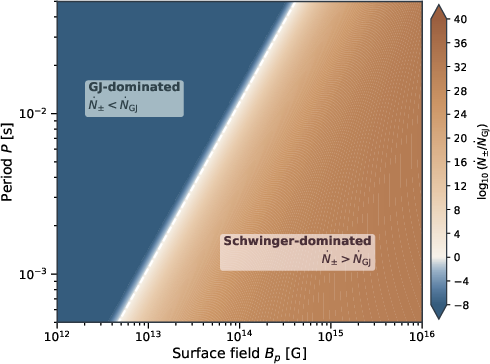
Figure 3: Birth map indicating the ratio F9, signaling Schwinger dominance even close to threshold.
Temporal Evolution and Energy Dissipation
Integrating rotational energy loss via Schwinger, magnetic dipole, and gravitational-wave channels, the paper presents detailed time-resolved evolution. For the fiducial scenario, Schwinger losses remove approximately G0 of G1 within G2ms, greatly suppressing gravitational-wave emission and confining the observable millisecond phase to an extremely brief interval.
Spin evolution and luminosity hierarchy are quantitatively tracked (Figures 4 and 5). Schwinger discharge is initially the dominant dissipative channel, with its rapid exponential decay transitioning control to electromagnetic and then gravitational mechanisms at longer timescales.
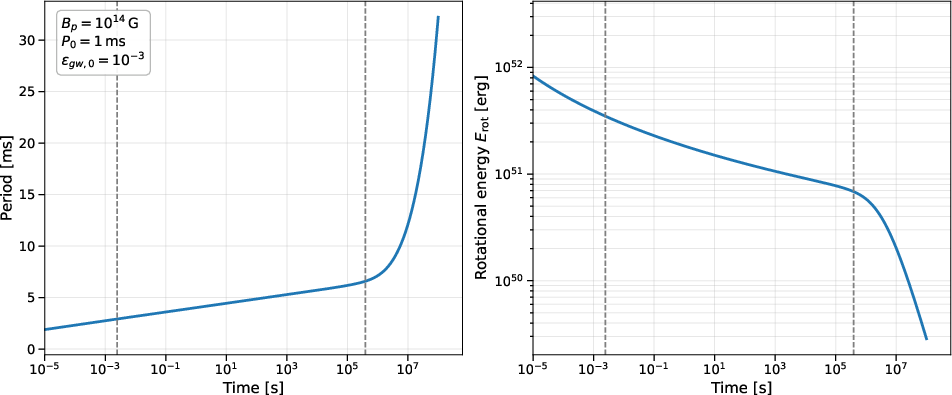
Figure 4: Spin evolution of the fiducial magnetar model, showing period growth and rapid depletion of rotational energy.
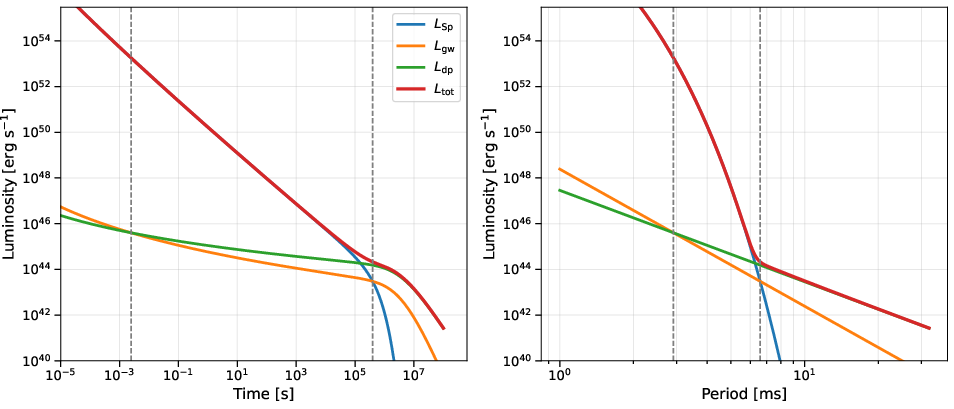
Figure 5: Evolution of luminosities for Schwinger, gravitational-wave, and magnetic dipole channels, highlighting early Schwinger dominance.
Over G3–G4 s, integrated emissions are G5 erg, G6 erg, G7 erg. Long-term period evolution bridges millisecond birth to second-scale mature magnetars (Figure 6).
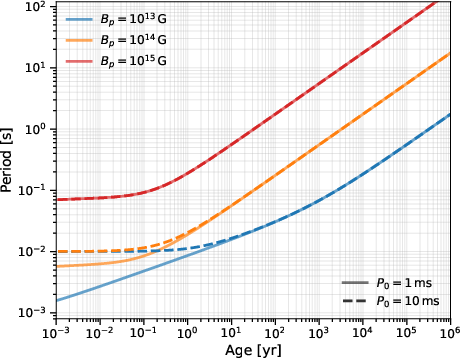
Figure 6: Long-term spin-period evolution for various birth periods and dipole fields, linking millisecond magnetars to the observed population.
Astrophysical Implications, Limitations, and Extensions
The primary implication is that vacuum Schwinger discharge can furnish the magnetosphere with leptons orders of magnitude faster than classical surface extraction, with substantial consequences for early pair loading, current closure, GRB outflows, and relativistic transient phenomenology. Enhanced high-energy particle production—especially along the polar axis—may impact cosmic ray and TeV photon origins.
Caveats include the idealized vacuum field assumption, conservative definition of Schwinger luminosity (neglecting post-creation kinetic energies), and fixed ellipticity treatment for gravitational-wave emission. Screening, gap formation, and MHD feedback will render discharge intermittent and time-dependent. A coupled kinetic–MHD analysis is essential for resolving actual emission rates and magnetospheric structure.
Future directions include kinetic modeling of screening and discharge dynamics, quantitative studies of particle escape and high-energy emission, and integration into GRB central engine frameworks.
Conclusion
This study establishes, within an aligned vacuum dipole model, that the Schwinger process is a dominant channel for early energy and particle supply in newborn magnetars with G8 near or above unity. The pair creation rate surpasses standard GJ flux by many orders, leading to rapid spin-down and dense pair outflow. The brief millisecond phase and strong lepton production suggest direct relevance to energetic astrophysical transients and potential contributions to high-energy cosmic phenomena. Extensions to kinetic modeling and global outflow dynamics are motivated to fully characterize the regime and its observational signatures.
Reference: "Energy Loss of Newborn Magnetars by Schwinger Process" (2604.21419)