Dissipative stabilization of Ostrogradsky modes in non-equilibrium field theory
Published 20 May 2026 in hep-th, gr-qc, and hep-ph | (2605.21689v1)
Abstract: In this work, we investigate higher-derivative quantum field theories and the problem of Ostrogradsky instability within an open-system Keldysh-Lindblad framework. Coupling the ghost sector to dissipative baths generates non-perturbative effective masses and dissipative widths through self-consistent gap equations. Above a critical coupling, the nonequilibrium dynamics develops bifurcated dissipative branches, signaling the emergence of a dissipative phase transition and a nontrivial critical structure in parameter space. We find that the resulting dissipative dynamics can suppress ghost excitations through two distinct mechanisms: in one branch, a large dynamically generated effective mass preserves a quasiparticle-like excitation, while in the second branch, strong dissipative broadening destroys the quasiparticle character through overdamped dynamics. Our results suggest that dissipative effects may provide a nonequilibrium mechanism for the spectral suppression of Ostrogradsky ghosts. The comparison with the healthy sector indicates that the stabilization mechanism is intrinsically tied to the ghost-like spectral structure.
The paper presents a Keldysh-Lindblad framework that uses self-consistent gap equations to dynamically stabilize Ostrogradsky ghost modes with a critical dissipative coupling.
It reveals bifurcated spectral branches for ghost modes, with one branch showing increasing effective mass and width while the other exhibits a saturating width under strong dissipation.
The analysis differentiates the ghost sector from the healthy sector, indicating that only the former undergoes dissipative phase transitions that regulate its negative residue instability.
Dissipative Stabilization of Ostrogradsky Modes in Nonequilibrium Field Theory
Introduction and Motivation
The Ostrogradsky instability, intrinsic to higher-derivative quantum field theories (QFTs), fundamentally impedes the construction of consistent models where ghost excitations—fields with negative norm or negative residue in their propagators—emerge from higher-derivative Lagrangians. This pathology undermines unitarity and induces unbounded Hamiltonians, with acute implications for attempts to quantize gravity and other fundamental fields. While numerous proposals have sought to regulate or reinterpret these ghost modes, the stability of such theories under nonequilibrium and open-system conditions remains underexplored.
This work investigates whether dissipative dynamics induced by coupling to external environments can provide a spectral stabilization mechanism for Ostrogradsky ghosts, within a non-equilibrium, open-system Keldysh-Lindblad framework (2605.21689). By formulating self-consistent gap equations for the effective mass and dissipative width via Lindblad-driven interactions, the study systematically analyzes the emergence of dissipative phase transitions (DPTs), bifurcated spectral branches, and the structural distinction between ghost and healthy sectors.
Framework: Quartic Higher-Derivative Models and Keldysh-Lindblad Formalism
The physical model considered is a scalar QFT with quartic derivatives, described by the Lagrangian
L=ϕ(x)(β4+α2□+□2)ϕ(x).
Spectral analysis yields two poles: a positive-norm ("healthy") and a negative-norm ("ghost") mode, the latter carrying the Ostrogradsky instability. In momentum space, the propagator's structure is governed by a spectral splitting Δ=α4−4β4, with the ghost pole contributing a negative sign to the spectral function.
The system is embedded within an open quantum environment via a quadratic Lindblad coupling, introducing dissipative dynamics. Specifically, Keldysh-Schwinger techniques yield a path integral representation for the nonequilibrium action, and the Lindblad jump operator acts only on the ghost sector, generating nonperturbative, self-consistent corrections to both the excitation mass and spectral width.
Self-Consistent Gap Equations and Dissipative Bifurcation
Through a 2PI (two-particle irreducible) formalism, the gap equations are derived for the effective retarded propagator. Dissipative effects alter the spectral function through complex-valued, self-consistent shifts in the mass (MR2) and the width (Γ), directly connected to the nonunitary Lindblad term. The Hartree term provides a local mass shift for the ghost, and remarkably, the sunset term vanishes, streamlining the analysis.
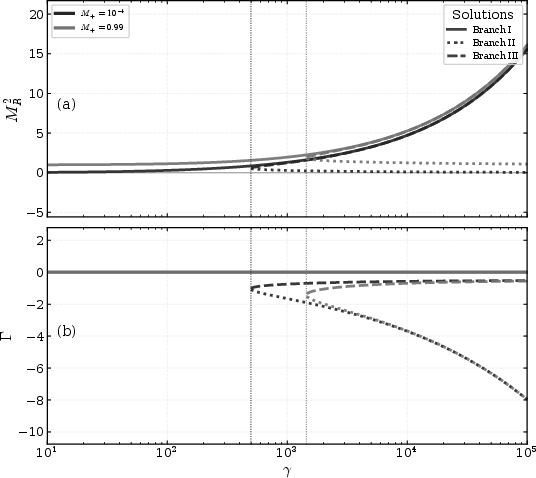
The principal numerical results, illustrated below, demonstrate the presence of a critical dissipative coupling zc=log10γc beyond which bifurcated solution branches for (MR2,Γ) emerge.
Figure 1: Ghost sector effective mass squared MR2 and width Γ vs. the logarithm of the coupling z=log10γ, revealing a DPT and bifurcated dissipative branches.
The NJL-like (Nambu–Jona-Lasinio) solution remains for all γ, but above Δ=α4−4β40 two additional branches with non-zero Δ=α4−4β41 appear. In the upper branch, Δ=α4−4β42 and Δ=α4−4β43 both increase, while in the lower branch, Δ=α4−4β44 remains small and eventually saturates. Δ=α4−4β45 is always negative (damped dynamics), dynamically suppressing exponential ghost growth.
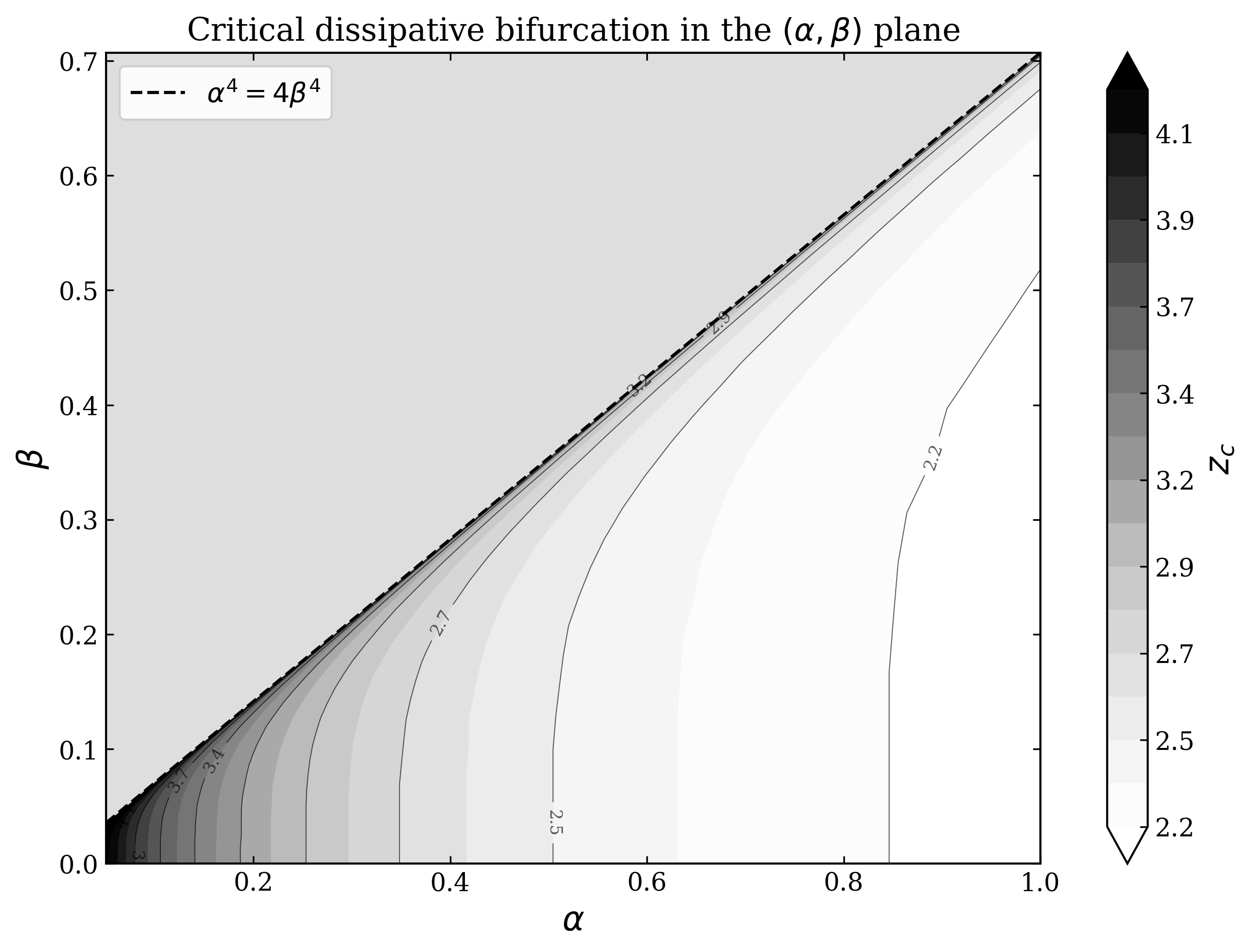
The parameter dependence and bifurcation structure are further mapped in the Δ=α4−4β46 plane.
Figure 2: Phase diagram showing contour lines of the critical coupling Δ=α4−4β47; shaded region indicates non-physical (complex) spectral splitting Δ=α4−4β48.
Approaching the degenerate limit (Δ=α4−4β49), the bifurcation threshold increases and eventually diverges, reflecting spectral coalescence of ghost and healthy modes.
Comparative Analysis: Healthy Sector versus Ghost Sector
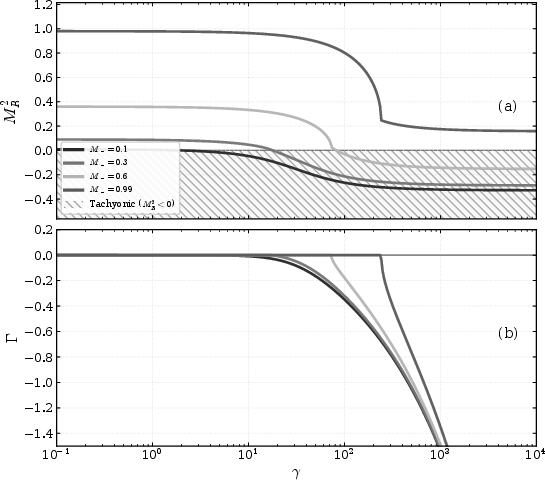
Contrasting dynamics arise upon coupling the healthy sector to a similar dissipative Lindblad bath. The gap equation solution reveals that mass MR20 decreases monotonically with MR21 and can reach zero, signaling a tachyonic transition, but no bifurcation or dissipative DPT arises.
Figure 3: (a) Effective mass squared MR22 of the healthy sector as a function of MR23; mass vanishes at finite coupling for light MR24, indicating instability; (b) Dissipative width MR25 for the healthy sector remains small or only becomes non-zero past the tachyonic threshold.
The absence of nontrivial MR26 solutions prior to the tachyonic transition, and the lack of branch bifurcation, underscore a fundamental structural distinction between ghost and healthy sectors under nonequilibrium Lindblad-driven dynamics.
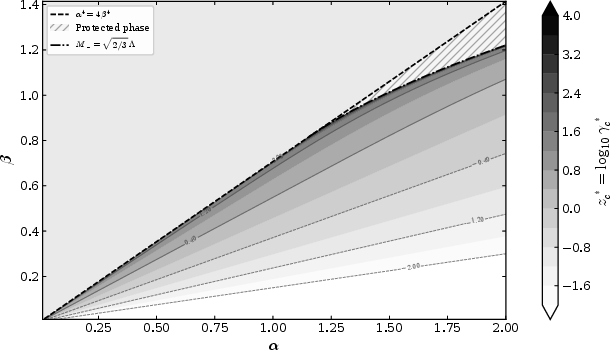
The MR27 phase diagram for the healthy sector delineates a region where the critical coupling for tachyonic transition diverges, demarcating a protected phase where the effective mass remains positive for arbitrarily large dissipation.
Figure 4: Phase diagram indicating the critical coupling MR28 for the onset of tachyonic instability in the healthy sector; region of unphysical (complex) bare masses is shaded.
This result confirms that dissipative stabilization—via bifurcated, spectrally broadened ghost modes—is not shared by the healthy sector, but is instead an intrinsic consequence of the negative residue spectral character of the Ostrogradsky mode.
Implications and Extensions
The identification of a dissipative phase transition and the bifurcation of spectral branches in the nonequilibrium ghost sector represent a robust spectral suppression mechanism, strictly kinetic and not a restoration of fundamental unitarity. This work establishes that dissipation can dynamically stabilize Ostrogradsky ghosts in open-system quantum field theory, with the emergence of both massive, weakly-broadened quasiparticle behavior and strongly overdamped, decohered regimes, depending on the coupling strength.
The theoretical implications span several domains:
Gravity and cosmology: Higher-derivative ghosts appear in quantum gravity and early universe models; dissipative suppression mechanisms are relevant for constructing physically viable theories.
Non-equilibrium QFT: The methodology demonstrates that coupling to baths can qualitatively transform the spectral properties of negative-residue modes.
Quantum information and control: The analysis underscores the role of dissipative engineering in controlling pathological excitations in open quantum systems.
Future developments should address the stability of the bifurcated solutions, the role of non-Markovian and spatially inhomogeneous effects, and the extension to models incorporating ghost-healthy sector interactions. Of particular note is the conjectured formation of dissipatively induced bound states involving both sectors, potentially restoring effective unitarity via emergent collective excitations.
Conclusion
Dissipative stabilization, analyzed through self-consistent Keldysh-Lindblad dynamics, provides an intrinsic, nonequilibrium mechanism for the suppression of Ostrogradsky ghost modes in higher-derivative quantum field theory. The emergence of bifurcated dissipative branches—absent for healthy modes—demonstrates that the negative spectral residue of ghosts can, under sufficient dissipation, be spectrally regulated. This provides a promising pathway for addressing the Ostrogradsky instability in open-system formulations of higher-derivative field theories, with substantive implications for quantum gravity, cosmology, and non-equilibrium quantum dynamics.