- The paper demonstrates that nonlinear spectral energy transfer can delay ghost-induced instabilities, resulting in metastable regimes in coupled scalar fields.
- It employs a space-time FEM to simulate nonlinear dynamics in (1+1) and (2+1) dimensions, highlighting the impact of spectral content and amplitude.
- Careful tuning of initial conditions and nonlinear potentials reveals critical thresholds where ghost effects are harnessed to maintain transient stability.
Introduction
The work "Numerical Investigations of Stable Dynamics in the Presence of Ghosts" (2604.25635) addresses the classical field-theoretic implications of introducing ghost degrees of freedom, i.e., fields with negative kinetic energy. The mathematical and physical issues posed by Ostrogradsky's theorem—particularly the lack of a lower bound on the Hamiltonian, resulting in potential catastrophic instabilities—traditionally preclude the presence of such modes. However, the explicit numerical analysis of nonlinear, coupled ϕ–χ scalar field systems, as implemented in this work, provides a robust exploration into the nuanced metastability and spectral structure that govern the classical evolution of ghost–normal field mixtures in both (1+1) and (2+1) dimensions.
Model, Discretization, and Methodology
The primary system studied consists of two coupled fields, one with a canonical kinetic term and one with a ghost-like (negative kinetic energy) term. The Lagrangian is
L=21ϕ(□+mϕ2)ϕ+2γχ(□+mχ2)χ+V(ϕ,χ),
where γ=−1 for the ghost field. The nonlinear coupling structure is systematically varied, notably including quartic ϕ2χ2 and lifted ϕ6-type potentials.
Spatial and temporal discretization proceeds via a space-time finite element method (FEM), enabling fully implicit, globally consistent solutions across a spacetime slab. This approach is particularly suited to hyperbolic, stiff, and indefinite-sign systems, enhancing energy conservation and controlling cumulative errors typical of explicit time-stepping. Nonlinearities are handled by PETSc's SNES library, forming and solving the nonlinear weak form residuals and their Jacobians.
Spectral and Amplitude Dependence of Instability
A central empirical finding is that nonlinear spectral energy transfer, not instantaneous or linear runaway, mediates instability in ghost–normal systems. Long-lived, dynamically stable regimes can be accessed by finely tuning the spectral content and amplitude, despite the Hamiltonian's indefiniteness.
Numerical simulations initiate the system with various classes of data, including plane waves, localized Gaussian packets, colored-noise spectra (with controlled IR/UV content), phase-correlated configurations, and oscillon-like seeds. High-wavenumber (UV) or low-amplitude initial data systematically result in extended metastable evolution, while low-wavenumber (IR) or large-amplitude configurations precipitate rapid instability. Inter-mode spectral transfer, modulated by nonlinearities, underpins the transition to instability.
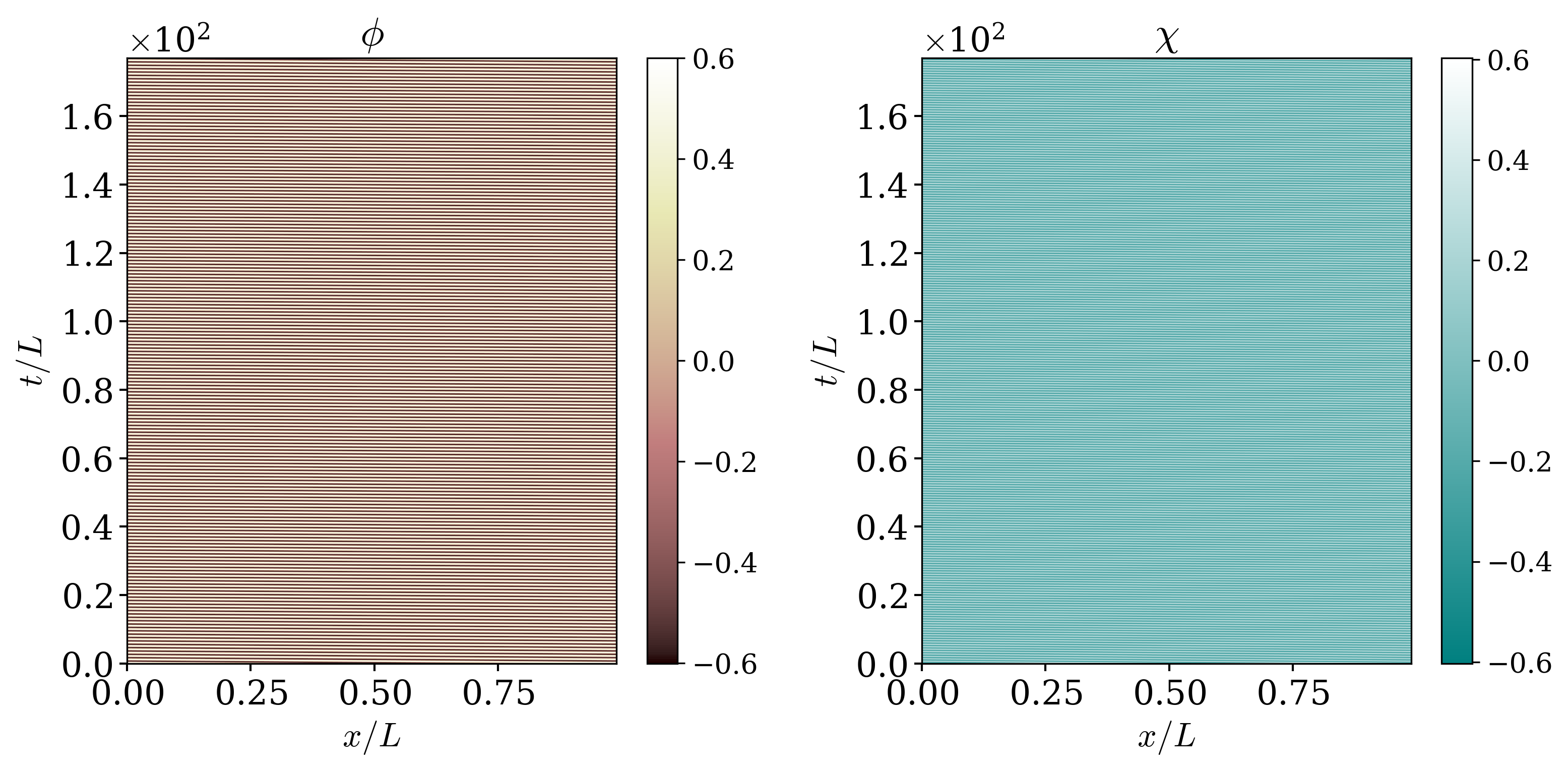
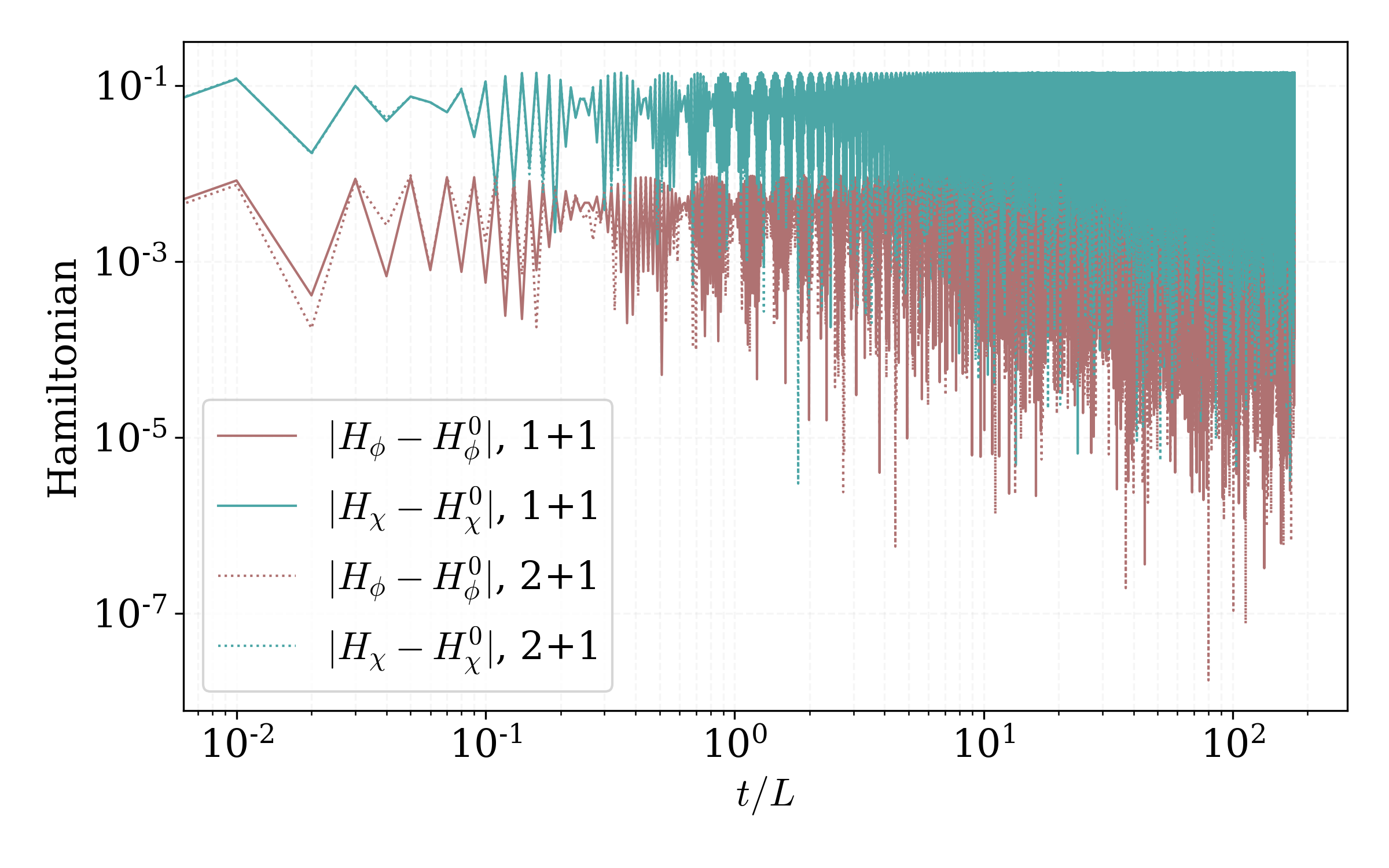
Figure 1: Representative evolution of the coupled ϕ–χ system (plane-wave initial data); instability is suppressed for moderation in amplitude and sufficiently large χ0.
Sensitivity to Initial Data and Nonlinear Potentials
The work demonstrates that spectral localization and phase structure significantly condition stability. Gaussian packets with increased width (lower effective χ1) are less stable. Colored-noise spectra exhibit rapid breakdown for IR-dominated initial states (χ2 spectral tilt) and extended survival for UV-dominated cases. Furthermore, coherent phase relations between sectors—particularly in synchronized, phase-correlated plane waves—accelerate instability when the overlap and energy exchange are maximal.
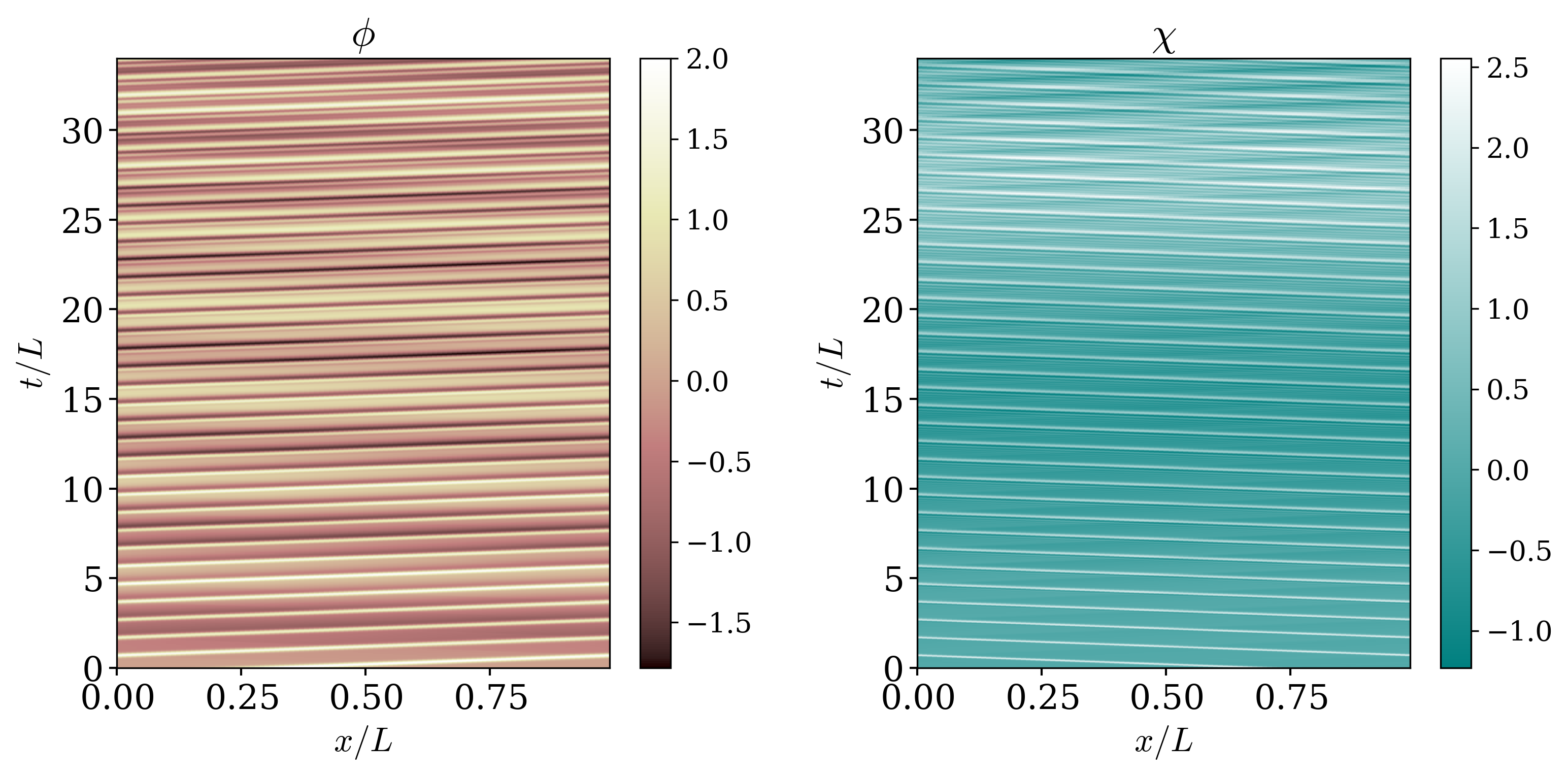
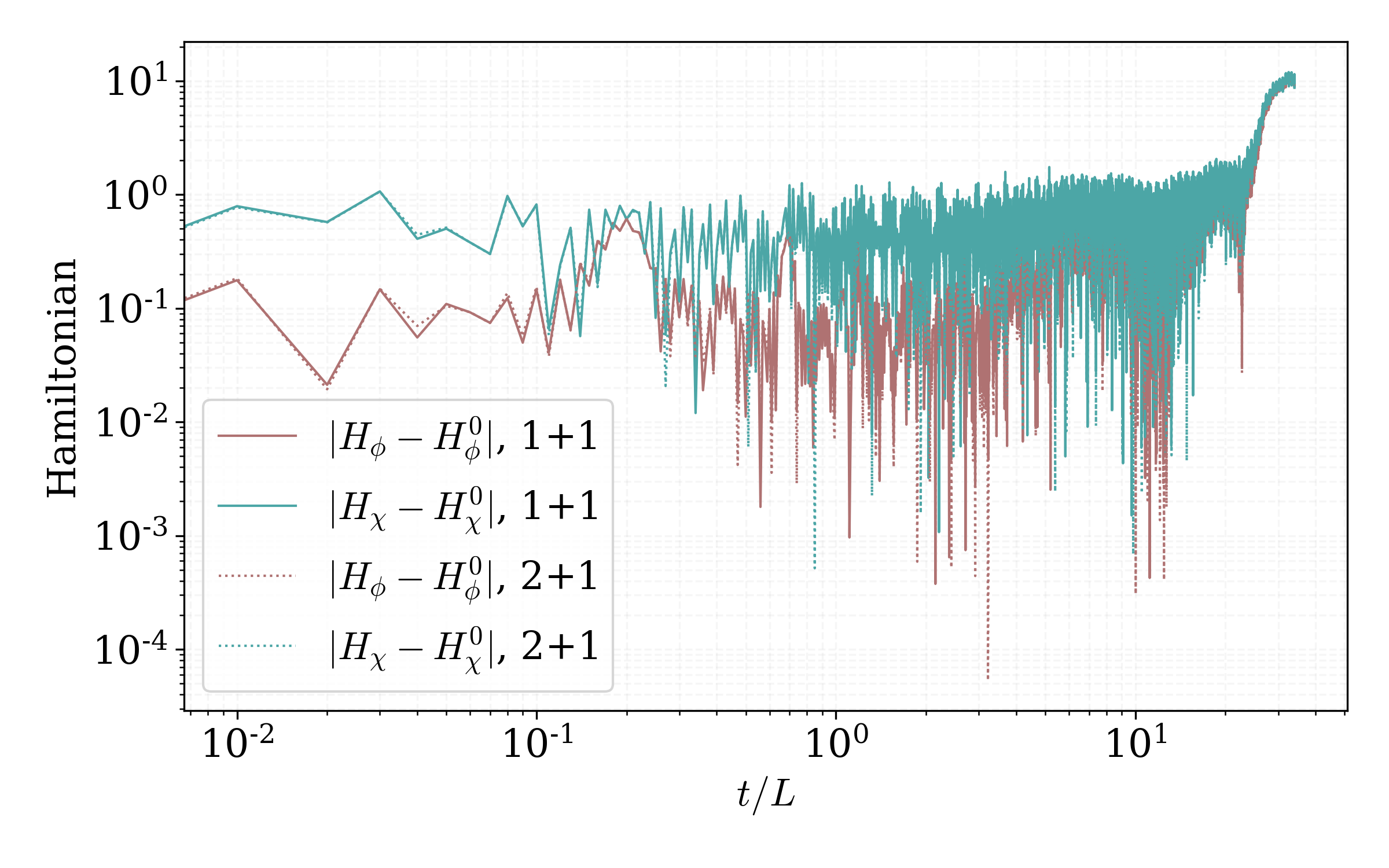
Figure 2: Gaussian packet initial data displays that increasing width (decreasing χ3) accelerates the development of the ghost instability.
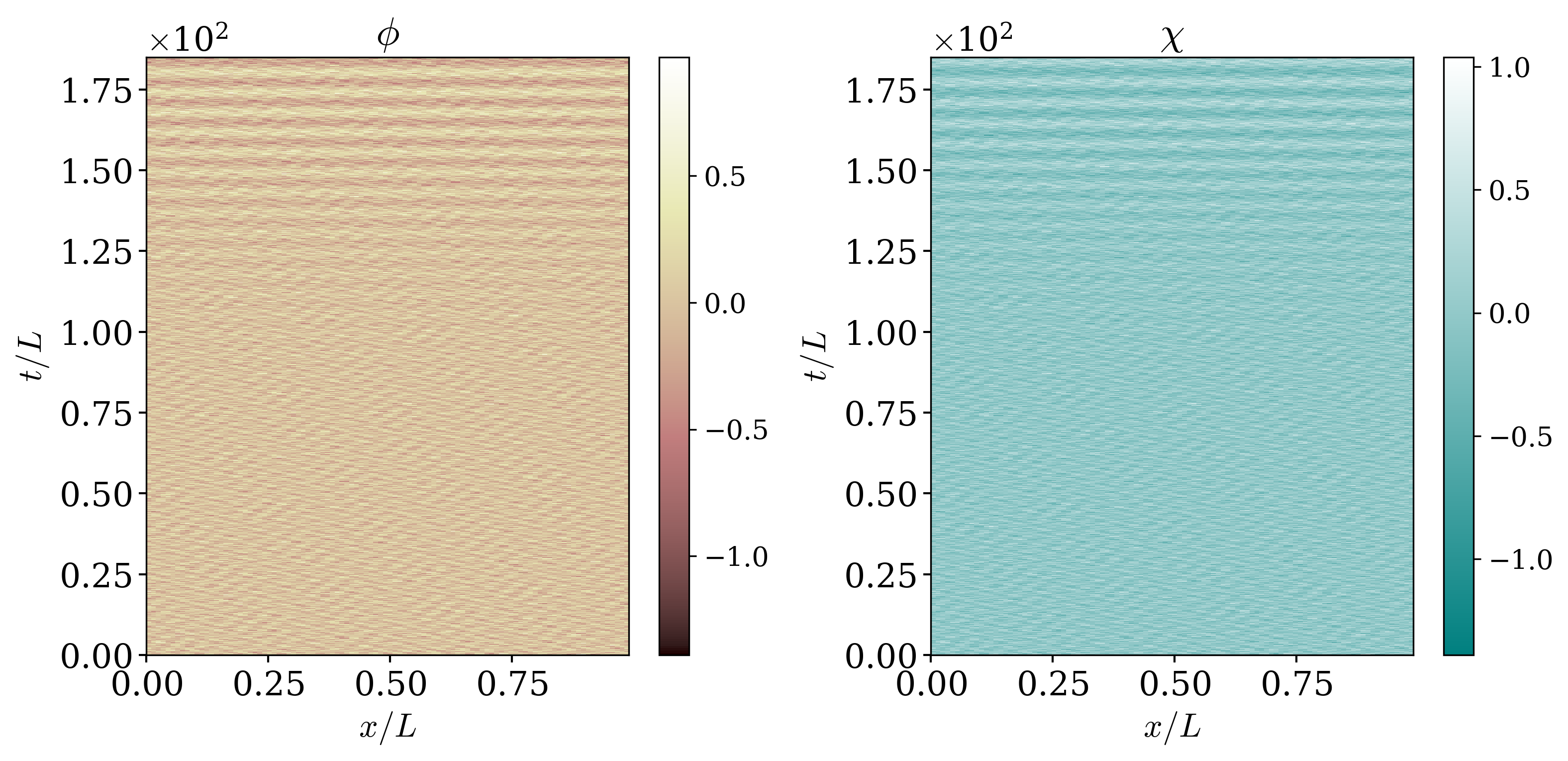
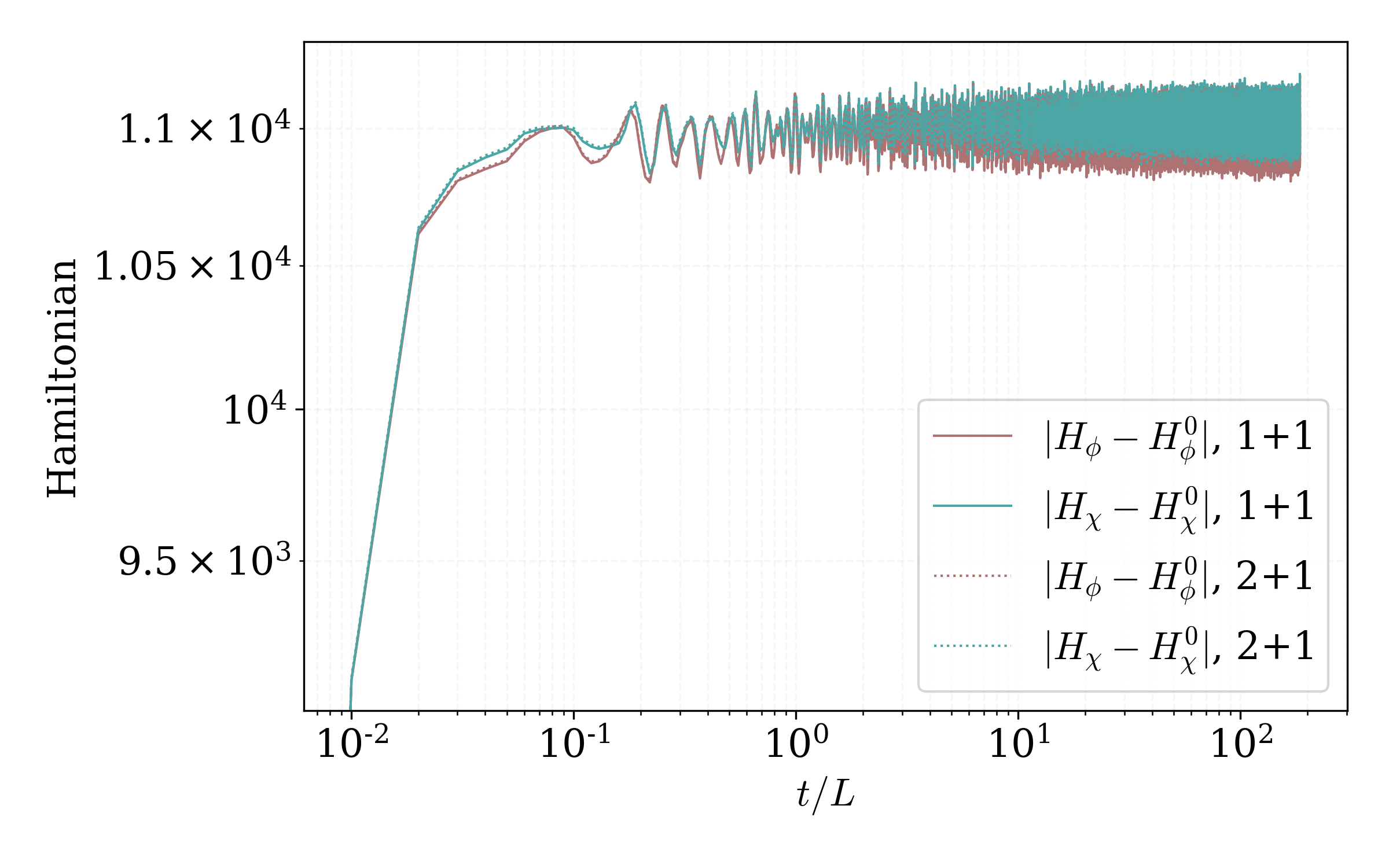
Figure 3: Colored-noise initial data with UV tilt supports longer-lived evolution, confirming the spectral mediation of instability.
The nonlinear self-interaction structure is critical. For instance, with the inclusion of a lifted χ4 potential supportive of oscillon-like solutions, the energy landscape is altered to admit transient metastable regimes. Such regimes can significantly extend the boundedness of the evolution, even in the presence of a ghost. The lifetime of these metastable states displays non-monotonic dependence on amplitude—longest near criticality—realizing a competition between nonlinear self-trapping and ghost-driven energy exchange.
Nonlinearity and Ghost-Driven Instability
Importantly, the analysis establishes that nonlinearity alone (even without a ghost) can induce finite-time breakdown of solutions. However, the inclusion of the ghost dramatically enhances and accelerates this process. The presence of nonlinear self-interactions acts in dual roles: sometimes suppressing growth by impeding efficient spectral transfer, other times accelerating instability by providing additional channels for energy flux.
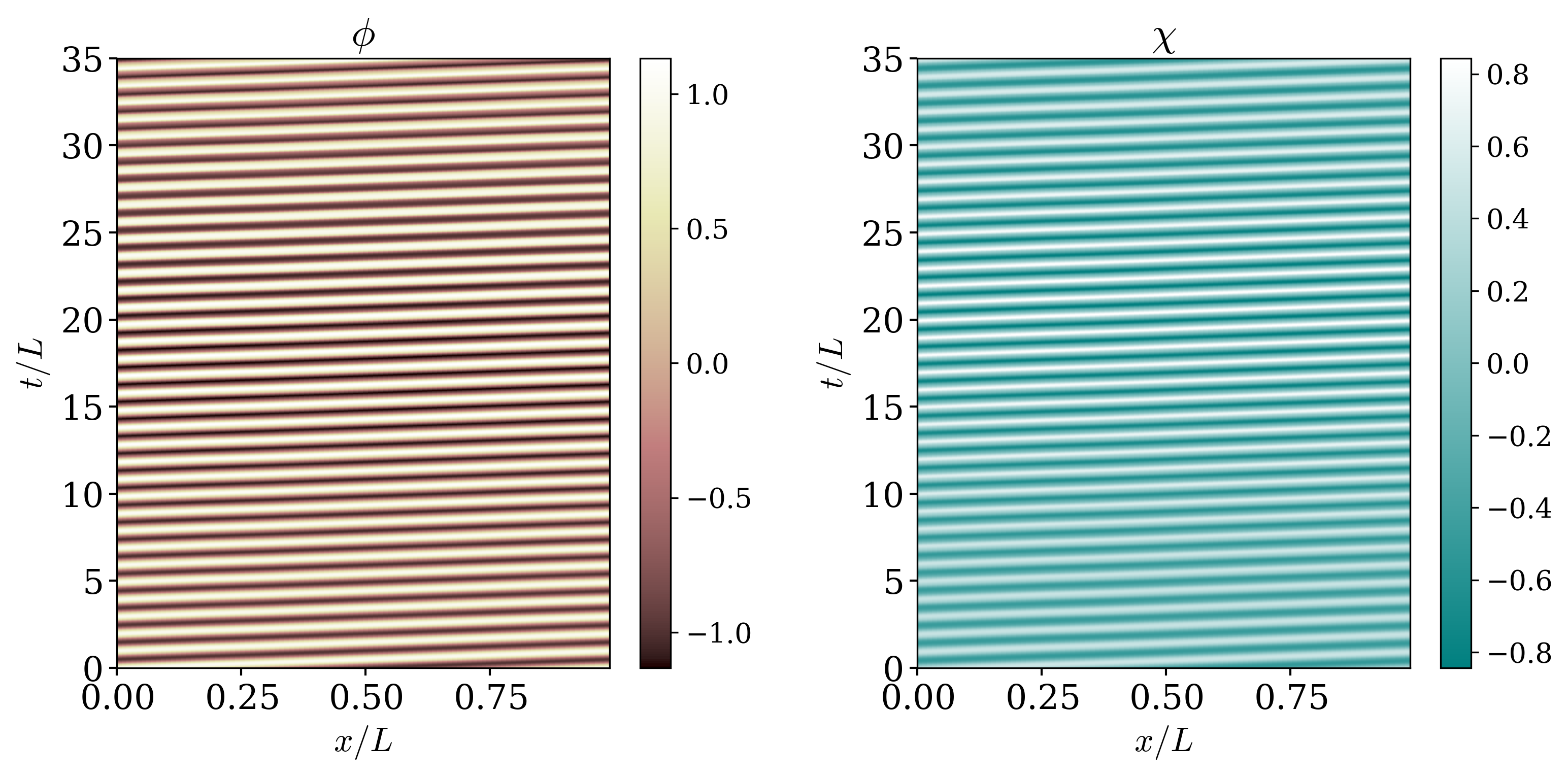
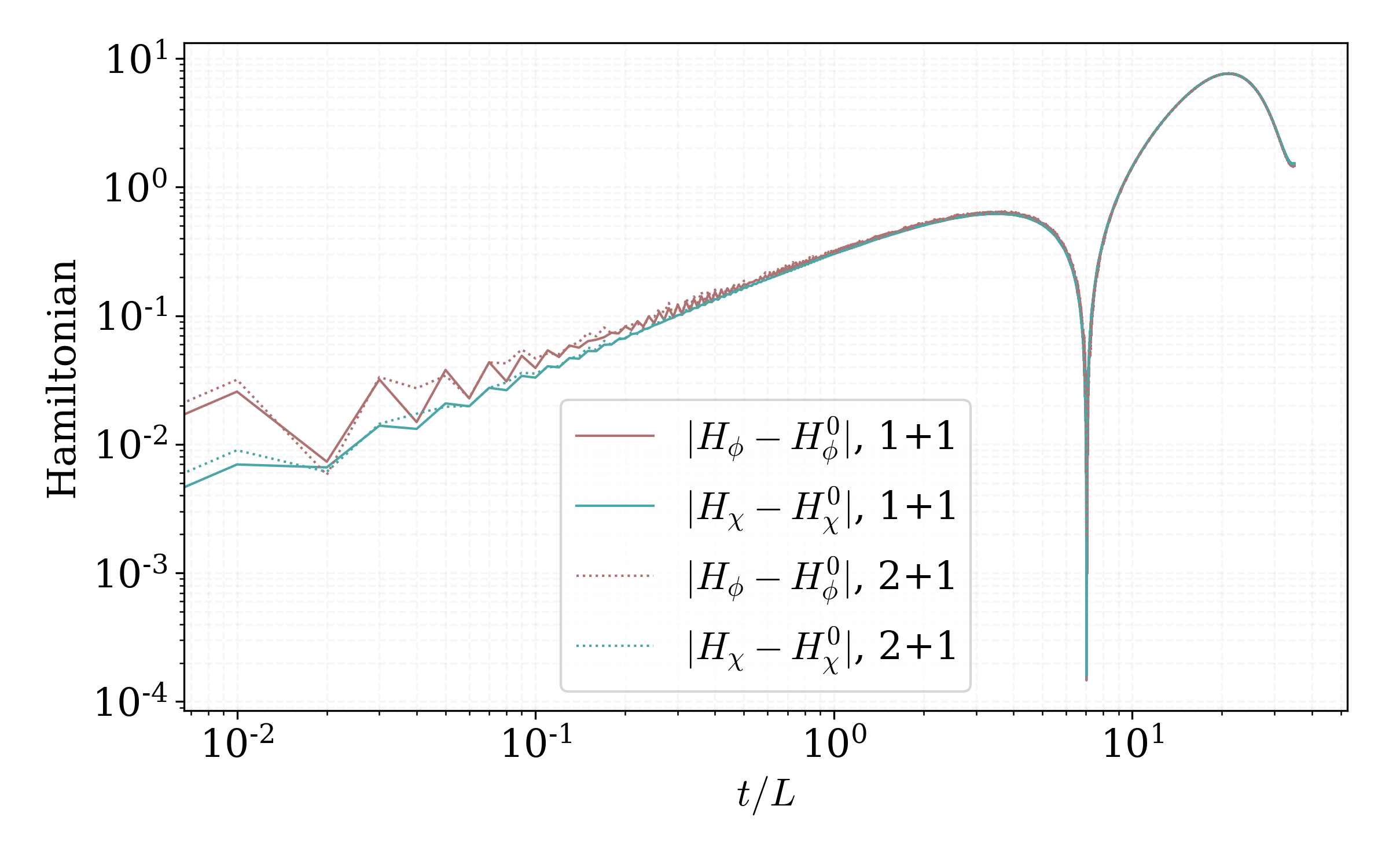
Figure 4: Phase-coherent plane waves with specific amplitude ratios and phase shifts reveal shorter lifetimes; instability rates depend on coherent energy exchange pathways.
The extended tests with oscillon-like seeds and lifted potentials further clarify the instability mechanisms.
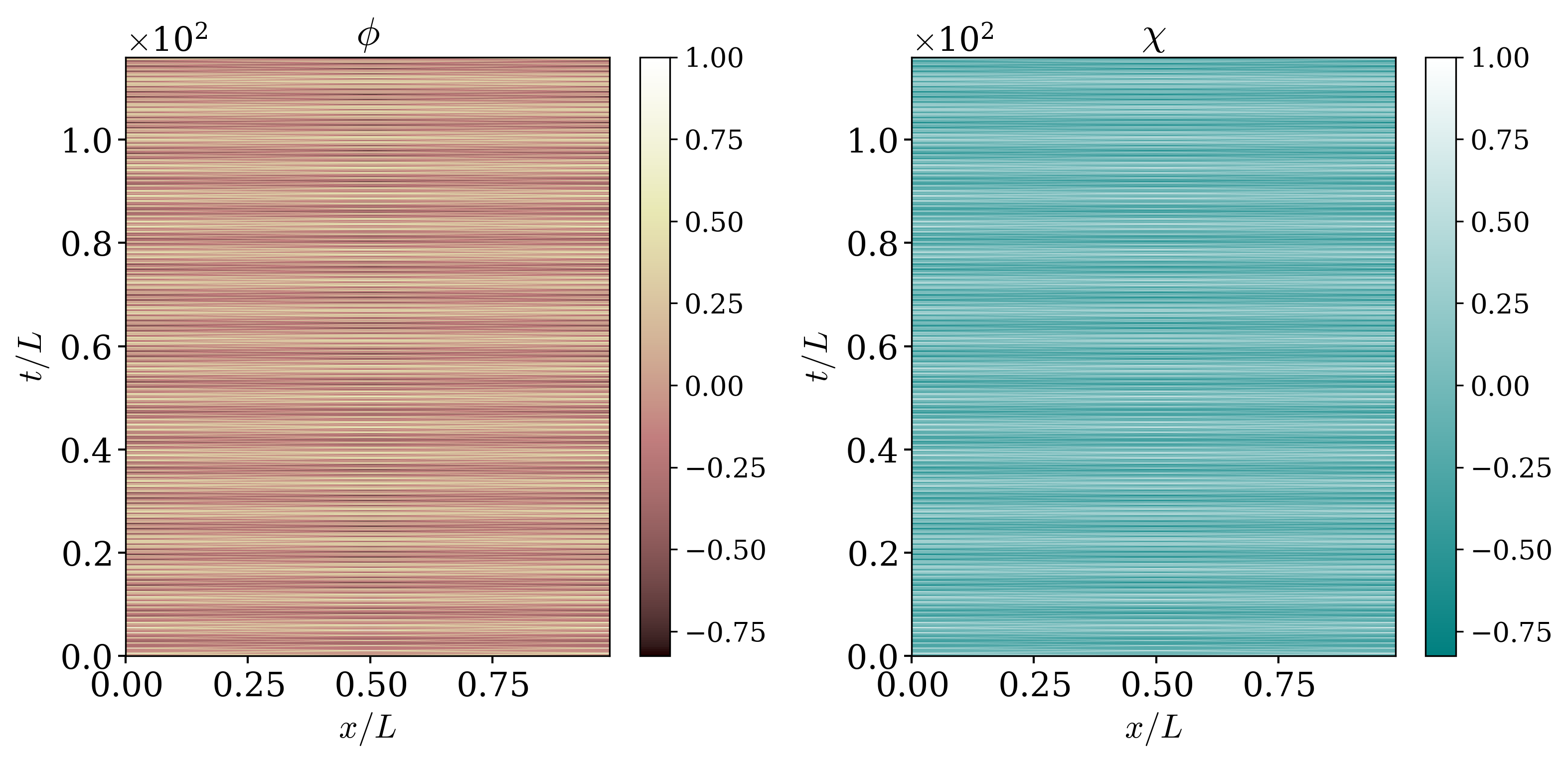
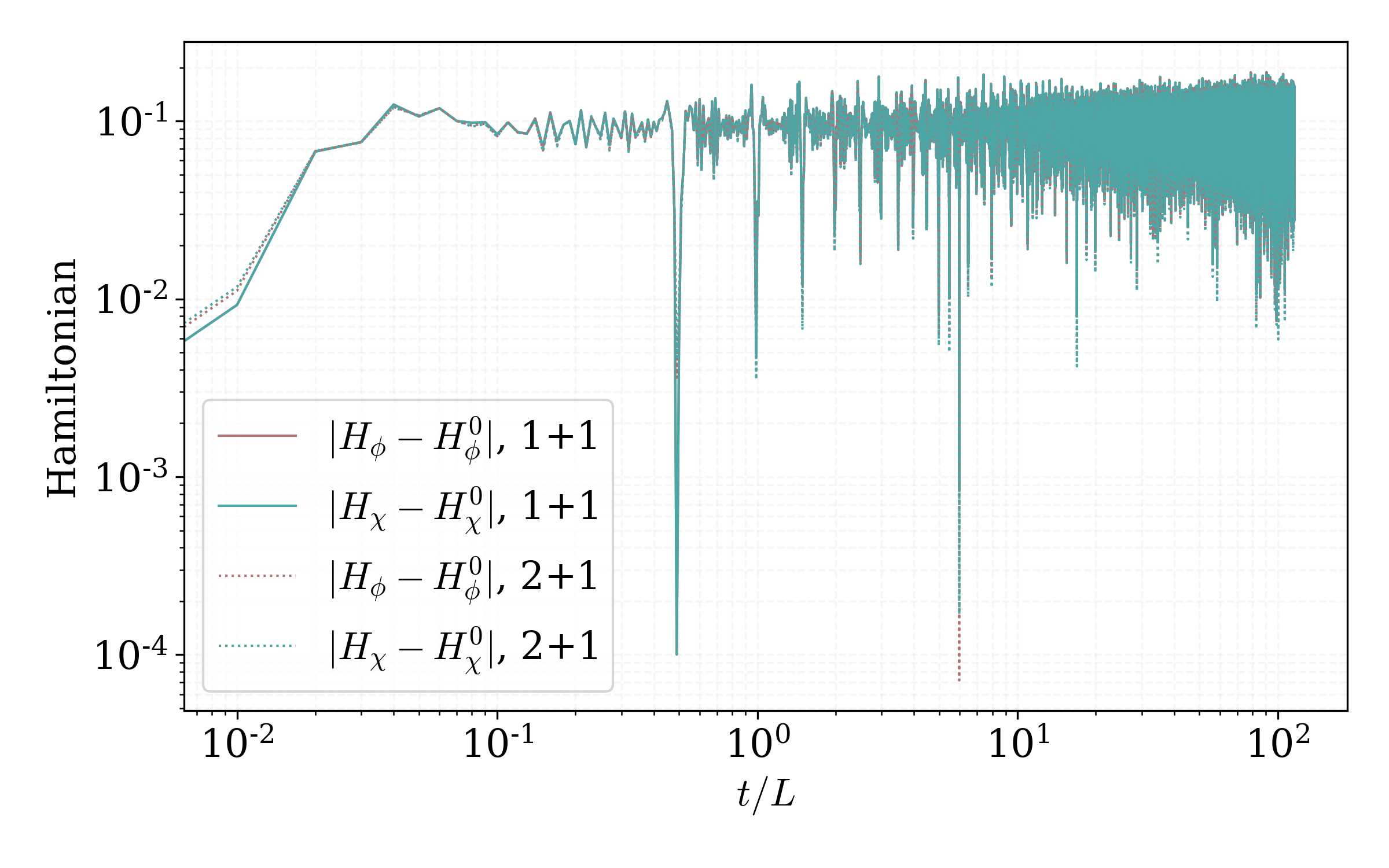
Figure 5: Oscillon-like initial data with nonlinearity but no ghost—Hamiltonian remains bounded and no explosive behavior is observed even as nonlinear effects accumulate.
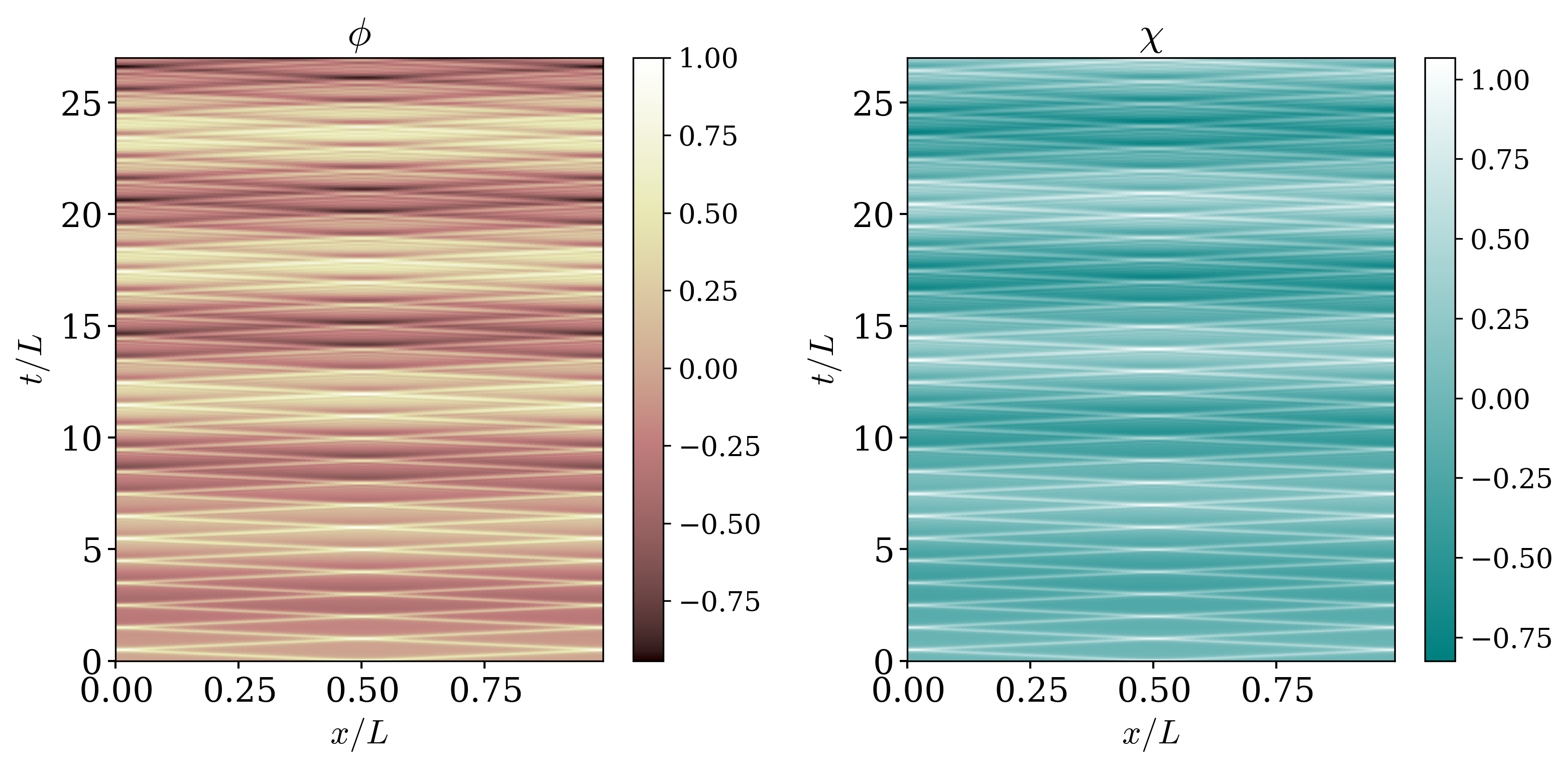
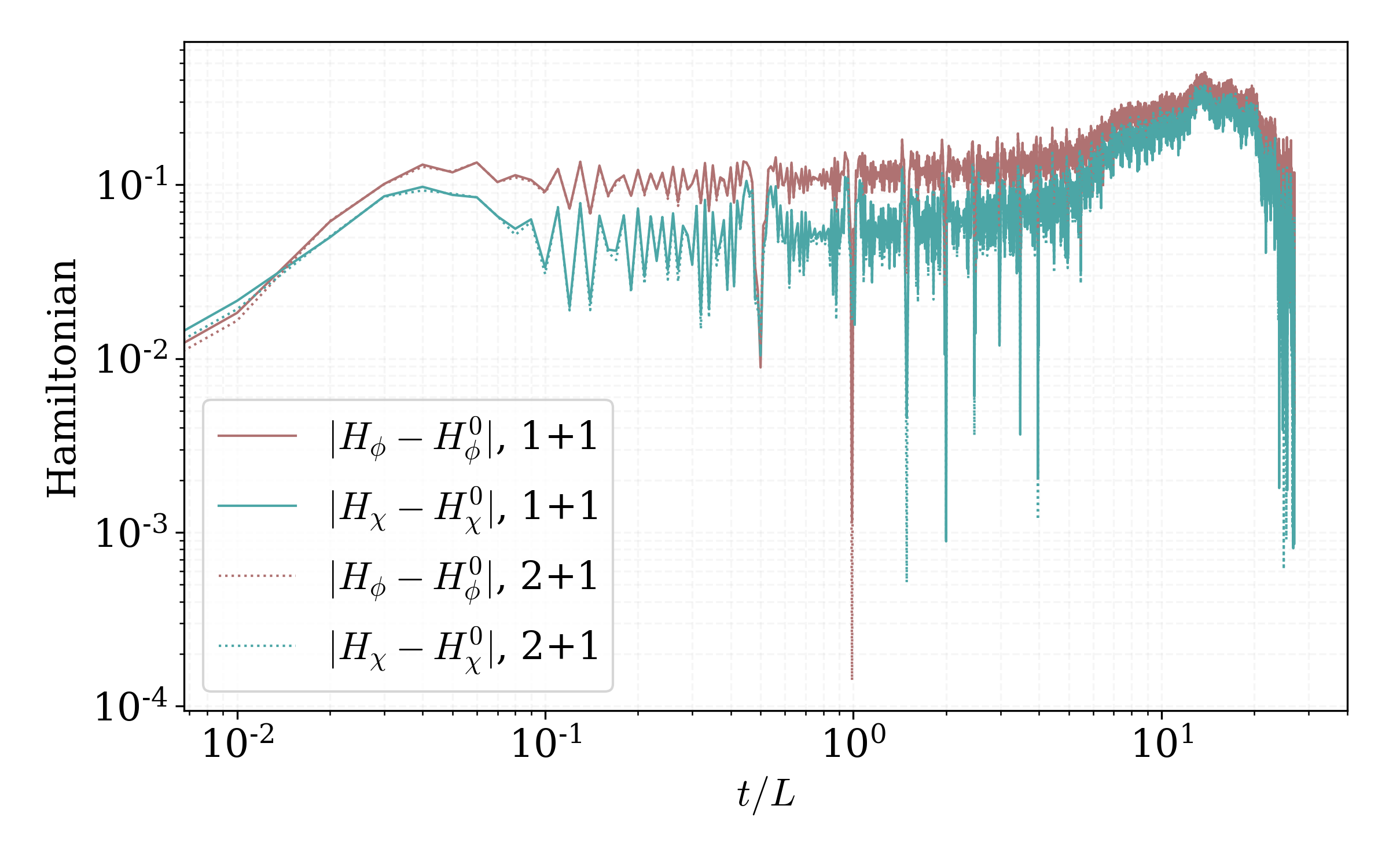
Figure 6: The same initial data with ghost mode activated. Instability and amplitude growth are substantially enhanced, and the Hamiltonian displays characteristic unbounded growth, confirming the role of the ghost in mediating instability.
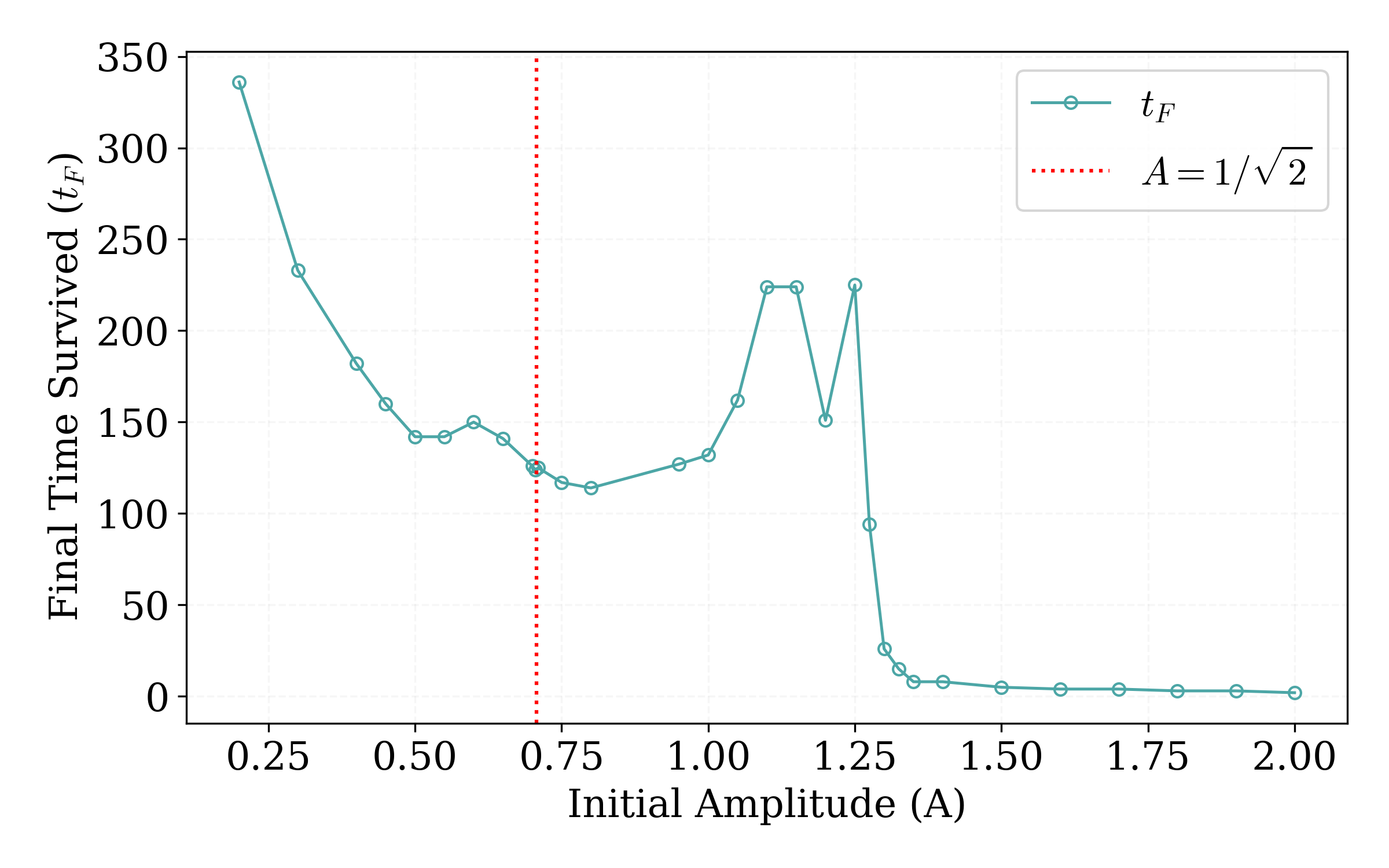
Figure 7: Lifetime versus amplitude under a lifted χ5 potential and ghost coupling. Quasi-metastable plateaus form near the oscillon-supporting threshold, illustrating the metastability induced by the flattened nonlinearity.
Theoretical and Practical Implications
This work makes a critical contradictory claim to the standard lore by demonstrating that ghost-containing classical field systems do not always manifest instantaneous or universally catastrophic instability. The instability is parametrically delayed for certain regimes—high frequency, low amplitude, or particular nonlinear structure and phase configuration—even when the Hamiltonian is unbounded from below.
This has substantial implications for EFTs and modified gravity models where ghostlike modes may arise above some cutoff. It suggests that ghost-induced instability, in certain spectral and field configurations, can fall outside practical time or energy scales of interest, and that bounded, physically meaningful classical evolution can persist over controlled time intervals even in the presence of Ostrogradsky-type ghosts. It also raises nuanced questions regarding the extent to which classical stability "failure" is determined by spectral, not purely Hamiltonian, properties.
Methodologically, this work highlights the advantages of space-time FEM for indefinite and nonlinear hyperbolic systems, setting a benchmark for future computational studies targeting nonstandard dynamical regimes—including mixed-sign or non-positive-definite systems in mathematical physics.
Conclusion
The results articulated in "Numerical Investigations of Stable Dynamics in the Presence of Ghosts" (2604.25635) rigorously map out the nonlinear, spectrally mediated landscape of stability in ghost–normal field systems. Ghost-driven instabilities exhibit a rich dependence on amplitude, spectral distribution, phase coherence, and nonlinear self-interaction structure. Controlled, long-lived metastable evolutions are achievable for nontrivial regions of configuration space, fundamentally challenging the universality of catastrophic instability expected for ghostly Hamiltonians. Both theoretical and computational strategies for ghost-laden systems must therefore recognize and exploit this spectrally structured metastability. Further analytical reductions and extension to higher dimensions could provide important insight into metastable ghost dynamics relevant to EFTs, quantum gravity, and nonlinear PDEs with indefinite Hamiltonian signatures.