- The paper introduces a co-design framework that integrates physics-informed frequency allocation with fidelity-aware transpilation to mitigate crosstalk and decoherence.
- It demonstrates that limiting module sizes to four qubits per SNAIL minimizes infidelity, with performance sharply declining when adding more qubits.
- The FINESSE transpiler lowers cumulative log-infidelity and circuit depth by up to 8.9% and 6.8% respectively, emphasizing hardware-aware optimization.
Fidelity-Aware Frequency Allocation and Transpilation Co-Design for Tunable Coupler Quantum Systems
Overview and Motivation
Superconducting quantum architectures with tunable couplers are attaining increasing prominence, especially as efforts intensify to scale quantum processors while mitigating crosstalk, coherence losses, and control complexity. Frequency crowding constitutes a principal bottleneck, particularly in designs leveraging nontrivial module sizes and flexible connectivity. The paper introduces a physics-informed co-design methodology that couples constrained frequency allocation—explicitly modeling both coherent spectator errors and incoherent decoherence—with transpilation strategies cognizant of link-level noise heterogeneity. The framework targets SNAIL-based third-order coupler architectures and is instantiated in the FINESSE transpiler, designed for minimal accumulated infidelity.
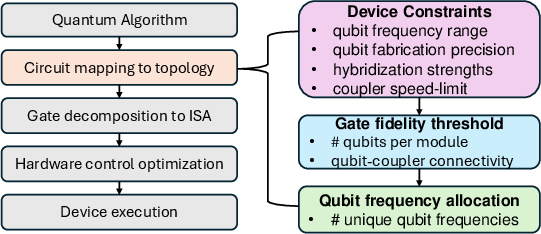
Figure 1: High-level workflow for the co-design of quantum computer architectures, from physical modeling through transpilation.
The implications span both the physical design—dictating achievable module sizes, frequency allocation ranges, and connectivity—and the quantum software stack, through transpiler modifications that integrate variability in physical gate fidelity into circuit mapping.
Physical and Error Modeling in SNAIL-based Modules
Tunable coupler processor architectures enable selective activation of entangling gates by resonantly driving parametric couplers. However, as the number of coupled qubits per module (e.g., per SNAIL element) grows, frequency crowding and spectator interactions increasingly constrain usable frequency assignments and degrade two-qubit gate fidelities.
Spectator-induced coherent errors stem from cross-resonances and hybridization pathways activated non-selectively, while incoherent errors arise via decoherence during extended gate times—a consequence of restricted detuning (see Figures 2 and 3). The Hamiltonian treatment retains dominant terms via the RWA, and quantifies infidelity as a function of detuning, hybridization strength, and decay times.
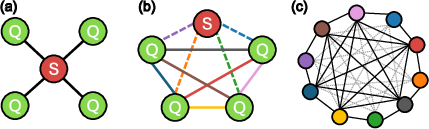
Figure 2: (a) SNAIL-qubit coupling graph; (b) 2-qubit conversion connectivity; (c) interference compatibility graph. The combinatorics of these interactions determine spectator pathways and the complexity of the frequency allocation problem.
Central findings include:
- Gate fidelity is over two orders-of-magnitude more sensitive to detuning for SNAIL-mediated gates compared with standard qubit-qubit gates, enforcing stricter spectral separation constraints.
- For the experimentally relevant SNAIL–transmon module, increasing beyond four qubits per SNAIL yields a highly nonlinear rise in infidelity due to compounded hybridization and nonlinear constraints.
- The minimal allowable module size under practical constraints for high-fidelity (>0.99) gate operations is found to be four qubits per SNAIL; by five qubits, minimum achievable fidelity drops to ∼0.94.
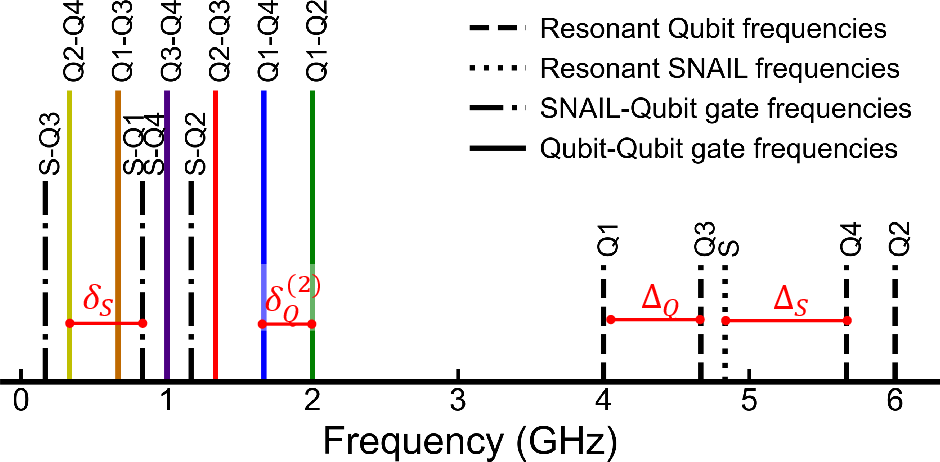
Figure 3: Spectral positioning of SNAIL and qubit bare modes (solid lines) and resulting interaction (conversion) resonance frequencies. Spectral crowding is intrinsic to increased qubit density.
Optimized Frequency Allocation: Aggregated Error Budgeting
The frequency allocation problem is mapped to a constrained optimization akin to a non-classical Frequency Assignment Problem (FAP), where different interaction terms (conversion frequencies, SNAIL–qubit, subharmonic, etc.) dictate coupled constraints.
The algorithm employs a global cost function, summing both coherent and incoherent errors for all gate pairs, with heavy penalties on frequency violations. Minimum required separations are derived empirically, balancing the scaling of infidelity with dense coupling.
Results indicate that with realistic device nonidealities, enforced single-qubit resolvability, and physical SNAIL operation ranges, the optimal tradeoff is achieved for 4-qubit, 4-edge SNAIL modules. More highly connected modules suffer dramatic reductions in minimum interaction detuning, reflected in a sharp fidelity decrease. This is captured in both analytic bounds (Golomb ruler) and numerical solutions, where four-edge topologies consistently dominate in fidelity.
FINESSE: Fidelity-Aware, Equivalence-Integrated SWAP Selection
Traditional transpilers such as SABRE optimize circuit depth or swap count, implicitly assuming uniform gate errors across the topology. This is increasingly detached from hardware reality in frequency-crowded, tunable coupler architectures, where link fidelities are highly variable and predicated on detailed device physics.
The FINESSE transpiler extends SABRE by:
- Replacing hop-count distance with fidelity-weighted distances in the routing heuristic, so SWAPs and routing choices are made to minimize cumulative log-infidelity.
- Integrating mirror-gate absorption (from MIRAGE) controlled by fidelity-aware acceptance criteria, allowing transpilation to exploit KAK-equivalent circuit variants when these lead to lower overall error accumulation.
- Supporting cross-platform applicability: evaluated both on SNAIL-based architectures and on heavy-hex IBM quantum devices using real calibration data for fidelity costs.
Overall, FINESSE achieves an average reduction of up to 8.9% in log-infidelity and 6.8% in transpiled depth compared to SABRE and MIRAGE for SNAIL devices, and up to 12.3% for heterogeneous heavy-hex architectures, underscoring substantial gains from hardware- and fidelity-aware routing.
Systematic Evaluation and Design Implications
Extensive simulation across a diverse suite of 8–32 qubit circuits reveals that:
- Increased intra-module connectivity, while reducing routing SWAP overhead, rapidly increases the cost of the worst links, making additional connectivity self-defeating beyond four edges per module.
- Fidelity-aware transpilation cannot fully compensate for underlying hardware constraints—in highly crowding regimes, hardware limits dominate.
- FINESSE’s advantage persists both when selecting seeds by its own objective and under uniform postselection, reflecting robustness to arbitrary fidelity weighting.
These trends robustly imply that—under contemporary SNAIL operating constraints—modular architectures benefit more from modest, high-quality connectivity than from maximal connectivity with compromised link fidelities. Compiler-level mitigation is insufficient to redress the penalty imposed by excessive frequency crowding.
Theoretical and Practical Consequences
From a theoretical standpoint, the results reify a fundamental fidelity–connectivity Pareto frontier imposed by physical frequency allocation and nonlinear device effects in modular quantum processors. On the practical side, the integration of infidelity-weighted transpilation represents a transformative shift away from depth-centric compilation, aligning abstraction layers in the quantum stack.
The techniques generalize to any architecture exhibiting significant nonuniformity in two-qubit gate errors, whether arising from frequency allocation, calibration heterogeneity, or fabrication-induced irregularity.
Conclusion
The co-design of physical frequency allocation and transpilation, as instantiated by FINESSE on SNAIL- and heavy-hex-based architectures, delineates new boundaries for achievable fidelity as function of module size, connectivity, and routing strategy. The study provides detailed modeling and experimental evidence that—in tunable coupler superconducting architectures—scaling module size beyond four qubits sharply penalizes global circuit fidelity due to the nonlinear accumulation of spectator and crowding errors. Future advances must target either expanded SNAIL frequency support, radical architectural innovations, or new error suppression strategies at the physical layer, as compiler advances alone cannot surmount these physical limitations. This paradigm will critically inform both hardware design trajectories and future quantum compiler innovations.