- The paper demonstrates that the effective potential, influenced by Proca hair and cosmological modifications, governs the spin-dependent QNM spectra.
- It employs high-order Padé-improved WKB and time-domain methods to achieve numerical accuracy below 0.15% relative error across spin sectors.
- Findings reveal that parameter variations, such as Proca hair and coupling constants, robustly affect mode lifetimes and spectral trends relevant to strong cosmic censorship.
Quasinormal Modes of Fields in Asymptotically de Sitter Black Holes within Generalized Proca Theory
Introduction
The paper systematically investigates the quasinormal spectra of massless scalar, electromagnetic, and Dirac fields in the background of asymptotically de Sitter (dS) black holes arising from generalized Proca theory. In these models, the Proca sector introduces a primary hair parameter and modifies the effective cosmological term, leading to nontrivial horizon structures and static patches. The study provides a unified framework to analyze spin-dependent perturbative phenomena within the same background, isolating geometric effects from those intrinsic to field spin.
Generalized Proca Black Hole Geometry
The employed geometry originates from a static, spherically symmetric solution in the generalized Proca sector, characterized by mass parameter M, Proca hair Q, and additional coupling constants (α,β,λ,c1). The effective cosmological constant Λeff is dynamically generated by the Proca sector, modifying both event and cosmological horizons. All three spin sectors—scalar (Klein-Gordon), electromagnetic (Maxwell), and massless Dirac—probe this common geometry through their respective master equations, with spin-dependence appearing solely in the effective potential structure.
Master Equations and Boundary Conditions
Each perturbing field is reduced to a one-dimensional master equation with a spin-dependent effective potential:
- Scalar field: Features a curvature term f′(r)/r in addition to the angular momentum barrier, making the ℓ=0 mode significantly sensitive to geometric deformations.
- Electromagnetic field: Governed strictly by a centrifugal barrier; the absence of the curvature term leads to a more monotonic and robust spectral response.
- Massless Dirac field: Reduced to two isospectral supersymmetric partner potentials, ensuring identical spectra for both chiralities.
Quasinormal modes (QNMs) are defined by appropriate ingoing and outgoing wave boundary conditions at the event and cosmological horizons, respectively.
Numerical Techniques and Frequency Extraction
Padé-improved WKB methods at high order (p=16) are applied to compute low-lying QNMs, with time-domain integration serving as an independent cross-check. The Prony method is used for extracting dominant frequencies from time-domain profiles, ensuring consistency with the frequency-domain analysis. The numerical accuracy is stringent, with relative discrepancies between WKB successive orders remaining below 0.15%, which is subdominant to the physical spectral drifts observed across parameter space.
Parameter Scans and Spectral Trends
Variation of Proca Hair Q
Increasing Q, while keeping other couplings fixed, pushes the geometry toward a charged three-horizon regime. This transition monotonically decreases the imaginary part Q0 across scalar, electromagnetic, and Dirac sectors, resulting in longer-lived perturbations. Concurrently, the real part Q1 increases in Q2 modes, with the scalar Q3 exhibiting non-monotonic behavior due to the enhanced curvature-coupling sensitivity.
Q4 Scan
A dense scan over asymptotic de Sitter couplings Q5 at fixed Q6 reveals that increasing Q7 robustly hardens the spectrum for physical Q8 values (except for the anomalously small Q9), raising both oscillation frequencies and damping rates.
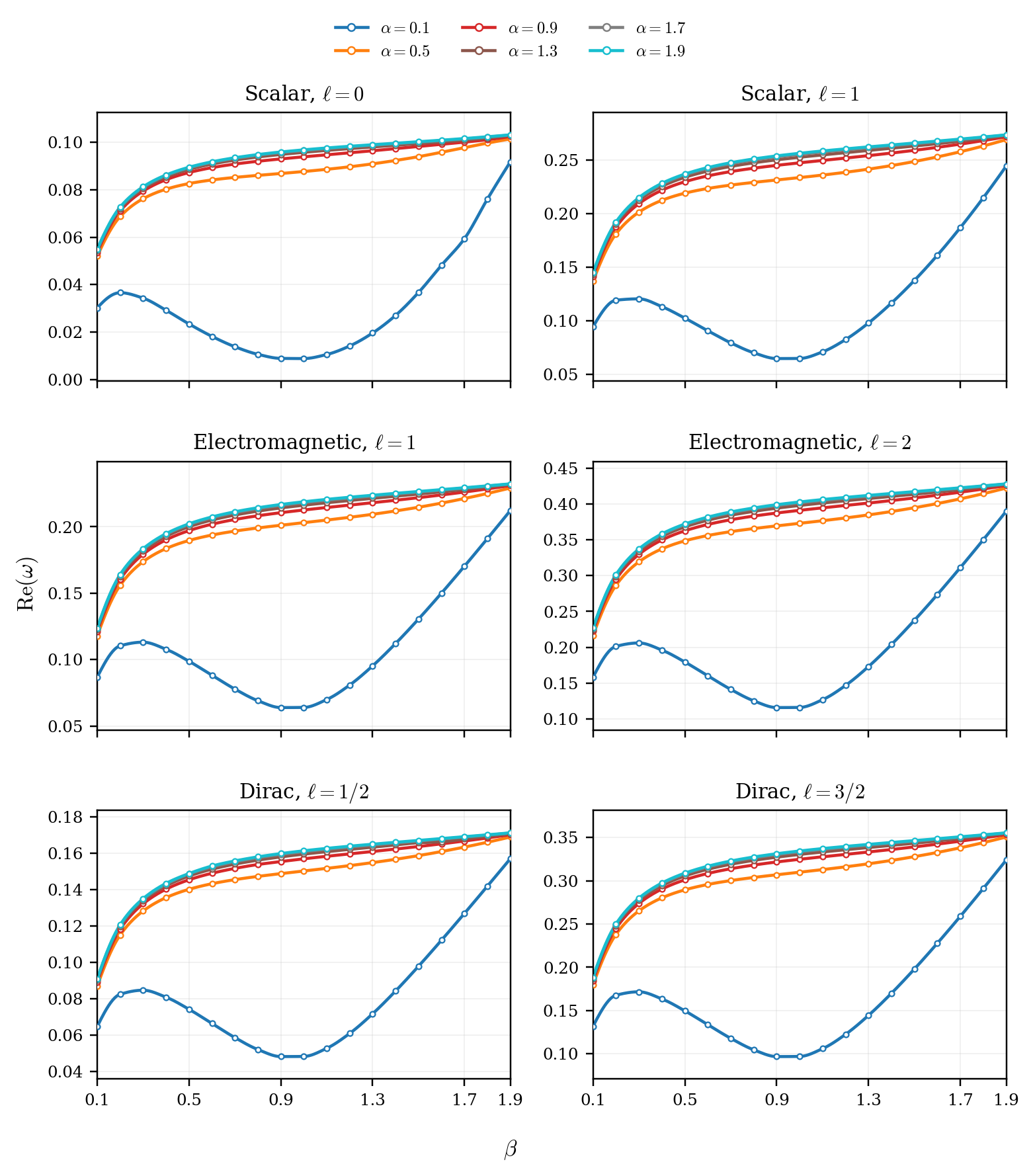
Figure 2: Real parts of fundamental QNM frequencies for (α,β,λ,c1)0 scans over six sectors at fixed (α,β,λ,c1)1, (α,β,λ,c1)2, (α,β,λ,c1)3, (α,β,λ,c1)4.
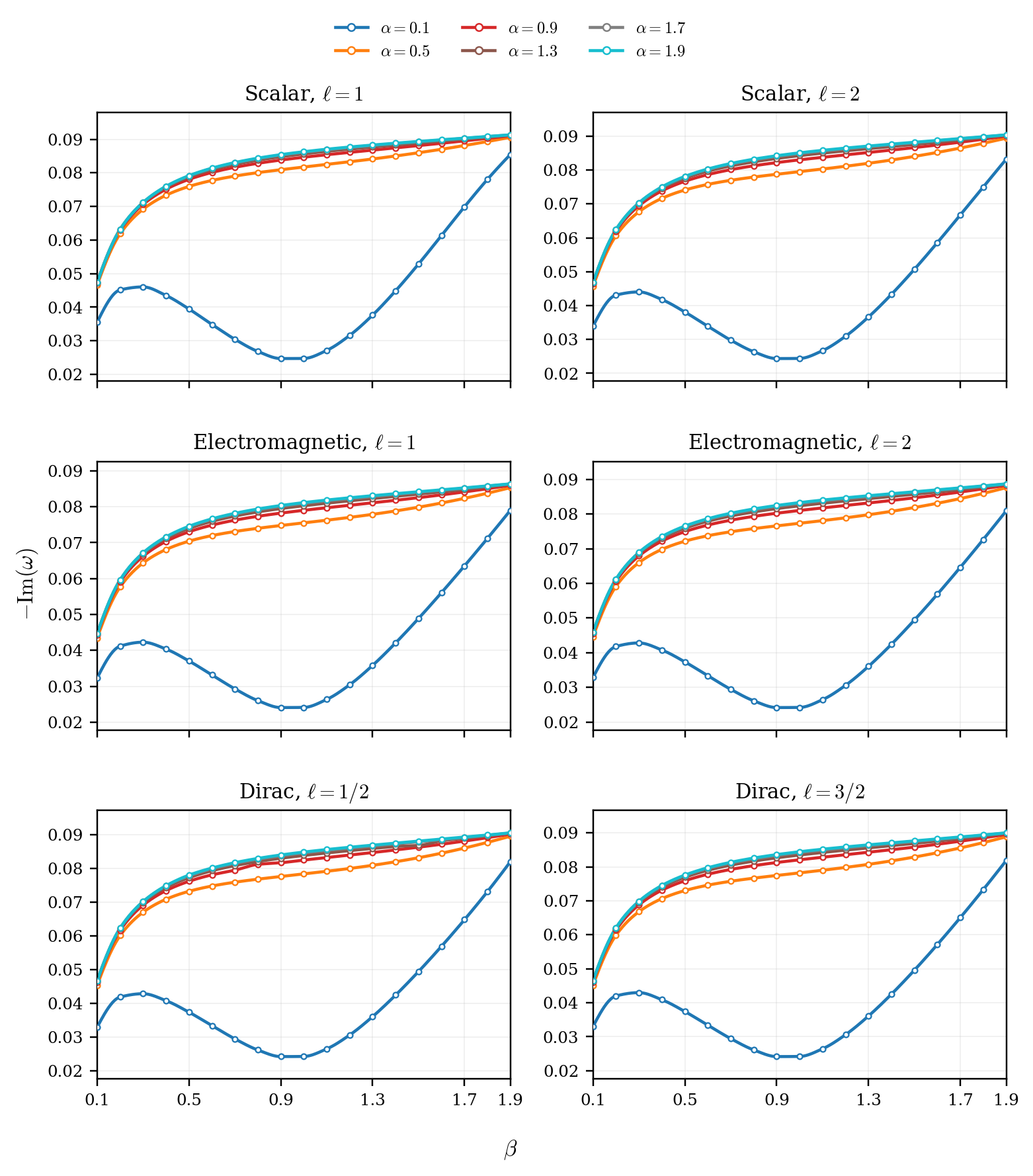
Figure 4: Damping rates (α,β,λ,c1)5 for the corresponding (α,β,λ,c1)6 scan, showing systematic spectral trends across all spin sectors.
The influence of (α,β,λ,c1)7 is primarily a uniform rescaling, with a more modest and sometimes non-monotonic impact on the damping rates.
(α,β,λ,c1)8 Scan
Variation of (α,β,λ,c1)9 leads to the strongest spectral softening observed: both oscillation frequencies and damping rates drop substantially as either parameter is increased.
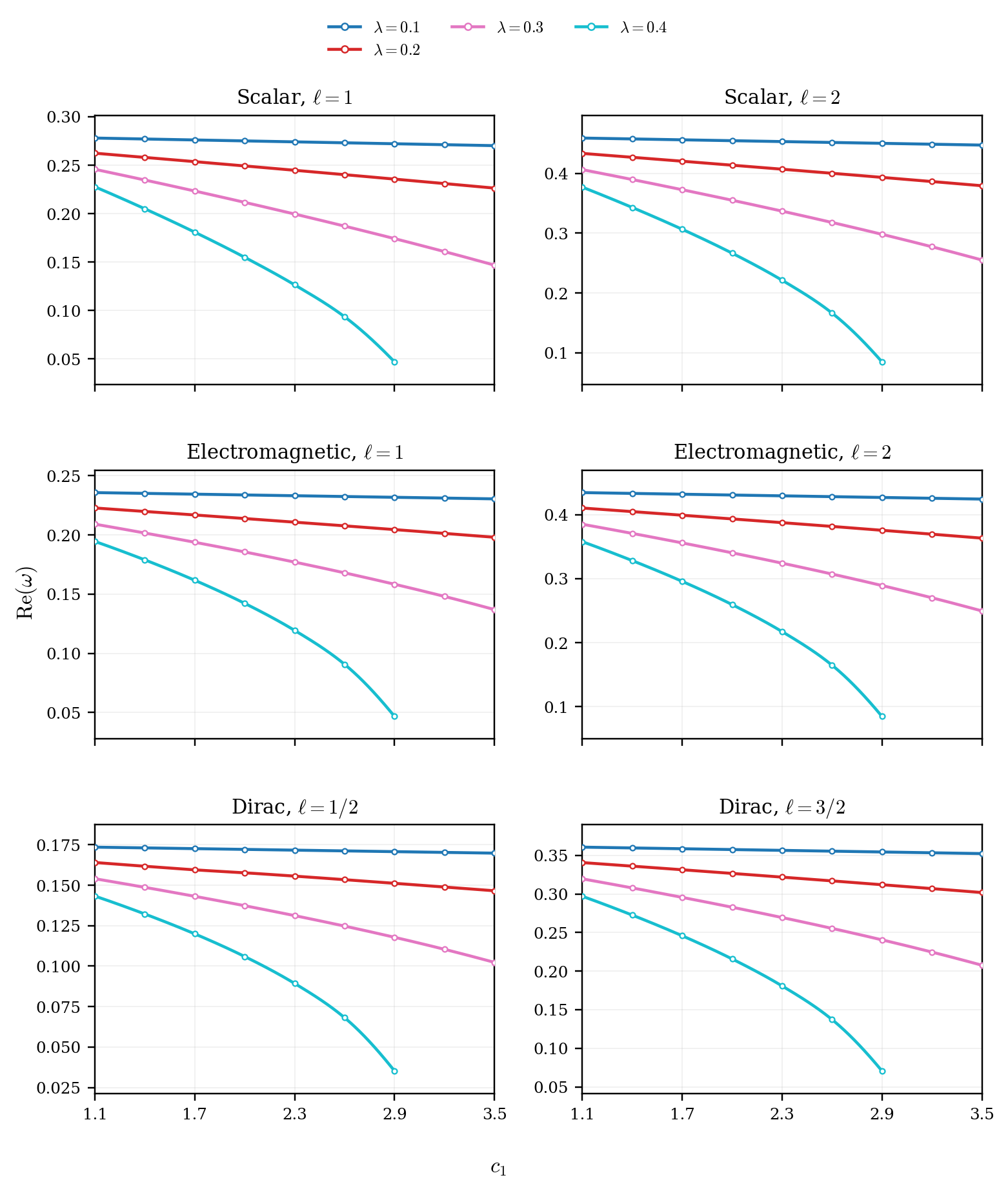
Figure 5: Real parts of QNM frequencies as functions of Λeff0 for fixed Λeff1 across representative sectors.
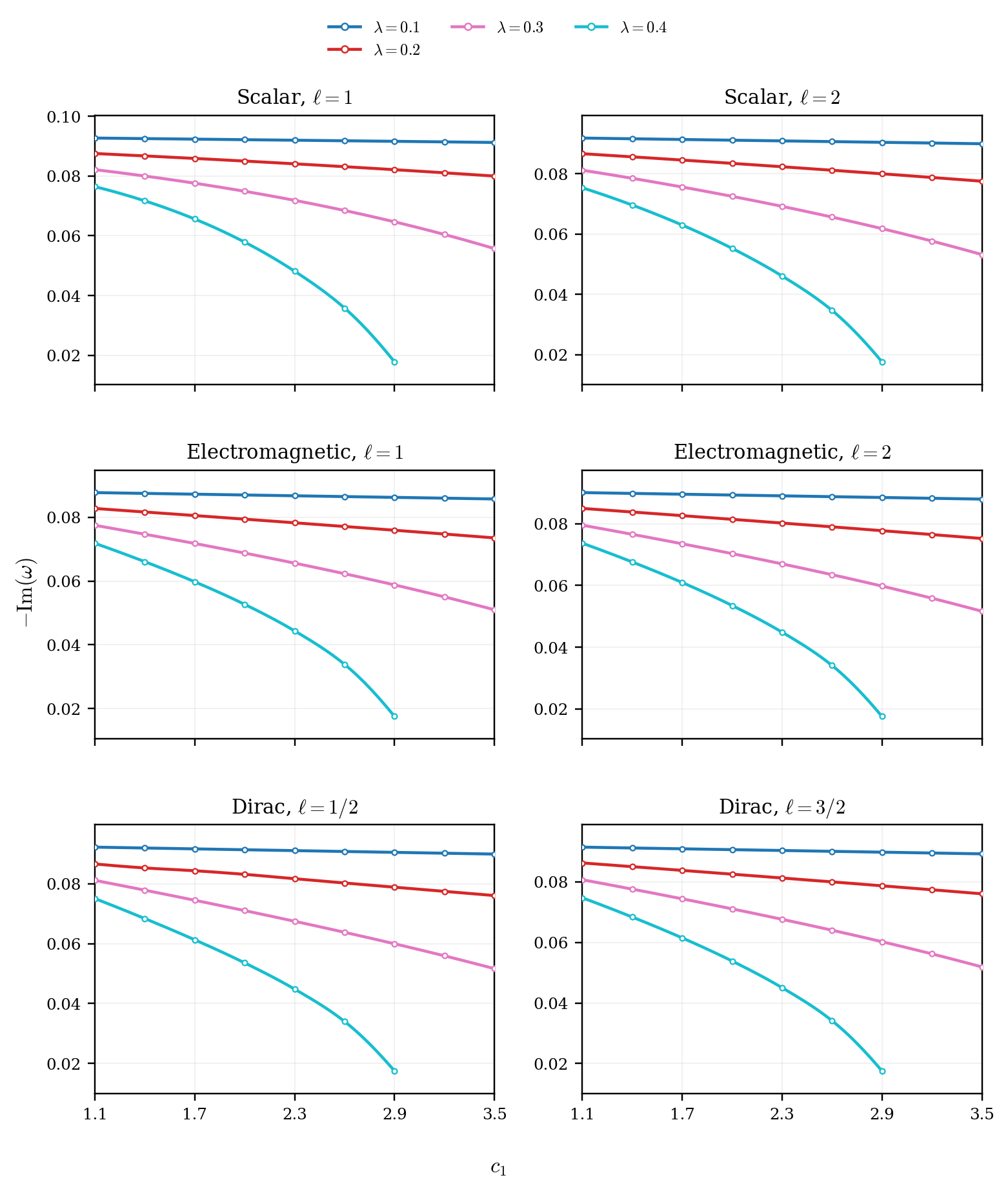
Figure 1: Damping rates Λeff2 for matched Λeff3 scan, demonstrating rapid suppression of QNM decay and oscillation.
Time-Domain Benchmarking
Precise agreement is verified between frequency-domain and time-domain extractions for the scalar Λeff4 mode in the neutral background:
(Figure 2)
Figure 3: Time-domain profile for scalar Λeff5 mode, showing Padé-WKB, Prony, and exact de Sitter values in tight agreement.
Both Schwarzschild-like (black hole) and dS branches are resolved numerically, and the de Sitter branch is in close correspondence with analytic results for empty dS space (Malik, 31 Mar 2026).
Theoretical and Practical Implications
Spin Hierarchy and Effective Potentials
The study rigorously establishes that the dominant source of spin dependence in QNM spectra is the structure of the effective potentials. The scalar Λeff6 mode responds most acutely to background geometry, while electromagnetic and higher-multipole scalar modes yield clear, monotonic spectral trends. Dirac modes interpolate smoothly between these regimes due to the nature of their partner potentials.
Strong Cosmic Censorship (SCC)
The results elucidate the SCC scenario for generalized Proca dS black holes. In the small black hole limit (Λeff7), the spectral gap Λeff8 for the empty-dS branch approaches zero, so the ratio Λeff9 (with f′(r)/r0 the Cauchy horizon surface gravity) also vanishes, trivially satisfying strong cosmic censorship in the regime where the black hole is much smaller than the cosmological scale. This mechanism and corresponding analytical behavior are consistent with recent results on exact empty-dS QNM spectra (Malik, 31 Mar 2026).
Grey-Body Factor Correspondence
The computed QNMs serve as accurate input for grey-body factor estimations via established eikonal correspondences (Konoplya et al., 2024, Konoplya et al., 2024). This link is restricted to the Schwarzschild branch of modes, as the de Sitter branch does not admit such correspondence due to its distinct boundary structure.
Outlook and Future Directions
Extensions to the gravitational sector, the treatment of massive field perturbations, and a broader scan over the charged three-horizon regime are natural continuations. Of particular interest is determining the detailed behavior of de Sitter-like branches throughout the three-horizon parameter domain and quantifying associated grey-body factors for all spin sectors.
Conclusion
The investigation delivers a comprehensive, spin-resolved analysis of QNM spectra for massless fields in generalized Proca black hole backgrounds with asymptotic de Sitter structure. Parameter scans reveal robust, spin-dependent spectral patterns and underscore the curvature term's key role in scalar perturbation sensitivity. The work clarifies the interplay between geometrical and field-theoretic parameters in determining mode lifetimes and spectral gaps, thereby informing both the theoretical understanding of SCC and practical calculations of black hole emission and signal decay relevant to observational astrophysics and particle production in black hole environments.
References
- "Quasinormal Spectra of Fields of Various Spin in Asymptotically de Sitter Black Holes within Generalized Proca Theory" (2605.12113)
- "Analytic Quasinormal Spectrum of Effective de Sitter Space in Generalized Proca Theory" (Malik, 31 Mar 2026)
- "Correspondence between grey-body factors and quasinormal modes" (Konoplya et al., 2024)
- "Correspondence between grey-body factors and quasinormal frequencies for rotating black holes" (Konoplya et al., 2024)

