Federated LoRA Fine-Tuning for LLMs via Collaborative Alignment
Published 20 May 2026 in stat.ML and cs.LG | (2605.21217v1)
Abstract: Low-rank adaptation (LoRA) has emerged as a powerful tool for parameter-efficient fine-tuning of LLMs. This paper studies LoRA under a federated learning setting, enabling collaborative fine-tuning across clients while preserving parameter efficiency. We focus on a highly heterogeneous regime in which clients share only partial structure and a substantial subset may be contaminated. We propose Collaborative Low-rank Alignment and Identifiable Recovery (CLAIR), a contamination-aware framework that relies only on preliminary local estimators. Its formulation applies broadly, from linear regression to neural network and LLM modules, whenever local adaptation can be represented by matrix-valued updates. CLAIR recovers the shared LoRA subspace and detects contaminated clients via a structured low-rank plus block-sparse decomposition. We prove exact recovery of the shared LoRA subspace in the noiseless case, stable recovery under preliminary estimation error, and consistent collaborative-set recovery under mild separation conditions. We further quantify the gain from CLAIR refinement: it reduces off-subspace estimation error through cross-client averaging while preserving client-specific variation within the shared LoRA subspace, thus improves over local fine-tuning whenever this oracle gain outweighs the costs of subspace estimation and benign-client heterogeneity. Empirically, we demonstrate the benefits of CLAIR by fine-tuning a Transformer architecture on a text-copying task. The results show accurate contamination detection and improved benign-client performance compared with local fine-tuning and non-robust federated averaging.
The paper introduces the CLAIR framework achieving federated LoRA fine-tuning via pairwise client difference matrix decomposition.
It demonstrates theoretical guarantees including exact shared subspace recovery and robust contaminated-client detection with empirical validation in transformer tasks.
Results show CLAIR outperforms naive FedAvg and local LoRA in heterogeneous regimes by reducing estimation error and negative transfer.
Federated LoRA Fine-Tuning for LLMs via Collaborative Alignment: An Expert Review
Overview and Motivation
The paper "Federated LoRA Fine-Tuning for LLMs via Collaborative Alignment" (2605.21217) analyzes the intersection of parameter-efficient fine-tuning for LLMs using Low-Rank Adaptation (LoRA), and federated learning with statistical heterogeneity and contamination across clients. The authors introduce the CLAIR framework (Collaborative Low-rank Alignment and Identifiable Recovery), which achieves federated LoRA refinement without requiring access to the underlying base model or explicit adapter decompositions. CLAIR leverages pairwise differences between client models, formulates them as a structured low-rank plus block-sparse matrix decomposition, and provides both theoretical guarantees and empirical performance improvements in federated settings with considerable heterogeneity and contamination.
Federated LoRA Problem Formulation
The fundamental challenge addressed is formalizing federated LoRA when clients possess models with incompatible backbones, unknown shared structure, and potential contamination. The authors extend classical PEFT approaches by modeling the client-specific adaptation as low-rank matrix-valued updates to the base weights: W(k)=W0+B(k)A(k)
with A(k) and B(k) the client LoRA factors.
Instead of requiring access to adapters or the backbone, the federated server receives only preliminary local estimators of W(k). The central inferential task becomes identifying the set of clients that share a compatible low-rank row-space structure (collaborative set), distinguishing benign from contaminated clients, and synthesizing an aggregated, refined estimator that leverages inter-client alignment without negative transfer.
Collaborative Alignment via Structured Matrix Decomposition
CLAIR circumvents the base model identifiability obstacle by operating on pairwise client differences. All pairwise differences are stacked to construct a matrix D, which contains shared low-rank signals (from aligned clients) and block-sparse contamination (from outlier clients). The decomposition reflects robust PCA, but under row-block sparsity and LoRA-specific geometric constraints.
The CLAIR estimator is obtained by solving a penalized convex program: L,Smin21g∑ωg∥g(D−L−S)∥F2+λL∥L∥∗+λS∥S∥1
where L is the low-rank component capturing the shared subspace; S is block-sparse and encodes contamination. The reconstructed row-space projector of L identifies the collaborative adapter subspace. To enable refinement, CLAIR uses majority voting on blockwise projection norms to select the collaborative set and then implements cross-client averaging with pairwise corrections.
Theoretical Guarantees and Statistical Analysis
The paper rigorously establishes exact and stable recovery properties:
In the noiseless regime, CLAIR achieves provable identification of the shared LoRA adapter row-space, even though individual low-rank/sparse components are non-identifiable due to shiftable ambiguity.
CLAIR delivers consistent contaminated-client detection under mild separation conditions, requiring only majority benign clients and nonzero mixed-pair signal gap.
Asymptotic recovery rates show that estimation error of the shared row-space projector decays at OP(K−1/2), with increasing client numbers.
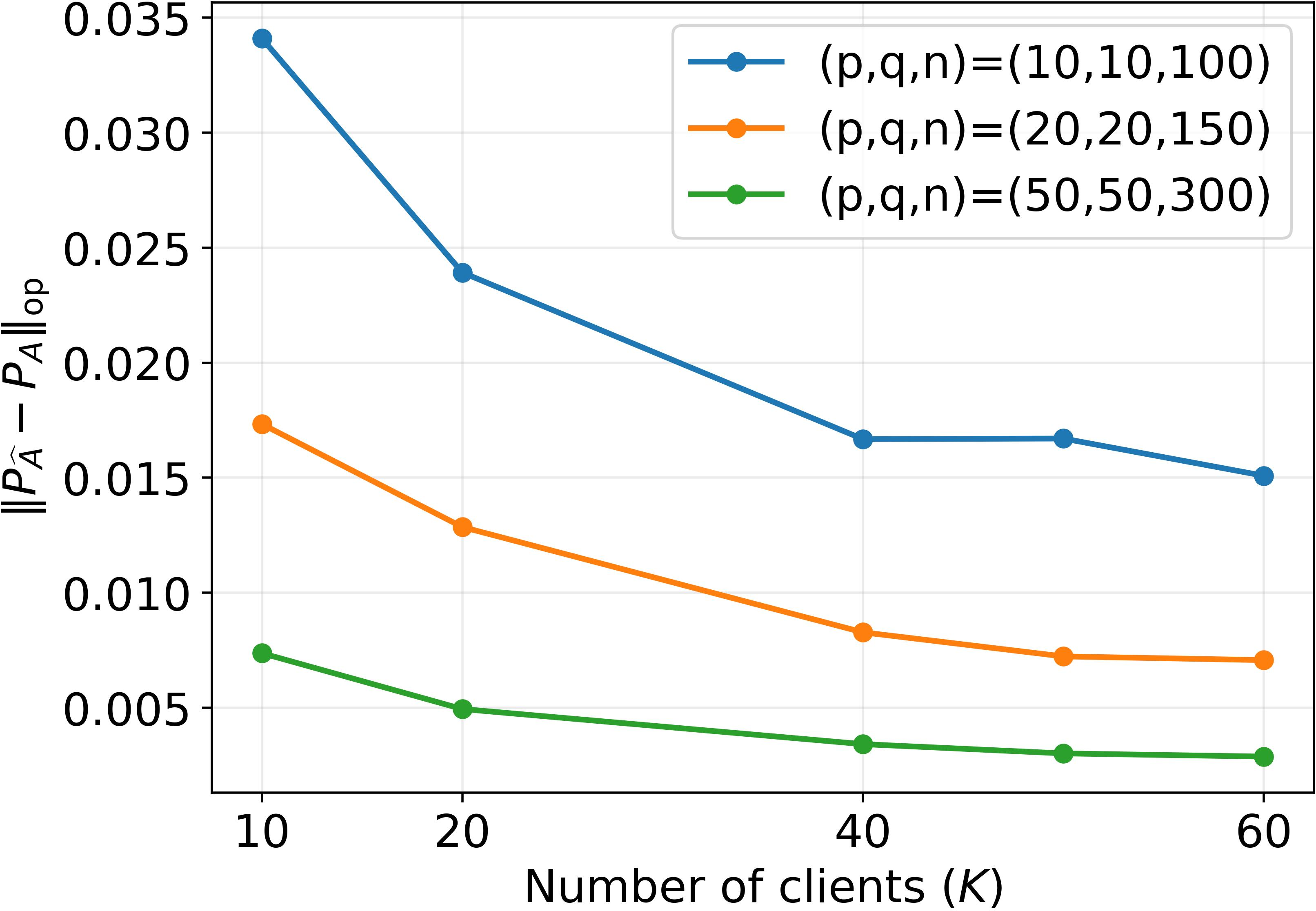
Numerical experiments in linear regression validate these theoretical claims. Estimation error of the row-space projector decreases with A(k)0 in all evaluated regimes:
Figure 1: Estimation error of the shared row-space projector compared to number of clients A(k)1 across A(k)2 regimes.
The authors empirically evaluate CLAIR in federated fine-tuning scenarios where client heterogeneity and contamination can be precisely controlled, using sequence-copying tasks with Transformer models fine-tuned via LoRA. Each client receives either the same or different copy distribution and segment length, and a single malicious client trains on an unrelated task.
Homogeneous Regime
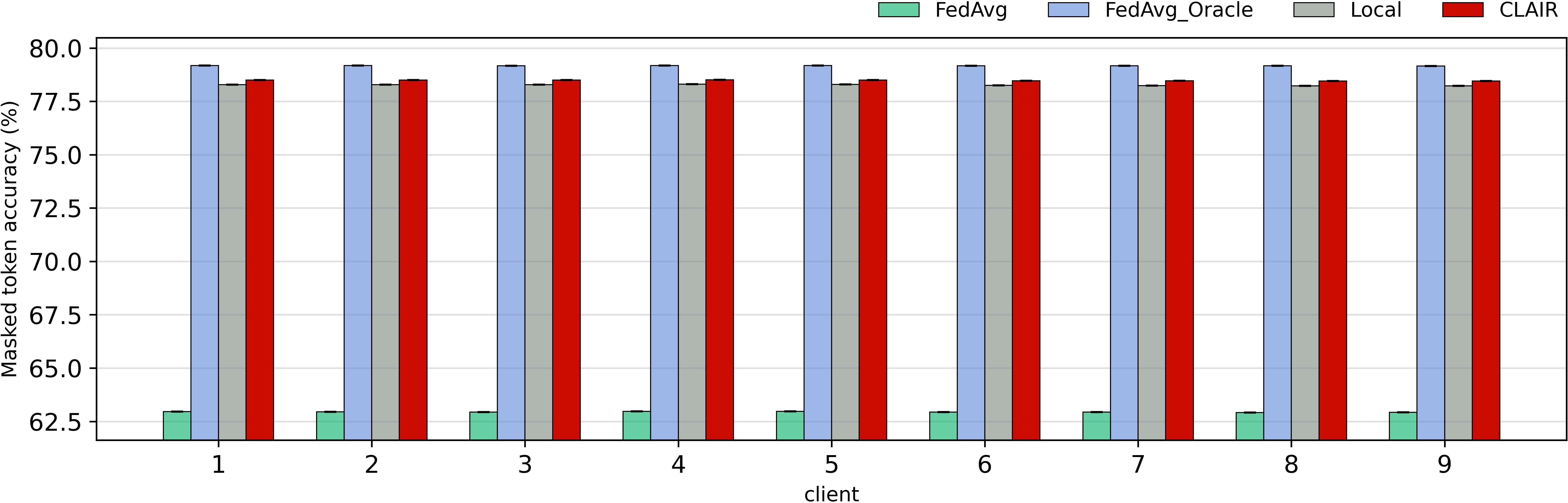
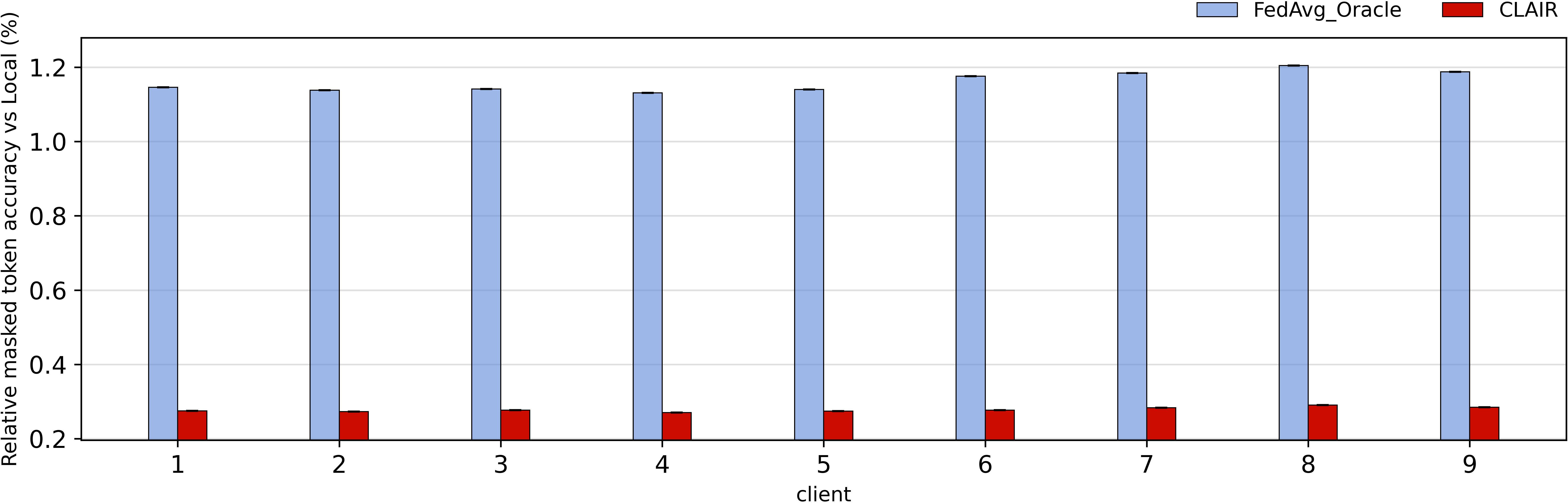
In the homogeneous setting, all benign clients share a common data distribution and task. CLAIR robustly identifies the contaminated client, yields an average masked next-token accuracy matching that of oracle FedAvg, and always outperforms naive FedAvg (which averages over all clients and suffers severe personalization bias):
Figure 2: Homogeneous copying experiment showing client-level masked next-token accuracy and relative gains versus local LoRA baseline.
Heterogeneous Regime
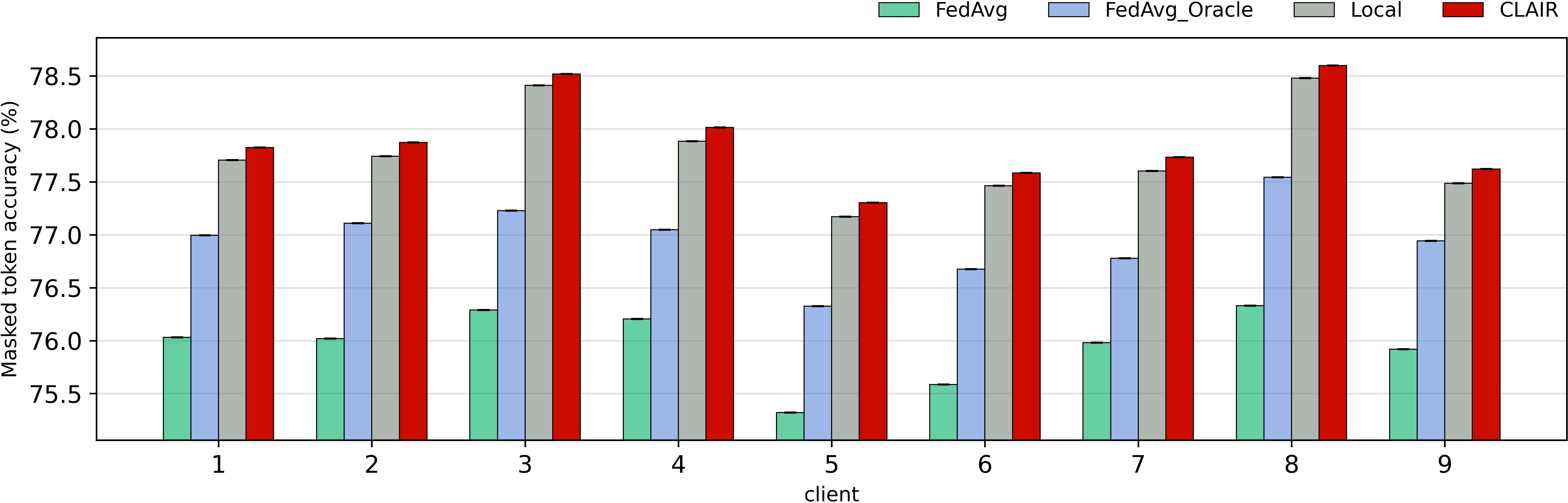
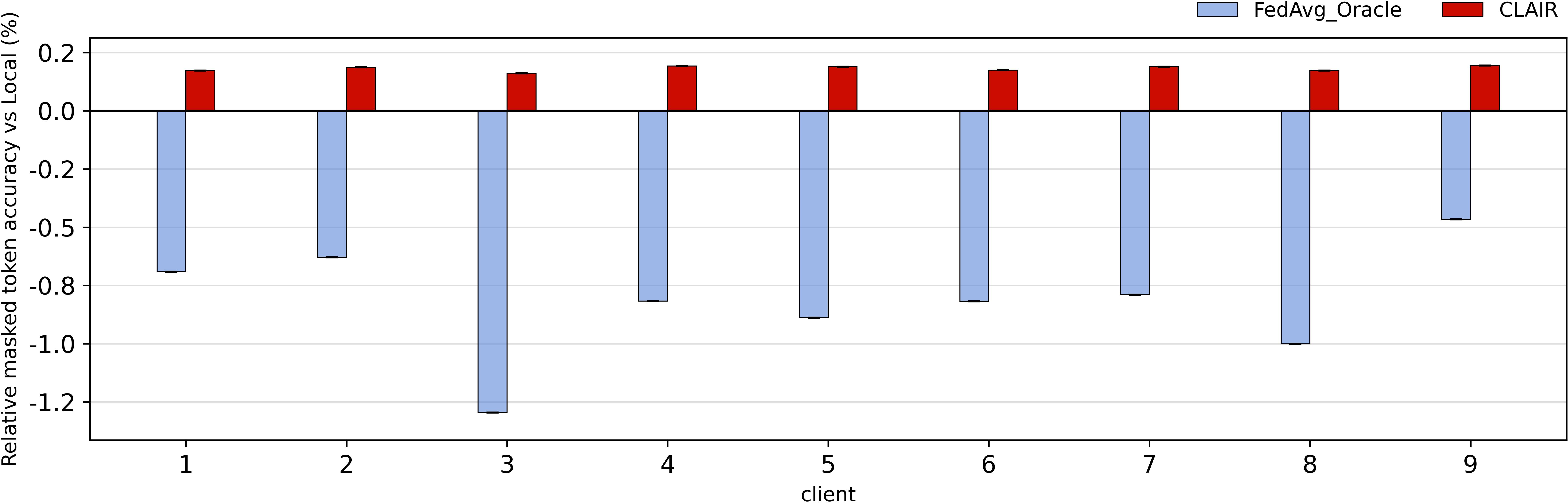
In the heterogeneous setting, benign clients differ in segment length and input distribution. Oracle FedAvg suffers from negative transfer; CLAIR selectively refines over the locally-detected collaborative set, maximizing own-client accuracy and robustly excluding the contaminated client:
Figure 3: Heterogeneous copying experiment depicting client-level masked next-token accuracy and relative improvement over local LoRA fine-tuning.
Strong numerical results include:
CLAIR outperforms local LoRA in all reported settings regardless of heterogeneity.
Naive FedAvg introduces greater error than local OLS in presence of contamination.
Collaborative-set recovery accuracy is near-perfect (>99%) in regimes with moderate A(k)3 and sample size.
Theoretical MSE analysis reveals that CLAIR's gain depends entirely on the reducible orthogonal complement noise, with variance shrinking as collaborative set size increases and LoRA rank decreases.
Practical and Theoretical Implications
Practically, CLAIR provides a robust method for federated fine-tuning of LLMs, compatible with sensitive domains (e.g., healthcare) lacking access to common backbones or adapters. It avoids negative transfer, scales favorably in presence of moderate contamination, and achieves significant error reduction via collaborative averaging.
Theoretically, CLAIR advances the understanding of identification and statistical efficiency in federated PEFT, clarifies limitations of classical robust PCA, and delineates the gain-vs-cost regime for collaborative refinement: variance reduction from averaging aligned clients must exceed heterogeneity and subspace estimation costs.
Future Directions
The authors indicate multiple avenues for extension:
Allowing multiple or overlapping collaborative sets, potentially with mixture-of-experts architectures, and layer-specific or client-dependent adapter ranks.
Relaxing preliminary estimator assumptions, developing theoretical guarantees under more realistic deep learning fine-tuning dynamics, including optimization noise and representation drift.
Integrating with privacy and differential privacy protocols in federated learning, or extending to non-matrix adaptation scenarios.
Conclusion
CLAIR enables robust federated LoRA fine-tuning for LLMs when no common backbone or adapter decomposition is available, reliably distinguishes benign and contaminated clients, and theoretically and empirically achieves substantial error reduction in local adaptation. Its principled matrix-decomposition approach and gain-cost analysis set the foundation for future federated PEFT protocols in highly heterogeneous and adversarial environments.
“Emergent Mind helps me see which AI papers have caught fire online.”
Philip
Creator, AI Explained on YouTube
Sign up for free to explore the frontiers of research
Discover trending papers, chat with arXiv, and track the latest research shaping the future of science and technology.Discover trending papers, chat with arXiv, and more.