- The paper introduces a novel framework that augments the Newtonian lunar tidal tensor with an alpha-dependent off-diagonal channel producing a 45° eigenframe rotation.
- It employs a Halilsoy-inspired approach to analytically derive the cross tidal residual, distinguishing between plus- and cross-type harmonics.
- The study offers practical insights for detecting subtle 45° tidal signatures in high-sensitivity gravimetric data.
Alpha-Dependent Cross-Tidal Residuals and the Halilsoy-Inspired 45° Eigenframe Channel
Abstract and Context
"Alpha-Dependent Cross-Tidal Residuals Beyond the Diagonal Newtonian Lunar Tensor: A Halilsoy-Inspired 45° Eigenframe Channel" (2605.21074) presents a mathematically explicit framework for augmenting the standard diagonal Newtonian lunar tidal tensor with an additional, physically motivated off-diagonal residual channel. Drawing on the off-diagonal tidal sector in Halilsoy's cross-polarized cylindrical gravitational-wave spacetime, the author introduces an alpha-dependent coefficient that encodes a 45∘-type eigenframe rotation, manifesting as a sin(2β) acceleration harmonic in the Earth's surface frame. This cross-channel is defined as a physically testable and analytically tractable extension rather than a replacement for canonical lunar tidal theory.
Newtonian Lunar Tide: Canonical Structure
The Newtonian quadrupolar tidal tensor encapsulates the dominant Earth–Moon gravitational interaction. In the principal (diagonal) frame, it possesses eigenvalues (2,−1) with principal axes separated by 90∘.
The projected tidal acceleration along a surface direction at angle β to the Earth–Moon axis follows a harmonically decomposed angular profile, focusing entirely on a plus-type cos(2β) channel. No independent cross-type sin(2β) term appears in the canonical tensor; projections at 45∘ only arise from linear combinations in the Newtonian context and are not independent tidal channels.
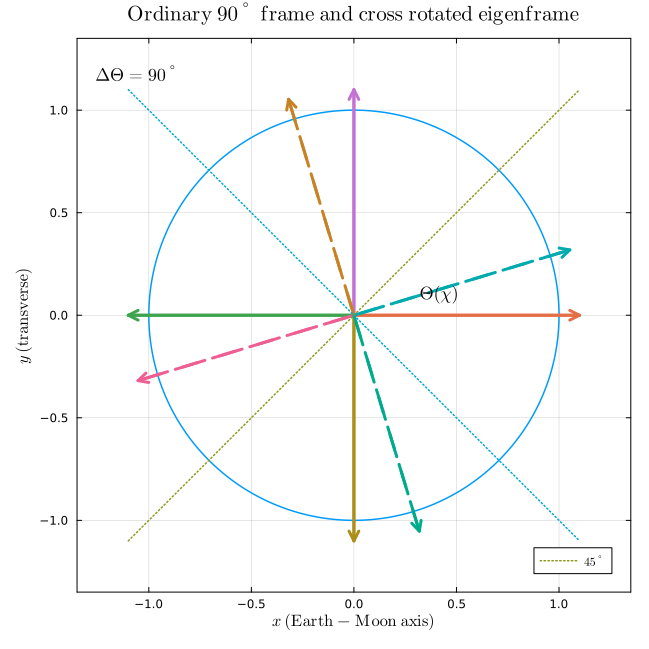
Figure 1: Ordinary 90∘ lunar tidal frame and cross-rotated eigenframe. For a nonzero cross residual, the principal axes rotate by ΘM,H while remaining orthogonal.
Halilsoy Cross-Polarization and Off-Diagonal Tidal Sector
By considering the cross-polarized sector of Halilsoy's cylindrical standing gravitational-wave solution, the framework identifies a concrete relativistic mechanism for the generation of off-diagonal tidal components. The Halilsoy metric's local curvature generically contains a component, proportional to a polarization parameter sin(2β)0, inducing a rotation of the local eigendirections.
This off-diagonal sector does not break the sin(2β)1 orthogonality of the principal stretching and squeezing axes but rotates the entire frame, allowing for an eigenframe orientation governed by an explicit function sin(2β)2.
The effective cross ratio sin(2β)3 is derived analytically by equating the eigenframe rotation ratios in both the lunar and Halilsoy frameworks, resulting in a dimensionless, physically motivated coefficient that can be embedded into the local lunar tensor.
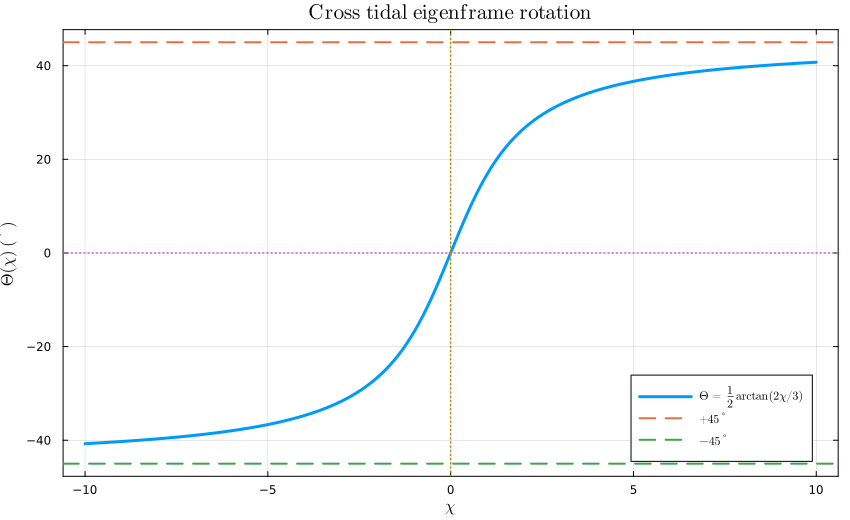
Figure 2: Universal eigenframe rotation curve sin(2β)4, mapping the cross ratio sin(2β)5 (or sin(2β)6) to the physical rotation angle. Small sin(2β)7 approximates Newtonian behavior, while large sin(2β)8 yields a sin(2β)9-rotated cross-dominant limit.
Effective Lunar–Halilsoy Residual Tensor
The effective two-dimensional local residual tensor is
(2,−1)0
where the off-diagonal coefficient is supplied by Halilsoy-inspired analysis rather than by arbitrary parameterization.
- Eigenvalues: Analytical expressions show that eigenvalue corrections are quadratic in (2,−1)1, while the eigenframe rotation is linear for small (2,−1)2.
- Eigenframe rotation: The central effect of the cross sector is to rotate the principal axes by
(2,−1)3
achieving a (2,−1)4 orientation in the cross-dominant regime (2,−1)5.
Projected Acceleration: Emergence of the (2,−1)6 Channel
The projected surface tidal acceleration from the effective tensor along a direction (2,−1)7 is:
(2,−1)8
where (2,−1)9. The added 90∘0 term constitutes an orthogonal residual channel—extremal at 90∘1-type orientations—missing from the diagonal Newtonian model.
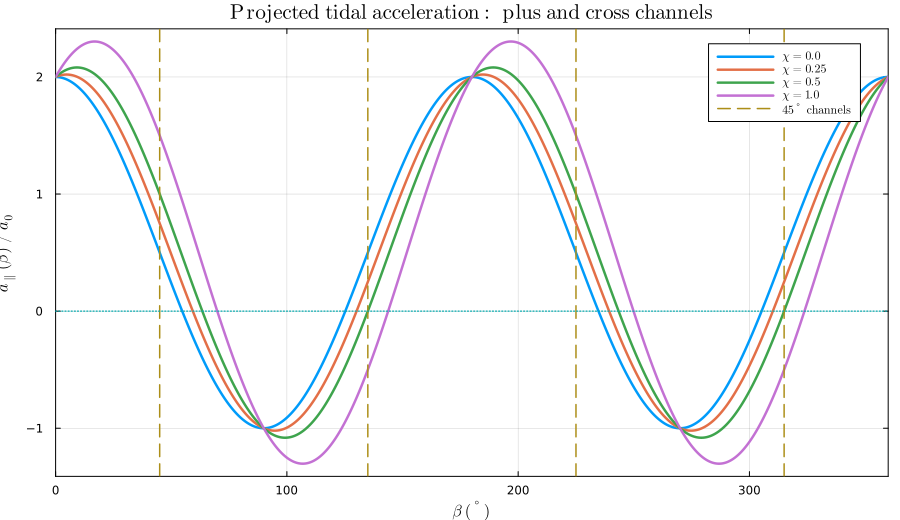
Figure 3: Projected tidal acceleration pattern 90∘2; nonzero 90∘3 introduces the cross-type 90∘4 channel and shifts the angular pattern. Dashed lines denote 90∘5-type extrema.
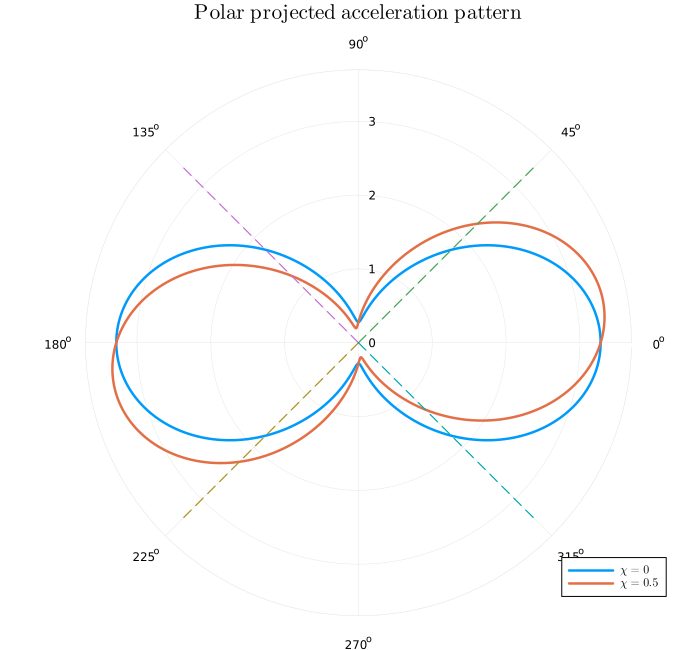
Figure 4: Polar representation of 90∘6; the standard plus-type harmonic (Newtonian) is deformed by the cross residual, emphasizing the 90∘7 directions.
Isolated Cross Channel and Quantitative Residuals
The residual-only term can be written as
90∘8
This isolates the off-diagonal sector's contribution, which vanishes on the standard axes and peaks at 90∘9 orientations.
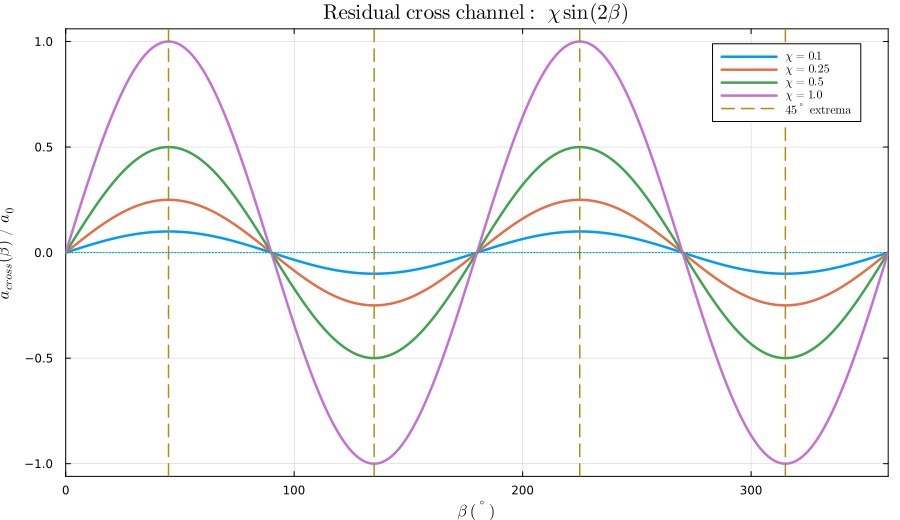
Figure 5: Residual-only cross channel β0, extremal at β1-type directions, vanishing along the principal axes.
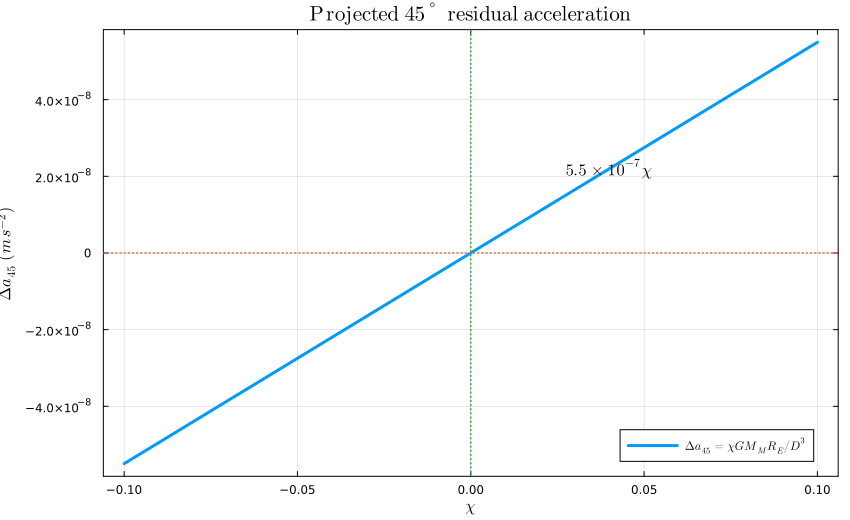
Figure 6: Projected β2-channel residual acceleration β3 as a function of the effective cross ratio β4, showing conversion into physical accelerations.
Visualization and Summary of the 90°–45° Structural Paradigm
The structure is visually summarized: The β5 Newtonian eigenframe forms the baseline, rotated for nonzero β6 to a β7-type orientation, with the total projected acceleration decomposing into plus- and cross-type harmonics.
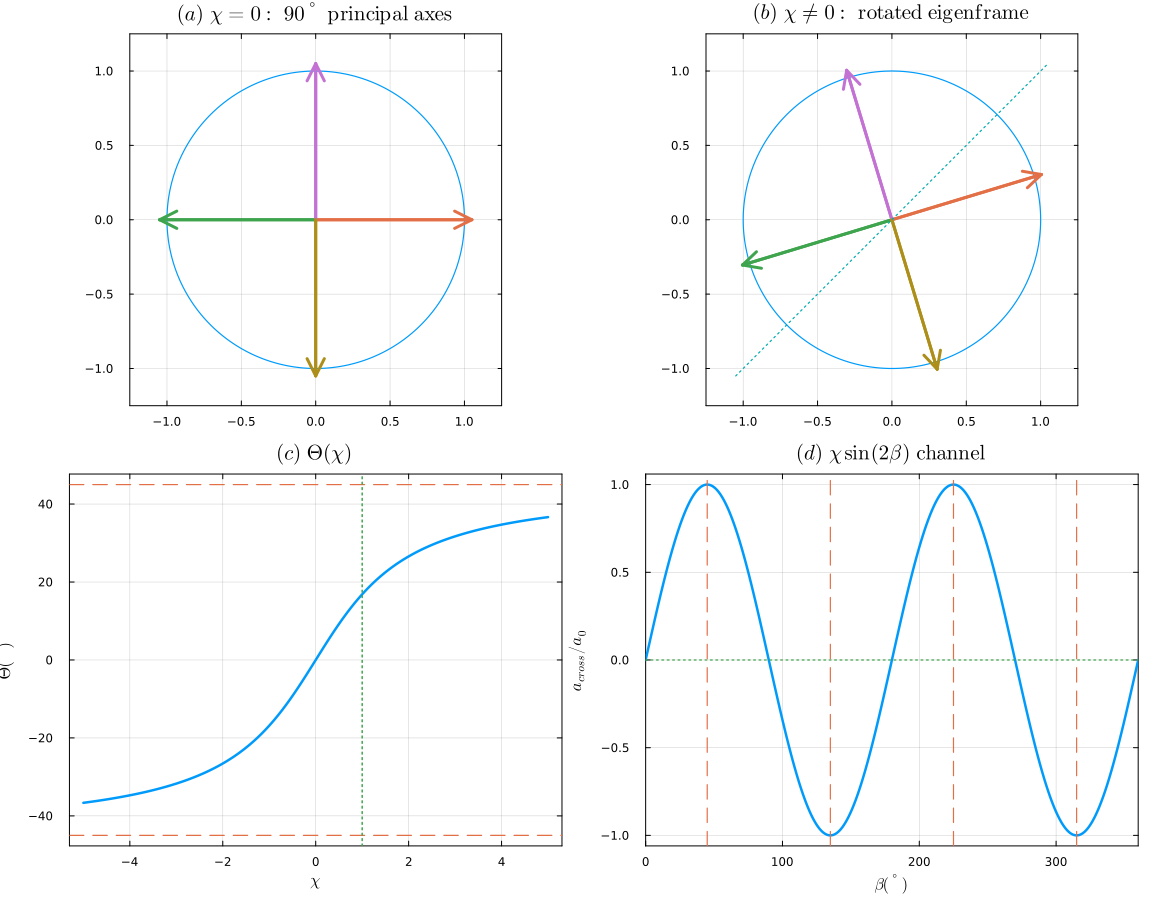
Figure 7: Schematic summary: (a) β8 Newtonian frame, (b) rotated eigenframe, (c) universal response curve for eigenframe rotation, (d) cross-residual pure harmonic.
Amplitude Scalings and Observational Implications
Quantitatively, the magnitude β9 sets the amplitude of the cross-channel relative to the ordinary lunar tide. Representative values yield
cos(2β)0
This is several orders of magnitude below dominant local tidal signals but lies within the noise envelope of high-sensitivity gravimetry.
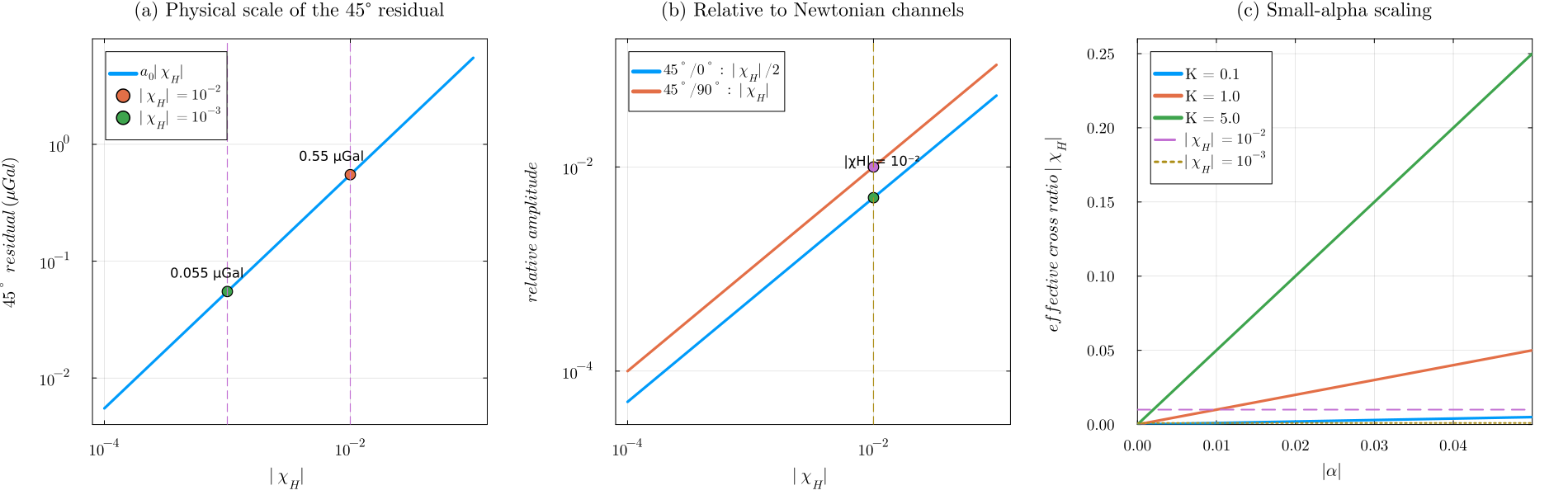
Figure 8: Amplitude ratio and physical scale for the proposed cross-tidal channel; residual accelerations are plotted as functions of cos(2β)1 and compared with the standard lunar tidal amplitude.
Theoretical and Practical Implications
The analysis provides an explicit off-diagonal residual tensor for the lunar tide, rooted in established mechanisms for relativistic eigenframe rotation rather than ad hoc parameterization. The cross-channel is not primarily a correction to total tidal magnitude but manifests as an orthogonal (cos(2β)2) harmonic signature in tidal residuals—eminently testable as a post-subtraction component after removing all known tidal, geophysical, and instrumental effects.
Potential implications include:
- Physical completeness: Provides a template for structured residual searches in high-precision tidal or gravimetric data, post-standard corrections, enabling empirical upper limits or possible identification.
- Frame alignment: Offers a mathematically clean formulation for the separation between principal-axis orientation (eigenframe rotation) and physical cos(2β)3 orthogonality—a generalizable insight for higher-dimensional tidal, elastic, or polarization analyses.
- Theoretic extensibility: Suggests extensions to 3D contexts on a rotating, deformable Earth, permitting more comprehensive general relativistic residual modeling.
- Comparison with gravitational-wave frameworks: Creates a bridge between tidal geophysics and gravitational-wave literature, sharpening analogies between plus/cross polarizations and symmetric tensor decompositions.
Conclusion
This paper establishes a mathematically explicit, Halilsoy-inspired residual tidal tensor for lunar tides, parameterized by an alpha-dependent coefficient encoding eigenframe rotation. The proposed cos(2β)4 cross channel emerges as an orthogonal residual beyond the diagonal Newtonian principal frame, generating a distinct cos(2β)5 harmonic. The analytic construction is well-suited as a target for future observational constraints and forms a robust technical paradigm for analyzing structured geophysical tidal residuals.