- The paper presents a 1PN framework for tidal interactions in spinning compact binaries, revealing that spin-induced tidal dissipation contributes at 2.5PN order.
- It derives explicit analytical expressions for orbital dynamics, energy balance, and gravitational wave flux, incorporating redshift corrections between body and global frames.
- The formalism enhances waveform modeling by addressing spin-tidal effects and resolving previous discrepancies in black hole horizon absorption predictions.
First-Post-Newtonian Dissipative Tidal Effects in Compact Binary Inspirals
Overview
This paper presents a comprehensive post-Newtonian (PN) framework for modeling dissipative, electric-quadrupolar tidal interactions in spinning compact binary inspirals at next-to-leading (1PN) order. The focus is on deriving explicit contributions to the orbital dynamics, energy balance, dissipative energy flux, and gravitational wave (GW) phase for quasi-circular systems where component spins are aligned or anti-aligned with the orbital angular momentum. Both neutron star and black hole binaries are encompassed. A key result is that spin-induced tidal dissipation, previously unaccounted for at this accuracy, enters the GW phase at 2.5PN order with a distinctive logarithmic frequency dependence. The formalism leverages a general, rotationally symmetric low-frequency tidal response, and it clarifies the relationship between local body-frame quantities and observables constructed in the binary center-of-mass frame, including a redshift correction that vanishes only in the extreme-mass-ratio limit.
The analysis employs the post-Newtonian equations of motion for strongly gravitating, spinning, tidally deformable bodies, as developed by Racine and Flanagan, extended to consistently include spin-quadrupole couplings and nonlinear corrections. The tidal response is parametrized through generalized conservative and dissipative electric Love numbers, encompassing leading- and next-order spin-tide interactions up to quartic order in spin. The calculation incorporates a generalized energy-balance law that clearly distinguishes conservative and dissipative contributions, enabling a clean separation of the corresponding corrections to GW templates.
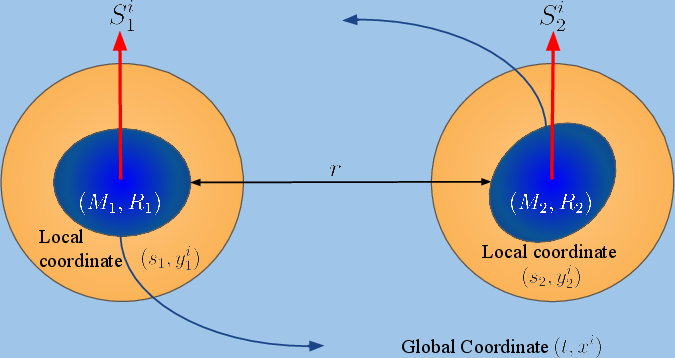
Figure 2: Cartoon (not to scale) depicting two tidally interacting, spinning neutron stars with radii R1,2 and aligned/anti-aligned spins, emphasizing the distinction between local body zones and the global PN zone.
A schematic of the computational pipeline demonstrates the logical sequence of the analysis: 1PN accurate equations of motion → tidal response parametrization and redshift transformation → Lagrangian formalism and balance law → analytical expressions for orbital energy, tidal dissipation, and GW flux → stationary phase approximation yielding the GW phase.
(Figure 2)
Figure 3: Schematic of the calculation pipeline from the 1PN equations of motion and tidal response to final expressions for the waveform GW phase.
Spin-Dependent Tidal Dissipation: Frequency Dependence and GW Phasing
A central finding is that dissipative spin-tide couplings, parametrized by H(1), correct the GW phase at 2.5PN order, entering with a nontrivial logarithmic dependence on frequency. This frequency dependence ensures non-degeneracy with phase shifts arising from coalescence time or phase, distinguishing this effect from other dissipative channels. Conservative spin-tide and higher-spin tidal couplings, captured by terms Λ(n), appear at higher PN order as subleading corrections.
A key numerical illustration is provided for the case of an equal-mass, spin-aligned binary black hole:
(Figure 3)
Figure 1: Frequency-domain dephasing contributions from H(0) (leading order dissipative tides) and H(1) (spin-tidal dissipation) for a 2×33M⊙ binary with →0.
The →1 spin-tidal correction can lead to a secular phase accumulation of order →2 radians over typical LIGO band frequencies for sources like GW250114, with a threshold for measurability at SNR →3.
Redshift Corrections and Comparison to Worldline EFT
The formalism clarifies the source of discrepancies between previous effective worldline theory (EFT) calculations of comparable-mass black hole absorption and the present gauge-invariant energy balance. Specifically, it identifies a "redshift" mismatch: the locally measured tidal absorption rates must be mapped to global binary variables through a redshift factor, a correction that is subleading in the extreme mass-ratio limit but becomes necessary for comparable-mass binaries. This resolves previously observed inconsistencies with black hole horizon absorption flux predictions, and shows that the standard energy-balance law used in EFT requires generalization beyond the test-mass case.
Practical and Theoretical Implications
Waveform Modeling: The derived phase corrections—specifically, spin-tidal dissipative terms at 2.5PN order with frequency-dependent prefactors—are directly relevant for constructing high-accuracy inspiral templates. Systematic biases in parameter inference or tests of GR can arise if these are omitted for high-SNR events.
Astrophysics of Dissipative Tides: For neutron star binaries, these results generalize previous leading-order dissipative tidal treatments. The formalism now permits modeling of systems where spin-locked configurations and tidal resonance phenomena are relevant, and provides guidance for future theoretical work on coupling between viscosity, composition-dependent dissipative coefficients, and GW observables.
Black Hole Absorption: The analysis demonstrates that even modest spins can produce non-negligible secular GW phasing, requiring their inclusion in models for third-generation detector science runs and rare high-SNR LIGO/Virgo/KAGRA events. The framework sets the stage for systematic parameter estimation and constraints on tidal heating and possible new physics in the strong-field regime.
Theoretical Developments: The redshift correction elucidated herein is a crucial element for any approach (e.g., worldline EFT, EOB, NR-perturbative matching) applied to spinning, comparable-mass systems. Extensions to precessing, eccentric, or dynamical tidal sectors are now more tractable within this modular balance-law approach.
Future Directions
Several natural extensions are identified:
- Inclusion of gravitomagnetic (odd-parity) tides and spin-resonant fluid modes.
- Full extension to eccentric or precessing binaries.
- Calculation of next-higher-order dissipative contributions, including nonlinear memory and tail effects, following the strategy now being applied to adiabatic tides [e.g., (Warburton et al., 2024)].
- Direct comparison with upcoming numerical relativity waveforms including self-consistent tidal dissipation.
- Application of the framework to template systematics and parameter biases in precision GW data analysis for both BH and NS binaries.
Conclusion
The formalism provides a 1PN-complete, gauge-invariant treatment of dissipative tidal effects—including previously unmodeled spin-tidal dissipation—in spinning compact binaries, with explicit corrections to the inspiral GW phase. The identification and quantification of these effects—especially their unique, frequency-dependent imprint on the GW signal—are indispensable for high-precision waveform modeling and strong-gravity astrophysics with next-generation GW detectors. The framework also clarifies open questions in worldline EFT approaches regarding the mapping from body-frame to global-frame observables. Extensions to additional tidal phenomena and more general binary configurations are immediate areas for further research.