- The paper’s main contribution is the introduction of a unified SO(3)F gauged framework that links SM flavor hierarchies with asymmetric dark matter via leptogenesis.
- It details a model employing heavy right-handed neutrinos, mirror fermions, and scalar VEV hierarchies to generate correlated baryon and dark matter asymmetries.
- It constrains the parameter space through FCNC, LFV, and collider data, predicting a distinctive dark matter mass of ~13.4 GeV with controlled self-interactions.
Gauged Flavour for Asymmetric Dark Matter: A Technical Summary
Overview and Motivation
The Standard Model (SM) leaves critical open questions, including the origin of flavor hierarchies, the nature of neutrino masses, and the genesis of both the baryon asymmetry of the Universe (BAU) and dark matter (DM). "Gauged Flavour for Asymmetric Dark Matter" (2605.20336) presents a unified framework where a gauged SO(3)F flavour symmetry acts on both visible and dark sectors, tightly linking these open problems. Leveraging the mechanism of leptogenesis, the framework describes how the spontaneous breaking of SO(3)F not only establishes fermion mass hierarchies but also dynamically generates correlated baryon and dark matter asymmetries. The work systematically explores all phenomenological constraints, with particular focus on anomaly cancellation (necessitating mirror fermions), flavor constraints, cosmology, and DM relic density.
Model Structure
The framework extends the SM by introducing:
- A gauged SO(3)F flavor symmetry under which three generations of SM and dark sector fermions are triplets;
- Three heavy Majorana right-handed neutrinos (νR) enabling high-scale leptogenesis and the seesaw mechanism;
- Three generations of dark matter fermions (χ), triplets under a new confining SU(3)DC;
- Mirror fermions added to ensure anomaly cancellation, with masses set by the VEVs vϕi of scalar triplets ϕi that break SO(3)F sequentially and hierarchically.
The SO(3)F symmetry breaking is achieved via scalar potentials engineered to produce the required VEV hierarchy, which maps on to the observed mass and mixing patterns in the SM through a seesaw-like mechanism with mirror fermions. The model restricts the SM flavor structure to left-handed quarks and right-handed leptons as SO(3)F0 triplets. Majorana and Dirac mass terms, generated via the scalar sector, induce flavor hierarchies and suppress FCNCs for light generations.
Mechanism for Baryogenesis and Asymmetric Dark Matter
High-scale leptogenesis produces a lepton asymmetry via out-of-equilibrium, CP-violating SO(3)F1 decays. This asymmetry is partially redistributed between baryons and dark matter through two classes of sphaleron processes:
- Electroweak (EW) sphalerons mediate the transfer of asymmetry from leptons to baryons;
- Flavour sphalerons associated with SO(3)F2 convert the lepton asymmetry also into a dark matter number (SO(3)F3) asymmetry.
Consequently, both visible and dark matter densities are set by a common mechanism, naturally explaining their similar cosmic abundances and solving the "coincidence problem" in ADM scenarios.
Phenomenological Constraints
Flavour Constraints
The spontaneous breaking of SO(3)F4 leads to massive flavour gauge bosons (SO(3)F5), which mediate FCNCs. The most stringent bounds arise from meson oscillations—particularly SO(3)F6 and SO(3)F7 mixing, constraining the largest and intermediate VEVs SO(3)F8 and SO(3)F9, respectively. The corresponding effective operators, generated at tree or one-loop level, contribute to precision observables:
- Kaon mixing: Sensitivity at SO(3)F0 TeV depending on phase assumptions;
- SO(3)F1 mixing: SO(3)F2 TeV, derived by matching the stringency of recent LHCb measurements and theoretical inputs.
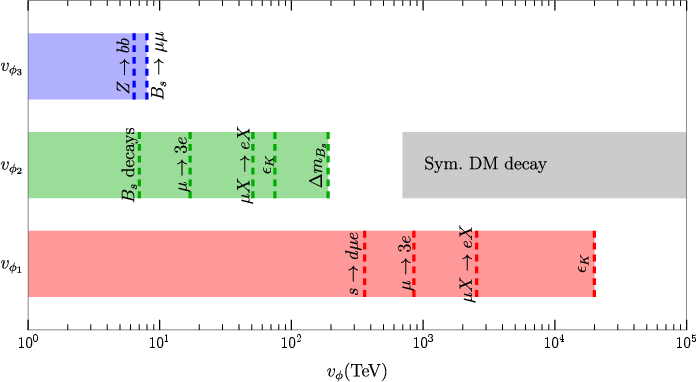
Figure 2: Compilation of the bounds on the three scalar VEVs SO(3)F3 from kaon oscillations, SO(3)F4 measurements, lepton flavor violation, and DM cosmology requirements.
LFV observables, such as SO(3)F5 and SO(3)F6-to-SO(3)F7 conversion, are also probed, with current constraints and considerable improvement expected in future experiments (e.g., COMET, Mu2e, Mu3e).
Collider and Electroweak Constraints
Mirror fermions introduced for anomaly cancellation—vector-like up- and down-type quarks and charged/neutral leptons—receive masses directly from SO(3)F8 VEVs. Direct LHC constraints require masses SO(3)F9 TeV for these states, while indirect limits from electroweak precision data and Higgs current operators lead to more stringent constraints, especially on mixing with third-generation SM fermions:
- νR0 TeV for mirror down;
- νR1 TeV for mirror lepton.
Precision measurements at future colliders (FCC-ee, FCC-hh) could further probe these scales.
Cosmological and Dark Matter Constraints
The interplay between baryogenesis and ADM generation ties the dark sector's parameters tightly to cosmological observables:
- The model predicts a DM mass νR2 GeV—resulting directly from the ratio of observed baryonic and DM energy densities and the branching of asymmetry via EW and flavor sphalerons.
- DM annihilation and the effective decay of the symmetric component are enforced via strong νR3 dynamics and sufficiently rapid dark meson decays into leptons mediated by νR4 gauge bosons—requiring νR5 TeV to avoid spoiling BBN.
- DM self-interactions, mediated by dark pion exchange, remain compatible with current astrophysical bounds: νR6 cmνR7/g, well below limits from halo and cluster observations.
Numerical Benchmark
For illustrative purposes, a benchmark with all Yukawa couplings set to unity and hierarchically arranged νR8 is considered:
- νR9 TeV (constrained by kaon mixing);
- χ0 TeV (constrained by χ1 and DM decay requirements);
- χ2 TeV (probing mirror fermion masses accessible by next-generation colliders).
This scenario successfully reproduces the observed SM mass and mixing hierarchies, while simultaneously satisfying all experimental and cosmological constraints.
Theoretical and Practical Implications
This work integrates mechanisms for flavor hierarchies, BAU, neutrino masses, and ADM under a coherent flavor-gauged paradigm, constructing a highly constrained and predictive scenario:
- Natural flavor protection arises via seesaw-suppressed SM Yukawas, providing inverse mass correlations with mirror fermions and suppressing new physics for lighter generations;
- Testability: Multiple observables—especially FCNCs, LFV, precision electroweak data, and future collider searches—provide complementary and stringent probes. The proximity of upper and lower bounds on χ3 from flavor and cosmological considerations enhances predictivity;
- DM properties: The framework resolves the coincidence of DM and baryon abundances dynamically and predicts both the DM mass and its self-interaction strength, making it directly falsifiable.
Future Directions
Possible avenues for future research include:
- Exploring UV completions or dynamical mechanisms that generate the specific scalar sector necessary for hierarchical χ4 breaking without significant tuning;
- Detailed lattice computations of dark sector spectroscopy, needed for precision calculation of DM properties and decay rates;
- Embedding the framework in models of partial compositeness, extra dimensions, or grand unification;
- Analysis of potential signatures in low-energy LFV, EDMs, and collider excesses that may uniquely signal this scenario.
Conclusion
"Gauged Flavour for Asymmetric Dark Matter" articulates a comprehensive model where a gauged χ5 flavor symmetry for both the SM and dark sectors addresses flavor hierarchies and ADM. The model imposes tightly constrained parameter space from flavor, collider, and cosmological data, and offers several direct points of experimental contact. Future experiments in flavor physics and next-generation colliders, as well as astrophysical and cosmological observations, are poised to further test or falsify the predictive structure underlying this approach.