- The paper introduces a stochastic excursion framework to segment continuous trajectories into excursions for a detailed analysis of transport and fluctuations in double quantum dot systems.
- It quantitatively relates excursion durations, residence times, and transition counts to key observables such as charge current, noise, and entropy production under different gate voltages.
- The study uncovers distinct operational regimes by decomposing noise sources and establishes improved thermodynamic uncertainty relations for mesoscopic quantum devices.
Stochastic Excursion Analysis of Transport and Fluctuations in Double Quantum Dot Systems
Introduction
This work implements the stochastic excursion formalism to analyze the trajectory-level dynamics of double quantum dot (DQD) systems coupled to fermionic reservoirs. The stochastic excursion framework provides a structured decomposition of complex system trajectories by partitioning state space into two regions, A and B, and treating each A→B⋯B→A sub-trajectory as an excursion. The focus is on the statistics of counting observables (transport, dynamical activity, entropy production), their fluctuations, and the role of excursion durations and residence times. Through this approach, the study offers new insight into transport, noise decomposition, and thermodynamic uncertainty relations in mesoscopic quantum dot devices operating under nonequilibrium steady-state conditions (2605.20166).
Double Quantum Dot Model
The DQD system consists of two coupled quantum dots, each tunnel-coupled to independent fermionic reservoirs with chemical potentials μL and μR, gate voltages VgL and VgR, and interconnected via an effective tunneling amplitude geff. Transport is driven by a source-drain bias Vsd. Occupation configurations map to a four-state Markovian process: ∣00⟩ (empty), B0, B1 (single occupations), and B2 (double occupation). The master equation is defined by the stochastic matrix B3, with transition rates governed by the Fermi functions of the reservoirs, Coulomb interaction B4, and coherent tunnel coupling Figure 1.
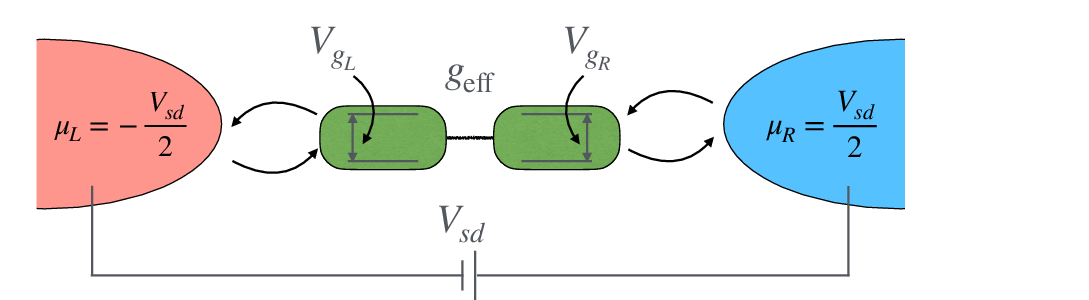
Figure 1: Schematic of the double quantum dot system coupled to left and right reservoirs, defining the topology relevant to transport dynamics, occupation, and transitions.
Coulomb blockade is optionally imposed via B5, restricting B6. Dynamics of the model are well-approximated by a classical master equation under high temperature and strong coupling conditions, relevant for contemporary solid-state implementations.
Excursion Framework and Counting Observables
The core innovation is the decomposition of continuous stochastic trajectories into excursions: segmented sub-trajectories beginning with B7 and terminating at B8. Here, B9 (empty state), and A→B⋯B→A0. Each excursion is characterized by: (i) a duration A→B⋯B→A1, (ii) a set of transitions A→B⋯B→A2, and (iii) corresponding counts A→B⋯B→A3.
Counting observables are linear functionals:
A→B⋯B→A4
allowing construction of charge currents, entropy production, or dynamical activity through the choice of weights A→B⋯B→A5. Notably, for thermodynamic observables, these weights are antisymmetric, ensuring proper current-like properties.
The cycle time is then A→B⋯B→A6, where A→B⋯B→A7 is the residence time in A→B⋯B→A8, and both are statistically independent (renewal process). The framework permits computation of all joint and marginal distributions of observables and times using a tilted generator formalism.
Sample trajectories and the partitioning into excursions are exemplified in Figure 2, which also depicts energy levels, transition rates, and region assignments.
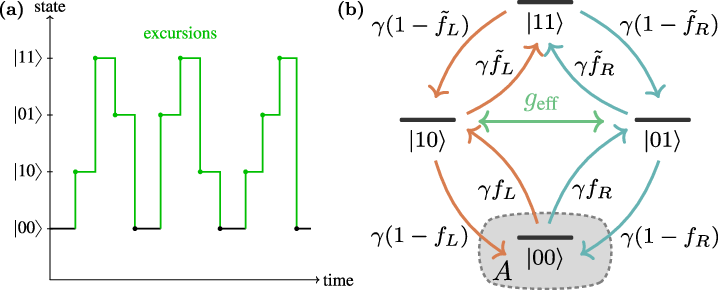
Figure 2: (a) Sample stochastic trajectory and its decomposition into excursions (green segments); (b) Detailed transition rates under the double quantum dot energy scheme with region A→B⋯B→A9 shaded.
Statistical Structure of Excursions
The authors provide a quantitative analysis of mean and variance for excursion durations, residence times, and cycle times as functions of gate voltage μL0. As μL1 is tuned, the dominant timescale alternates between prolonged residence and excursion times, governed by Fermi function dependencies in injection and extraction rates.
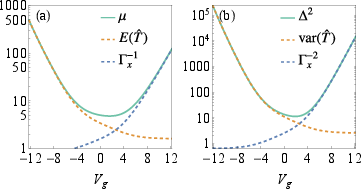
Figure 3: (a) Average cycle, excursion, and residence times; (b) Variance of these times, all plotted logarithmically as a function of gate voltage. Parameters highlight distinct dynamical regimes.
This temporal asymmetry has direct implications on observables: negative μL2 results in extended excursions (slow returns to μL3), whereas positive μL4 supports prolonged occupancy in μL5 (system remains idle).
Transport, Dynamical Activity, and Entropy Production
Charge Current
The right-dot charge current is specified by μL6, focusing on particle transfer events from right reservoir to right dot. A 2D sweep yields current and noise maps consistent with Coulomb diamond characteristics; high current and noise co-locate with strong bias and low μL7. In blockade, only three excursion outcomes for current exist (success, fail, disaster), facilitating explicit outcome probability calculations.
Dynamical Activity
Dynamical activity is characterized as the average number of transitions per unit time (or per excursion). Its spatial map diverges from current: the central diamond (low transport) exhibits maximum activity, a result of rapid intra-dot tunneling dominating the dynamics.
Entropy Production
Entropy production is built from pathwise log-ratios of forward and backward transition rates. As expected, entropy production mirrors net particle current and vanishes where detailed balance prevails (central region with strong coherent dot-dot tunneling but balanced injections). Quantitative proportionality between transport and entropy production is proven for all thermodynamic observables under this model.
Noise Decomposition and Outcome Distributions
A key result is the exact decomposition of current noise μL8 into three terms:
μL9
where each term captures distinct fluctuation sources: internal excursion statistics, temporal fluctuations, and cross-correlations. Numerical analysis (via the Fano factor) shows profound parameter sensitivity and distinct behavior with/without Coulomb blockade.
For the blockade scenario, analytical formulas are given for the probability of a successful, failed, or disastrous transport per excursion. The analysis illuminates that regions maximizing net transport do not always correspond to deterministic behavior—high current can coexist with significant disaster/fail probabilities, illustrating nontrivial trade-offs.
State Observables and Correlations
Populations of each state are mapped throughout parameter space. Regions with extended residence or excursion times concentrate system occupation in μR0 or μR1, respectively. In the central diamond, the occupation is shared symmetrically between singly occupied states; this translates to maximal dynamical activity but vanishing current and entropy production. The mutual information between the two dots is maximal in this regime, quantifying strong correlations induced by repeated coherent hopping.
Thermodynamic Uncertainty Relations (TUR, KUR, CUR)
The framework enables direct examination of central nonequilibrium uncertainty relations:
- TUR: Relates current, noise, and entropy production, providing a lower bound on the relative uncertainty of any thermodynamic current.
- KUR: Binds current fluctuations to total dynamical activity.
- CUR: Provides an improvement upon the KUR, bounding uncertainty by an "excess" time observable.
These relations are mapped as functions of control parameters (μR2, μR3), revealing that the limiting bound for current fluctuations shifts between entropy production, activity, and excess-time-dominated regimes, depending on whether the system is transport-dominated, idle, or engaged in pure intra-dot transitions.
Future Directions and Implications
The stochastic excursion formalism provides tools beyond traditional full counting statistics for resolving detailed, trajectory-level dynamics as well as the thermodynamic structure of mesoscopic transport. The key insights for DQD systems include:
- Full outcome distribution per excursion (successes/fails/disasters), essential for understanding device reliability and functional trade-offs.
- Decomposition of noise sources, suggesting operational regimes for optimizing precision or balancing dissipation.
- Direct evaluation of model-specific thermodynamic uncertainty relations.
Future directions include extension to larger state-spaces (beyond 2-dot architectures), exploring memory effects and feedback, and quantifying the role of coherence and quantum correlations within the excursion structure. The excursion approach is also poised to refine theoretical bounds on dissipation, precision, and establish new design principles for quantum-dot-based thermodynamic engines and information processors.
Conclusion
The stochastic excursion framework provides a rigorous analytical and numerical structure to unravel the underlying trajectory-level statistics in double quantum dot transport. Its explicit decomposition of observables and noise sources reveals novel operational regimes and trade-offs in mesoscopic physics. The methodology not only refines our understanding of transport and fluctuations but also serves as a foundation for future studies targeting complex feedback, correlated environments, and the development of more general thermodynamic uncertainty principles in quantum and classical settings.
Reference
Stochastic trajectories and excursions in a double quantum dot system (2605.20166)