- The paper introduces a novel stochastic framework that separates information entropy from thermodynamic entropy in quantum scattering.
- It employs two-point measurement protocols to extract full-counting statistics for entropy production and current fluctuations, matching established Landauer-Büttiker results.
- The framework paves the way for practical applications in non-equilibrium quantum devices and sets the stage for exploring thermodynamic uncertainty in coherent systems.
Stochastic Entropy Production in Quantum Scattering Theory
Introduction and Motivation
The quantification of entropy production in quantum transport remains a pivotal problem at the intersection of quantum thermodynamics and condensed matter physics. In the context of coherent quantum conductors—where electronic transport is governed by strong coupling and quantum coherence—conventional stochastic thermodynamic frameworks, built primarily for weakly coupled systems, become inadequate. Notably, uncertainty relations derived for weak coupling exhibit violations in the presence of quantum coherence, exposing fundamental gaps in the stochastic description of dissipation and irreversibility for strongly coupled quantum systems.
This work ("Stochastic entropy production in scattering theory" (2604.10322)) systematically develops a stochastic framework for entropy production tailored to scattering theory, which underpins the coherent transport regime in quantum electronics. By distinguishing the roles of information and thermodynamic entropy at different stages of quantum transport, and by utilizing two-point measurement protocols, the authors bridge the conceptual gap between quantum stochastic thermodynamics and the operational toolkit of mesoscopic coherent conductors.
The process considered involves several distinct stages that are rigorously delineated. First, a multipartite quantum system—representing the set of leads in a mesoscopic device—is initialized in a separable state, ρin. This state is subjected to a unitary evolution (the scattering event), described by a scattering matrix S, which entangles the subsystems (the leads) but preserves the total von Neumann entropy due to unitarity. Following this, measurements and subsequent equilibration with macroscopic baths (the environmental reservoirs) induce genuine thermodynamic irreversibility and entropy production.
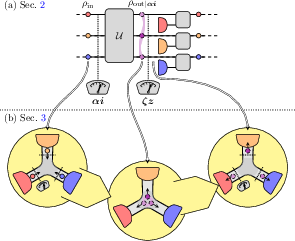
Figure 1: Schematic for the operational steps—measurement of the separable input, unitary scattering, measurement of the output, and thermalization with baths—each demarcating distinct avenues for entropy change.
Crucially, the authors differentiate between two categories of entropy change:
- Information Entropy Change: Quantified as the change in the von Neumann entropy for reduced states of subsystems, this reflects the loss or gain of information accessible through local measurements, arising exclusively from the generation of correlations under the global unitary. This form of entropy, sensitive to measurement protocols, does not strictly correspond to thermodynamic irreversibility.
- Thermodynamic Entropy Production: Associated with the subsequent coupling of subsystems to their macroscopic baths, this entropy is captured via the change in the bath's von Neumann entropy. The thermodynamic entropy change satisfies the second law via relative entropy and becomes especially transparent when baths are described by generic nonthermal occupations, extending the formalism beyond equilibrium scenarios.
Mathematically, the paper details the nontrivial relationship between these two entropy contributions, emphasizing, for example, that in the weak-coupling quasi-static regime, the information entropy change is exactly converted into thermodynamic entropy change in the baths, while strong coupling and nontrivial measurement protocols can engender significant deviations.
Two-Point Measurement Scheme and Stochastic Quantification
Access to stochastic entropy production, including higher moments and fluctuation statistics, is enabled by implementing a two-point measurement (TPM) scheme. This protocol involves local projective measurements before and after the unitary scattering, mapping the change in observables—such as particle number or energy—in each scattering event to a stochastic trajectory.
The TPM framework provides:
- Event-resolved stochastic entropy production for both local (single-lead) and global (multi-lead) settings.
- Direct access to fluctuations and full-counting statistics of physically meaningful currents (e.g., charge, energy, entropy).
- A clear operational distinction between entropy changes due to information loss (non-recoverable via local measurement) and entropy delivered to the baths (thermodynamically dissipated).
The expectation value and cumulants of stochastic entropy production extracted using the TPM are shown to match known results for charge and energy currents (via the Landauer-Büttiker formalism) while addition-ally enabling rigorous derivation of entropy current fluctuations—a result previously lacking a systematic foundation.
Application to Scattering Theory: Marginal States and Current Statistics
The formalism is concretely instantiated for multipartite systems corresponding to the leads of a coherent conductor. Via the explicit decomposition of input/output states using scattering matrix elements, the authors compute marginal reduced states and their entropies both pre- and post-scattering, elucidating the nonlinear dependence of information entropy change on transmission probabilities (contrasting the linearity of thermodynamic entropy).
The framework is extended to extract the full probability distributions of transferred quantities, leading to compact expressions for average currents and zero-frequency noise:
- Current Statistics: The approach recovers the Landauer-Büttiker expressions for time-averaged particle and energy currents, confirming the operational equivalence of the stochastic approach with established scattering theories.
- Noise and Fluctuations: Using the TPM statistics, the zero-frequency current noise expressions—including for entropy currents—are rigorously derived, closing the gap between intuitive but previously ad hoc fluctuation estimates and formal quantum stochastic thermodynamics.
A powerful aspect is the accommodation of nonthermal baths, allowing treatments of non-equilibrium resources and quantum refrigerators subject to nontrivial input fluctuation structures.
Implications and Outlook
This paper provides a systematic and extensible toolkit for addressing questions of irreversibility, dissipation, and stochastic thermodynamics in the regime of strong quantum coherence and open-system dynamics. Notably, the derivation of entropy current fluctuations stands out as a result with immediate implications for the analysis of quantum transport entropy flows and non-equilibrium fluctuation theorems.
Practical and theoretical implications include:
- Non-equilibrium Device Engineering: Formalism is readily applicable to design and analysis of quantum heat engines, thermoelectric devices, and quantum refrigerators operating with nonthermal reservoirs or subject to strong driving.
- Generalization Potential: While demonstrated for non-interacting scattering processes, the framework could be extended to incorporate interacting systems, feedback protocols, and measurement engines, accommodating richer non-equilibrium and feedback scenarios.
- Uncertainty Relations: The operational foundation for entropy fluctuations enables investigation of thermodynamic uncertainty relations and their limitations in coherent quantum regimes, a subject of considerable interest for fundamental quantum thermodynamics.
Conclusion
By marrying the repeated interaction framework and two-point measurement protocols with quantum scattering theory, this paper establishes a robust stochastic description of entropy production and fluctuations in coherent quantum transport. The explicit distinction between informational and thermodynamic contributions, together with rigorous derivation of current and noise statistics for entropy and other observables, positions this framework as a vital reference point for future explorations in quantum stochastic thermodynamics of open, coherent, and possibly interacting quantum systems.