Concurrent enforcement of polyconvexity and true-stress-true-strain monotonicity in incompressible isotropic hyperelasticity: application to neural network constitutive models
Published 19 May 2026 in math-ph and cond-mat.mtrl-sci | (2605.20031v1)
Abstract: The design of physics-augmented neural networks (PANNs) for the purposes of constitutive modeling has received considerable attention as of late for a variety of material behaviors. Here, we revisit the classical framework of isotropic incompressible hyperelasticity in light of recent advances in the study of constitutive inequalities. We show that polyconvexity implies true-stress-true-strain monotonicity for a large class of incompressible strain-energy functions. The resulting elastic law obeys the physically reasonable Legendre-Hadamard (or ellipticity) condition as well as the notion of increasing stress with increasing strain. These results then inform the architecture of four distinct PANNs which are subsequently calibrated to three different sets of experimental data each. We show that different PANN parametrizations - satisfying the same constitutive constraints a priori - have varying approximation power for the description of material behavior. Moreover, even when distinct parametrizations perform comparatively well within the calibration regime, they show pronounced differences in extrapolation. This observation motivates a critical discussion about the predictive power of PANNs which also has implications for the modeling of more complex material behavior by virtue of neural networks.
The paper shows that enforcing polyconvexity in incompressible hyperelasticity automatically ensures true-stress-true-strain monotonicity for many energy formulations.
It develops physics-augmented neural network (PANN) architectures that integrate classical invariants and principal stretches, highlighting differences in interpolation and extrapolation performance.
The study underscores that while constraint enforcement guarantees stability, additional criteria like stress curvature control may be necessary for robust and predictive material modeling.
Concurrent Enforcement of Polyconvexity and True-Stress-True-Strain Monotonicity in Incompressible Isotropic Hyperelasticity
Overview and Motivation
The paper "Concurrent enforcement of polyconvexity and true-stress-true-strain monotonicity in incompressible isotropic hyperelasticity: application to neural network constitutive models" (2605.20031) addresses foundational and practical challenges in constitutive modeling for incompressible isotropic hyperelastic materials. Specifically, it explores the interplay and concurrent imposition of polyconvexity and true-stress-true-strain monotonicity (TSTS-M) as constitutive constraints, providing rigorous analysis on their implications for material stability, model selection, and neural architecture design. The work is motivated by the limitations of conventional hyperelastic models, the rising adoption of physics-augmented neural networks (PANNs), and the need for predictive, physically consistent data-driven material laws.
Constitutive Constraints in Hyperelasticity
The study systematically revisits classical and modern constitutive constraints underpinning finite-strain elasticity, emphasizing those most relevant for incompressible rubbers and soft materials. Among several possibilities, key focus is placed on:
Polyconvexity: Introduced by Ball, polyconvexity is a sufficient and practical condition ensuring existence theorems in nonlinear elasticity and guaranteeing the physically significant Legendre-Hadamard ellipticity (stability to infinitesimal disturbances). In the incompressible setting, polyconvexity is imposed via convexity in the deformation gradient and its cofactor, with strain energy expressed as W(F)=G(F,cofF).
True-Stress-True-Strain Monotonicity (TSTS-M): Encodes the physically reasonable axiom that stresses should increase monotonically with strains, formulated specifically in the logarithmic strain (Hencky strain) and Cauchy stress pair. For isotropic hyperelasticity, it relates to strict monotonicity and convexity of the energy with respect to logV (where V is the left stretch).
Hill’s Inequality: Concerns necessary and sufficient conditions for monotonicity and stability in the rate response, expressible as strict convexity in principal logarithmic strains under incompressibility.
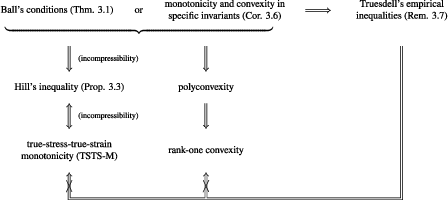
The relationships and implications between these constraints are clarified in a schematic overview.
Figure 1: Overview of various constitutive constraints and their relations in isotropic incompressible hyperelasticity.
Analytical Results: Polyconvexity Implies TSTS-M in Incompressible Case
The paper delivers a rigorous analysis establishing that, for a large class of isotropic incompressible hyperelastic materials, polyconvexity (satisfying Ball's sufficient conditions) automatically enforces TSTS-M. This advances earlier knowledge, which recognized that in compressible settings, polyconvexity and TSTS-M are largely independent and sometimes mutually exclusive. The authors generalize the proof of Ball's theorem via the theory of majorization, showing that monotonic convex parametrizations in principal stretches (and their reciprocals) assure both polyconvexity and TSTS-M. This is extended to various invariant-based and principal stretch-based energy formulations.
Parametric consequences include:
The Ogden, Mooney-Rivlin, and neo-Hookean energies are encompassed in this framework and inherit both constraints.
Novel corollaries for neural network constitutive models: parametrizations in terms of principal invariants or Schatten norms can inherit polyconvexity and TSTS-M via appropriate convex monotonic neural architectures.
The analysis also raises an open question: While polyconvexity strictly implies TSTS-M for broad classes, there exist rare pathological polyconvex energies (e.g., using signed singular values) not covered by Ball’s conditions where TSTS-M is not automatic.
PANN Architecture and Constitutive Model Design
Leveraging the analytical results, the authors construct four distinct PANNs—each satisfying polyconvexity and (where possible) TSTS-M by design:
PANN--I: Neural network energy parametrized by classical invariants of the right Cauchy-Green tensor.
PANN--λ: Direct parametrization in principal stretches, incorporating explicit permutation invariance for polyconvexity.
PANN--ν: Uses signed singular values with full permutation and sign symmetry; generalizes the notion of isotropic polyconvexity but does not always guarantee TSTS-M.
Input-convex and convex-monotonic neural network architectures (ICNNs and CMNNs) ensure the energy is convex and monotonic with respect to their arguments, and thus satisfy the required constraints by construction.
Calibration to Experimental Data: Interpolation and Extrapolation Performance
The PANNs are calibrated against three experimental datasets (vulcanized rubber, EPDM, and DLP polymer) using standard protocols (Adam optimizer, mean-squared error on Piola stress in standard deformation modes). The assessment considers both interpolation accuracy and extrapolation behavior:
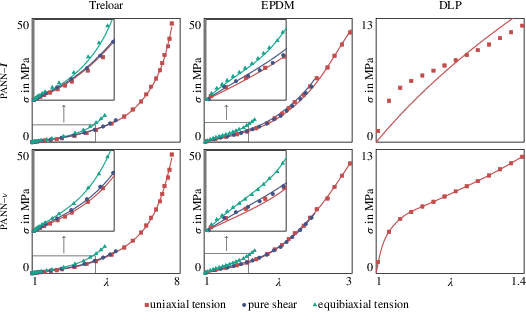
Interpolation: Within the calibration regime, most PANNs yield similar highly accurate fits for standard materials (Figure 2). Differences are more pronounced in complex, less conventional materials, with the signed singular-value-based architecture occasionally demonstrating superior flexibility.
Figure 2: Interpolation capabilities of the PANN--I and PANN--ν models for multiple deformation modes and materials.
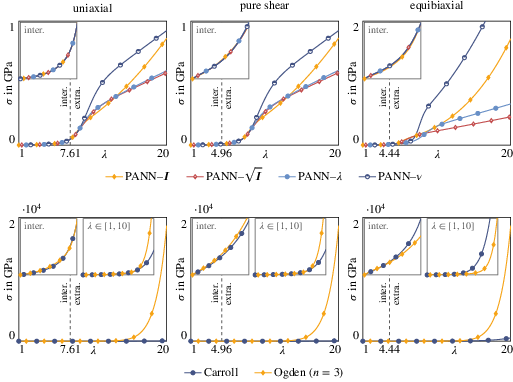
Extrapolation: Out-of-calibration behavior diverges significantly. While all architectures retain monotonically increasing Cauchy stress (by construction), their quantitative extrapolation diverges, and qualitative response (e.g., stress curvature at large stretches) differs, sometimes conflicting with physical expectations of idealized elasticity.
Figure 3: Extrapolation for different constitutive models calibrated to Treloar's data, illuminating divergence in predictions outside the data regime.
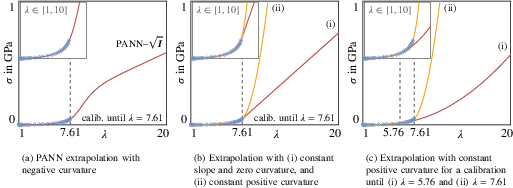
Stress Curvature: Notably, beyond the calibrated strain range, PANNs may predict Cauchy stress responses with negative curvature—contradicting physical intuition for most rubbers, which stiffen with increasing stretch. The authors propose that additional constraints (e.g., enforcing positive stress curvature) might be necessary for robust ideal-material modeling.
Figure 4: Cauchy stress predictions from PANNs, showing monotonicity but negative curvature at large stretches, suggesting inadequacy of monotonicity alone for ideal elasticity.
Implications, Limitations, and Open Questions
The findings have several substantial theoretical and practical ramifications:
Model Selection: Even within the set of PANNs obeying the same rigorous constraints, architectural choices (parametrization of the energy, neural structure) substantially impact both interpolation flexibility and extrapolation prediction. There is no unambiguous best choice for extrapolation, highlighting a limitation of pure phenomenological data-driven approaches.
Constraint Sufficiency: The combination of polyconvexity and TSTS-M, while ensuring stability and monotonicity, does not guarantee physically realistic extrapolation. In particular, the lack of control over stress curvature at large strains may render model predictions nonphysical in the regime where experimental data are unavailable.
Data-Driven Modeling: The "inductive bias" introduced by PANN architecture is critical. While neural architectures offer improved expressivity over fixed-form energies, regularization by physics-motivated constraints is not in itself predictive for all relevant mechanical behaviors, especially for strong extrapolation tasks.
Future Work: The authors suggest three main directions:
Developing or enforcing additional constraints (e.g., on Cauchy stress curvature) for more robust idealized elasticity modeling.
Investigating the Bayesian calibration and uncertainty quantification in PANN constitutive models ([Wollner et al., 2026], [Linka et al., 2025]).
Extending analysis beyond incompressible isotropic elasticity to more complex settings (anisotropy, compressibility, inelasticity).
Conclusion
This work provides a comprehensive analytical and computational framework for concurrently enforcing polyconvexity and true-stress-true-strain monotonicity in incompressible isotropic hyperelastic constitutive modeling, specifically for implementation via physics-augmented neural networks. The main analytical contribution is the demonstration that, under sufficient conditions, polyconvexity guarantees TSTS-M for a large class of parametrizations, with significant implications for both theoretical stability and neural architecture design. Through systematic calibration to experimental data, the authors reveal pronounced interpolation-extrapolation discrepancies across PANN architectures, even under identical constraints, and highlight a need for additional physical criteria—specifically, constraints on stress curvature—to achieve extrapolative robustness in "ideal elasticity" modeling. These insights bear direct relevance for ongoing development of predictive, data-driven constitutive models for soft solids and open new directions for research on both neural architectures and the physics of material modeling.
“Emergent Mind helps me see which AI papers have caught fire online.”
Philip
Creator, AI Explained on YouTube
Sign up for free to explore the frontiers of research
Discover trending papers, chat with arXiv, and track the latest research shaping the future of science and technology.Discover trending papers, chat with arXiv, and more.