- The paper presents a calibrated diagnostic protocol using memory order parameters and TVD to differentiate between genuine thermal relaxation and non-thermal trapping in quantum annealers.
- Experimental results on D-Wave QPUs demonstrate rapid subsystem relaxation with increased environmental coupling and size, setting a benchmark for annealer-based sampling.
- The study reveals the limitations of classical local-update dynamics and offers actionable standards for reverse annealing applications in quantum machine learning and simulation.
Subsystem Relaxation and Calibrated Sampling Diagnostics for Quantum Annealers
Introduction
This paper investigates the relaxation behavior of subsystems within programmable quantum annealers and introduces a protocol for validating the sampling distribution produced under reverse annealing. The study leverages subsystem–environment partitioning on D-Wave Zephyr (Advantage2) and Pegasus (Advantage system6.4) QPUs, systematically varying environment size, coupling strength, disorder, preparation, and geometry. By focusing on the subsystem's independence from initial conditions, and contrasting its readout distribution with a calibrated conditional-Boltzmann reference, the work delineates conditions under which annealer outputs are genuinely representative of thermal equilibrium and exposes critical failure modes where relaxation is misidentified.
Reverse annealing protocols are widely applied in quantum ML, hybrid optimization, and Boltzmann machine training pipelines, yet ambiguity persists regarding when initial-state memory is truly erased and what distribution is actually being sampled (2605.19381). By experimental control over subsystem–environment parameters, a quantitative framework is provided for diagnosing subsystem relaxation, memory erasure, and non-thermal trapping phenomena.
Reverse Anneal Protocol and Subsystem–Environment Partition
The experimental architecture initializes a connected subsystem (∣S∣=6) and an environment (∣E∣ up to 50), partitioned on the QPU topology and linked via programmable boundary couplers with strength λ. Reverse annealing begins with a classical configuration (s=1), ramps to a pause point sp where quantum fluctuations are introduced, holds for time tp, and resumes classical evolution for readout.
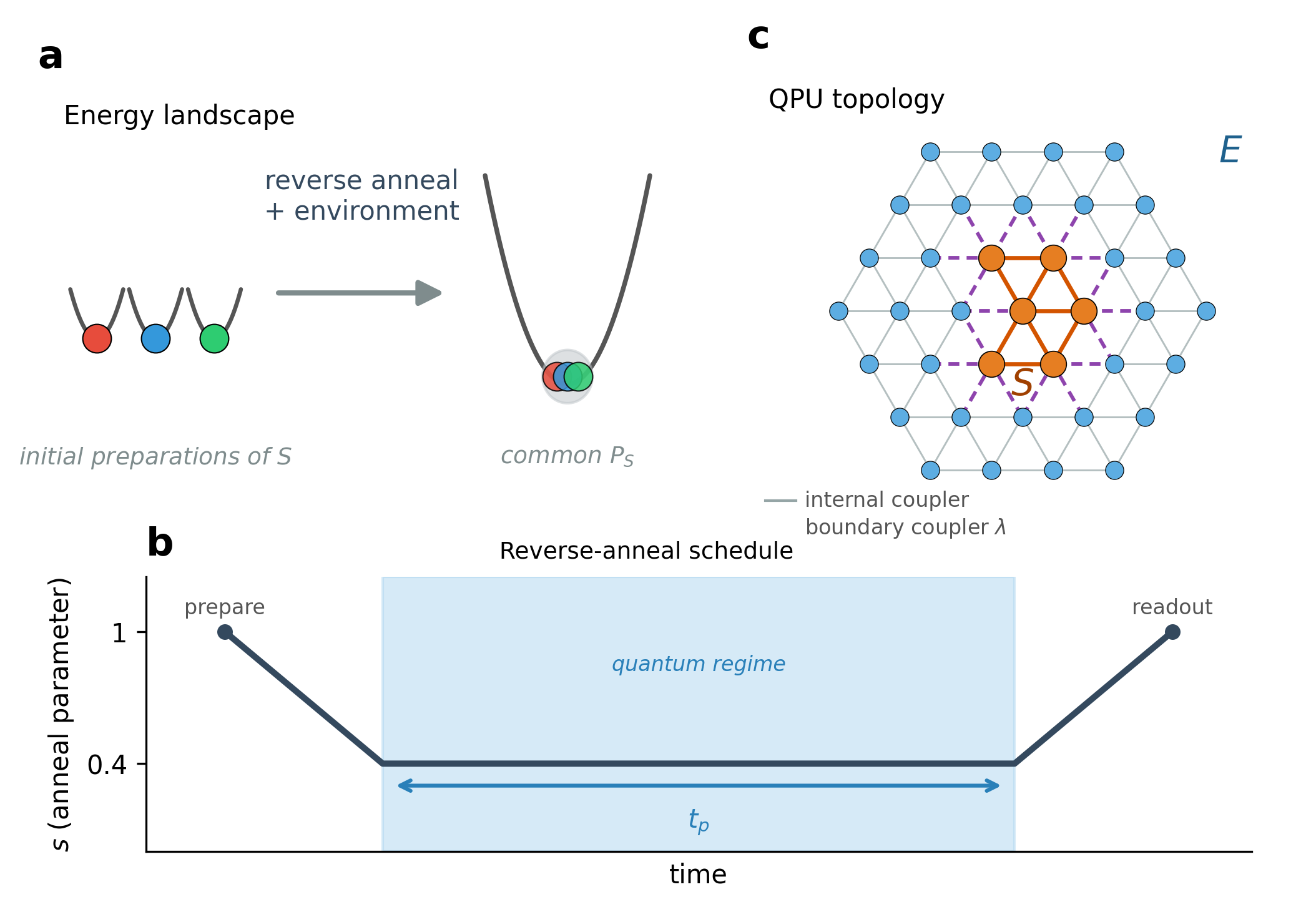
Figure 1: Reverse-anneal schedule and subsystem–environment partition showing classical initialization, quantum pause, and environment coupling architecture.
The memory order parameter M, defined as the maximum TVD between subsystem marginals from different initial preparations, is employed to determine initial-state independence. Complete relaxation is signaled by M→0, while full memory retention yields M=1.
Subsystem Relaxation with Tunable Environment
Increasing environment size and coupling strength induces subsystem relaxation on both QPU generations. For Advantage2, M decreases sharply from 1.0 at ∣E∣0 to ∣E∣10.005 at ∣E∣2 and less than 0.005 for ∣E∣3. The crossover in ∣E∣4 is monotonic with ∣E∣5: from 0.94 at ∣E∣6 to ∣E∣7 for ∣E∣8.
Pause-depth sweeps further show that the threshold coupling ∣E∣9 shifts with λ0, consistent with the decreasing transverse field being critical for relaxation dynamics. Cross-platform energy scales yield λ1 (Advantage2) and 4.3 (System6.4), indicating that platform-dependent open-system dynamics are necessary to resolve deviations from a universal master curve for memory erasure.
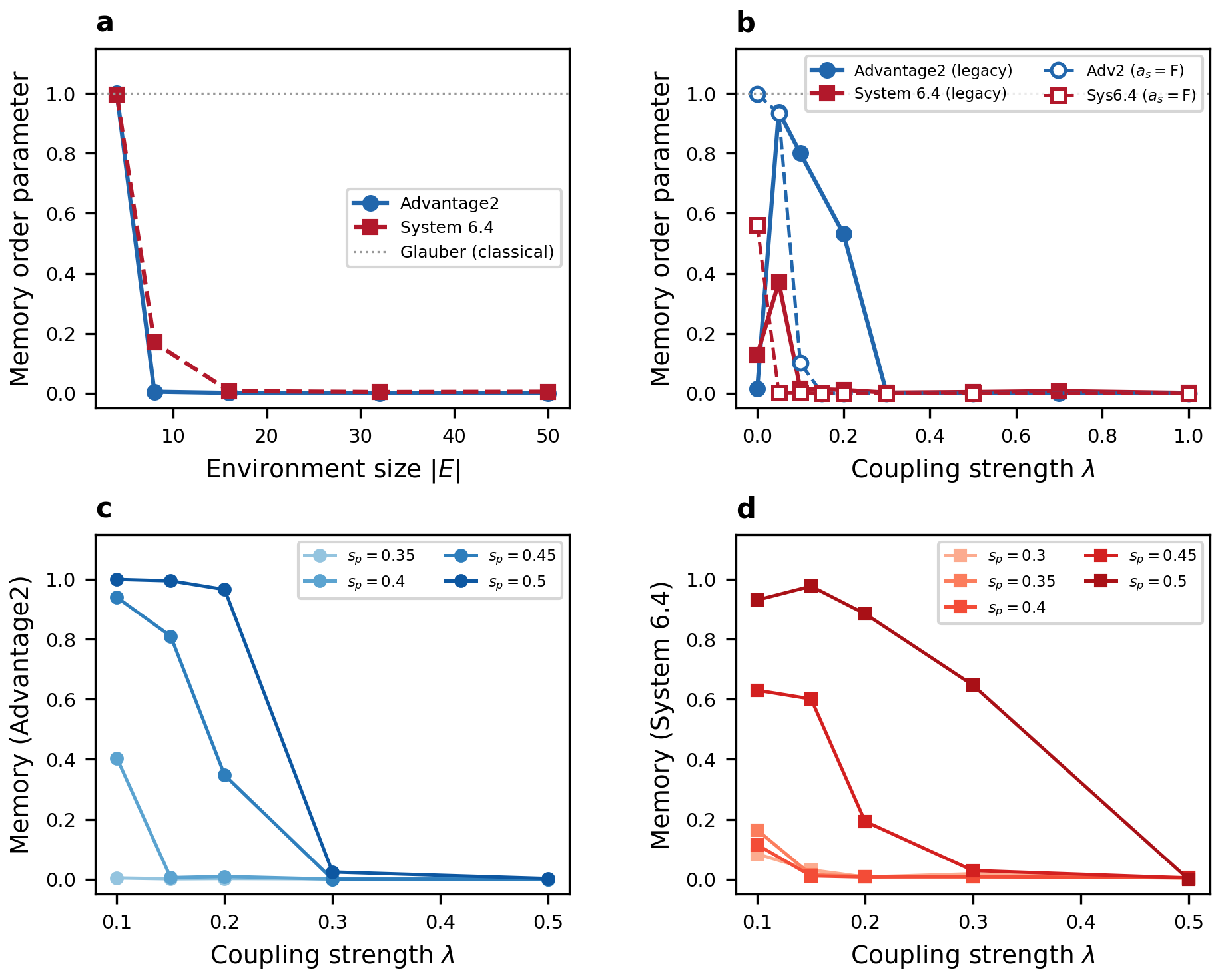
Figure 2: Subsystem memory order parameter as a function of environment size and coupling, illustrating relaxation crossover and platform dependencies.
Disorder Arrests Relaxation
Quenched disorder (random longitudinal fields) competes with environmental relaxation. For λ2, λ3 is near zero, but rises sharply to 0.74 (λ4) on Advantage2 and 0.50 (λ5) on System6.4, in line with reduced λ6 thresholds. A λ7 crossover diagram exposes an empirical threshold for memory retention; denser native Zephyr subgraphs relax across a broader range of λ8 due to higher boundary connectivity.
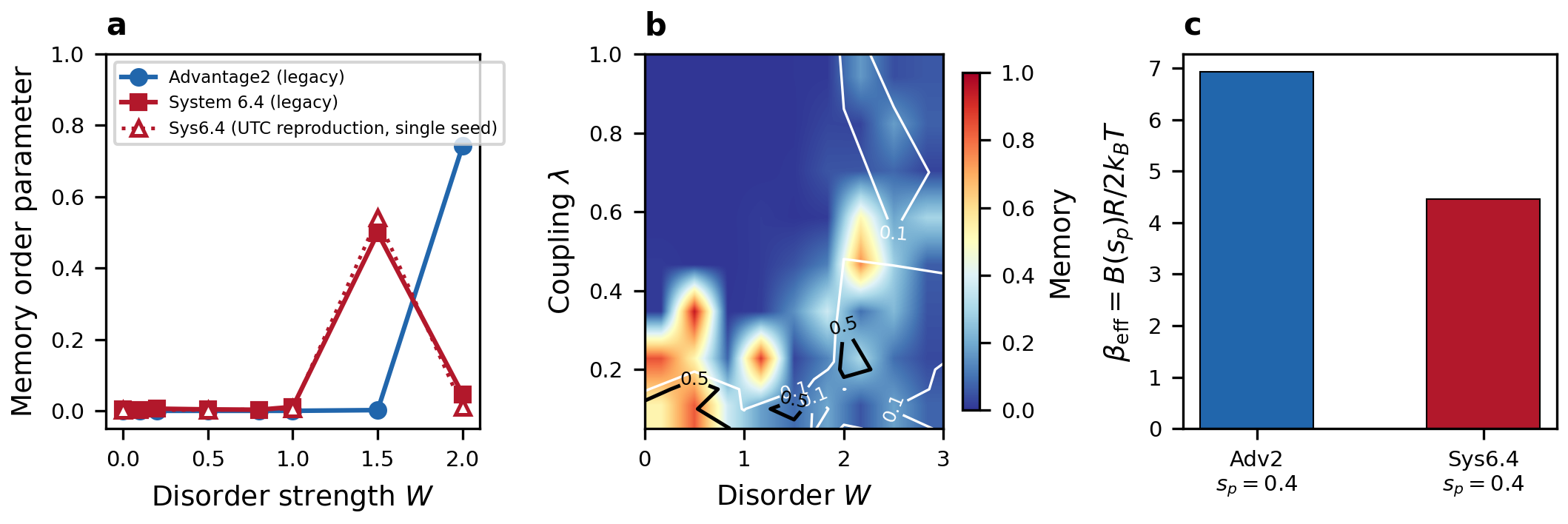
Figure 3: Disorder-induced arrest of subsystem relaxation with increasing λ9, including crossover in s=10 space and effective energy scale calibration.
Calibrated Conditional-Boltzmann Diagnostic
An independently calibrated effective inverse temperature (s=11) is determined via single-qubit probes subjected to reverse annealing. Measured subsystem marginals (s=12) are contrasted with a classical conditional Gibbs reference calculated at s=13, with TVD (s=14) acting as a discrepancy detector.
For relaxed ferromagnetic conditions, s=15 is s=16, far below sampling errors, and independent of s=17—indicating a consistency check rather than true thermometry. However, sizable s=18 flags relaxed-but-non-thermal wrong-basin trapping, which memory erasure alone would miss. Out of 494 total Advantage2 conditions, 113 are relaxed (memory criterion s=19); only three exhibit non-Boltzmann trapping (sp0), while memory-retaining conditions exhibit median sp1.
Quantum reduced Gibbs diagnostics reiterate that unconditional marginals average over both symmetry sectors, yielding poor agreement, whereas the classical conditional reference remains tight.
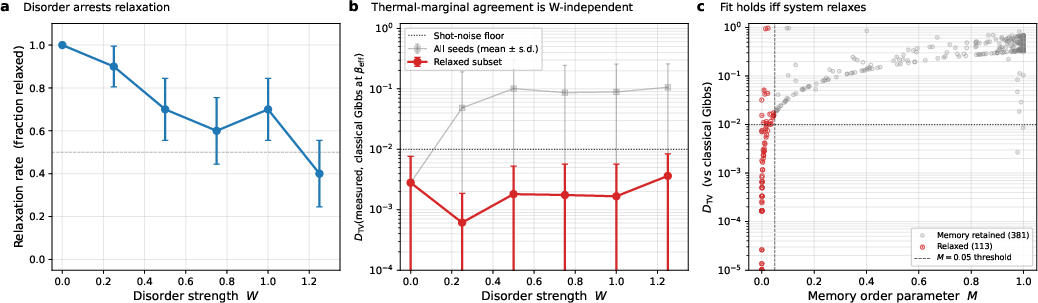
Figure 4: Fraction of relaxed disorder realizations and TVD to calibrated conditional Gibbs reference, discriminating relaxed, trapped, and memory-retaining regimes.
Classical and Small-System Controls
Device-temperature single-spin-flip Glauber and O(3) SVMC show no relaxation (sp2) across all parameter ranges, emphasizing the inadequacy of classical local-update dynamics in replicating observed QPU relaxation. ED of closed quantum Hamiltonians and Lindblad master equations corroborate QPU trends regarding subsystem relaxation, with pause-depth (sp3) dependence highlighting the role of transverse field and open-system effects.
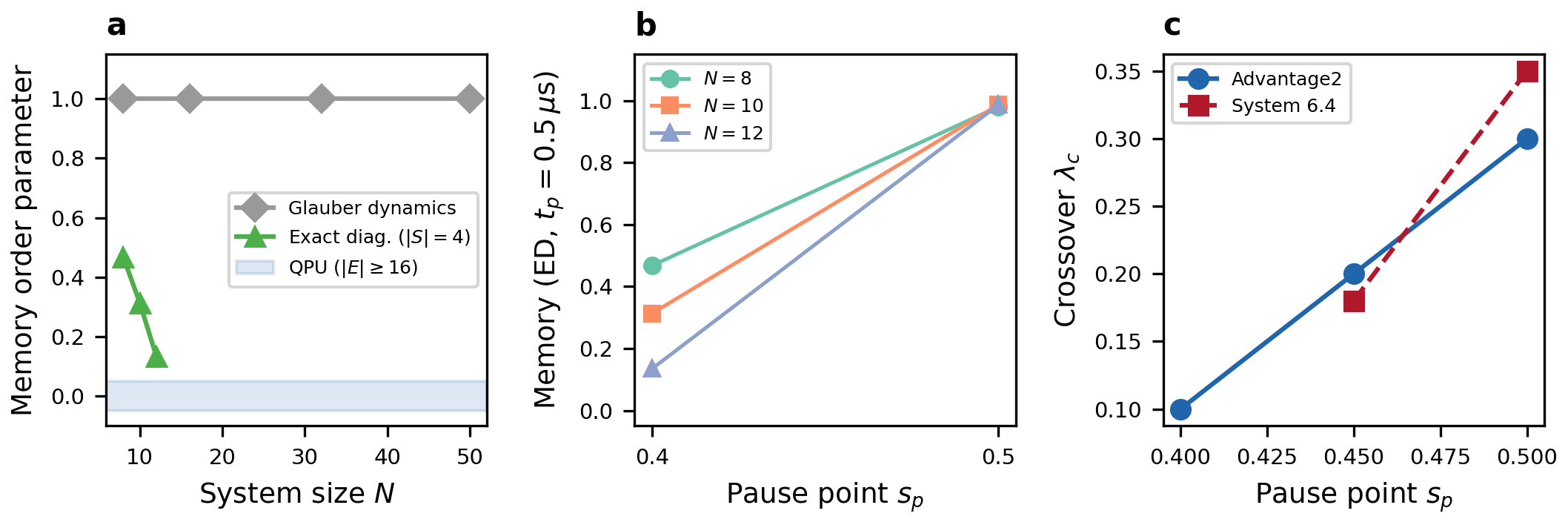
Figure 5: Comparison of classical and small-system quantum baselines against QPU relaxation, demonstrating strong separation in memory erasure response.
Barrier Crossing Under Mixed Frustration
Instances with mixed frustration (sp4 for sp5, ferromagnetic sp6) expose a critical benchmarking failure: Advantage2 QPU relaxes 70% of cases at device sp7, but local Glauber relaxes only 10% and requires sp8 for parity—a sevenfold misprediction. Parallel tempering (non-local updater) aligns with QPU rates at device temperature, confirming that relaxation gap originates from update locality, not quantum dynamics. Exact enumeration reveals sp9 local minima (mean gap tp0, tp1), suppressing activation for single-spin flips at device temperature.
Fully frustrated environments (tp2) yield zero relaxed instances, underscoring environmental preparation as essential for subsystem relaxation.
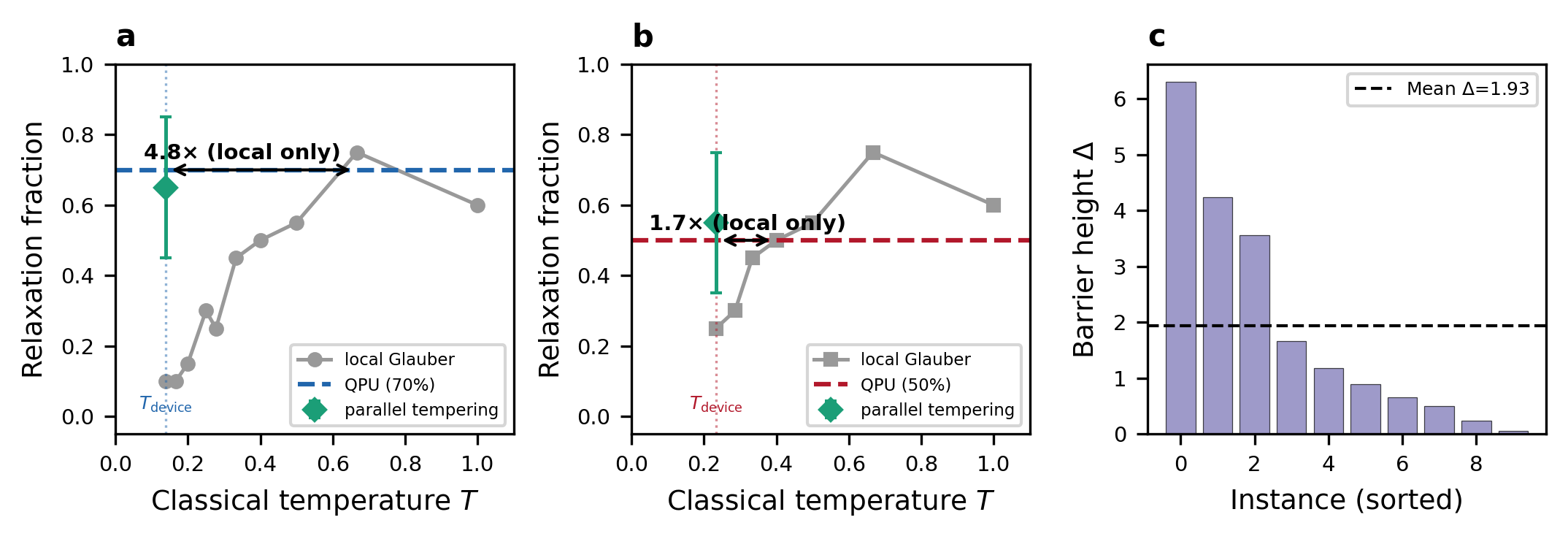
Figure 6: Local-update failure and non-local sampling recovery under mixed frustration, detailing temperature gap, relaxation rates, and energy landscape statistics.
Discussion and Implications
The protocol combines memory erasure (tp3) with calibrated conditional-Boltzmann TVD (tp4) to unambiguously classify subsystem relaxation, non-thermal trapping, and memory retention. Annealer-based samplers must report both observables, embedding, calibration, and anneal parameters for reliable benchmarking. Ordered, low-energy environments are effective baths, while random or fully frustrated environments prevent relaxation.
Practically, users employing reverse-anneal as equivalent to local thermal dynamics risk severe mispredictions, notably in the presence of frustration. The result provides a transferred benchmarking standard for annealer-as-sampler workflows, without implying isolated-system thermalization or quantum computational advantage.
Theoretically, this protocol establishes quantum annealers as testbeds for open-system relaxation dynamics—scaling beyond exact diagonalization and complementing cold-atom or trapped-ion experiments. Future experiments with controlled environment microstates, larger frustrated systems, and QPU noise calibration will refine the subsystem-bath paradigm and enhance dynamical calibration tools.
Conclusion
This study formulates a subsystem-level validation protocol for programmable quantum annealers, combining memory order parameters with calibrated reference diagnostics to accurately classify relaxation, memory retention, and non-thermal trapping. Strong numerical evidence establishes environmental coupling and preparation as governing relaxation thresholds, demonstrates local-update inadequacy in capturing QPU dynamics, and provides actionable benchmarking tools for quantum annealer-based sampling workflows. The results have direct implications for quantum ML, Boltzmann machine training, and open-system quantum simulation, presenting a foundation for rigorous and transferable diagnostic standards in future annealing technologies.