- The paper introduces a triangulation-agnostic generative pipeline that leverages Matérn noise for mesh signal generation, ensuring noise invariance across different mesh discretizations.
- The methodology employs spectral analysis and efficient sampling via sparse linear systems, yielding robust flow matching across diverse mesh resolutions and topologies.
- Experimental results demonstrate significant improvements in generalizing across human deformations and unseen shapes, while outlining limitations in handling extreme topological noise.
Matérn Noise for Triangulation-Agnostic Flow Matching on Meshes
Generative modeling of triangle meshes remains significantly constrained by the challenge of triangulation dependence. Unlike images or regularly structured data, triangle meshes represent irregular discretizations of 2-manifolds, with variations in mesh resolution, geometry, and topology causing standard generative protocols to fail to generalize across triangulations. This paper introduces a framework addressing this limitation by developing a triangulation-agnostic generative pipeline for mesh signal generation, with key contributions in noise modeling, spectral theoretical analysis, and pipeline design (2605.19305).
The work leverages the flow matching (FM) paradigm, a continuous-time generative framework related to denoising diffusion probabilistic models, adapting it to meshes by solving the critical open question of constructing triangulation-agnostic noise. The primary theoretical contribution is the identification and analysis of Matérn processes—Gaussian random fields whose discretization enables noise statistics invariant to the mesh triangulation.
Triangulation-Agnostic Noise via Matérn Processes
The central insight is that standard noise models, such as iid Gaussian noise applied to mesh vertices, are unsuitable for mesh generative models that must generalize beyond a fixed triangulation. The paper formalizes three criteria for triangulation-agnostic noise distributions via spectral analysis: (i) per-frequency independence, (ii) mesh-invariant frequency statistics, and (iii) bounded high-frequency content. Matérn noise, defined as solutions to a screened Poisson equation with spectral decay controlled by a screening parameter τ, is shown to uniquely possess these properties.
Sampling Matérn noise is efficient: a sparse linear system involving the mesh Laplacian and mass matrix is solved with a Cholesky factorization, yielding noise whose spectrum is invariant under mesh refinement. Notably, normalization of the screening term using the Laplace-Beltrami spectrum's Frobenius norm is employed to achieve scale and shape invariance.
Flow Matching Pipeline on Meshes
The generative pipeline starts with Matérn noise sampled on the desired mesh, followed by iterative denoising via flow matching. The pipeline uses PoissonNet as the denoiser—a local-global, triangulation-agnostic architecture which predicts flow velocities in the gradient domain. The FM ODE is solved using midpoint integration, producing samples that are distributions of mesh vertex positions or other signals of interest.
Experimental Validation and Analysis
The method is evaluated on generating deformations of 3D human meshes (SMPL model) in different poses, trained on a single mesh triangulation. Figure 1 demonstrates that the trained generator synthesizes a diverse range of human poses on triangulations orders-of-magnitude denser than in training, confirming robust generalization.
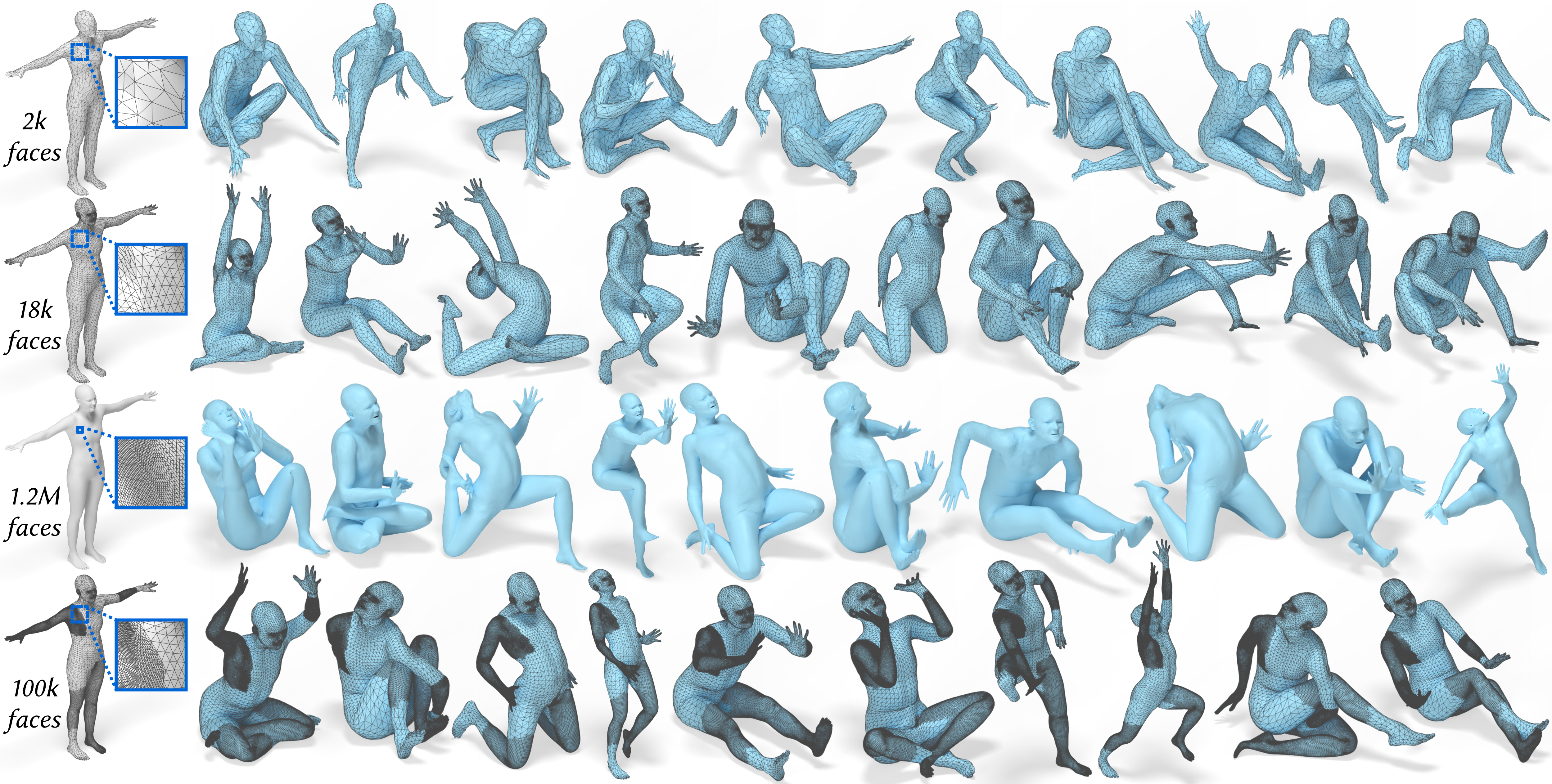
Figure 2: Generated reposings; the model, trained on an 18k-face mesh, produces plausible human poses on arbitrary target meshes.
To rigorously assess generalization, the closest training sample and regressed SMPL parametric mesh are shown for each generated output in Figure 3. It is evident that generated samples fall within the underlying deformation manifold defined by the SMPL prior, not mere interpolations or overfits to the training set.
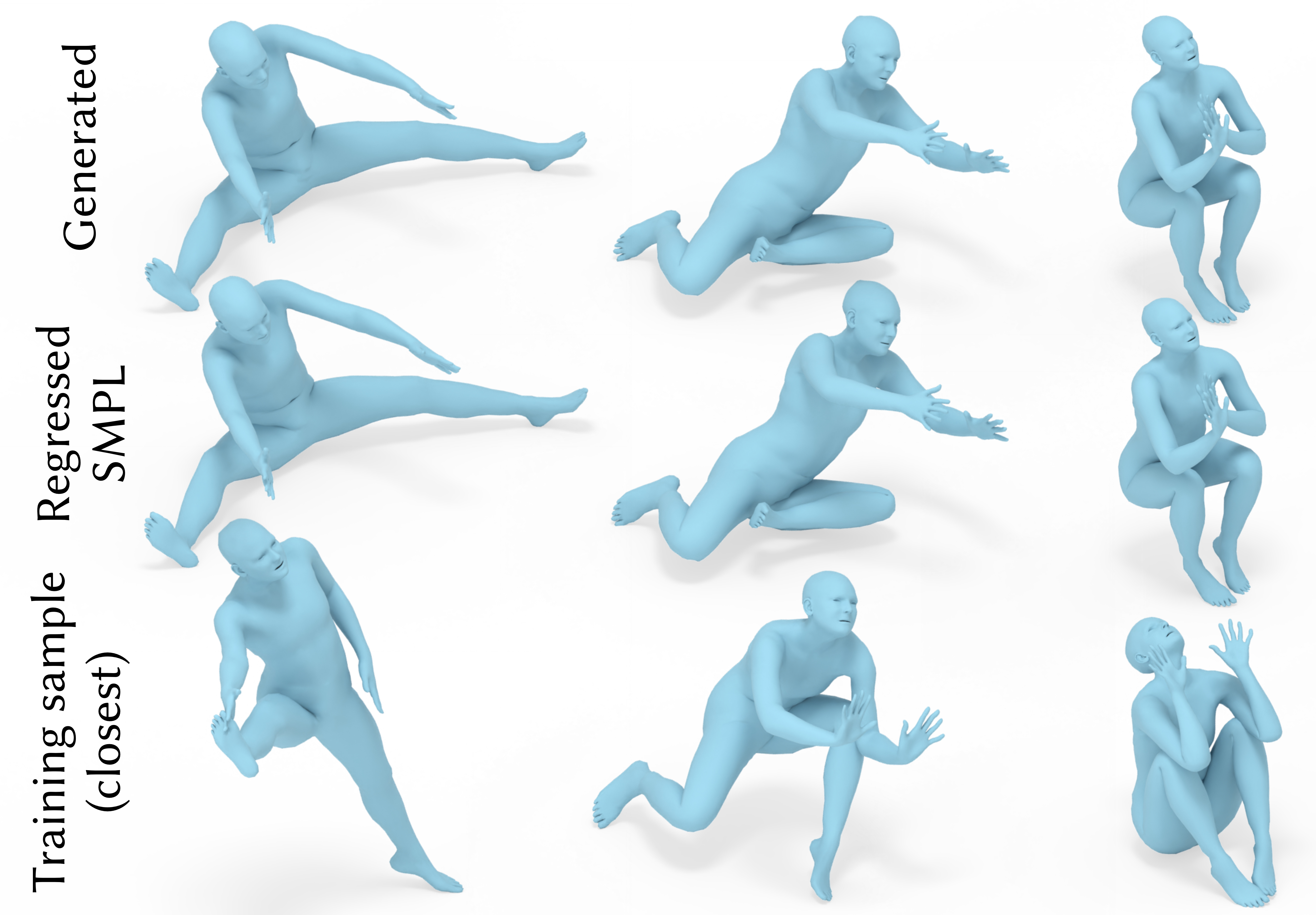
Figure 4: Closest training sample and regressed SMPL meshes, illustrating generalization beyond training data.
Generalization to Unseen Shapes
The framework is trained to generate deformations corresponding to arbitrary, unseen humanoids given a template mesh. Figure 5 presents results across radically different body shapes, confirming the method’s invariance to the particular triangulation and robustness to moderate inter-shape topology variation.

Figure 6: Generalization to previously unseen humanoid meshes, verifying the invariance and flexibility of the learned generative prior.
The method is tested on elastic simulation datasets, where the training mesh is at low resolution, and at inference, arbitrarily higher-resolution variants are used. Figure 7 and Figure 8 illustrate that the generative pipeline maintains sample quality and diversity across resolutions ranging from the 10k training mesh to 70k+ faces and above, with stable computational cost.
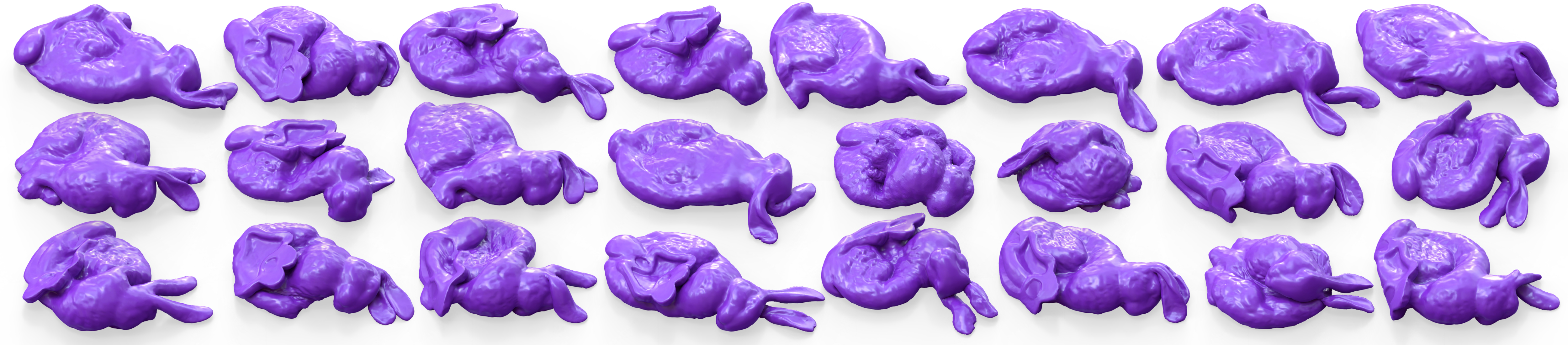
Figure 1: Diverse elastic equilibrium states for a high-res bunny, all produced using a model trained on 9k faces only.
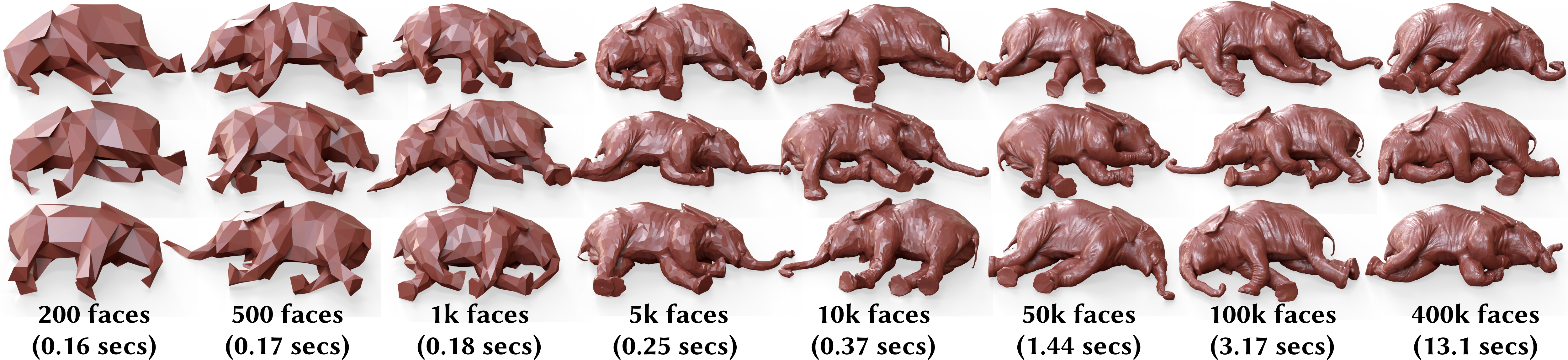
Figure 9: Comparable elastic equilibrium results across mesh resolutions, demonstrating efficiency and scalability.
Thin-featured and complex topologies are also supported (Figure 10), and the generated samples match the distribution of ground-truth physical equilibria.
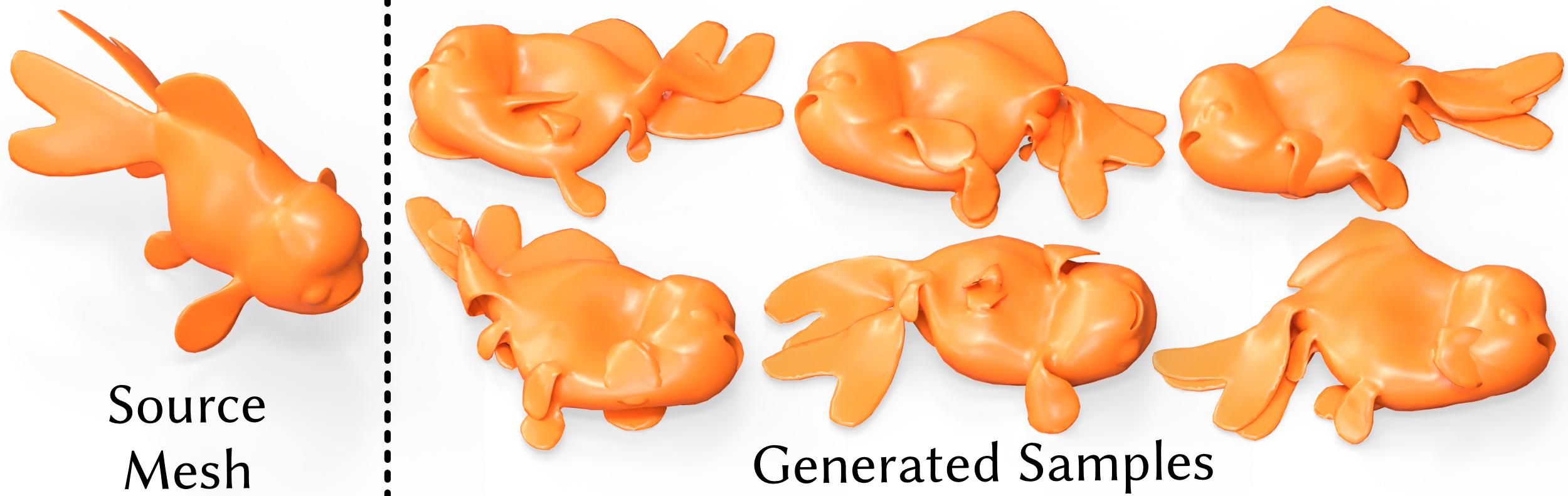
Figure 5: Plausible physical deformations in complex, thin regions such as fins, evidencing the model's mesh-adaptive qualities.
Robustness and Failure Cases
The pipeline exhibits resilience to topological noise and triangulation corruption. Even with partial mesh removals (Figure 11) or severe edge flip-induced poor triangulations (Figure 12), samples remain plausible except for artifacts near new boundary regions or severely degenerate regions.
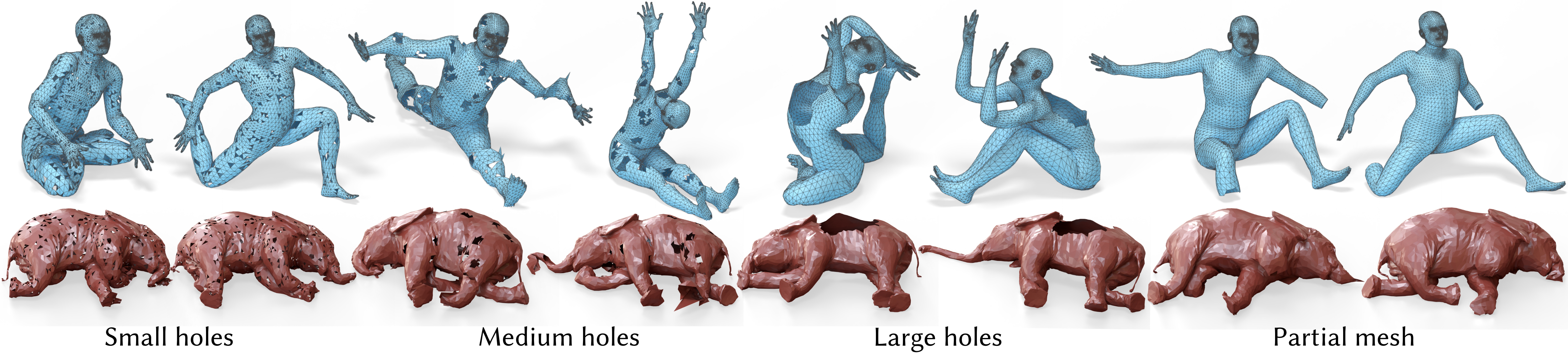
Figure 3: Outputs on topologically corrupted source meshes; valid results are retained except near modified boundaries.
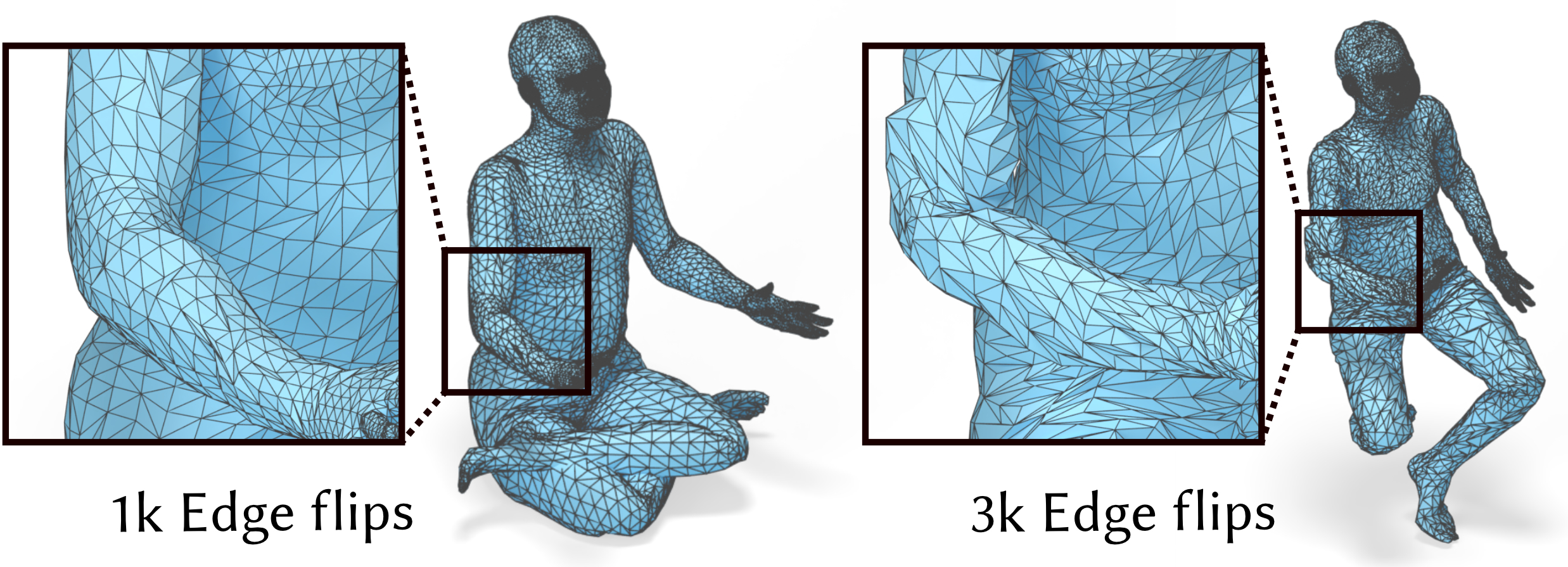
Figure 7: Results with significantly deteriorated triangulation quality, showing robustness albeit with reduced accuracy.
However, the learned generative model can produce unphysical solutions such as self-intersection or ground penetration, as highlighted in Figure 13.

Figure 8: Failure cases involving physically inaccurate deformations (penetration and self-intersection).
Ablation studies indicate a significant performance drop when alternative noise models (iid Gaussian or white noise) are used or when the spectral decay (screening term) is omitted. Comparisons with state-of-the-art mesh generative models (MDF, DoubleDiffusion) show superior distribution coverage, matching metric (COV, MMD), and quantitative accuracy for the proposed approach.
Theoretical Implications and Future Prospects
The paper establishes, both theoretically and empirically, that the Matérn process and its finite-element discretization provide a unique solution for mesh-generative frameworks requiring invariance to mesh discretization. This analytic connection between spectral geometry and generative modeling has relevance for broader non-Euclidean learning domains.
Practically, this triangulation-agnostic approach can be deployed in 3D asset generation, animation retargeting, biomedical shape modeling, and physical simulation data augmentation, all while supporting high-fidelity detail propagation across resolutions and triangulations. The design is compatible with future improvements in mesh-based neural operators, including architectures adapted for color image generation on meshes, volumetric signals, and temporal or multi-object domains.
Limitations remain regarding the backbone's frequency capacity, connectedness restrictions, and sensitivity to extreme topological noise, which future work on operator design and generalized noise processes could address.
Conclusion
This work makes a substantive contribution to generative modeling on meshes by rigorously addressing the critical challenge of triangulation dependence. The combination of Matérn noise, spectral formulation, efficient sampling, and flow matching pipeline sets a new baseline for practical, robust, and generalizable mesh-based generative models. The framework’s extensibility indicates substantial promise for non-Euclidean generative methods in graphics, scientific computing, and computational design applications.

