Non-Bloch Quantum Geometry of Non-Hermitian Systems
Published 19 May 2026 in cond-mat.mes-hall and quant-ph | (2605.19272v1)
Abstract: We formulate quantum geometry for non-Hermitian systems under open boundary conditions. By defining quantum-geometric quantities in both real-space and non-Bloch representations, we establish a unified framework beyond conventional Bloch band theory. Our central result is an exact equivalence between the real-space integrated quantum metric and a non-Bloch integrated quantum metric defined on the generalized Brillouin zone. We further introduce localized non-Bloch Wannier functions in the presence of the non-Hermitian skin effect and show that the non-Bloch integrated quantum metric gives the gauge-invariant part of their spread functional. These results establish quantum geometry as a natural framework for characterizing open-boundary non-Hermitian band structures and the localization properties encoded in skin modes.
The paper establishes the equivalence between real-space and non-Bloch IQM in non-Hermitian open-boundary systems, providing a diagnostic for topological phase transitions.
The paper demonstrates through numerical and analytical methods that enhanced quantum metrics signal delocalization near topological transitions in models like the non-Hermitian SSH.
The paper constructs non-Bloch Wannier functions that reveal complex IQM structures, offering a robust framework to quantify localization and topological properties in non-Hermitian settings.
Quantum Geometry Beyond Bloch Theory: Integrated Quantum Metric and Wannier Localization in Non-Hermitian Systems
Introduction
Quantum geometry, codified via the quantum metric and Berry curvature, is fundamental for describing crystalline systems under Hermitian band theory. In open-boundary non-Hermitian systems, the advent of the non-Hermitian skin effect (NHSE) causes a breakdown of conventional Bloch theory, restricting the applicability of standard quantum-geometric quantities. "Non-Bloch Quantum Geometry of Non-Hermitian Systems" (2605.19272) establishes a comprehensive framework for quantum geometry in non-Hermitian systems with open boundary conditions (OBC), connecting the integrated quantum metric (IQM) in real space and in the generalized Brillouin zone (GBZ), and connecting these geometrical invariants to localization properties via generalized Wannier functions.
Quantum Geometry in Non-Hermitian OBC Systems
Unlike periodic systems, non-Hermitian models with OBC can exhibit bulk states localized near boundaries due to the NHSE. The authors define a real-space IQM for such OBC systems:
Qm,xxrs=−N1Tr{P^m[x^,P^m][x^,P^m]},
with the projector P^m constructed from left/right biorthogonal eigenstates. This formalism allows analyzing the quantum geometry even when translational symmetry (and conventional k-space approaches) are absent or ill-defined.
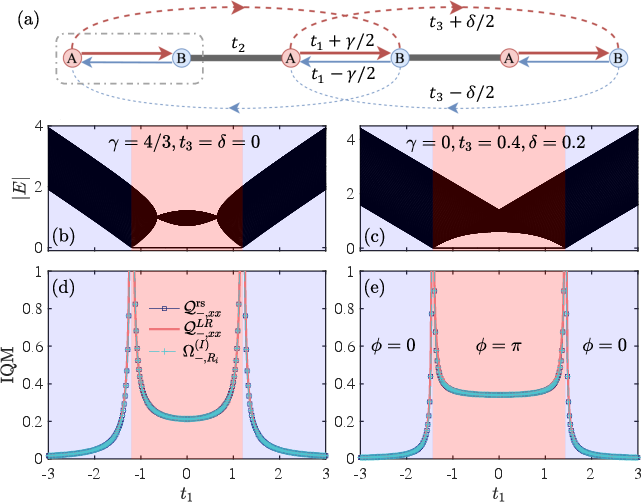
Numerical exploration with a non-Hermitian SSH model (Figure 1) demonstrates that Qm,xxrs is strongly phase-sensitive: the metric becomes large and diverges near topological transitions, signaling enhanced delocalization in topological regimes, and is suppressed in trivial phases.
Figure 1: (a) Schematic of non-Hermitian SSH model with nonreciprocal hopping. (b)-(c) Energy spectrum absolute values as function of t1. (d)-(e) Real-space IQM, non-Bloch IQM, and Wannier spread across t1, highlighting correspondence and phase discrimination.
Non-Bloch Quantum Geometry: Equivalence of Representations
Central to this work is the formal equivalence between the real-space IQM under OBC and a non-Bloch IQM defined via the biorthogonal states on the GBZ. By constructing non-Bloch waves
∣ψm,βR⟩=N1βx∣um,βR⟩,⟨ψm,βL∣=N1⟨um,βL∣β−x,
and integrating over the GBZ, one obtains a non-Bloch quantum metric
Qm,xxLR=2π1∫GBZχm,xxLR(k)dk,
where the integrand χm,xxLR is GL(1,C)-gauge invariant. The paper establishes P^m0, verified numerically and analytically. This gives a practical computational route: both real-space and non-Bloch-momentum representations yield identical quantum-geometric information under OBC.
Non-Bloch Wannier Functions and Localization
To physically interpret the IQM, the manuscript constructs non-Bloch Wannier functions:
P^m1
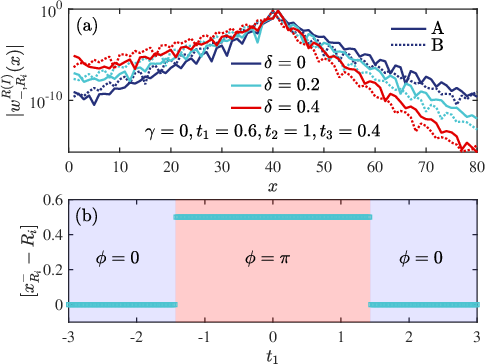
with biorthogonality ensured between left and right functions. In Hermitian limits (GBZ as unit circle), these revert to standard Wannier functions; in the presence of NHSE and non-circular GBZ, localization becomes boundary-asymmetric, as shown in Figure 2.
Figure 2: (a) Profiles of P^m2 for various P^m3; asymmetry emerges as non-Hermitian parameters increase. (b) Wannier center shift versus P^m4, verifying the non-Bloch Berry phase prediction.
The IQM is proven equivalent to the gauge-invariant part P^m5 of the Wannier spread functional for these basis states:
P^m6
Thus, the non-Bloch IQM lower bounds the spatial delocalization of non-Bloch Wannier functions, making it a sharp probe of localization phenomena in OBC non-Hermitian settings.
Complex IQM and the Biorthogonal Structure
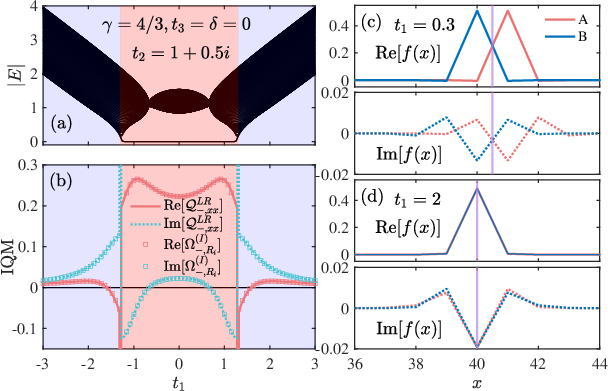
A key difference from Hermitian systems is that, due to biorthogonality, the Wannier spread and IQM can acquire an imaginary part. Analyzing the overlap function P^m7 (the pointwise product of left and right Wannier functions), the IQM is decomposed into contributions from positive/negative real and imaginary components. Figure 3 illustrates the spatial profile of P^m8 across a topological transition: the real part signals broad delocalization in topological regimes and sharp localization in trivial phases; the imaginary part, typically subdominant, reflects the biorthogonal nature of the eigenbasis.
Figure 3: (a) Energy spectrum and (b) IQM modulus versus P^m9 across a phase transition. (c)-(d) Real and imaginary parts of k0, visualizing the complex structure of non-Bloch Wannier distributions in topological and trivial phases.
The paper states that while k1's biorthogonal normalization requires k2, the complex-valued nature of the IQM/ Wannier spread endows localization bounds and diagnostics with a richer structure than their Hermitian analogues.
Theoretical and Practical Implications
The equivalence demonstrated here firmly extends quantum-geometric methods to open-boundary non-Hermitian systems, embedding the physics of skin modes and spectral topology into the language of non-Bloch quantum geometry. Importantly, the IQM remains a sensitive diagnostic of topological phase transitions under OBC, flagging quantum localization transitions unavailable in Bloch-based analyses.
Construction and analysis of exponentially-localized non-Bloch Wannier bases suited for systems with severe boundary-induced physics (NHSE).
Extension of quantum-geometric quantum bounds, superfluid weight criteria, and topological markers to non-Hermitian settings where the bulk-boundary correspondence is generalized or broken.
Numerical methods for both real-space and non-Bloch momentum calculations, facilitating study of large, disordered, or complex-geometry systems.
Conclusion
This work rigorously unifies open-boundary quantum geometry in non-Hermitian systems by demonstrating the equivalence of the real-space and non-Bloch IQMs and connecting these to Wannier localization properties. The results clarify how quantum geometry characterizes the localization and topological properties of non-Hermitian systems, fundamentally generalizing the role of the quantum metric in quantum matter beyond Hermitian Bloch theory.
Future developments may include: extension to interacting and higher-dimensional systems, leveraging IQM for identifying novel topological invariants in non-Bloch bands, and application to experimental probes of localization and quantum geometry in photonic, electronic, and mechanical metamaterials with controllable non-Hermiticity.
“Emergent Mind helps me see which AI papers have caught fire online.”
Philip
Creator, AI Explained on YouTube
Sign up for free to explore the frontiers of research
Discover trending papers, chat with arXiv, and track the latest research shaping the future of science and technology.Discover trending papers, chat with arXiv, and more.