- The paper demonstrates an innovative method where freezing an auxiliary modulator reconfigures the effective Hamiltonian for superconducting qubits.
- It achieves high-fidelity iSWAP gates with an average infidelity of 6.4×10⁻⁶ and robust interaction suppression, with ratios exceeding 200.
- The protocol simplifies hardware design by operating with fixed-frequency qubits and drive-only control, transforming dynamical freezing into an active engineering tool.
Drive-Only Interaction Engineering via Dynamical Freezing
Introduction
This work systematically investigates an interaction engineering paradigm in fixed-frequency superconducting qubit architectures, leveraging a mechanism the authors term freezing-induced interaction engineering. They demonstrate that dynamically constraining (freezing) an auxiliary quantum subsystem in a dressed eigenstate serves not only to suppress unwanted evolution (as in traditional quantum Zeno-type protocols), but crucially reconfigures the effective Hamiltonian landscape experienced by other qubits. This insight resolves a persistent trade-off in superconducting quantum logic: the tension between fast, strong native interactions (enabling high speed two-qubit gates) and the operational simplicity of drive-only gate protocols, which traditionally suffer from weak effective couplings.
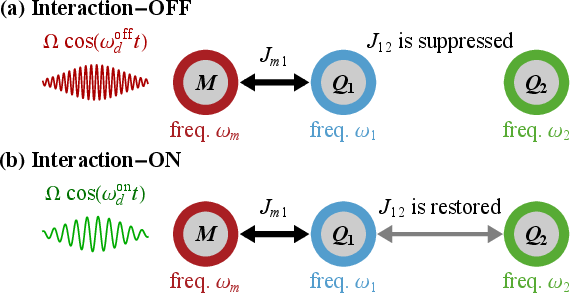
Figure 1: Conceptual layout of the three-qubit system, illustrating how a driving field on modulator M toggles the Q1-Q2 interaction via dynamical freezing.
Mechanism of Dynamical Freezing and Hamiltonian Engineering
The physical system comprises three qubits: two targets (Q1, Q2) connected by a fixed native exchange coupling, and a modulator qubit (M) coupled only to Q1. The protocol consists of applying a strong transverse drive to M, freezing it dynamically in a dressed eigenstate of the effective (rotating-frame) Hamiltonian. The resulting projective constraints mean that M no longer participates dynamically, and the projection of the global Hamiltonian onto the frozen state induces a renormalization of Q1's local Hamiltonian. This in turn renders the detuning between Q10 and Q11 (Q12) dynamically tunable via the drive frequency alone, without any need for direct manipulation of the native qubit frequencies or coupler elements.
Interaction Switching: On and Off Regimes
By judiciously choosing the drive frequency, the effective detuning between Q13 and Q14 can be set either:
- Interaction-Off: Large detuning, suppressing the residual exchange coupling
- Interaction-On: Zero detuning (resonance in the dressed frame), restoring strong coherent exchange suitable for entangling operations
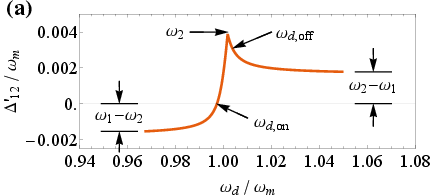
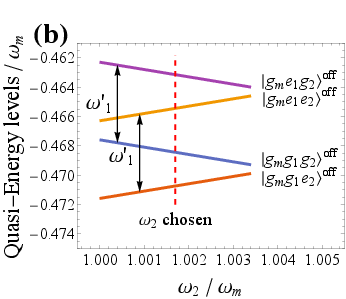
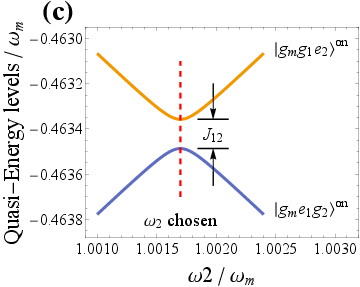
Figure 2: The effective detuning Q15 as a function of drive frequency, evidencing sharp tunability between the interaction-on (resonant) and -off (detuned) regimes.
Floquet analysis of the full time-dependent system reveals a clear avoided crossing in the on regime reflecting coherent two-qubit exchange, and the absence thereof in the off regime. The authors implement an iSWAP gate by initializing Q16 appropriately and switching the drive frequency, allowing the native Q17-Q18 interaction to generate entanglement during the on period, and otherwise decoupling the qubits.
The protocol involves a complex parameter space; the authors analyze performance via both single-parameter and joint multi-parameter optimization, focusing on interaction-on (iSWAP) gate fidelity and the effective off-state suppression ratio Q19.
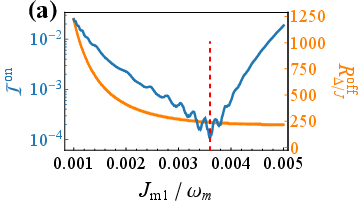
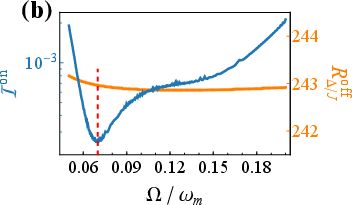
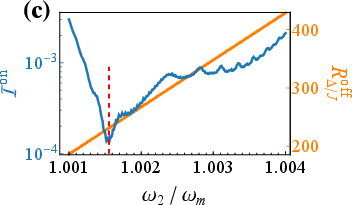
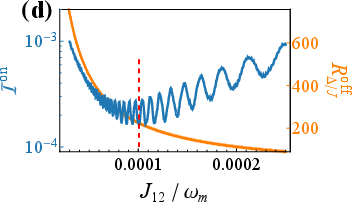
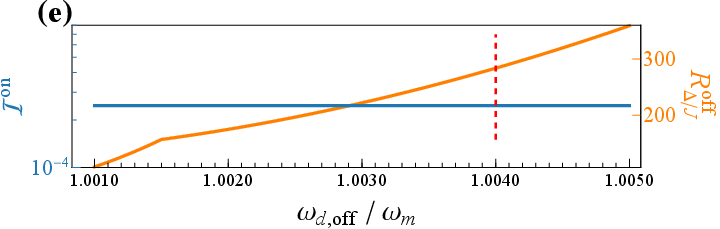
Figure 3: Single-parameter scans over protocol controls (e.g., Q20, Q21, Q22, Q23, Q24) reveal optimal settings and the robustness of interaction suppression.
Key findings include:
- High-fidelity entangling gates can be attained with average infidelity Q25 as low as Q26 in full lab-frame simulation at optimal parameter sets.
- Interaction suppression is strong, with Q27 generically and exceeding Q28 at the optimal point.
As gate time increases (decreasing Q29), both iSWAP fidelity and interaction suppression improve; however, very short gate times degrade fidelity due to residual non-idealities and the breakdown of effective Hamiltonian approximations.
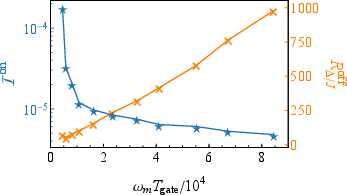
Figure 4: Gate time dependence, showing the trade-off between gate speed, fidelity, and interaction suppression. Both on-state fidelity and off-state decoupling benefit from longer times (smaller Q10).
Practical Implementation and Theoretical Implications
The protocol is particularly well-suited for superconducting transmon architectures, requiring only fixed-frequency qubits and static exchange couplings, with all operational tunability relegated to microwave drives applied to the modulator. This dramatically reduces hardware and control complexity compared to tunable-frequency qubits or flux-driven couplers, while retaining the speed of native interactions. Calibration overhead is minimized, as parameter adjustments are needed only once per device.
Theoretically, this work expands the role of dynamical freezing in quantum control, upgrading it from a passive (protection-only) mechanism to an active resource for interaction engineering and Hamiltonian design. The approach generalizes to any platform with tunable local drives and native two-qubit interactions, forming a broader template for "programmed" entanglement and modular gate construction.
Conclusion
This study elucidates a protocol that utilizes dynamical freezing of an auxiliary modulator to produce drive-only, high-performance switching of two-qubit interactions in superconducting circuits. The results, both in analytic treatments and in ab initio simulations, demonstrate that native-coupling speed and drive-only operational simplicity can indeed be combined, overcoming longstanding limitations in the field. Extending this paradigm to larger systems and leveraging freezing-induced Hamiltonian engineering for more complex entanglement structures or dynamical protocols will be a promising direction for future quantum information processing architectures.

