- The paper shows that periodic modulation of the magnetic field enables tunable transverse spin-spin coupling in a hybrid alkali–noble-gas system via a Bessel-function dependence.
- Experimental results validate the Floquet renormalization model, significantly extending nuclear coherence times by decoupling interactions near Bessel zeros.
- The approach offers practical benefits for quantum memories, precision comagnetometry, and the exploration of non-Hermitian quantum dynamics in atomic vapors.
Floquet Engineering of Spin-Spin Interactions in Hybrid Atomic Systems
Background and Motivation
Noble-gas nuclear spin ensembles are prominent in precision metrology and quantum technology due to their extreme coherence times, arising from weak environmental interactions and shielding by closed electronic shells. However, their weak environmental coupling presents a practical obstacle to the initialization, manipulation, and readout of their quantum state—particularly in room-temperature vapor cells commonly used in comagnetometry, quantum metrology, and fundamental searches for exotic physics. Traditional approaches employ spin-exchange collisions with alkali vapors, leveraging the Fermi-contact interaction to polarize and read out nuclear spins indirectly. This spin-exchange is typically strong and acts in both the longitudinal and transverse channels, and its effective strength depends on the relative orientation of the alkali and noble-gas spin polarizations.
Controlling this spin-spin coupling dynamically and independently from other system parameters is essential for advanced quantum measurement protocols, quantum memories, and for the mitigation of systematic effects in precision searches. The present work demonstrates tunable, Floquet-engineered control of the effective transverse spin-spin interaction in a hybrid alkali–noble-gas system, achieved by rapid periodic modulation of the leading magnetic field direction. The resulting interaction strength is governed by a Bessel-function dependence on the modulation index, providing a continuous, nonlinear tunability inaccessible via static magnetic fields or other parameters.
Theoretical Model of Floquet Renormalization
The interaction Hamiltonian between the alkali and noble-gas ensembles is dominated by the Fermi-contact term, HFC=λS⋅I, and is traditionally characterized via mean-field effective magnetic fields that couple the alkali electron and nuclear spin polarizations. The full dynamical evolution for both ensembles is described via the coupled Bloch-Hasegawa equations, including transverse (exchange) couplings and relaxation:
dtd(P⊥e P⊥n)=−iM(t)(P⊥e P⊥n)−iF(t)
with M(t) containing both the static and (via Bm(t)) modulated magnetic fields, and off-diagonal coupling coefficients ηen,ηne.
Applying Floquet theory, i.e., moving to a rotating frame matched to the fast AC field, and averaging over the period, the authors derive an effective interaction matrix where the transverse exchange coupling is renormalized by a zeroth-order Bessel function, J0(β), of the modulation index. Explicitly,
Meff(β)=(ωe−iΓeηenJ0(β) ηneJ0(β)ωn−iΓn)
with β=(Ωe−Ωn)/ωm, Ωe,n the modulation amplitudes for electronic and nuclear spins. Physically, the fast AC modulation averages the relative orientation dynamics between the electron and nuclear spin polarizations, leading to a tunable reduction—or even suppression—of the spin exchange rate. Near zeros of J0(β), the transverse coupling effectively vanishes, leaving the static longitudinal coupling untouched.
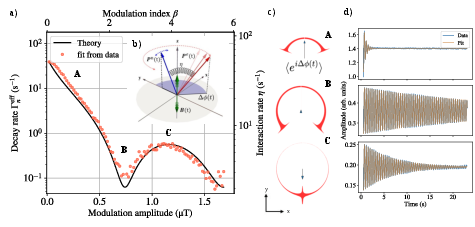
Figure 1: Schematic illustration and experimental data showing parametric field modulation controlling the relative precession between alkali (red) and noble-gas (blue) spins; the observed nuclear decay rate follows a dtd(P⊥e P⊥n)=−iM(t)(P⊥e P⊥n)−iF(t)0 dependence.
The nuclear effective relaxation rate and frequency shift then acquire explicit dtd(P⊥e P⊥n)=−iM(t)(P⊥e P⊥n)−iF(t)1 dependence, enabling in situ continuous control of both the coupling strength and, consequently, the nuclear ensemble's coherence properties.
Experimental Demonstration
The theory is verified using a hybrid comagnetometer containing K and Rb as electron-spin species and dtd(P⊥e P⊥n)=−iM(t)(P⊥e P⊥n)−iF(t)2He as the noble-gas nuclear species inside a multi-layer shielded vapor cell. Spin polarization is initialized and detected with hybrid optical pumping and probe Faraday rotation, respectively.
Parametric modulation is applied to the leading (longitudinal) dtd(P⊥e P⊥n)=−iM(t)(P⊥e P⊥n)−iF(t)3-field with a strong AC component, and the response is measured as a function of modulation amplitude and frequency. Free precession decay (FPD) signals are demodulated and fitted to extract the nuclear effective decay rate (dtd(P⊥e P⊥n)=−iM(t)(P⊥e P⊥n)−iF(t)4), precession frequency, and amplitude.
Notably, the measured nuclear transverse relaxation rate shows pronounced minima—nearly vanishing—at modulation amplitudes corresponding to the zeros of dtd(P⊥e P⊥n)=−iM(t)(P⊥e P⊥n)−iF(t)5, in agreement with the theoretical prediction. By varying dtd(P⊥e P⊥n)=−iM(t)(P⊥e P⊥n)−iF(t)6 the transverse coupling dtd(P⊥e P⊥n)=−iM(t)(P⊥e P⊥n)−iF(t)7 is tuned smoothly over more than an order of magnitude, and the relaxation time extends by nearly two orders of magnitude at the decoupling points. The experimental results confirm the non-monotonic, highly nonlinear, Bessel-function dependence of the coupling and system response.
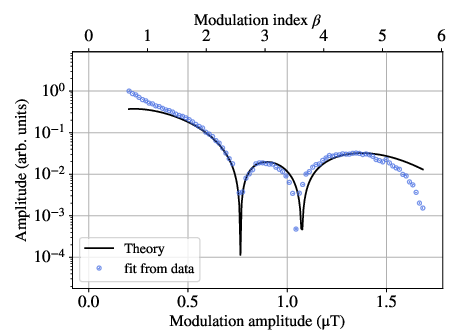
Figure 2: Measured amplitude response as a function of modulation amplitude, showing Bessel-function nulls and suppression with high AC fields.
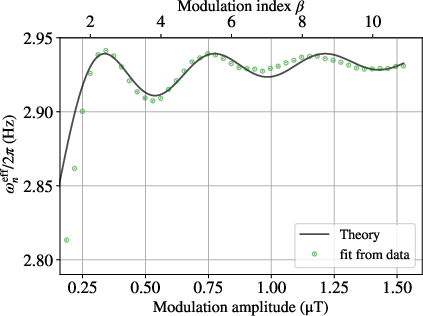
Figure 3: Effective nuclear precession frequency as a function of modulation index dtd(P⊥e P⊥n)=−iM(t)(P⊥e P⊥n)−iF(t)8; frequency oscillates with dtd(P⊥e P⊥n)=−iM(t)(P⊥e P⊥n)−iF(t)9, matching theory up to M(t)0.
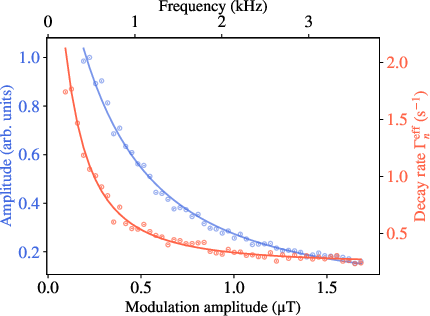
Figure 4: Nuclear response amplitude and decay rate for fixed modulation index, revealing suppression at high field amplitudes due to resonance broadening.
Systematic deviations at large M(t)1 are attributed to incomplete electron-mode suppression and modulation-induced variations in the "slowing-down" factor (M(t)2), but these are not fundamental limitations—calibration suffices for practical purposes.
Practical Implications and Future Directions
Parametric Floquet engineering introduces a robust, reversible control handle on the transverse coupling in hybrid atomic systems, with multiple key implications:
- Quantum memory and information: The ability to dynamically decouple and recouple nuclear and electronic spins without changing static fields or vapor parameters makes these systems excellent candidates for quantum memories with controlled read/write protocols [katz2022optical, katz_coupling_2021]. During storage, decoupling can extend coherence to hours; recoupling enables efficient readout.
- Precision measurement: Dynamically tuning spin-exchange rates enhances experimental flexibility. For comagnetometry-based searches for new physics (e.g., ultralight dark matter [gavilan-martin_searching_2025, bloch_nasduck_2022]), controlled decoupling mitigates systematic errors that arise from unwanted relaxation. Tunability could also optimize bandwidth and resonance conditions for frequency-dependent probes [jiang_floquet_2022, bloch_new_2022].
- Non-Hermitian degeneracies (exceptional points): The engineered two-level dynamics with tunable, complex-valued coupling enables controlled realization and encircling of exceptional points, providing a testbed for non-Hermitian quantum dynamics and ultrasensitive sensor readout [kopciuch_liouvillian_2025, miri_exceptional_2019, dembowski_encircling_2004].
- Extensibility: The Floquet approach generalizes to off-resonant regimes, allowing sideband-mediated coupling far from hybrid resonance—potentially enhancing spin transfer and broadening the operational parameter space for quantum sensors.
Conclusion
This work establishes that parametric modulation of the leading field provides a powerful, general protocol for Floquet engineering of spin-exchange interactions in hybrid atomic systems. The resulting M(t)3 dependence of the transverse coupling is verified both theoretically and experimentally, allowing for real-time, wide-range control of interaction strength with minimal disruption of static system properties. Practically, this opens new operational regimes for quantum memories, comagnetometers, and non-Hermitian quantum dynamics experiments. Future work will likely pursue optimized protocols for quantum information storage, advanced nulling of systematic effects in exotic-physics searches, and deeper exploration of engineered non-Hermitian phenomena in atomic vapors.

