- The paper presents a modular framework for automating algorithm recommendation and orchestration in hybrid quantum-classical optimization, enabling scalable decision-making.
- It employs a networked tree of atomic computation nodes to manage problem encoding, algorithm selection, and backend adaptation with transparency and configurability.
- The empirical analysis in its scalability module highlights feasible quantum configurations while flagging non-characterizable regimes to prevent wasted computational efforts.
The QuaST Decision Tree: Automated Recommendation Framework for Hybrid Quantum-Classical Optimization
Motivation and Problem Statement
The paper introduces the QuaST Decision Tree (QDT), a modular framework for automating algorithm recommendation and workflow orchestration in hybrid quantum-classical combinatorial optimization (CO) scenarios. The absence of abstraction layers connecting quantum algorithmic development with user-facing industrial application workflows inhibits practical adoption of quantum computing (QC) in domains like logistics, production, and finance. While software toolchains and individual quantum algorithms have matured, coordinated support for end-to-end hybrid pipelines—including problem modeling, encoding, algorithm selection, hyperparameter tuning, and backend targeting—remains underdeveloped.
Compounding this challenge, existing abstraction solutions are fragmented, often tied to specific algorithmic paradigms or backend technologies, and do not offer a unified, extensible decision architecture. The highly dynamic nature of quantum algorithm research and rapidly shifting hardware capabilities also demand high modularity, transparency, and configurability from any proposed solution.
Design Principles and Framework Architecture
The QDT is conceived as a fully modular, extensible, and automation-centric decision framework. It is structured around a networked tree of computation nodes, each representing an atomic task (e.g., problem encoding, algorithm selection, optimizer assignment, backend adaptation). The key architectural decisions and design principles include:
- Automation Without Restriction: The framework must enable fully automated recommendations while allowing expert inspection/override of all decisions and modular integration of new algorithms or pipelines.
- Granular Modularity and Locality: All workflow components (algorithms, hyperparameters, encodings, backends) are encapsulated in nodes with localized dependencies, enabling efficient maintenance, testability, and extensibility.
- Configurable Automation: Queries at decision points can be globally toggled between manual input and data-driven automatic selection. Pathways through the decision tree are programmatically configurable via YAML and JSON.
- Transparency and Traceability: The primary data structure (
ProblemData) traces the evolution of the problem state through pipelines, capturing fine-grained transformations for later inspection.
- Efficiency and Environment Adaptability: QDT is deployable as part of larger HPC stacks, as rapid prototyping tools for R&D, or as plug-in translation layers within commercial optimization solvers.
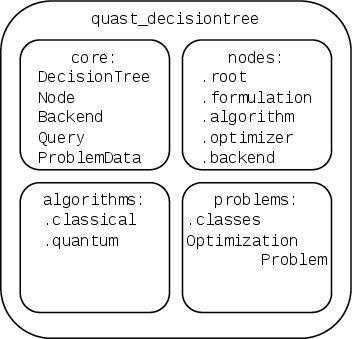
Figure 1: Components of the {quast-decisiontree} package, delineating core orchestration, modular nodes, algorithm and problem templates, and utilities.
The execution protocol resembles a two-pass DAG traversal: the forward pass pipelines the problem through the selected computational nodes, transforming it toward solution and backend execution; the backward pass decodes, post-processes, and interprets returned results. Nodes may branch based on problem data or runtime context to support rich conditional logic.

Figure 2: The algorithm selection subtree from a typical QDT instance, showing differentiated decision paths for hybrid, variational, and classical algorithms, with convergence points for shared components like optimizer selection.
QDT: Integration Scenarios
The modular backbone of QDT supports deployment across heterogeneous environments:
- HPC Software Stack Integration: QDT instances are configured by administrators to map users' problem specifications (e.g., QUBO) to backend-specific workflows and optimal hybrid algorithms, abstracting user-facing complexity and maximizing infrastructure utilization.
- Research Prototyping: Rapid composition and switching between algorithms or pipelines (via YAML/JSON path specifications) enable reproducible experimentation and streamlined integration of novel methods.
- Industrial Solver Translation: As a pre/post-processing translation layer, QDT shortens integration effort for quantum-enhanced solvers by encapsulating reusable, configurable workflow fragments tailored to customer-specific requirements.
Empirical validation across deployment modes demonstrates negligible overhead relative to backend execution or queueing latency, underscoring the framework’s practical suitability.
Automation Modules: Scalability-Guided Hybrid Quantum Recommendations
The critical innovation in QDT arises from highly specialized automation modules, exemplified by the VQA Scalability Analysis module. This component operationalizes a data-driven methodology for resource estimation and feasibility classification of variational quantum algorithms (VQAs). Drawing on comprehensive benchmarking, the scalability module characterizes the interaction between finite sampling error and optimizer resilience thresholds, producing a shot requirement curve nshots(n) for each algorithm-optimizer-problem triplet under exponential, power-law, and logarithmic scaling hypotheses.
Key automation behaviors include:
- Instance-aware Recommendation: For given QUBO instances, problem type, and structure (size, density, etc.), the module queries a rich database of empirical fits to estimate shot requirements and compare against “disadvantage thresholds” (i.e., whether quantum computation would ever outperform classical brute-force enumeration).
- Dynamic Algorithm Selection: Only configurations with feasible shot budgets are recommended. Non-characterizable regimes (where convergence data is inconsistent) are flagged to avoid unjustified quantum resource allocation.
- Output Automation: The module emits both detailed analysis artifacts and ready-to-deploy QDT configuration files, compatible with hands-free and interactive execution.
The demonstration on a challenging MaxCut instance (n=60, ρ=0.4) highlights stringent feasibility: only VQE with NGD or Powell optimizers achieves feasible quantum resource requirements, while most QAOA variants are infeasible or uncharacterizable.
Implications and Future Directions
The QDT’s core implication is the practical realization of an end-to-end abstraction layer that supports and accelerates industrial adoption of hybrid quantum-classical optimization workflows. By decoupling infrastructure and algorithmic choices from domain modeling, and by continuously adapting to new algorithmic research via modular plug-ins, QDT sets a template for generalizable, transparent, and maintainable quantum software orchestration.
The scalability automation module further establishes a principled baseline for feasibility-aware quantum algorithm recommendation, mitigating wasted computational effort and guiding users toward algorithmic regimes with real potential for quantum advantage.
Moving forward, increased coverage of automation modules and continuous empirical expansion of scalability databases will improve recommendation accuracy and widen QDT’s application domains. As maturity increases, integration into production environments and rigorous benchmarking across diverse industrial tasks will further validate and refine the framework’s efficacy and value proposition.
Conclusion
The QuaST Decision Tree framework delivers a versatile, modular, and automation-centered abstraction layer for hybrid optimization in practical quantum computing contexts. By unifying disparate components—from problem encoding to backend selection—under a highly configurable, transparent, and data-driven decision architecture, it materially advances the state-of-the-art in making quantum-enhanced solutions accessible and efficient for both researchers and industry practitioners.