- The paper introduces an adaptive allocation framework that minimizes the semiparametric efficiency bound for average survival effect estimation in censored settings.
- The paper develops a closed-form Adaptive Survival Estimator (ASE) that sequentially learns survival and censoring hazards with provable asymptotic normality and valid time-uniform inference.
- The paper empirically demonstrates that censoring-aware adaptive allocation significantly reduces MSE and maintains nominal confidence intervals compared to traditional methods.
Adaptive Experimentation for Censored Survival Outcomes: A Technical Analysis
Introduction and Motivation
This work addresses the critical problem of efficient adaptive experimentation for time-to-event (survival) outcomes under right censoring—a setting common in clinical trials, precision medicine, and rare disease studies. The central innovation is the development of an adaptive allocation framework that directly targets minimization of the semiparametric efficiency bound for average survival effect (ASE) estimation, extending classical Neyman allocation to accommodate uncertainty introduced by both event and censoring processes. The proposed Adaptive Survival Estimator (ASE) provides a closed-form, model-agnostic, sequential design and estimator with formal guarantees under adaptive policies, including asymptotic normality and valid time-uniform inference.
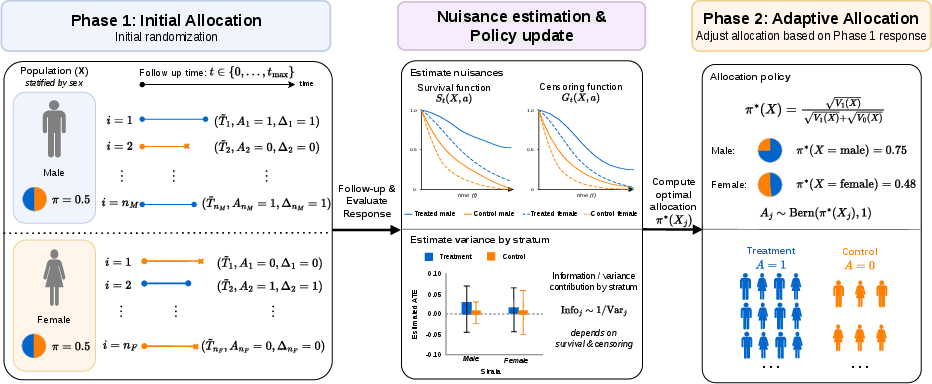
Figure 1: The semi-parametric framework for adaptive experimentation with censored survival outcomes, integrating sequential optimal allocation and robust estimation.
The paper considers sequential adaptive experimentation for binary treatment assignment, with observed covariates X, assigned arm A∈{0,1}, event time T, and censoring time C, yielding partially observed time-to-event data (X,A,min{T,C},Δ), where Δ=I(T≤C). The estimand is the average survival effect curve τt=EX[P(T(1)>t∣X)−P(T(0)>t∣X)] for t on a discrete horizon.
Adaptive policies πr(⋅∣X,Hr−1) may depend on past data and covariates. Efficiency is defined relative to the variance of influence function-based estimators under the chosen policy. Notably, identifiability relies on standard ignorability, consistency, positivity, and non-informative right censoring assumptions.
Semiparametric Efficiency and Optimal Adaptive Allocation
The authors derive the semiparametric efficiency bound for ASE estimation as a function of the allocation policy π(x). This variance decomposes into two main components: (i) survival uncertainty (the variance of conditional survival probabilities), and (ii) censoring uncertainty (inflation from arm/covariate-specific censoring mechanisms).
The optimal (A-optimal) allocation policy is shown to have the form
A∈{0,1}0
where A∈{0,1}1 is a closed-form function of both survival and censoring hazards. A key insight is that, even with equal censoring hazard functions across arms, censoring asymmetry arising from arm-specific event hazards leads to significant deviation from both uniform and Neyman allocation.
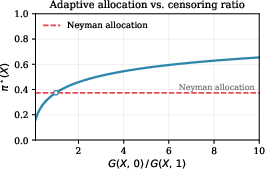
Figure 2: Optimal allocation A∈{0,1}2 diverges from uniform and Neyman allocation as the censoring asymmetry, measured by A∈{0,1}3, increases, reflecting the joint impact of event and censoring mechanisms.
This demonstrates that classical adaptive allocation strategies that ignore censoring are suboptimal in survival analyses. Including censoring-induced variability in the allocation policy is necessary for efficiency.
Adaptive Survival Estimator (ASE) and Sequential Inference
The ASE sequentially learns nuisance parameters (survival and censoring hazards) using arbitrary regression or machine learning models within each arm, performs allocation updates according to the derived optimality criterion, and produces plug-in pseudo-outcomes via the efficient influence function (EIF). A technical advance is the construction of a sequential cross-fitting scheme to control finite-sample bias and enable orthogonal nuisance learning in adaptive settings, facilitating martingale CLT-based inference.
Robust truncation of A∈{0,1}4 prevents allocation collapse in small strata and stabilizes the EIF denominator, which is required for both theoretical and practical validity.
Theoretical results establish:
- Asymptotic normality for the ASE at the efficiency-optimal variance bound under mild A∈{0,1}5 nuisance convergence conditions, even with only A∈{0,1}6 rates and without Donsker conditions.
- Robustness to censoring hazard misspecification: the estimator retains consistency as long as the event hazard model is consistent, and vice versa (double robustness if event/censoring are variation-independent, e.g., in the "no-ties" scenario).
- Uniform coverage: time-uniform asymptotic confidence sequences can be constructed for arbitrary stopping times using empirical Bernstein martingale techniques.
Empirical Evaluation
Synthetic- and semi-synthetic evaluations (Twins dataset) benchmark ASE against non-adaptive and censoring-agnostic adaptive baselines with plug-in and AIPW Neyman allocation. ASE exhibits substantial and persistent efficiency gains in mean squared error (MSE), rapid convergence, and accurate coverage of nominal confidence intervals.
Notable empirical findings:
- ASE achieves relative MSE within A∈{0,1}7 of the full oracle at A∈{0,1}8 samples, while censoring-agnostic or non-adaptive baselines exhibit a A∈{0,1}9 to T0 efficiency gap.
- Adaptive allocation using censoring-aware optimality is the main driver of efficiency gains; randomization-only or plug-in strategies do not close the gap.
- ASE maintains nominal 95% confidence interval coverage even as T1 increases, in contrast to plug-in and traditional methods, which exhibit deteriorating coverage.
- The robustness property is observed empirically: under deliberate misspecification of censoring hazard, ASE-MS remains consistent and converges at a similar rate.

Figure 3: ASE consistently outperforms baselines in synthetic experiments; left: relative MSE vs. oracle, middle: MSE convergence rate, right: empirical CI coverage.

Figure 4: On the semi-synthetic Twins dataset, adaptive allocation with ASE yields the lowest MSE and fastest convergence, maintaining valid coverage even under partial nuisance misspecification.
Practical Implications and Theoretical Impact
This paper provides the first unified optimal allocation and semiparametric estimation framework for adaptive sequential trials in right-censored survival settings, generalizing credentialed optimal experimental design concepts (A/D/E-optimality) and EIF-based semiparametric inference to adaptive survival analysis. The methodology is robust to model choice for nuisance components, compatible with neural or non-parametric regressors, and directly extensible to high-dimensional regimes.
By incorporating censoring-induced uncertainty into the allocation, the framework enables more efficient evidence generation in cost- or sample-constrained settings typical in oncology, rare disease, and platform trials. The allocation mechanism is fully closed-form, requiring no additional model fits for variance components.
This level of efficiency is essential for the design of next-generation adaptive clinical trials, as well as for reinforcement-learning-inspired interventions in healthcare and other fields with censored time-to-event outcomes. The ability to provide valid, time-uniform inference under adaptive data collection also supports interim monitoring and ethically driven early stopping.
Future Directions
Potential avenues for methodological extension include multi-arm or continuous-treatment designs, generalization to dependent censoring, accommodation of delayed outcomes, and integration with off-policy and meta-learning frameworks for individualized treatment effect estimation under outcome censoring. Ongoing work could explore combinatorics with conformal or distribution-free uncertainty quantification for survival effects, and applications to precision medicine and clinical trial research infrastructure.
Conclusion
This paper rigorously formulates and solves the problem of efficiency-optimal adaptive experimentation with censored survival outcomes. By deriving and implementing a closed-form allocation rule and EIF-based estimator, it sets a high bar for both statistical optimality and practical deployability in sequential survival analysis. Empirical and theoretical evidence confirm the necessity and benefit of including censoring variances in adaptive allocation for ASE inference.
(2605.18459)

