- The paper establishes asymptotic variance reduction for classical survival estimators, such as KM and IPCW-KM, under rerandomization.
- It derives uniform weak convergence through a geometric decomposition of influence functions, linking covariate balance to reduced stochastic variation.
- The study shows that the DML estimator's variance remains invariant when proper covariate adjustments nullify the design-stage effects of rerandomization.
Asymptotic Theory of Rerandomization for Survival Analysis
Introduction and Motivation
Rerandomization restricts treatment allocations in randomized experiments to those achieving improved covariate balance, with the aim of enhancing statistical efficiency for the estimation of causal effects. While theoretical results for rerandomization have addressed finite-dimensional average treatment effects (ATEs), the extension to survival outcomes—whose estimands are infinite-dimensional functional parameters—remained an open challenge. This work systematically develops the asymptotic theory for treatment-specific survival function estimators under rerandomization, providing uniform weak convergence results and establishing variance reduction for estimators such as the Kaplan-Meier (KM), inverse probability of censoring weighted KM (IPCW-KM), and debiased machine learning (DML) estimators.
Rerandomization Designs and Survival Estimands
The analysis is conducted in a super-population framework, with attention to both marginal and conditional survival functions: ST,a(t) and ST,a(t∣z) for treatment arms a∈{0,1} and baseline covariates z. The rerandomization design selectively accepts treatment allocations meeting prespecified Mahalanobis distance thresholds for covariate balance, thereby restricting the space of possible randomizations and inducing dependence among treatment assignments.
Survival analysis is subject to right-censoring, which is addressed via independent or covariate-dependent censoring assumptions. The estimators considered—KM, IPCW-KM, and DML—target treatment-specific survival functions, which serve as the foundation for inference on summary causal effects such as survival probability differences and hazard ratios.
Asymptotic Properties of Survival Estimators Under Rerandomization
Kaplan-Meier and IPCW-KM Estimators
Uniform consistency of these estimators is preserved under rerandomization. Importantly, the limiting processes for both estimators under rerandomization are shown to admit a geometric decomposition: a projection onto the subspace spanned by the rerandomization covariates (with reduced stochastic variation due to the constraint) and an orthogonal Gaussian process residual.
The uniform weak convergence of the KM and IPCW-KM estimators is established, with the limiting variance at each time point t reduced by a factor proportional to the covariance between the estimator's influence function and the rerandomization covariates, and the severity of the rerandomization constraint. The asymptotic variance reduction is governed by the quantity
$\rho_a(t) = \frac{_{T,B^*,a}(t)^\top _{B^*}^{-1} _{T,B^*,a}(t)}{\Sigma_{T,a}(t,t)}$
and is nonzero unless covariate-outcome correlation is absent.
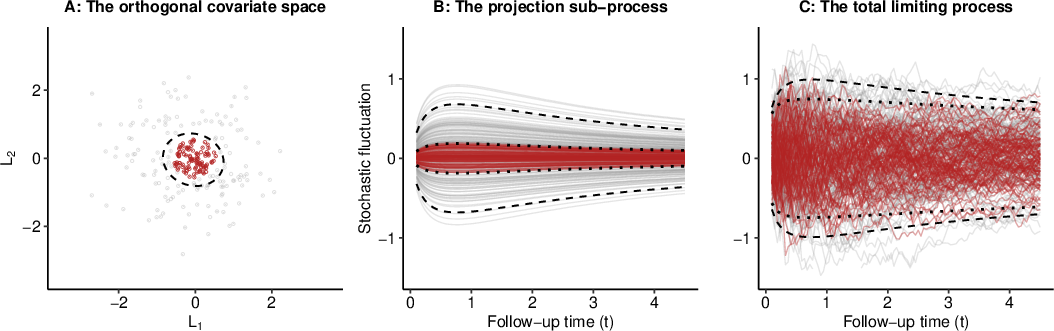
Figure 1: The geometric effect of rerandomization on the limiting processes of the KM estimator, showing how restricting covariate imbalance leads to tighter confidence bands via projection and residual decomposition.
Debiased Machine Learning Estimator
The DML estimator leverages the efficient influence function (EIF) via cross-fitted nuisance estimation, achieving the semiparametric efficiency bound. The key result is the asymptotic variance of the DML estimator remains invariant under rerandomization, provided the rerandomization covariates are included in the analysis-stage covariate adjustment. This follows from the Neyman orthogonality property: the projection onto the rerandomization covariate subspace is asymptotically zero, implying that rerandomization is ignorable for DML-based survival function estimation.
Extensions to Stratified Rerandomization
All asymptotic results are extended to stratified rerandomization schemes, where baseline strata (categorical or discretized) are used to further refine randomization and balance. The variance reduction architecture for KM and IPCW-KM estimators persists, with stratification adjusting the covariance structure to account for within-stratum balancing.
Numerical and Empirical Evaluation
Simulation studies are conducted under various data-generating processes and sample sizes, demonstrating:
- Empirical standard errors for KM and IPCW-KM estimators are smaller under rerandomization and stratified rerandomization relative to simple randomization.
- Empirical coverage probabilities of pointwise and uniform confidence intervals are appropriate, with rerandomization yielding tighter intervals.
- The DML estimator consistently achieves lower standard error than KM/IPCW-KM, but its variance is unaffected by rerandomization.
A real-data application using the GBSG2 breast cancer trial data further corroborates these findings. Relative variance reductions for the KM and IPCW-KM estimators range from 2.85% to 6.57% under rerandomization schemes when compared to simple randomization, while the DML estimator's variance exhibits no change across randomization designs.
Practical and Theoretical Implications
The established asymptotic theory identifies a critical operational boundary for the use of rerandomization in randomized experiments with survival outcomes:
- Design-stage covariate balancing via rerandomization delivers measurable asymptotic variance reduction for classical survival estimators (KM and IPCW-KM), but is asymptotically redundant when analysis-stage estimators efficiently adjust for covariates (DML).
- Interval estimates from unadjusted survival estimators in rerandomized trials are conservative; analysts should use variance corrections derived from this theory to obtain sharper inference.
Practically, rerandomization is most impactful when the analysis plan does not employ efficient covariate adjustment. The magnitude of variance reduction depends on the prognostic signal of balanced covariates. Theoretically, the results lay groundwork for further study in high-dimensional settings (e.g., increasing covariates, finely stratified designs), and highlight the interplay between design-stage and analysis-stage efficiency.
Conclusion
This work rigorously characterizes the asymptotic effects of rerandomization for survival outcomes and quantifies the variance reduction attainable via constrained randomization. For the KM and IPCW-KM estimators, rerandomization and stratified rerandomization systematically reduce asymptotic variance, as confirmed in both simulation studies and real-data applications. For the DML estimator, the orthogonality of the EIF negates the impact of rerandomization, providing guidance on the limits of design-stage interventions given analysis-stage flexibility. The results offer precise recommendations for trialists choosing between classical and modern analysis strategies in survival analysis, and provide a foundation for future theoretical developments.
Reference: "Asymptotic theory of rerandomization for survival analysis" (2604.23393)

