Published 18 May 2026 in quant-ph | (2605.18291v1)
Abstract: The unpredictability of quantum physics gives rise to intrinsic randomness. In an adversarial scenario, any additional degrees of freedom must be attributed to an eavesdropper with correlations to the measurement set-up. The true randomness is then quantified by the probability that she correctly guesses the measurement outcomes, optimised over all possible strategies. Extremal measurements are appealing here, since they do not allow information to leak to such an eavesdropper. Beyond projective measurements, however, a simple question remains open: how much intrinsic randomness can be generated by a given extremal measurement? In a step towards solving it, we characterise the randomness generated by any unbiased extremal rank-one measurement acting on any state, solving the problem explicitly in dimension two. Four-outcome qubit measurements of this type are tomographic, so these results hold for fully source-device-dependent randomness too. The tetrahedral symmetric informationally complete (SIC) measurement, we find, has the least intrinsic randomness within this class. We also present the skewed SIC family of measurements, and use them to partially solve an open problem: we prove that $2 \log d$ bits of randomness, the maximal amount, can be generated device-dependently (or source-device-independently) in any dimension in which there exists a SIC measurement.
The paper presents a novel framework analyzing intrinsic randomness generated by extremal rank-one POVMs beyond traditional projective measurements.
It derives general lower bounds for min-entropy and constructs explicit measurement families, including skewed SIC POVMs, that approach maximal randomness.
The qubit case is fully resolved, revealing a trade-off between tomographic completeness and randomness generation critical for secure quantum protocols.
Quantum Randomness Beyond Projective Measurements: Intrinsic Randomness from Extremal POVMs
Overview
The paper "Quantum randomness beyond projective measurements" (2605.18291) systematically investigates intrinsic randomness generated by general extremal rank-one POVMs, surpassing the traditional analysis limited to projective measurements. The study characterizes how much randomness can be generated by extremal (indivisible) measurements, provides general lower bounds for the randomness attainable from any state and any unbiased extremal measurement in arbitrary dimension, and fully solves the qubit (dimension two) case. Notably, it constructs families of measurements (including skewed and scissors-like MIC POVMs) that approach the theoretical maximal min-entropy for randomness generation and reveals that, among unbiased MICs, SIC POVMs always minimize intrinsic randomness.
Intrinsic Randomness and Measurement Extremality
The unpredictability of quantum measurement outcomes, formalized via the conditional min-entropy, quantifies a measurement's ability to generate intrinsic randomness. In adversarial scenarios, this entropy is given as Hmin=−logpguess, where pguess is the optimal probability for a correlated eavesdropper to guess the measurement outcome.
Extremal measurements—POVMs not expressible as convex combinations of others—are central since they guarantee no adversarial classical side information about the measurement process. The Shannon entropy of outcome distributions is maximized over all pure input states, and attention is restricted here to rank-one extremal POVMs, including projective and minimal informationally complete (MIC) measurements.
Skewed SIC Measurements and Maximal Randomness
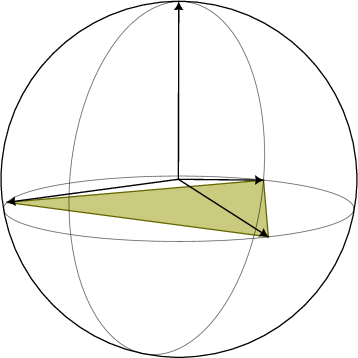
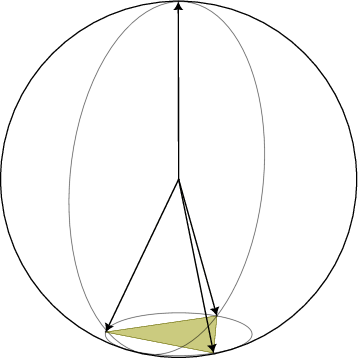
The study introduces skewed SIC POVMs, a biased MIC family in every dimension where SICs are known to exist. These measurements, constructed by adjusting one outcome's weight and normalizing, are tunable via a parameter γ:
N1=γΠ1,Nj=d−11−γ(⋯),j=2,…,d2
where {Πj} are the SIC projectors.
Crucially, by setting γ=1/d2, the probabilities for all outcomes on a fiducial pure state are uniform, saturating the theoretical upper bound of 2logd bits of randomness. This uniformity holds not only for pure states but also for isotropically noisy (i.e., depolarized) inputs with an optimal choice of γ, by matching the distribution to the spectrum of ρ.
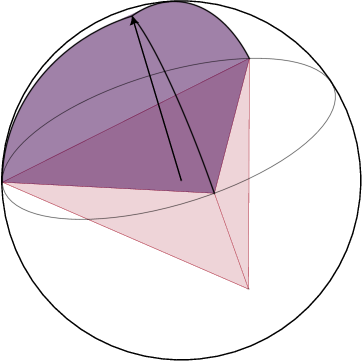
Figure 1: Maximally random, γ=41, skewed SIC POVM for qubits produces a uniform distribution from a pure input and saturates min-entropy bounds.
This explicit construction demonstrates that in any dimension where an SIC exists, there is a device-dependent (or even source-device-independent) protocol for generating the maximum possible intrinsic quantum randomness.
Randomness of Unbiased Extremal Rank-One Measurements
A comprehensive analysis is made for arbitrary unbiased extremal rank-one pguess0 POVMs, in which pguess1. The randomness generated when measuring a state pguess2 is shown to be determined by the maximal fidelity with any convex mixture of measurement projectors:
pguess3
where pguess4.
This leads to powerful, general lower bounds:
State-independent bound: All such measurements yield at least pguess5 bits of min-entropy for any state (relevant for source-device-independent scenarios).
Projective vs. pguess6-outcome MICs: Only MICs with pguess7 outcomes can achieve more than pguess8 bits of min-entropy, i.e., can outperform projective measurements.
Qubit (d=2) Case: Complete Solution and Geometry
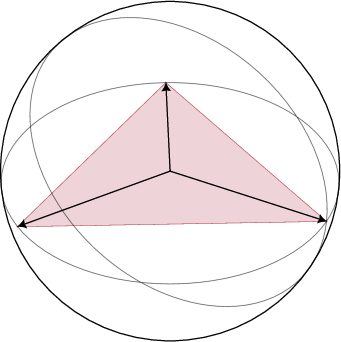
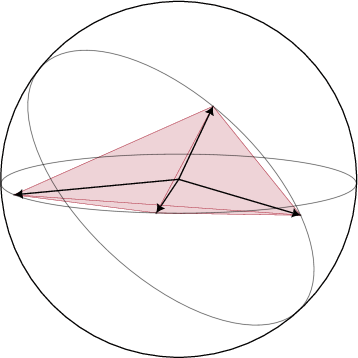
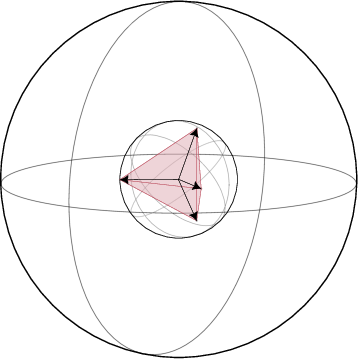
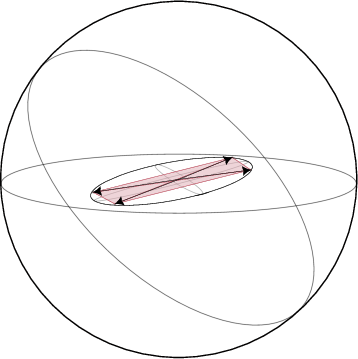
The qubit case admits comprehensive analytic results due to geometric simplicity. Unbiased extremal qubit POVMs fall into three families: projective (2-outcome), trine (3-outcome), and MICs (4-outcome). The 4-outcome unbiased MICs are shown to be group-covariant and can be parametrized by two angles, defining the vertices of a disphenoid (non-regular tetrahedron) in the Bloch sphere.
Figure 2: Bloch sphere visualization of a trine measurement (left) and an unbiased MIC (right), each representing equiangular and tomographically complete qubit measurements, respectively.
For any qubit MIC, the maximal intrinsic randomness is achieved by a pure state normal to any face of the tetrahedron formed by POVM vectors, yielding
pguess9
where γ0 is the distance from the center to the face. Notably, among all unbiased qubit MICs, the SIC POVM (regular tetrahedron, γ1) achieves the minimumγ2 and thus the lowest maximal randomness.
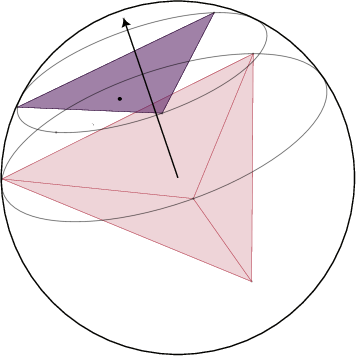
Figure 3: The shape γ3 depicts the region of quantum states for which the optimal decomposition into measurement-specific pure states arises when evaluating eavesdropper guessing probability.
For arbitrary mixed states, the optimal eavesdropper decomposition is precisely characterized via geometric constructions involving convex hulls and normal translations/dilations.
Scissors-Like POVM Families and Randomness Saturation
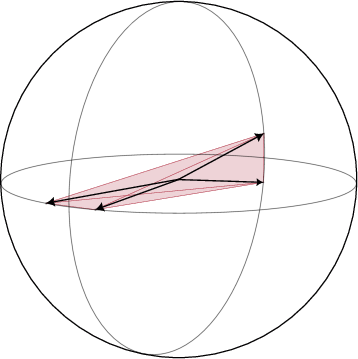
A family of "scissors" MICs interpolates between SIC (most tomographically powerful, least random) and measurements approaching full maximal randomness by contracting the tetrahedron faces toward a limiting configuration. This is parameterized by setting γ4 and reducing the opening angle γ5:
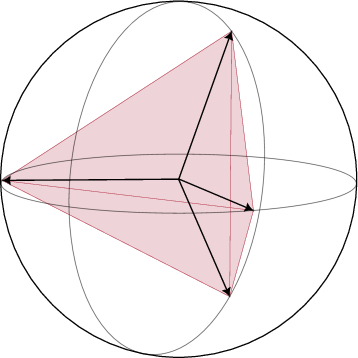
Figure 4: A SIC POVM (left) versus a scissors measurement (right). The scissors measurement can get arbitrarily close to saturating the min-entropy bound while becoming non-extremal at the limit.
In higher dimensions, scissors-family constructions based on Weyl-Heisenberg group or geometric design generalizations yield minimal unbiased MICs approaching the maximal γ6 bits, provided proper parameterization (e.g., specific fiducial state selection for qutrits, ququarts).
Implications, Contrasts, and Prospects
Theoretical Impact
The explicit connection between randomness generation and the geometric/algebraic structure of MICs and their convex polytopes deepens the foundational understanding of quantum measurement theory. The result that the SIC POVM—optimal for tomography—yields the least intrinsic randomness among unbiased MICs is particularly significant, highlighting a fundamental trade-off between information completeness for reconstruction and unpredictability of outcomes.
Practical Relevance
The results are relevant for designing quantum random number generators and quantum cryptographic protocols where device- or source-device-independent certification is required. By constructing explicit measurement protocols saturating entropy bounds, the work provides templates for realizing maximal quantum randomness in laboratory and commercial settings.
Future Directions
Key open questions include:
Whether such maximal randomness POVMs can enable device-independent randomness certification—only partially explored for qubits and certain scissors-family measurements.
Whether the "minimum randomness" property of the SIC among unbiased MICs generalizes strictly to higher dimensions.
The role of noise and imperfect devices: While ideal extremal measurements are studied here, incorporating realistic imperfections is essential for deployment.
Conclusion
By constructing explicit biased and unbiased extremal rank-one POVMs, the paper establishes both achievable protocols and general lower bounds for quantum randomness beyond projective measurements, fully solves the problem for qubits, and introduces new connections between measurement structure, randomness, and quantum information tasks. The framework developed informs both foundational and applied quantum information science.
Figure 5: Visualization of a SIC POVM—the regular tetrahedron in the qubit Bloch sphere—demonstrating the minimum achievable maximal min-entropy among unbiased extremal MICs, complementing its status as the optimal tomographic measurement.