Published 18 May 2026 in math-ph and cond-mat.stat-mech | (2605.18093v1)
Abstract: The Korteweg-De Vries (KdV) equation is a paradigmatic model of integrable classical fields, admitting solitoning solutions. When many solitons are near to each other, their shapes are modified, and it is not manifest, from the KdV field, where they are. This is a key problem in the analysis of a soliton gas, as its main object, the density of states, is a number of solitons per unit length. How to define solitons' positions at finite densities in the macroscopic limit? A sensible criterium is that, projecting out solitons lying outside a mesoscopic region, the KdV field is unchanged in this region, and the result is a multi-soliton field supported there. In the context of emergent hydrodynamics, this is referred to as a fluid-cell projection. In this paper we solve this problem. We define solitons' positions and a fluid-cell projection, and show that it has these properties, without introducing radiative corrections. We show that the weak limit of conserved densities can be evaluated using the density of states. On large scales the solitons' positions satisfy the semi-classical Bethe equations introduced in the context Generalised Hydrodynamics, that accounts for the two-body scattering shift and encodes factorised scattering. A non-rigorous derivation reproduces the kinetic equation of the KdV soliton gas, first proposed by Gennady El in 2003 using Witham modulation theory from finite-gap solutions. The results hold under simple conditions on spectral parameters, and certain physically natural conditions on impact parameters. No randomness is required. Our proof is based on a novel tau function for the multi-soliton KdV field, which also allows us to obtain new bounds on the growth of the multi-soliton support and on the supremum of the field and its derivatives. We believe the methods are generalisable to other solitonic models.
The paper introduces a rigorous definition of effective soliton positions using coupled Bethe-type equations for dense KdV soliton gases.
It employs fluid-cell projection to isolate local soliton dynamics, ensuring that field observables correspond solely to solitons within a fluid cell.
The analysis establishes explicit bounds on the field support and outlines a framework extendable to other integrable soliton gas models.
Soliton Position Theory in KdV Soliton Gases: Rigorous Foundations and Projection Mapping
Introduction
The manuscript "Where solitons are in a KdV soliton gas" (2605.18093) addresses a foundational challenge in the emergent hydrodynamics of integrable nonlinear wave equations: how to define, extract, and track the positions of individual solitons inside dense, interacting multi-soliton Korteweg-de Vries (KdV) solutions—the so-called soliton gas regime. Historically, while the kinetic and hydrodynamic behaviors of soliton gases have been heuristically described via density of states and modulation theory, the precise localization and counting of solitons at finite densities within the field (as opposed to their identification in asymptotic, well-separated limits) has lacked a satisfactory, constructive definition. This paper bridges that gap using a rigorous algebraic and analytic construction that recasts local soliton "positions" as a solution to semi-classical Bethe-type equations, formalizes fluid-cell projections, and demonstrates the compatibility of these constructions with emergent hydrodynamics and local observables in the KdV field.
Problem Setup and Motivation
Integrable systems like the KdV equation admit N-soliton solutions, constructed via the inverse scattering method or tau functions, whose asymptotic scattering behavior is factorized and elastic. Traditionally, soliton positions are only unambiguously defined in the infinite past or future and when solitons are well separated. However, in the high-density, mesoscopic regime relevant to soliton gas theory, soliton "shapes" overlap nontrivially, making their localization in the field mathematically ambiguous. This presents a fundamental obstacle to directly connecting the spectral/spatial density ρ(χ,x)—used in kinetic theory and Generalized Hydrodynamics (GHD)—to concrete, local field-theoretic observables.
A key desideratum is a definition of "soliton position" such that, upon projection of the field outside a given mesoscopic fluid cell, the internal structure and local observables within the cell are preserved and reconstructable solely from solitons within it. This "fluid-cell projection" and the supporting notion of local quasi-particles (solitons) are pivotal for rigorous derivations of kinetic and hydrodynamic descriptions from microstates.
Main Results and Construction
Algebraic Characterization of Soliton Positions
The author introduces a map from the soliton field parameters (spectral parameters χi, impact parameters yi) to effective, field-theoretically meaningful soliton positions xi. These positions are defined as the solution to the coupled nonlinear Bethe-type equations:
yi+vit=xi(t)+21j=i∑sgn(xi(t)−xj(t))φij,
where vi=4χi2 and φij=χi1logχi+χjχi−χj encode the two-body soliton scattering shifts. This construction effectively implements the so-called collision rate ansatz at the core of GHD.
These effective positions:
Match asymptotic definitions in dilute, non-overlapping regimes,
Are defined for arbitrary soliton configurations at any finite time,
Encode all local observable information in fluid cells via an appropriately defined projection,
Are algebraically computable from the N-soliton tau function representation.
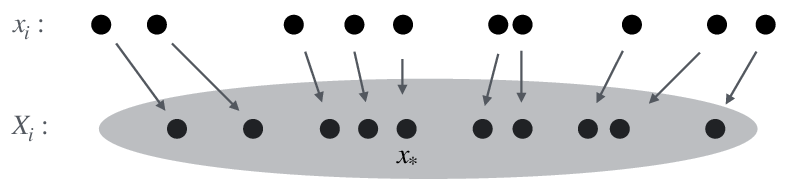
Figure 1: Magnifying glass effect: cartoon illustration of how magnifying-glass positions Xi relate to the true Bethe/BGHD effective positions xi; only locally do these coincide.
Fluid-Cell Projection and Locality
Given a spatial interval (fluid cell), the field is projected to be supported only on solitons whose effective positions xi are inside the cell. Importantly, the remaining field matches the original within the cell, and information from outside is decoupled up to an error term that vanishes in the macroscopic limit.
The impact parameters for the projected field are adjusted by precise scattering shifts to account for the absence of solitons exterior to the cell, using the same algebraic structure as the full N-soliton solution. The mapping and its properties are proved using tau function identities and representations constructed to highlight locality.
Weak Limits and Local Observables
The main theorem establishes that, under a family of physically motivated and algebraically checkable density and regularity assumptions on χi0, one can:
Extract a local, empirical density of solitons—the "density of states"—as a weak limit of the effective positions,
Rigourously compute the Euler-scale limits of all conserved and generic local densities in the field based purely on χi1,
Demonstrate that, on scales large compared to microscopic soliton width and separation but small compared to system size, local field averages are governed exclusively by the subset of solitons inside the interval, with the rest affecting only boundary corrections that vanish as χi2.
These results build a concrete bridge from field-theoretic microstates to their hydrodynamic and kinetic descriptions.
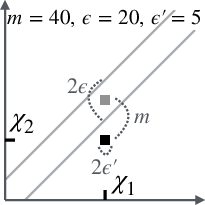
Figure 2: Schematic integration domain in tau function expansion, showing the structure of fully included (i = 1, j = 2) and excluded (i = j = 1) terms in the mollified density representation.
Control of Field Support and Boundedness
Novel bounds are established for the spatial support of the multi-soliton field: the field and all its derivatives are proven to be exponentially small outside a "core" captured by the extremal effective positions. The supremum of the field and its derivatives is controlled in terms of polynomial functions of χi3 (number of solitons), with explicit constants determined by density assumptions.
Explicit Examples and Universality
The formalism and results are shown to cover standard dilute soliton gas models and are expected to generalize to other integrable soliton gases (e.g., Toda, sine-Gordon, and higher-dimensional analogues). The analysis is robust, not relying on randomness or Anderson localization phenomena, emphasizing its deterministic, algebraic nature.
Implications and Future Directions
This work rigorously grounds the correspondence between microstate structure and mesoscopic hydrodynamics in integrable PDEs. It justifies the use of effective Bethe-type positions for extracting macroscopic variables and supports the kinetic theory and GHD formalism employed in both mathematical physics and experimental realization (such as cold atom systems).
The construction clarifies the role of integrability—namely, factorizable scattering and the existence of a solvable quasi-particle network—in enabling this mapping, suggesting universality for a broad class of classical and quantum soliton gases. It also prepares the groundwork for similar constructions in higher-dimensional and non-scalar-field integrable hierarchies.
Going forward, the algebraic approach used here hints at new ways to study fluctuations, non-Gaussian correlations, and higher-order hydrodynamic corrections. Extending the machinery to encompass radiative (non-solitonic) field components and to derive hydrodynamic fluctuations ab initio remains a compelling challenge.
Conclusion
"Where solitons are in a KdV soliton gas" (2605.18093) provides a rigorous, constructive solution to the problem of identifying and tracking soliton positions at finite densities within KdV soliton gases. By encoding soliton positions as Bethe/kinetic-type variables and formalizing the fluid-cell projection, the work enables direct connection between field-theoretic, observable quantities and emergent hydrodynamics. These results foundationally support the kinetic and GHD paradigm in integrable field theories, with significant implications for both mathematics and experiment.