- The paper quantifies the minimal quantum contribution (<1% QPU time) in D-Wave hybrid portfolio optimization.
- It demonstrates that constraint-native CQM outperforms penalty-encoded BQM by achieving optimal, zero-gap solutions across tested instances.
- The study reveals that penalty encoding leads to dense logical graphs, causing chain breaks and scalability challenges for QPU-based methods.
Audit of Quantum Contribution in D-Wave Hybrid Portfolio Optimization
Summary of Objectives and Methods
This paper rigorously dissects the contribution of quantum resources within D-Wave's hybrid solvers for the cardinality-constrained mean-variance-turnover (MVT) portfolio optimization problem. The study benchmarks four solution pathways: direct QPU sampling, D-Wave hybrid BQM (penalty-encoded), D-Wave hybrid CQM (constraint-native), and classical baselines (Gurobi MIQP and simulated annealing). The analysis spans a systematic sweep over problem size (N), covariance density structure (diagonal, block, dense), and solver wall-clock budget, using both controlled synthetic instances and real equity data from the Fama–French 49 industry set.
Crucially, the investigation is anchored by an explicit audit of quantum processing unit (QPU) attribution: detailed runtime decomposition (wall-clock, QPU access time, classical phases) is reported to quantify the proportion of computation genuinely performed by quantum hardware. Structural properties relating to the density of the logical graph under penalty encoding, and deterministic budget saturation characteristics of the CQM path, are also thoroughly analyzed.
Structural Impact of Penalty Encoding and Density Collapse
A central structural finding is that penalty-encoding the cardinality constraint as a quadratic term (A⋅11⊤) in the QUBO formulation induces a dense, fully connected logical graph, irrespective of the original problem's covariance density. This density-axis collapse is both theoretically predicted and empirically validated: chain-break fractions and embedding overheads for direct QPU runs are shown to be nearly invariant across sparse and dense covariance regimes at any fixed N.
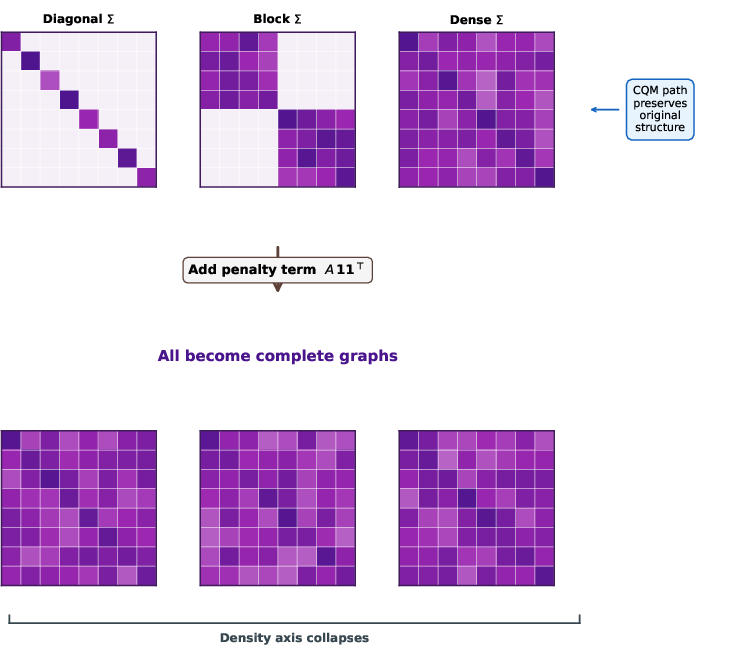
Figure 1: Density-axis collapse under penalty encoding. Three structurally different covariance matrices all become complete graphs after adding the cardinality penalty A⋅11⊤.
Practically, this implies that for penalty-encoded QUBO workflows (both direct QPU and hybrid BQM), the minor embedding bottleneck and error-inducing chain breaks fundamentally limit solution quality as problem size increases, independent of the problem's native sparsity.
The experimental results consistently indicate that the constraint-native CQM interface dominates the penalty-encoded BQM path on the tested instances, across all problem sizes and covariance densities. Notably, the CQM path achieves exact matches to the proven Gurobi optima on all instances (N=10 to $120$) where Gurobi proves optimality, with zero gap, while the BQM and simulated annealing degrade as N increases due to penalty domination.
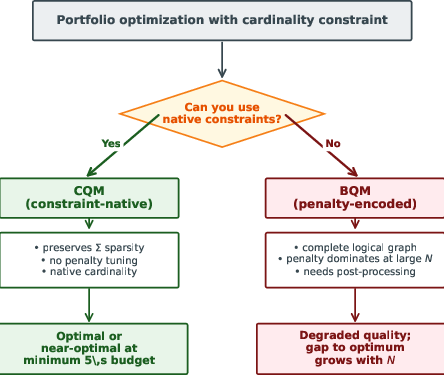
Figure 2: Formulation choice for D-Wave portfolio optimization. CQM preserves sparsity, eliminates penalty tuning, and achieves optimal solutions at minimum budget; BQM creates dense graphs and degrades with N.
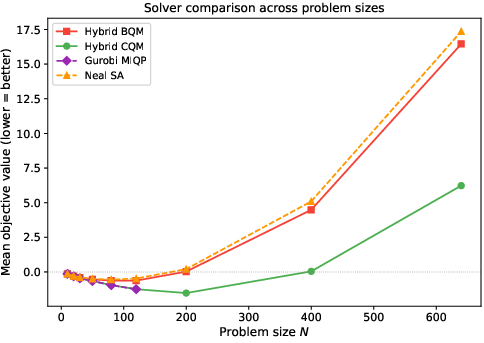
Figure 4: Mean objective value vs N for solver families. Hybrid CQM (green) tracks the Gurobi baseline (dashed purple), whereas Hybrid BQM (red) and simulated annealing (orange) diverge for large N.
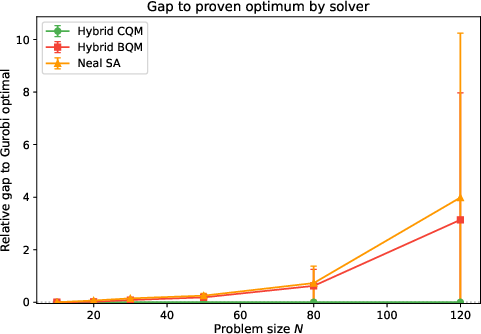
Figure 6: Relative gap to Gurobi optimal vs N. CQM (green) is optimal across the tested range, BQM and SA gaps grow monotonically with A⋅11⊤0 due to penalty dilution.
Empirical findings further confirm that this formulation effect is not solver-specific: simulated annealing, operating on the same penalty-encoded QUBO, demonstrates parallel degradation patterns, underscoring constraint dilution as the mechanism.
QPU Attribution and Hybrid Solver Architecture
D-Wave hybrid solvers primarily allocate computational budget to classical decomposition, subproblem generation, and feasibility-aware reassembly, with the QPU typically accounting for A⋅11⊤1 of wall-clock time in CQM runs—mean QPU access time is A⋅11⊤2 s out of a A⋅11⊤3 s wall-clock budget.
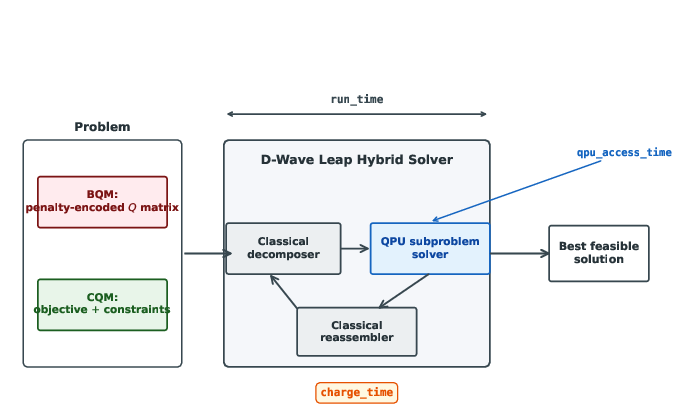
Figure 7: D-Wave hybrid solver architecture, depicting iterative classical decomposition and QPU subproblem solving, with explicit runtime component reporting.
This establishes that the reported "hybrid win" for constraint-native CQM is primarily a classical pipeline result. Quantum sampling contributes only incrementally and is not the dominant driver of optimality or performance within these hybrid solutions.
Determinism and Budget Saturation in CQM
Hybrid CQM demonstrates a notable property of budget saturation: for the MVT portfolio problem, identical solutions are reached across wall-clock budgets from 5 to 300 seconds and across repeated runs, indicating deterministic convergence for this constraint set and instance family.
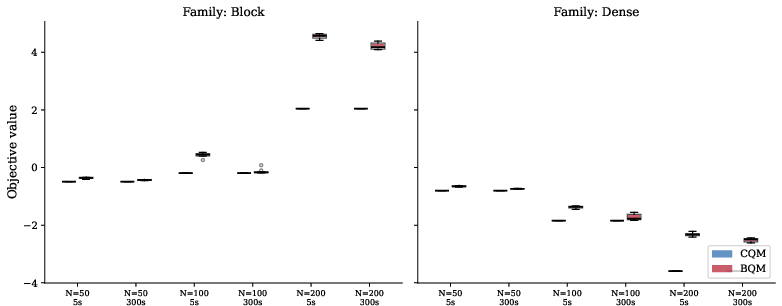
Figure 3: Stochastic validation—10-run box plots show zero variance for CQM across budgets, in contrast with BQM's stochasticity and inability to match CQM's performance.
Correspondingly, budget tuning is rendered moot for CQM on this class of problem. In contrast, BQM's performance improves with additional wall-clock budget, albeit never reaching CQM's solution quality for any tested A⋅11⊤4 or budget.
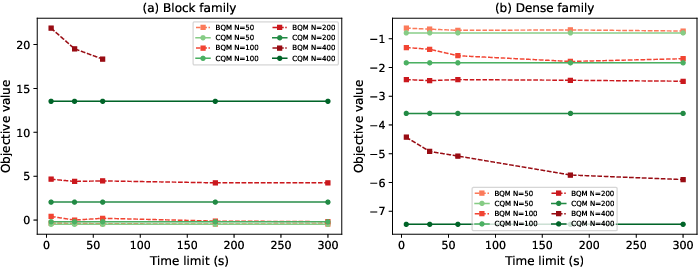
Figure 5: Budget response curves for hybrid BQM and CQM. CQM achieves flat, optimal objective values at all tested budgets; BQM improves but always lags behind.
For direct QPU access, the impact of constraint dilution is manifest in rapidly increasing chain-break fractions (A⋅11⊤5 for A⋅11⊤6) and large embedding overheads. The consequence is that decoded solutions for large A⋅11⊤7 become increasingly determined by post-processing heuristics rather than by QPU annealing.
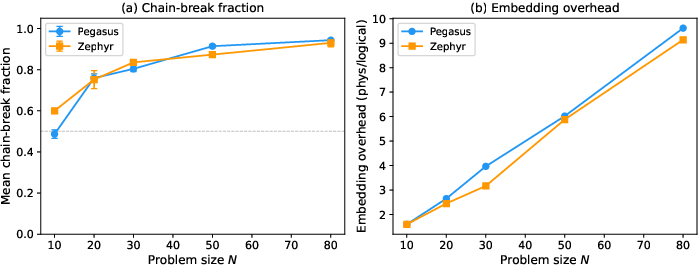
Figure 10: Mean chain-break fraction and embedding overhead vs problem size for direct QPU runs, split by hardware topology.
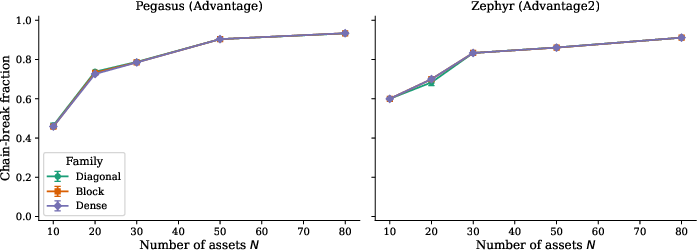
Figure 9: Chain-break fraction vs A⋅11⊤8, split by density family and hardware. Overlap of all three density families confirms penalty-induced density collapse.
Tests on real Fama–French equity data reaffirm these patterns, with chain-break statistics closely tracking those observed in synthetic benchmarks.
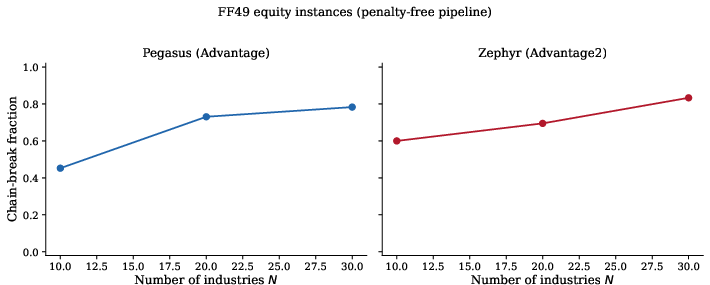
Figure 8: Direct QPU on real Fama-French equity data—chain-break fraction vs A⋅11⊤9 matches synthetic trends, confirming structural results hold for real-world financial matrices.
Implications and Future Directions
The findings have several notable implications:
- Formulation trumps solver choice: For the D-Wave ecosystem, the modeling interface (constraint-native vs penalty-encoded) is a far more significant determinant of performance than hardware selection or quantum annealer invocation strategy.
- Quantum attribution must be explicit: Evaluation of quantum-assisted hybrid methods must quantify the division of labor between classical and quantum resources, as the degree of quantum sampling may be minimal for structured constraint-native workflows.
- Benchmark axes must be carefully interpreted: Covariance matrix density is rendered irrelevant for penalty-encoded approaches, undermining the interpretability of density-based scaling tests for these methods.
- Practical recommendation: For portfolio selection and similar allocation tasks, the D-Wave CQM interface is preferable, both operationally and from a reproducibility standpoint.
On the theoretical front, further expansion to mixed-integer, non-binary, or multi-period constraint classes will be required to test the generalizability of the CQM advantage and to evaluate the role of quantum sampling in more intricate hybrid decompositions. Assessment on larger-scale, real-world finance datasets and competitive comparisons with state-of-the-art heuristics beyond Gurobi may further enrich the understanding of where, if anywhere, quantum resources can offer practical benefits in institutional settings.
Conclusion
This audit clarifies that in D-Wave’s hybrid framework for cardinality-constrained portfolio optimization, the main operational advantage lies in classical, constraint-native algorithmic components, with quantum processing contributing only a small fraction of computation and solution quality. Penalty-encoded paths structurally induce scaling bottlenecks due to logical graph densification and constraint dilution. For practical deployments, constraint-native CQM is superior, both in solution quality and in eliminating the need for solver budget or penalty tuning. Benchmark reporting should explicitly partition classical and quantum contributions, and claims of hybrid or quantum advantage must be justified with transparent resource attribution and classical baselines. The formulation-choice effect observed here reframes how quantum finance benchmarks and deployments should be both interpreted and reported.