- The paper demonstrates that resonance alone doesn’t ensure geometric phase robustness; alignment between unitary and dissipative dynamics is crucial.
- It employs Kerr nonlinearity and a Lindblad master equation approach to analyze entanglement evolution using negativity metrics.
- The study highlights that optimal initial state preparation and tailored dissipation are key for preserving quantum coherence in open systems.
Dynamically Enabled Robustness of Geometric Phases and Entanglement in the Nonlinear Jaynes–Cummings Model
Introduction and Motivation
The nonlinear Jaynes–Cummings model (JCM) is a central framework for understanding hybrid light–matter interactions, integrating two-level systems with quantized electromagnetic cavity modes. Extending the standard JCM by including Kerr-type nonlinearities enables detailed control of quantum evolution and is directly relevant to quantum information processing and open quantum system theory. While resonance conditions in linear JCM are known to engender robustness of global quantum properties such as geometric phases (GPs), the interplay between nonlinearity, initial-state preparation, and dissipation in the context of robustness and entanglement dynamics within open quantum systems remains insufficiently characterized.
This paper establishes that resonance—or even geodesic state evolution—is not alone sufficient to guarantee robustness of geometric phases or entanglement in nonlinear JCM. Instead, it introduces a comprehensive geometric criterion: robustness emerges only when dissipation preserves the geometric structure of the unitary dynamics, signaled by the alignment between coherent and dissipative evolution in Hilbert space.
The Nonlinear Jaynes–Cummings Model and Dissipative Dynamics
The system under consideration generalizes the JCM Hamiltonian by incorporating a Kerr nonlinearity:
H^=2Δσ^z+χn^2+g(σ^+a^+σ^−a^†),
where Δ is detuning, χ is the Kerr nonlinearity strength, and g is the atom–field coupling constant. The inclusion of nonlinear effects results in sector-dependent renormalization of detuning, directly impacting the effective dressed-state structure.
Open-system dynamics, incorporating cavity losses and atomic decoherence, are described via a Lindblad master equation:
ρ˙(t)=−i[H^,ρ]+γD(a^)+pD(σ^−)+pzD(σ^z),
where each dissipator D(O^) captures a distinct decoherence channel.
Entanglement Dynamics: Geometric Control and Dissipative Degradation
Entanglement generation is quantified by the Negativity, a monotone under LOCC. Within the single-excitation subspace, the effective dynamics permit a Bloch-sphere representation where the Hamiltonian axis is controlled via Δ and χ.
Closed-system unitary evolution under resonance and appropriate initial conditions produces highly regular Rabi oscillations and maximal entanglement transfer between atom and field, particularly along geodesic trajectories on the Bloch sphere. As the initial state aligns with the rotation axis, entanglement oscillations diminish in amplitude but increase in average value, demonstrating the geometric sensitivity of entanglement dynamics.
In contrast, the introduction of dissipation (via cavity leakage and atomic dephasing) damps these oscillations and eventually suppresses entanglement.
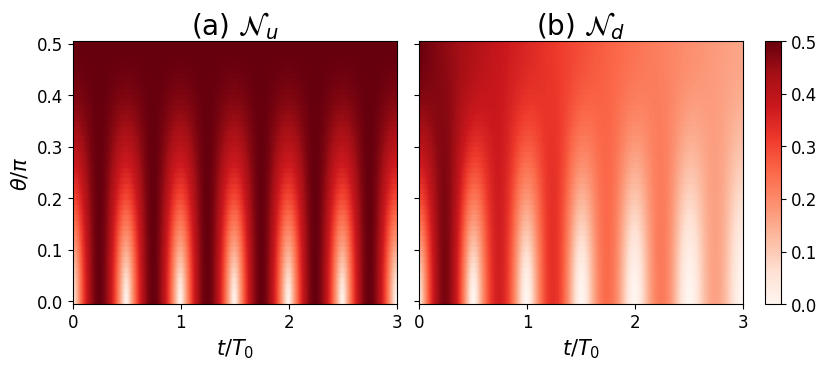
Figure 1: Negativity dynamics in time in resonance condition Δ=χ for different initial conditions for (a) closed systems and (b) open system evolution.
Entanglement dynamics away from resonance, for initial states perpendicular to the Hamiltonian axis, exhibit confinement near the maximally entangled equatorial region of the Bloch sphere. Increasing detuning skews the rotation axis, yielding altered entanglement characteristics.
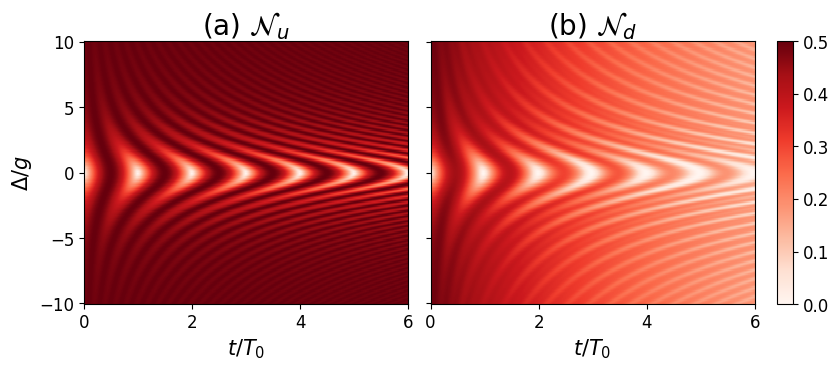
Figure 2: Negativity dynamics in time for different values of Δ and Δ0 for conditions perpendicular to the Hamiltonian direction, both closed and open systems.
Geometric Phase Robustness: Beyond Resonance and Geodesicity
The geometric phase (GP), sensitive to the global properties of the quantum trajectory, is computed using the kinematic formalism, extending to non-unitary dynamics via the Uhlmann and Tong constructs.
Prior works suggested that resonance in the linear JCM confers robustness of the GP against dissipation. This study, however, exposes the limitations of such a spectral perspective. Numerical simulations show that even with the resonance condition satisfied, robustness of the GP is contingent on the initial state's direction: only for initial states perpendicular to the rotation axis (ensuring geodesic motion on the Bloch sphere) is the GP unaffected by decoherence. Deviation from this optimal condition yields significant discrepancies between the GPs of the open and closed systems.
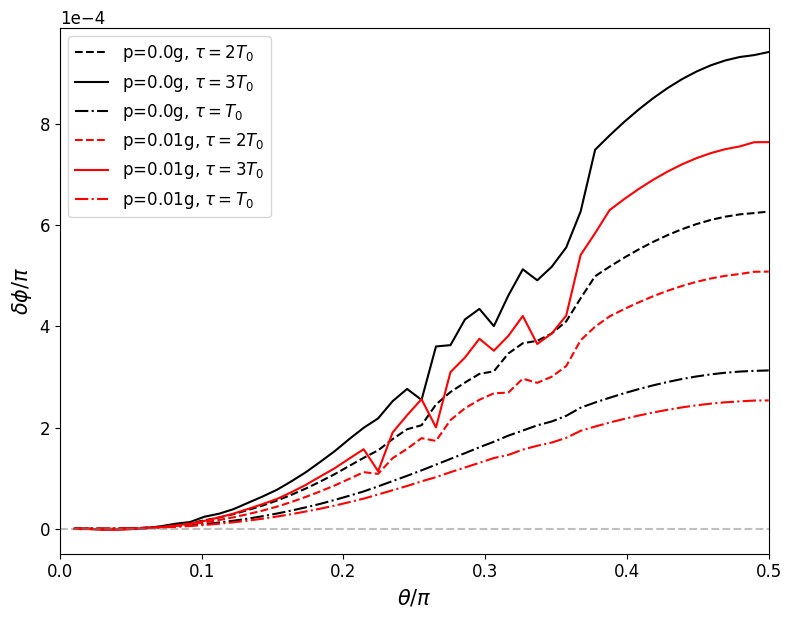
Figure 3: Difference of GP between closed and open system after a time Δ1 when varying initial condition direction Δ2 at resonance.
Allowing general off-resonance dynamics and initializing perpendicular to the Hamiltonian axis reveals that geodesic evolution is not universally protective: the GP's robustness disintegrates under dissipation unless additional dynamical symmetries are present.
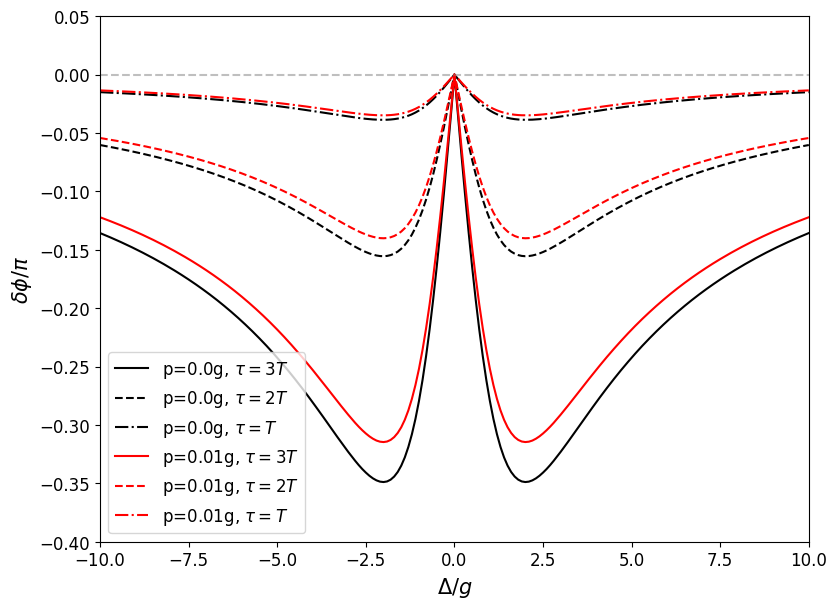
Figure 4: Difference of GP between closed and open system after a time Δ3 while varying Δ4 (off-resonance) with initial state perpendicular to the Hamiltonian direction.
The underlying mechanism is elucidated through a Bloch-sphere analysis. Under resonance, the evolution of the dominant density-matrix eigenvector in the open system precisely shadows the unitary trajectory, confining the dissipative contraction within a plane and preserving the geometric phase. Off resonance, the dissipative trajectory departs from this plane, and the GP deviates accordingly.
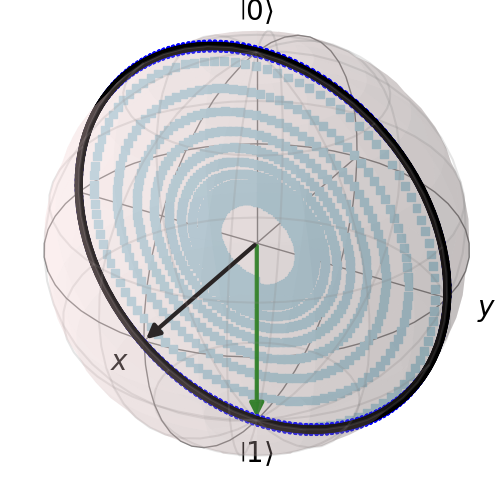
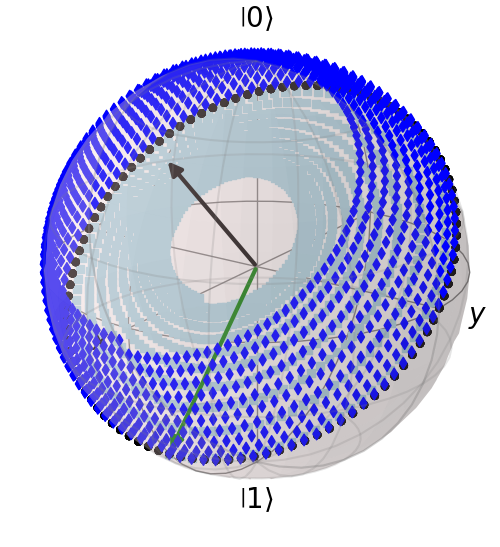
Figure 5: Trajectory on the Bloch sphere for perpendicular initial condition at resonance; the dissipative spiral follows the plane of the Hamiltonian-induced unitary trajectory.
Theoretical and Practical Implications
This work advances the theoretical understanding of geometric protection mechanisms in open quantum systems. Crucially, it demonstrates that resonance and geodesic initial-state preparation, while necessary, are not universally sufficient for geometric-phase robustness. Instead, the dynamical alignment between unitary and dissipative trajectories is required. This has direct implications for quantum control in superconducting circuits, cavity QED, and engineered open quantum platforms, especially for applications relying on holonomic and geometric quantum computation.
The broader implication is a call to refine the criteria for decoherence resilience in quantum architectures: robust geometric quantum phenomena demand careful synchronization of system Hamiltonian, initial state, and engineered dissipation.
Conclusion
The results presented delineate a geometric criterion for the dynamical protection of quantum coherence and geometric phases in nonlinear light–matter systems. Kerr nonlinearities modify resonance conditions but do not, alone, guarantee robustness. True robustness of geometric phases and entanglement requires not only resonance and geodesic evolution but also a specific preservation of the underlying unitary pathway by the dissipative dynamics. These findings suggest that future strategies for robust quantum control should target not merely spectral conditions or geometric paths but the entire coherent–dissipative evolution, potentially by tailoring system–environment interactions to preserve desired geometric structures in Hilbert space. This framework informs both fundamental open quantum system theory and the development of resilient quantum information protocols.