- The paper shows that imposing Boolean kinetic constraints on superradiance transforms separable mixed states into extensively entangled dark states with Θ(N^2) scaling.
- It presents rigorous analytical scaling laws and numerical validations for superradiant emission via constrained jump operators in spin and Rydberg systems.
- The study details experimental protocols using Rydberg arrays and demonstrates robustness against realistic imperfections like dephasing and interaction tails.
Extensive Mixed-State Entanglement in Kinetically Constrained Superradiance
Introduction
The study examines collective quantum emission—superradiance—under kinetic constraints in cavity-coupled spin and Rydberg systems. Traditional Dicke superradiance yields separable mixed states and negligible many-body entanglement. In contrast, kinetically constrained superradiance, induced by Boolean local rules such as AND or EAST, generates extensive mixed-state entanglement. This work rigorously quantifies the scaling of superradiant emission and elucidates the structure of the resulting dark-state manifolds, alongside robust numerical and analytic results applicable to experimental platforms based on Rydberg atoms.
Model and Cavity Elimination
The system consists of N spin-1/2 degrees of freedom coupled to a lossy cavity. The collective decay is driven by a jump operator F=∑jPjσj−, where Pj enforces local kinetic constraints. Adiabatic elimination of the cavity in the bad-cavity regime yields a master equation for the spins: ρ˙s=−i[χF†F,ρs]+ΓD[F](ρs)
with dissipator D[F](ρ)=FρF†−21{F†F,ρ}. The kinetic constraint modifies the collective emission statistics, affecting the accessible configurations and ultimately the nature of the stationary (dark) states.
Scaling of Superradiant Emission
The paper derives exact and lower-bound scaling laws for the superradiant emission under general Boolean kinetic constraints with finite range w. For the canonical AND model, the operator FAND involves only sites whose nearest neighbors are excited: FAND=∑jnj−1σj−nj+1
On a periodic ring, the number of reachable configurations after k jumps is analytically determined. This yields the intensity for the kth jump layer,
F=∑jPjσj−0
In the thermodynamic limit, the normalized intensity function F=∑jPjσj−1 remains nonzero for extensive F=∑jPjσj−2, confirming genuinely quadratic scaling: F=∑jPjσj−3
This scaling persists across all local Boolean constraint operators, with bounds derived via a combinatorial insertion lemma. Early emission occurs at collective intensity F=∑jPjσj−4, and the time to reach peak emission scales as F=∑jPjσj−5.
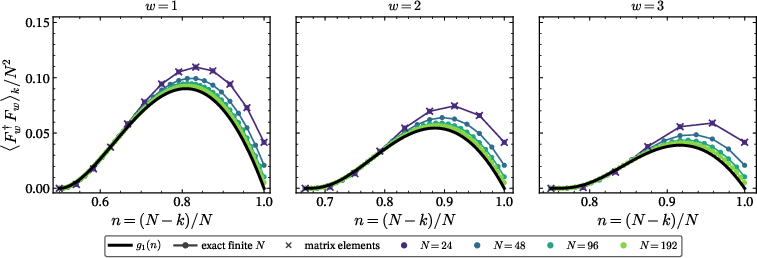
Figure 1: Thermodynamic scaling and finite-size checks for range-F=∑jPjσj−6 AND constraints with exact analytical formulas and numerically verified results.
Structure of Dark-State Manifold
The stationary states are dark to the dissipator, i.e., F=∑jPjσj−7. For the open EAST constraint (F=∑jPjσj−8, dark states are classified by local block correlators:
- F=∑jPjσj−9: independent-set states with no adjacent excitations.
- Pj0: superpositions with single adjacent pairs but no triples.
- Higher hierarchy: states with longer excitation blocks recursively constructed.
Each dark state is generated via local cancellation procedures, and the full kernel structure is organized by maximal run-length motifs. The essential result is a hierarchy of fragmentation inaccessible in the unconstrained Dicke limit.
Entanglement Properties and Witness Construction
The analysis demonstrates that Dicke superradiance yields separable stationary states, i.e., no genuine many-body entanglement post-relaxation. Conversely, for kinetic constraints, the mixed-state dark manifold includes extensively entangled states. The adjacent-excitation correlator Pj1 functions as an entanglement witness: any dark stationary state with Pj2 is necessarily entangled.
This is rigorously proven for separable states in the dark manifold, establishing a definitive criterion for genuine many-body entanglement generated by the constrained superradiant decay.
Validity of Rotating Wave Approximation (RWA)
The rotating wave approximation is justified via comparison of RWA and non-RWA cavity-eliminated dynamics across coupling regimes. For Pj3, the RWA accurately reproduces mean excitation and stationary properties; deviations appear at stronger coupling due to virtual counter-rotating processes, which modify the late-time structure of the dark-state manifold but leave early collective decay dynamics essentially unchanged.
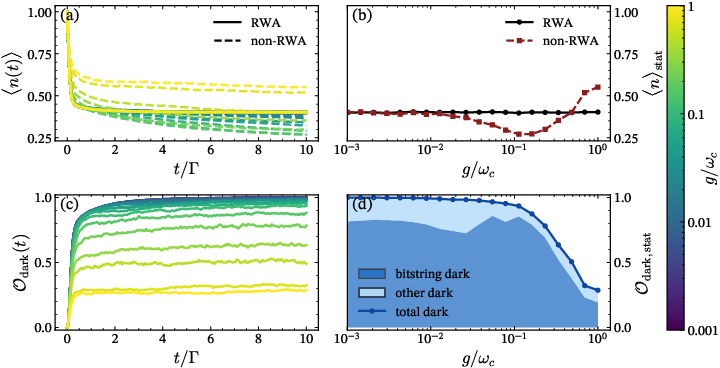
Figure 2: Comparison of mean excitation and stationary values for RWA (solid) and non-RWA (dashed) dynamics across coupling strengths.
Dynamical Simulations: DTWA vs Quantum-Jump
The discrete truncated Wigner approximation (DTWA) is benchmarked against exact quantum-jump simulations. DTWA accurately captures one-body observables and the timing and height of the superradiant burst. However, it fails for higher-order correlators and entanglement measures due to cumulant truncation, particularly in the stationary regime where quantum coherence and interference within the fragmented dark manifold are critical.
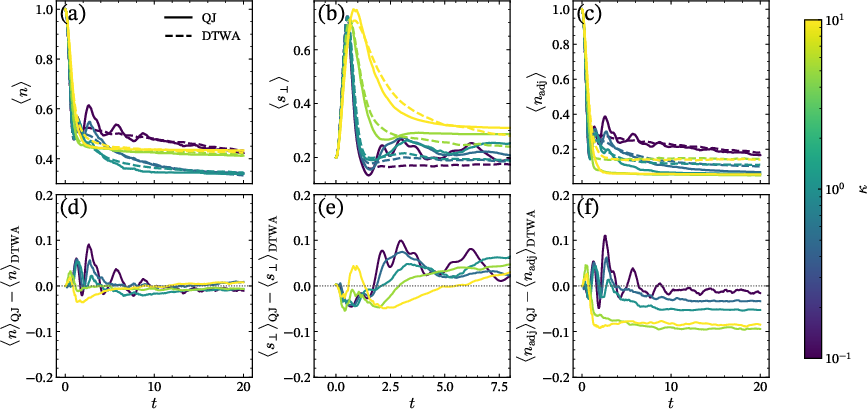
Figure 3: Benchmarking DTWA against quantum-jump results for excitation density, transverse coherence, and adjacent correlators.
Experimental Realization: Rydberg Atom Implementation
The paper details a protocol for realizing constrained superradiance in cavity-coupled Rydberg arrays, leveraging tunable detunings and laser-induced Stark shifts to encode constraints (EAST, XOR, AND) in the decay channels. Parameter estimates align with existing experimental capabilities, including control over van der Waals interactions and cavity linewidths.
Robustness to Experimental Imperfections
Rydberg Tails
Next-nearest-neighbor interaction tails modify the ideal constraint only quantitatively; the superradiant burst and its quadratic scaling persist. Late-time observables are slightly shifted, and, notably, mixed-state entanglement can be enhanced at intermediate tail strengths.
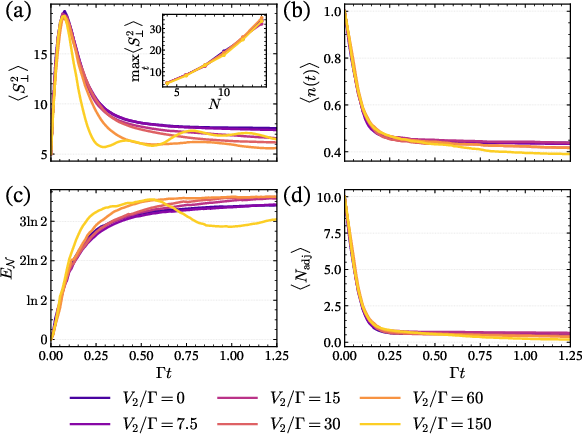
Figure 4: Effect of next-nearest-neighbor interaction tails on superradiant burst, excitation density, logarithmic negativity, and adjacent correlator.
Dephasing Noise
The entanglement signal is robust to common-mode dephasing, with the logarithmic negativity remaining unaffected across several decades of dephasing strength. Local dephasing, however, suppresses both the peak and plateau of the entanglement as its strength increases.
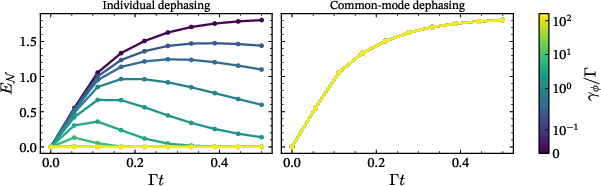
Figure 5: Impact of individual vs common-mode dephasing on logarithmic negativity for a half-chain bipartition.
Conclusion
Kinetically constrained superradiance robustly generates extensive mixed-state entanglement, in stark contrast to unconstrained Dicke superradiance. The quadratic scaling of collective emission, hierarchical fragmentation of the dark manifold, and definitive entanglement witness are substantiated analytically and numerically. The mechanism remains experimentally viable in Rydberg arrays, withstands realistic imperfections, and represents a concrete route to producing highly entangled mixed states in cavity QED platforms. Extensions may include probing the emergent structure of dark states, exploring Hilbert space fragmentation under open-system dynamics, and leveraging the entanglement witness for quantum simulation and information processing.