Generating collective spin cat states via photon-number measurements near the Dicke critical point
Published 15 May 2026 in quant-ph | (2605.15945v1)
Abstract: We propose a method for generating collective spin cat states in a cavity-coupled atomic ensemble by exploiting strong light-matter entanglement and anti-squeezing associated with the superradiant phase transition. We numerically and analytically demonstrate that the cat states can be heralded by photon-number measurement on the ground state of the Dicke model. The near-critical regime enhances both the cat-state size and the probability of obtaining larger photon-number outcomes, and outcomes with larger photon numbers yield even larger cat states. We also show that a thermodynamic-limit analysis clarifies the generation mechanism and connects it to a natural light-matter analogue of generalized photon subtraction for optical cat-state generation. These results suggest that exploiting criticality in strongly coupled light-matter systems could open new directions for matter-based many-body quantum technologies.
The paper introduces a measurement protocol that generates high-fidelity collective spin cat states near the Dicke critical point.
It employs photon-number measurements to conditionally project atomic ensembles, achieving cat state sizes with l_opt >> 1 and fidelities over 0.995.
Numerical and analytical analyses reveal a trade-off between measurement probability and SCS size, underscoring the protocol's experimental relevance in cavity QED systems.
Generation of Collective Spin Cat States via Photon-Number Measurements Near the Dicke Critical Point
Overview and Motivation
The paper presents a protocol for generating collective spin cat states (SCSs) in atomic ensembles coupled to cavity fields, leveraging criticality near the superradiant phase transition in the Dicke model. The approach exploits strong light-matter entanglement and anti-squeezing at the critical point. By conditioning atomic states on photon-number measurement outcomes in the cavity field, the protocol heralds SCSs whose size and fidelity are strongly enhanced near criticality. Theoretical and numerical analyses extend from finite-size systems to the thermodynamic limit, establishing both practical feasibility and fundamental connections to generalized photon subtraction schemes in quantum optics.
Theoretical Framework: Dicke Model and Superradiant Criticality
The Dicke model describes an ensemble of N two-level atoms collectively coupled to a single-mode cavity, characterized by the Hamiltonian
with eigenstates built from cavity photon number and collective spin basis. The system exhibits a superradiant phase transition at gc=ωcavωatom/2 in the thermodynamic limit, manifesting diverging light-matter entanglement and squeezing [lambert_Entanglement_2004], [emary_Chaos_2003].
Spin cat states of the form ∣cat(θ)⟩∝∣+θ,0⟩±∣−θ,0⟩ are considered, with size quantified by the normalized arc length lopt=Nθopt, where θopt is the fidelity-optimal angle.
Protocol: Photon-Number Heralding in the Near-Critical Regime
The proposed protocol consists of two steps:
Prepare the ground state of the Dicke model near the critical point.
Perform a photon-number measurement on the cavity field.
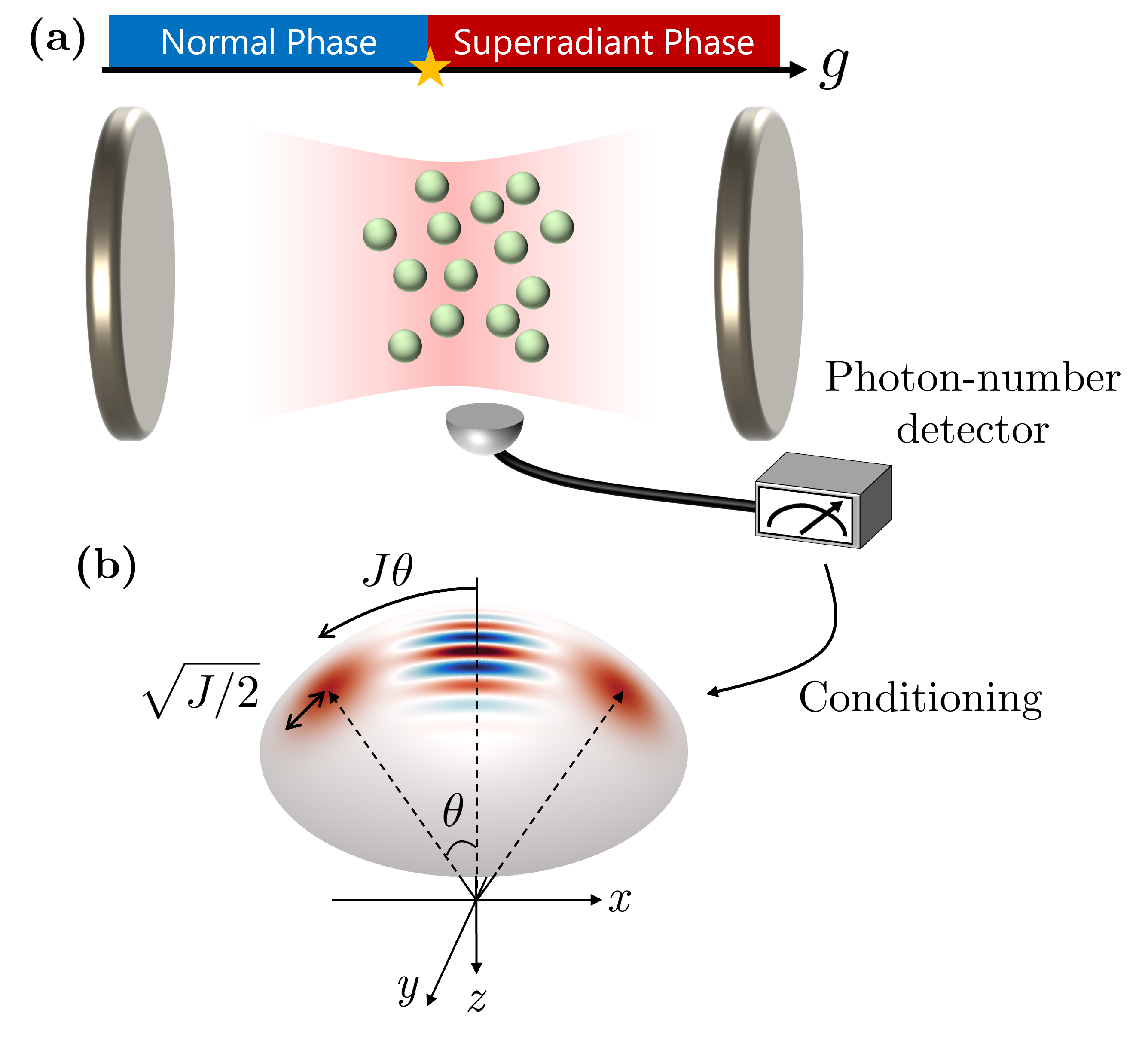
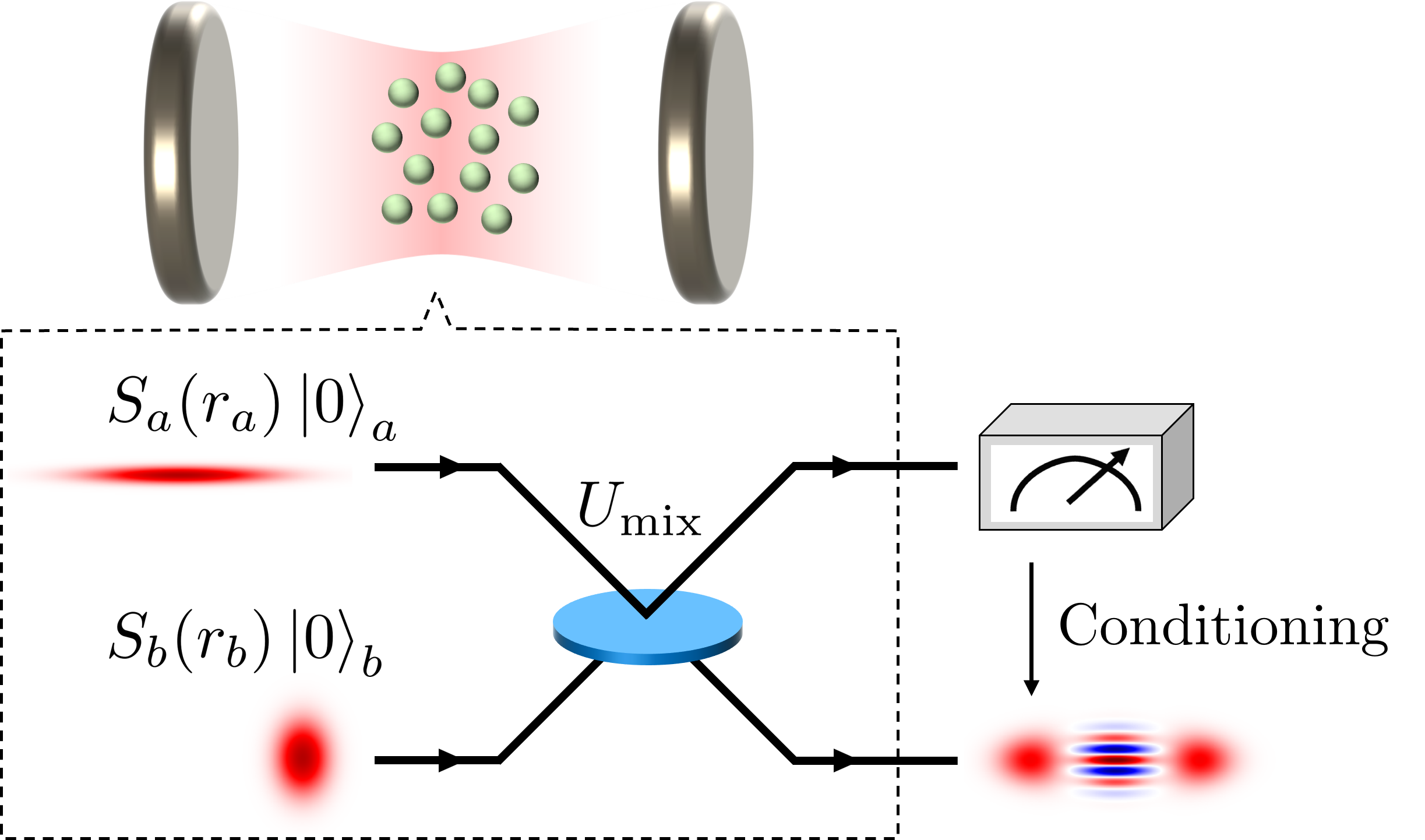
This measurement projects the atomic subsystem onto a heralded state ∣ψn⟩ conditional on the photon-number outcome n. The protocol is schematically illustrated in
Figure 1: Photon-number measurement in a strongly-coupled ensemble near the Dicke critical point heralds the generation of SCSs in the atomic subsystem.
The quantum state engineering relies crucially on near-critical entanglement and anti-squeezing, enhancing both the distinguishability and coherence of the superposed spin components.
Numerical Results: SCS Size and Trade-off with Measurement Probability
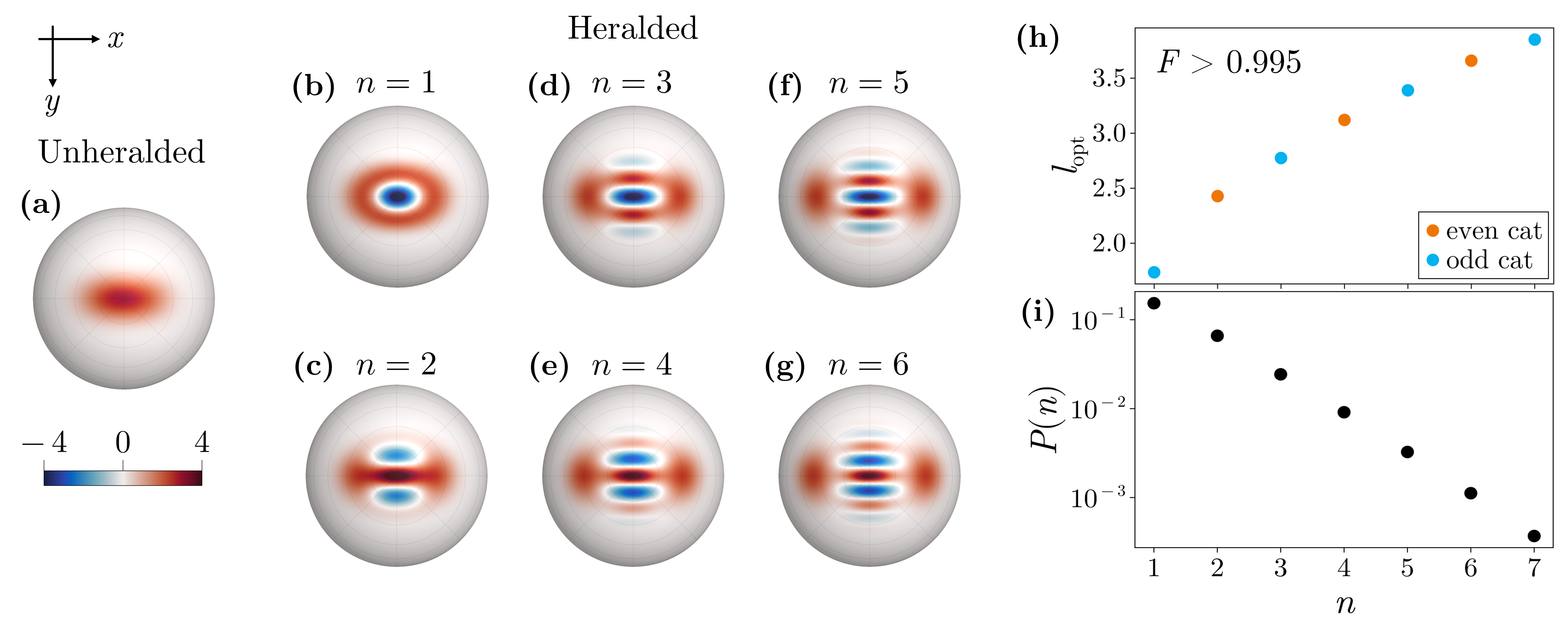
Numerical simulations reveal that the heralded atomic states exhibit strong cat-state features, including Wigner negativity and interference fringes (see
Figure 2: Wigner function analysis of atomic states under photon-number measurement; heralded states exhibit non-Gaussianity and cat-like interference, with size increasing with photon number outcome.
Quantitative findings highlight that:
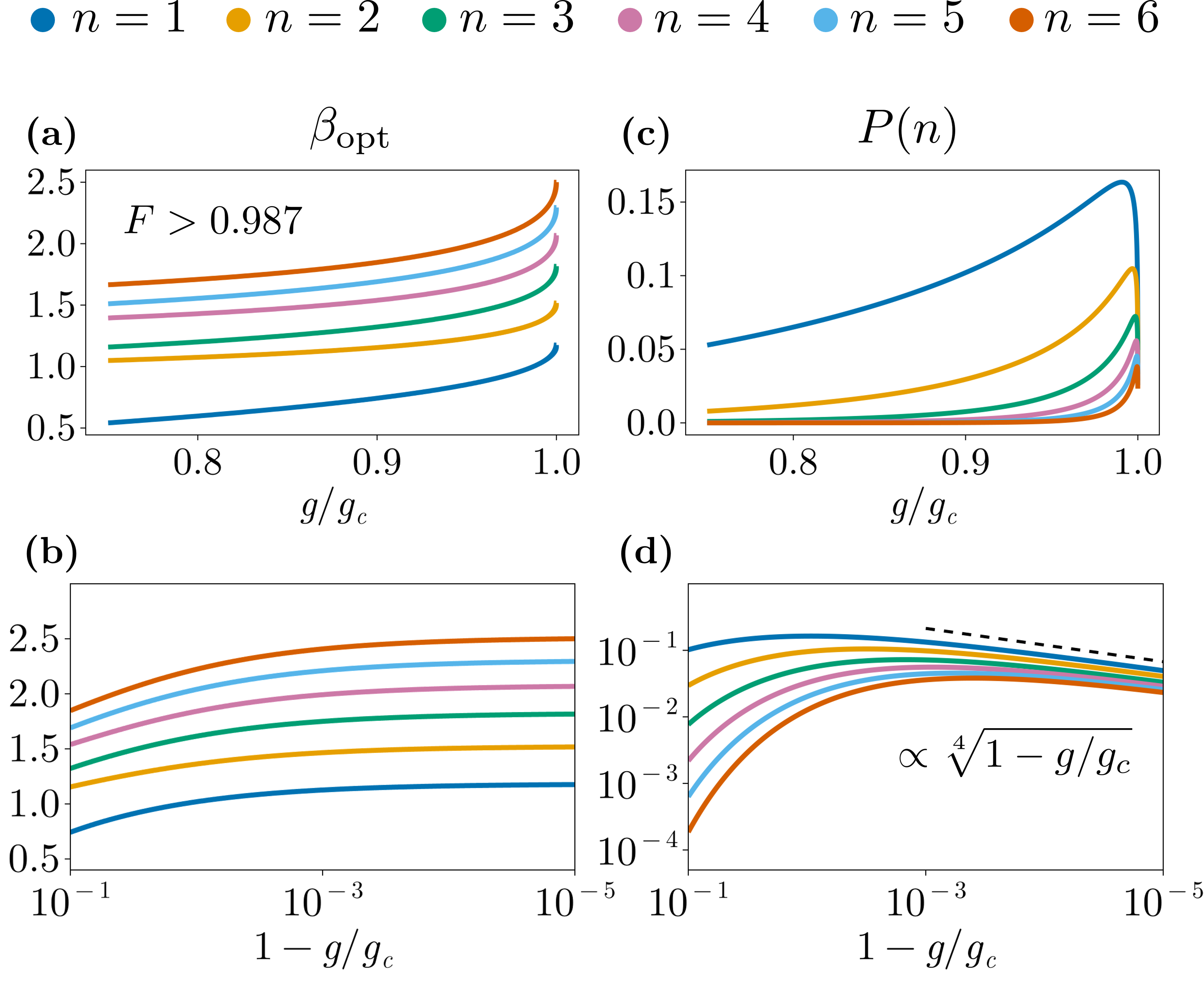
The size lopt of the SCS increases with photon number n, reaching values H^=ωcava^†a^+ωatom(J^z+2N)+Ng(a^†+a^)(J^++J^−)0 for moderate H^=ωcava^†a^+ωatom(J^z+2N)+Ng(a^†+a^)(J^++J^−)1. The fidelities to ideal cat states consistently exceed H^=ωcava^†a^+ωatom(J^z+2N)+Ng(a^†+a^)(J^++J^−)2 for all H^=ωcava^†a^+ωatom(J^z+2N)+Ng(a^†+a^)(J^++J^−)3.
The probability H^=ωcava^†a^+ωatom(J^z+2N)+Ng(a^†+a^)(J^++J^−)4 of measuring photon number H^=ωcava^†a^+ωatom(J^z+2N)+Ng(a^†+a^)(J^++J^−)5 decays exponentially with H^=ωcava^†a^+ωatom(J^z+2N)+Ng(a^†+a^)(J^++J^−)6, indicating a trade-off: larger spin cat states are achieved with decreasing likelihood.
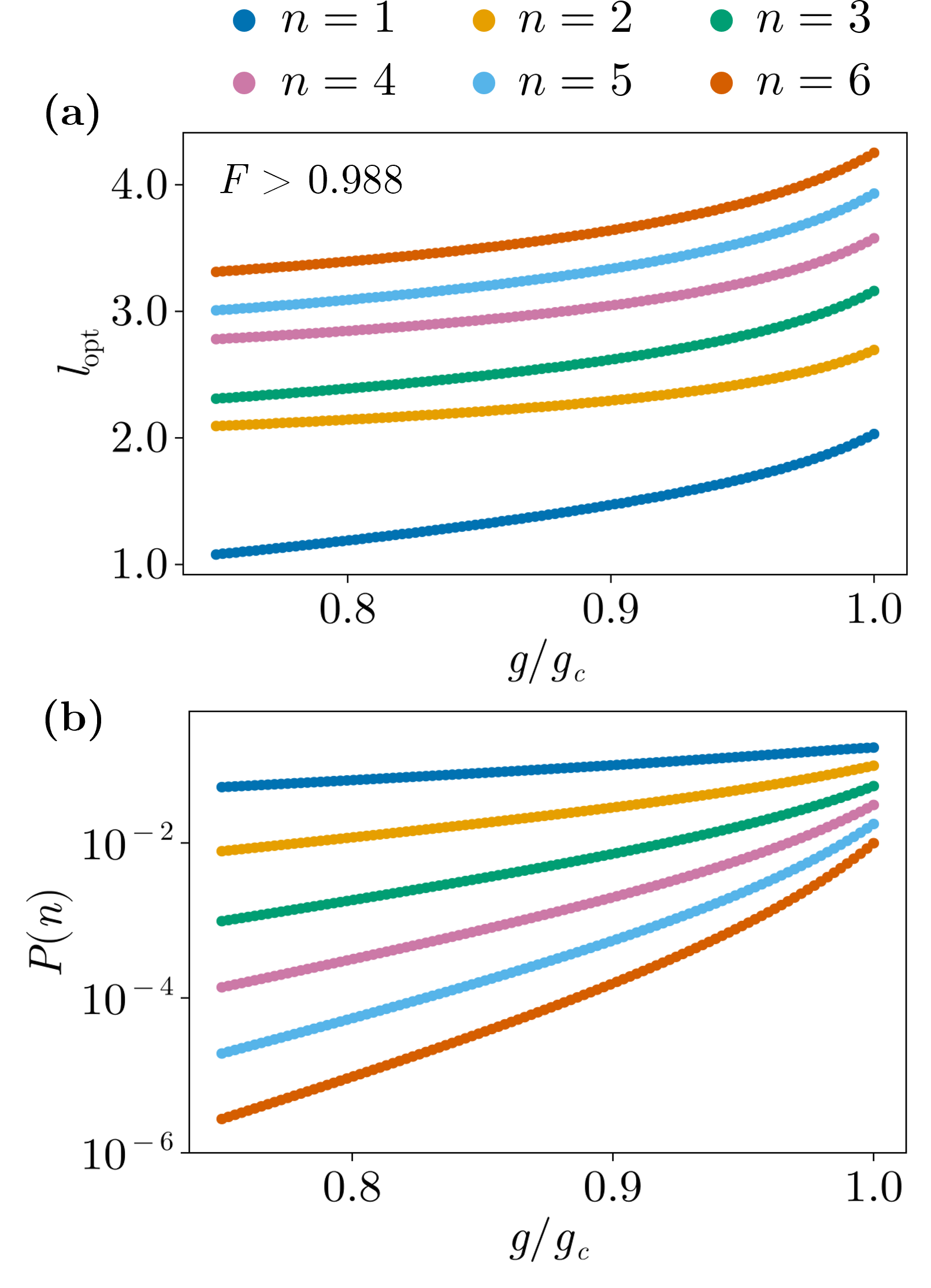
Crucially, approaching the Dicke critical point enhances both H^=ωcava^†a^+ωatom(J^z+2N)+Ng(a^†+a^)(J^++J^−)7 and H^=ωcava^†a^+ωatom(J^z+2N)+Ng(a^†+a^)(J^++J^−)8, resulting in larger and more probable cat states (see
Figure 3: Near-critical enhancement of SCS size and measurement probability as a function of coupling strength H^=ωcava^†a^+ωatom(J^z+2N)+Ng(a^†+a^)(J^++J^−)9 and photon-number outcome gc=ωcavωatom/20.
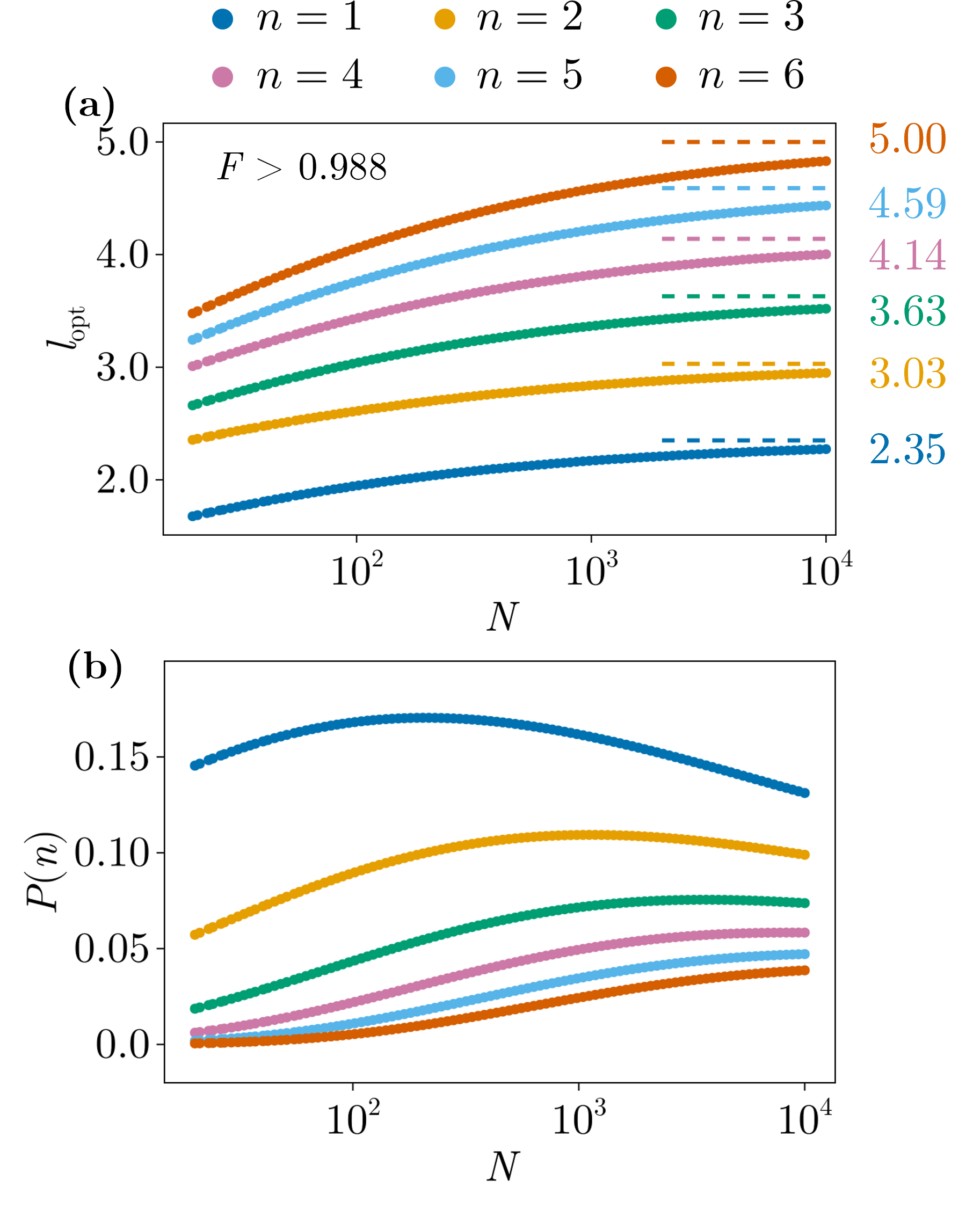
Scaling behavior with atom number gc=ωcavωatom/21 is analyzed, confirming saturation of gc=ωcavωatom/22 in the thermodynamic limit, and non-monotonic behavior in gc=ωcavωatom/23 for large gc=ωcavωatom/24 (
Figure 4: Scaling of SCS size and measurement probability with atom number gc=ωcavωatom/25 in the near-critical regime; saturation in the thermodynamic limit.
Analytical Insights: Thermodynamic Limit and Generalized Photon Subtraction
Analytical treatment via Holstein-Primakoff maps enables interpretation of the Dicke ground state as two-mode squeezed states mixed by a beam splitter. This connects the protocol directly to generalized photon subtraction schemes in quantum optics (
Figure 5: Ground state entanglement and effective beam splitter mapping underpinning the generalized photon subtraction mechanism for SCS generation.
Explicit expressions demonstrate that photon-number measurement on the cavity mode conditionally produces gc=ωcavωatom/26-boson subtracted squeezed states in the atomic subsystem. Optimal cat-state amplitudes gc=ωcavωatom/27 grow as the critical point is approached but saturate for gc=ωcavωatom/28, consistent with numerical results and establishing gc=ωcavωatom/29 in the thermodynamic limit (
Figure 6: Optimal SCS amplitude and measurement probabilities near the critical point; scaling and saturation phenomena in the thermodynamic limit.
Near criticality, fixed-∣cat(θ)⟩∝∣+θ,0⟩±∣−θ,0⟩0 measurement probabilities scale as ∣cat(θ)⟩∝∣+θ,0⟩±∣−θ,0⟩1, tending to zero but relatively enhancing high-∣cat(θ)⟩∝∣+θ,0⟩±∣−θ,0⟩2 outcomes.
Protocol Variants and Experimental Relevance
Analysis extends to off-resonant regimes and confirms that frequency detuning can be used to further enhance SCS size, albeit with reduction in heralding probability. Numerical convergence and robustness analyses support applicability to realistic cavity QED platforms. The protocol is compatible with experimental achievements in Bose-Einstein condensates and cavity photon-number counting [baumann_Dicke_2010], [guerlin_Progressive_2007].
Implementation in driven-dissipative and nonequilibrium settings remains a critical open problem, calling for adaptation of the protocol to steady-state environments and assessment of decoherence resilience.
Practical and Theoretical Implications
The findings establish that quantum criticality in strongly coupled light-matter systems can serve as a powerful resource for measurement-induced non-classicality in matter ensembles. The protocol achieves high-fidelity, large SCSs with enhanced probability, presenting new possibilities for quantum-enhanced metrology, quantum information processing, and bosonic code architectures.
Conclusion
The paper rigorously develops a measurement-based method for generating collective spin cat states in atomic ensembles via photon-number measurement near the Dicke critical point (2605.15945). Strong numerical evidence and thermodynamic limit analysis substantiate that this protocol enables conditional preparation of large, high-fidelity SCSs, exploiting criticality for enhanced generation rates. The underlying mechanism is rooted in entanglement and anti-squeezing, and is fundamentally connected to generalized photon subtraction in quantum optics. The work advances both theoretical understanding and practical strategies for many-body quantum state engineering in light-matter systems.
“Emergent Mind helps me see which AI papers have caught fire online.”
Philip
Creator, AI Explained on YouTube
Sign up for free to explore the frontiers of research
Discover trending papers, chat with arXiv, and track the latest research shaping the future of science and technology.Discover trending papers, chat with arXiv, and more.