- The paper demonstrates that grouping mutually commuting Pauli terms via graph coloring significantly enhances Trotterized quantum simulation fidelity.
- The paper employs empirical analyses on 1D and 2D spin systems, showing that commutation-based orderings outperform traditional random and heuristic methods.
- The paper finds that optimal ordering strategies scale well with system size, offering practical improvements for NISQ device implementations.
Commutation-Based Trotter Ordering in Heisenberg-Style Hamiltonian Simulation
Introduction and Motivation
The paper "An Analysis of Commutation-Based Trotter Ordering Strategies on Heisenberg-Style Hamiltonians" (2604.23138) examines the role of term ordering in Trotterized quantum simulation of Heisenberg-like spin models. While Trotterization is fundamental for emulating quantum evolution on gate-based quantum computers, tight theoretical bounds on Trotter error often misestimate its magnitude by neglecting Hamiltonian structure, especially commutativity. The authors formalize and evaluate strategies that exploit the commutator graph of the Hamiltonian, partitioning terms into maximally commuting groups via graph coloring, and empirically assess fidelity across various 1D and 2D spin systems.
Commutation Graphs and Grouping Strategies
Central to the analysis is the construction of the commutation graph: vertices represent Pauli strings in the Hamiltonian, with edges for non-commuting pairs. Coloring this graph provides a minimal set of groups of mutually commuting terms. For non-mixed Heisenberg-style Hamiltonians, an "XYZ-coloring" is always possible with at most three colors by assigning terms containing only X, Y, or Z to their respective groups. For 1D spin chains—with only nearest-neighbor interactions—the chromatic number can be reduced further (sometimes down to 2), using handcrafted spatial-locality-based colorings.
Formally, group-evolve Trotterization evolves each group collectively, leveraging the fact that evolution with respect to commuting terms is exact. For first-order Trotter formulas, the ordering within each group is irrelevant; for higher-order Suzuki formulas, groups act as atomic units.
Ordering Methods and Baselines
The study compares three main commutation-based ordering schemes:
- Group-Evolve (XYZ-coloring, optimal coloring, greedy, handcrafted): Partition Pauli strings via commutation graph coloring; evolve groups as atomic units.
- EqualiseGroups, DepleteGroups: Previously proposed ordering heuristics selecting terms one-at-a-time from commuting groups based on coefficient magnitude.
- Baselines (Magnitude, Lexicographical): Sort terms by coefficient magnitude or lexicographic Pauli string order, independent of commutation.
A random ordering is included as a stochastic reference.
Empirical Evaluation
Impact of Ordering on Fidelity
The ordering of Hamiltonian terms was found to significantly impact the fidelity of Trotterized quantum simulation. For modest Trotter step counts and system sizes, the spread in fidelity across random orderings covers nearly the entire permissible interval, confirming that ordering is not a perturbative effect but a leading-order determinant of simulation accuracy.
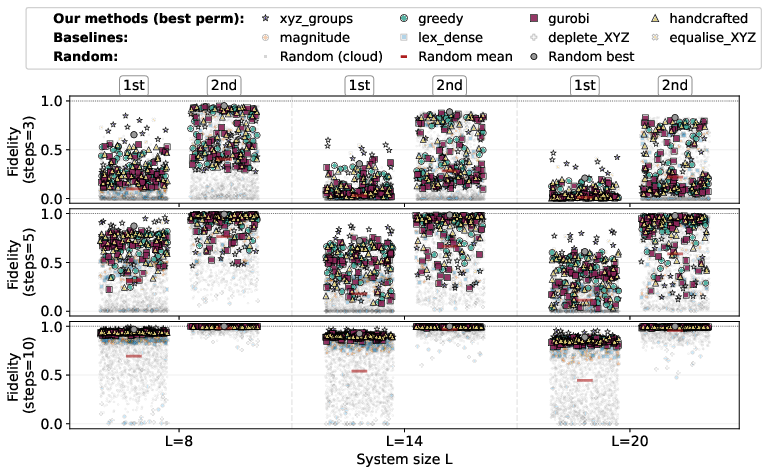
Figure 1: Fidelity for each ordering method as a function of system size for the 1D XXZ chain; commutation graph-based orderings consistently achieve high fidelity across all system sizes and step counts.
Structured vs. Random Orderings
Commutation-based orderings (particularly group-evolve strategies using the XYZ-coloring) consistently yield fidelities in the upper envelope of the random distribution, with performance advantages growing with system size and for lower Trotter step counts. This advantage is notably pronounced in 2D (triangular and rectangular lattices), where connectivity increases term non-commutativity and random orderings more easily degrade.
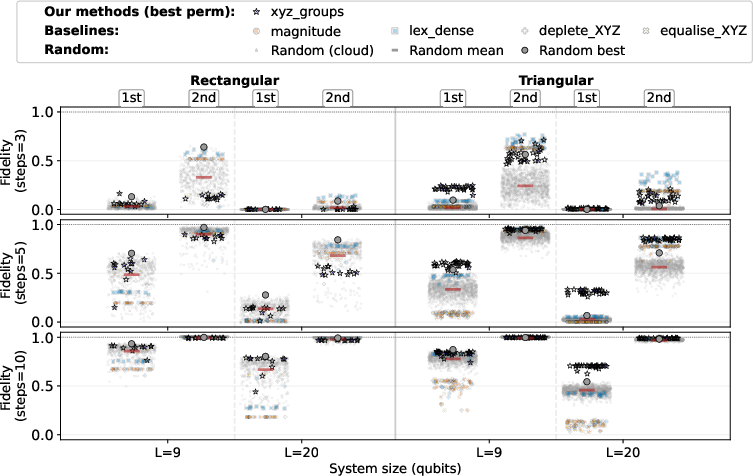
Figure 2: Ordering fidelity for 2D rectangular and triangular lattices; xyz_groups (commutation-based) orderings outperform baselines across a range of step counts and lattice sizes.
Comparison with Baselines and Heuristics
Under both first- and second-order Trotter formulas, commutation-based coloring methods (xyz_groups, greedy, gurobi, handcrafted) outperformed baseline ordering strategies. In 1D systems, xyz_groups dominated under first-order Trotterization, while spatial-locality-based handcrafted or greedy colorings excelled in second-order cases. For 2D lattices, xyz_groups led under both Trotter orders (with rare exceptions), despite the steeper fidelity decay with system size.
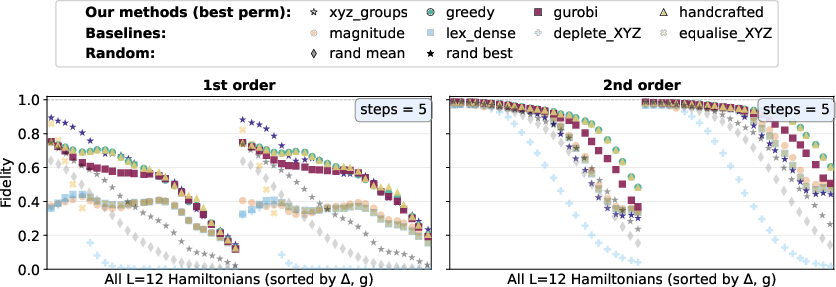
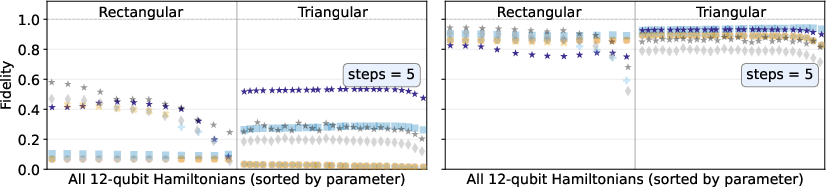
Figure 3: Per-Hamiltonian fidelity at L=12 for various ordering methods, showing xyz_groups and handcrafted outperforming baselines consistently.
Permutation Effects
The optimal permutation of commuting groups depended on system geometry and Trotter order, but a modest search over m! group permutations sufficed to reliably locate high-fidelity orderings. In 1D systems, permutation 120 consistently yielded the best xyz_groups fidelity for first-order Trotter, whereas handcrafted coloring permutations could dominate for second-order Trotter. For 2D systems, permutation 021 was stably optimal in triangular lattices.
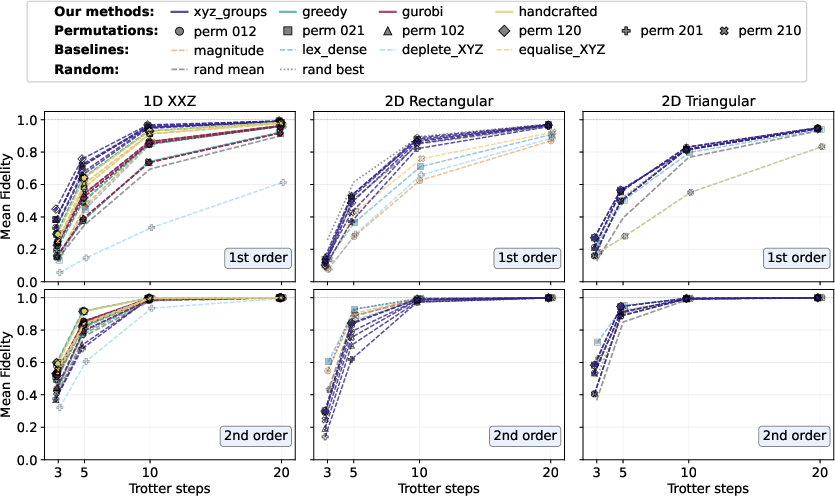
Figure 4: Mean fidelity per ordering as a function of Trotter steps, showing all group permutations for commutation-based methods; xyz_groups is dominant for 1D first-order Trotter.
Scaling with System Size
Commutation-based orderings exhibit slower fidelity degradation with increasing system size, especially in 1D spin chains under first-order Trotter formulas, maintaining a substantial lead over random and baseline methods even as L→20. For 2D lattices, the fidelity decline is steeper but commutation-based methods still show clear advantage.
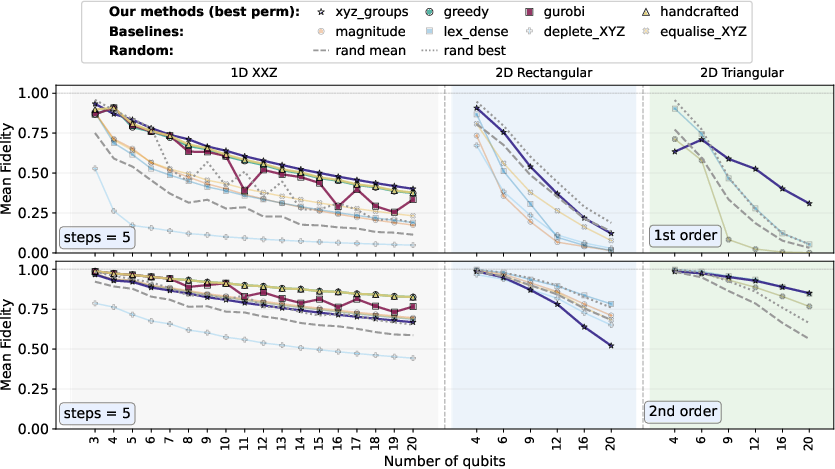
Figure 5: Mean fidelity vs. system size; commutation-based orderings (xyz_groups) degrade slower with size, showing superior scaling compared to random and baseline orderings.
Theoretical Insights
The chromatic number of commutation graphs for Heisenberg-style Hamiltonians is bounded, and optimal coloring can be efficiently constructed for non-mixed Pauli terms, furnishing practical ordering strategies with favorable error properties. Extensions to more complex Hamiltonians—such as those with mixed Pauli strings or non-trivial molecular interaction graphs—were suggested as promising routes for future exploration.
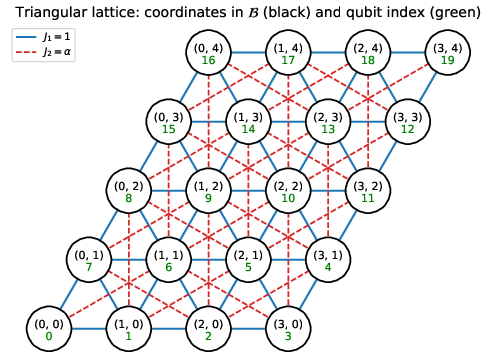
Figure 6: Interaction graph for a 2D triangular lattice, visualizing connectivity structure relevant for commutation graph construction and index assignment.
Practical and Theoretical Implications
Commutation-based Trotter ordering strategies yield robust improvements in quantum simulation fidelity, particularly in regimes relevant for noisy intermediate-scale quantum (NISQ) devices where circuit depth is constrained. The results indicate that exploiting Hamiltonian structure through commutation groupings is a highly effective way to minimize Trotter errors without increasing circuit complexity. There is potential for adaptation of these strategies to include coefficient weighting, parallelization of gate sequences, and application to Hamiltonians beyond the Heisenberg model class. Understanding the structural properties of commutation and compatibility graphs may lead to further advances both in error mitigation and circuit optimization.
Conclusion
This study provides a rigorous theoretical and empirical account of the effect of term ordering in Trotterized quantum simulation, demonstrating that commutation-based coloring strategies substantially outperform both random and conventional ordering baselines. The methodology scales favorably with system size and is broadly applicable to Heisenberg-type spin systems. The approach is immediately relevant for maximizing fidelity and minimizing circuit depth in practical quantum simulation algorithms, and its extension to exotic Hamiltonians and coefficient-weighted groupings remains a compelling direction for future research.

