- The paper proposes Diagonal Adaptive Non-local Observables (DANO), a method that restricts optimization to diagonal Hermitian measurement operators to reduce classical simulation complexity.
- The method translates into significant accuracy improvements, achieving 66.7% on MNIST and 87.9% on Yale B while reducing the measurement parameter space substantially.
- Empirical results show that switching to DANO can rescue a poorly performing VQC, highlighting its potential for scalable quantum machine learning.
Diagonal Adaptive Non-local Observables for Quantum Neural Network Measurement Optimization
Overview and Motivation
The paper "Diagonal Adaptive Non-local Observables on Quantum Neural Networks" (2605.15410) introduces a measurement-centric framework for quantum machine learning, targeting variational quantum circuits (VQCs) and quantum neural networks (QNNs). The core proposal is Diagonal Adaptive Non-local Observables (DANO), a method to efficiently enlarge the function space of QML models by optimizing measurement operators, but restricting them to diagonal Hermitian forms. This strategy leverages the mathematical equivalence between arbitrary Hermitian measurement and diagonal Hermitians under unitary similarity, thereby maintaining expressivity while dramatically reducing classical optimization complexity and parameter requirements.
The motivation addresses two key bottlenecks: the resource constraints of NISQ hardware and the classical computational cost associated with optimizing and simulating general Hermitian observables in the adaptive measurement paradigm. By restricting non-local observable optimization to diagonal matrices and pairing with sufficiently expressive circuit unitaries, DANO achieves a reduction of O(4k) to O(2k) for k-local measurement parameters, supporting more scalable experimentation and deployment.
Theoretical Contributions
The paper's main theoretical insight is that diagonal Hermitians, combined with unitary evolution, suffice as canonical representatives of the adaptive non-local observable (ANO) space via equivalence classes defined by unitary similarity. The authors formalize this equivalence, showing DANO retains full ANO expressivity under certain circuit expressibility conditions (as guaranteed by the Solovay-Kitaev theorem).
This translates to practical advantages in classical simulation and optimization. DANO reduces the observable parameter space from K2 to K (K=2k), and the corresponding measurement-side computation, while still encompassing conventional VQC designs as a special case. The theoretical result is further refined by discussing topological closure and dense approximation in the subgroup generated by a finite gate set, ensuring DANO approaches ANO with sufficient circuit depth and gate diversity.
Experimental Evaluation
MNIST Digit Classification
The authors benchmark DANO versus ANO and standard VQC baselines on a downsampled MNIST digit classification task. All models use identical VQC architectures, while measurement locality k is varied.

Figure 1: Increasing k in DANO (sliding k-local diagonal measurements) steadily improves MNIST test accuracy compared to the fixed-Pauli VQC baseline.
DANO achieves 66.7% accuracy at k=8, a substantive increase over pure VQC (32.7%) and lower locality settings. Notably, the classical optimization cost and memory requirement for DANO at O(2k)0 is 256x lower than ANO, which becomes intractable beyond O(2k)1 due to exponential scaling. The improvement with increasing O(2k)2 exhibits diminishing returns between O(2k)3 and O(2k)4, suggesting partial saturation for coarse-grained image features.
Yale B Face Recognition
A more challenging experiment on a subset of the Yale B face database underscores the utility of higher O(2k)5 in DANO.
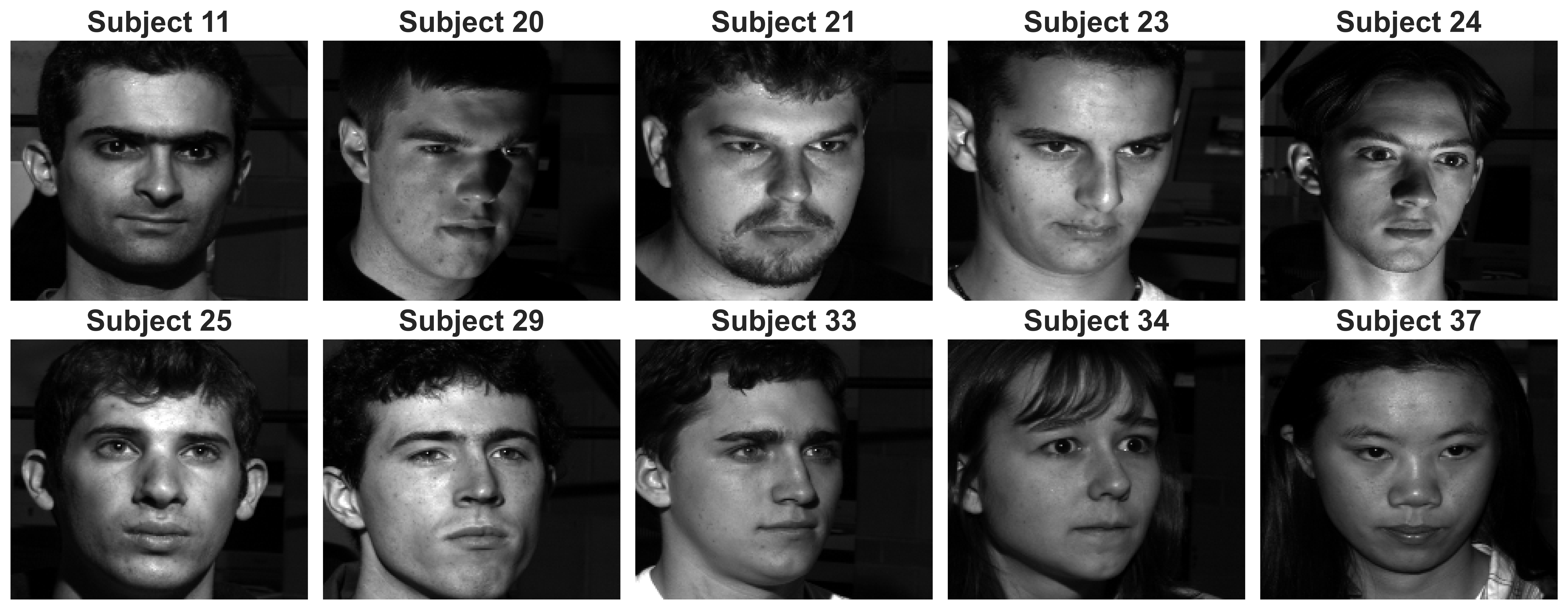
Figure 2: Selection of 10 identities from Yale B for face recognition tasks.
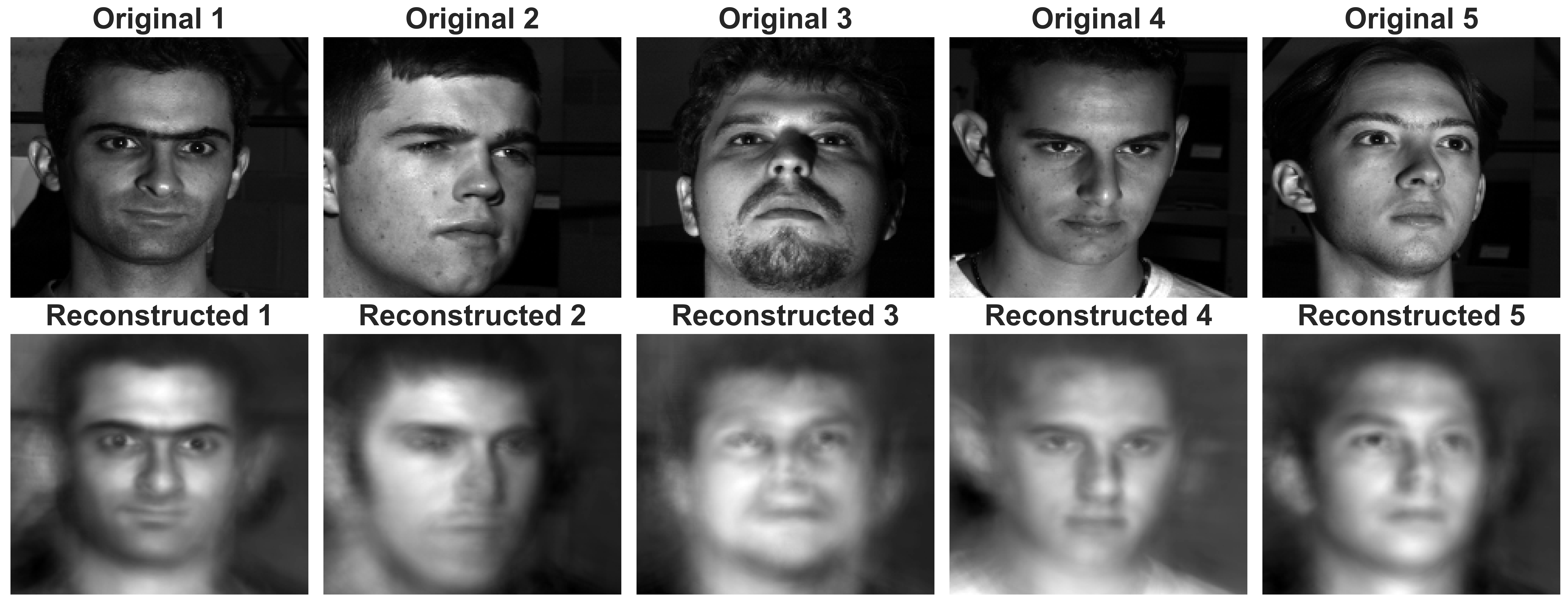
Figure 3: Inverse PCA reconstruction of faces demonstrates that compressed features retain identity information sufficient for downstream classification.
Here, as O(2k)6 increases from 4-local to 10-local, DANO delivers monotonic accuracy gains, culminating in 87.9% test accuracy (versus 30.3% for baseline VQC). Improvement remains strong across locality increments, reflecting the increased complexity and correlation structure in the face dataset versus MNIST.

Figure 4: Test accuracy curves on Yale B show steady ascent as O(2k)7 increases in DANO; higher locality enables capture of nontrivial feature dependencies.
Measurement Rescue Protocol
An intervention experiment freezes a poorly performing VQC after 30 epochs and switches to DANO by optimizing only diagonal measurement eigenvalues. Test accuracy rapidly rises from 30.3% to 80.8%, closely approaching the best end-to-end trained 10-local DANO (87.9%).

Figure 5: "Rescue" of a saturated VQC by replacing measurement with DANO eigenvalues demonstrates the disproportionate impact of the measurement spectrum versus further circuit optimization.
Practical and Theoretical Implications
DANO offers a scalable path for measurement-side optimization in QML, trading some measurement expressivity at fixed O(2k)8 for orders-of-magnitude reduction in classical optimization and simulation cost. This makes larger-O(2k)9 non-local measurements practical, even in classical emulation, and expands the feasible design space for quantum neural networks on NISQ devices.
Theoretical implications extend to the structure of QML hypothesis classes, enlarging the function space not just by circuit engineering but also by observable selection. DANO, as a parameter-efficient measurement optimization scheme, lays groundwork for further hybrid measurement strategies and could be adapted for other tasks—such as reinforcement learning and quantum super-resolution (as cited in companion works).
Future research should investigate expressivity limits for fixed circuit sets, the role of measurement optimization in overcoming barren plateaus, and integration with structured model classes (e.g., convolutional or recurrent QNNs). As quantum hardware matures, DANO’s diagonal measurement parameterization may inform hardware-aware measurement strategies and quantum-inspired classical algorithms.
Conclusion
Diagonal Adaptive Non-local Observables represent a formally sound and practically efficient method to enhance quantum neural network performance via adaptive measurement optimization. By restricting optimization to diagonal Hermitian observables and leveraging circuit expressivity, the approach supports substantial accuracy gains with classical computational feasibility, as validated against MNIST and Yale B benchmarks. The method’s mathematical guarantees and empirical effectiveness suggest broad applicability for scalable quantum machine learning, both for classical simulation and future fault-tolerant quantum hardware.