- The paper introduces SSTS, an algorithm that uses score Jacobian information and Schur complements to extract causal order without iterative optimization.
- It decouples causal structure extraction from non-convex optimization, enabling deterministic DAG recovery with significantly fewer edge violations in high dimensions.
- Empirical results show scalable performance with robust recovery in both linear and non-linear models, while highlighting trade-offs between algebraic exactness and statistical estimation.
Optimization-Free Causal Discovery via Score-Schur Topological Sort
Motivation and Context
The paper addresses the structural bottleneck in continuous causal discovery. Traditional combinatorial search algorithms for extracting Directed Acyclic Graphs (DAGs) from observational data are computationally intractable in high dimensions due to exponential scaling. While continuous optimization techniques (e.g., NOTEARS) provided algebraic acyclicity formulations enabling gradient-based methods, these are restricted by non-convex optimization landscapes, resulting in susceptibility to local minima and poor scaling for high-dimensional or non-linear data. Score-based paradigms further enabled generative modeling with topological ordering, but often required iterative score model retraining or complex architectural masking, posing severe efficiency limitations.
The Score-Schur Topological Sort (SSTS) is introduced as an optimization-free causal discovery algorithm, extracting causal topological order directly from unconstrained score networks by leveraging the geometric and algebraic signatures encoded within the Score-Jacobian Information Matrix (SJIM). The core contribution is the decoupling of causal structure extraction from non-convex optimization, reframing causal discovery as a statistical estimation problem governed by finite-sample limits.
Theoretical Contributions
Algebraic Mapping of Causal Structure
SSTS operates by utilizing the SJIM, defined as the expected negative Hessian of the log-density, I=Ep(x)[−∇x2logp(x)]. In linear Gaussian Additive Noise Models (ANMs), the SJIM contains explicit topological information:
- Leaf Node Identifiability: Diagonal entries Iii reach their minimum for true leaf nodes, facilitating their detection without structural optimization.
- Schur Complement Marginalization: Once a leaf node is isolated, its marginalization is equivalent to the Schur complement of the SJIM with respect to the leaf index. This mechanism is mathematically exact in linear ANMs, enabling sequential, deterministic extraction of topological order by repeated Schur eliminations.
For non-linear ANMs, expectation and matrix inversion operations do not commute. The paper formalizes the non-linear marginalization gap (Δ), arising from the covariance of gradient vectors, −σ21Covp(x)(∇x∖lfl). This gap is localized to the parent neighborhood of marginalized nodes and induces accumulating extraction error during sequential marginalizations.
Conventional score-based methods require iterative retraining or masking for marginalization. SSTS eliminates this by leveraging a single pre-trained score network and algebraically extracting structure via matrix operations. The transformation replaces constrained optimization with deterministic algebraic elimination, reducing the computational complexity to O(d3) (where d is the variable dimension) for matrix extraction.
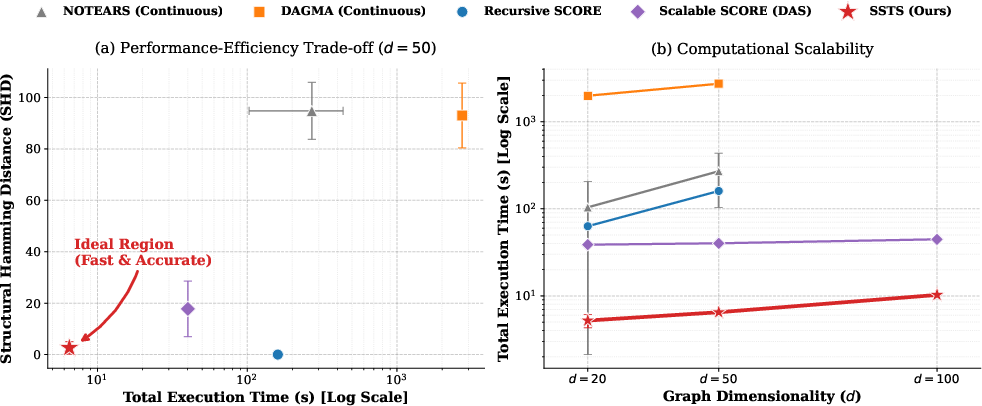
Figure 1: SSTS efficiently recovers causal graph structure on non-linear manifolds, maintaining favorable performance-efficiency trade-offs and scaling to d=100 dimensions in under 15 seconds.
Algorithmic Extensions
High-Dimensional and Sparse Regimes
Empirical Results
Linear and Non-linear ANM Recovery
- Linear ANMs: Experiments confirm exact topological extraction with zero edge violations up to d=1000 both for analytical and empirical precision matrices.
- Non-linear ANMs: SSTS achieves SHD Iii0 with extraction times of Iii1 seconds at Iii2, far outperforming constrained optimizers (DAGMA: SHD Iii3, Iii4s).
- Exact Schur Complement vs. Expectation: Computing the exact sample-wise Schur complement prior to expectation strictly reduces edge violations, but incurs an Iii5 computational cost, highlighting a trade-off between algebraic fidelity and scalability.
Biological Data and Mechanism Robustness
- Sachs Protein Network: On real-world data (Iii6), SSTS attains SHD Iii7 and TPR Iii8, outperforming DAGMA and Scalable SCORE methods in both accuracy and efficiency.
- Distributional Shifts and Mechanisms: SSTS is robust to multiplicative noise but fails under post-nonlinear mechanisms (PNL), where non-linear mappings obscure the diagonal energy signature required for algebraic extraction.
Scaling and Finite-Sample Boundaries
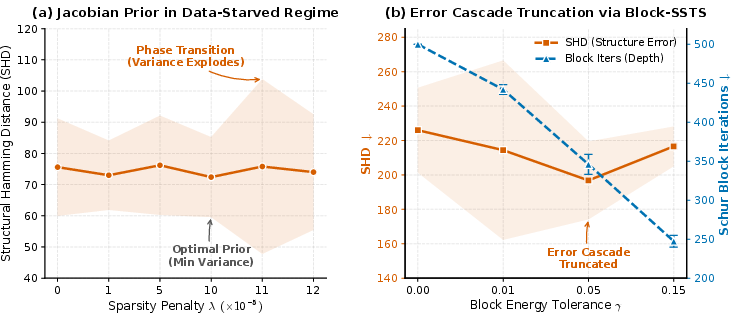
SSTS scales block-wise extraction efficiently to Iii9 with a bounded VRAM (Δ0 GB) and direct extraction times (Δ1s). As dimensionality increases, the statistical estimation variance of the score Jacobian dominates structural fidelity, emphasizing the transition from optimization-bounded to estimation-bounded causal discovery.
Practical and Theoretical Implications
The paradigm shift brought by SSTS has several implications:
- Computational Bottleneck Shift: By eliminating acyclicity constraints during extraction, SSTS transfers the bottleneck from optimization to statistical estimation, making accurate score learning essential for high-dimensional, non-linear causal discovery.
- Metric Robustness: The paper formalizes the mathematical degradation in rank correlation metrics (e.g., Kendall’s Δ2), advocating for edge violation counts as the rigorous structural metric, invariant to topological ambiguity.
- Limits of Algebraic Extraction: The expectation gap in non-linear ANMs, although localizable and optionally patchable (at high computational cost), poses a fundamental challenge for causality in arbitrary non-linear regimes.
Future Directions
Potential advances may include:
- Covariance Patch Mechanisms: Developing scalable methods to compensate the non-linear expectation gap without Δ3 complexity.
- Score Estimation Methods: Improving generative modeling architectures to reduce finite-sample estimation variance in extreme regimes.
- Generalization Beyond ANM: Extending algebraic extraction to post-nonlinear and other generative mechanisms with modified diagonal energy signatures.
Conclusion
SSTS reframes continuous causal discovery as a statistical estimation-driven process by algebraically mapping topological extraction to Schur complements of score Jacobians. Exactness holds in linear regimes; approximation errors arise in non-linear regimes, governed by the expectation gap and score estimation variance. The fundamental bottleneck is now determined by statistical fidelity rather than optimization locality, offering scalable causal structure discovery for high-dimensional, non-linear systems.