- The paper demonstrates that quantum walks in energy space can decouple population thermalization from full state convergence, establishing a framework for nonthermal behavior.
- It employs classical birth-death-lazy stochastic dynamics integrated with collision-assisted unitary maps to achieve Gibbsian equilibrium alongside persistent coherence.
- Perturbative analysis and numerical simulations quantify coherence effects, offering insights for quantum simulation and thermodynamic protocols.
Energy-Space Quantum Walks: Structural Decoupling of Thermalization and State Convergence
Introduction and Motivation
The paper "Energy-space quantum walks: Thermalization without state convergence" (2605.15339) establishes energy-space quantum walks as an effective minimal framework for probing how equilibration, thermalization, and irreversibility emerge independent of microscopic system-bath models. The central thesis is that thermalization can be reframed as a transport phenomenon in an energy-space ladder, with a structural decoupling between population dynamics (energy distribution) and quantum coherence (off-diagonal elements in the density matrix). The work systematically demonstrates that classical birth-death-lazy stochastic dynamics on this ladder leads to Gibbs equilibrium distributions, while embedding this process in a collision-assisted quantum walk enables persistent coherence-induced deviation from the thermal manifold, even after population equilibration. This separation permits thermalization of populations without convergence of the full quantum state, quantifying the role of coherence as a controllable contribution to nonthermal stationary behavior.
Classical Energy-Space Dynamics and Gibbs Equilibration
The classical regime is formulated as stochastic energy-space transport, with transition probabilities for absorption (p+), emission (p−), and lazy steps (p0). The effective dynamics preserve diagonality and is encapsulated in a CPTP map Φ, leading to birth-death-lazy population evolution. Nonunitality (p+=p−) induces bias and irreversibility, with the stationary solution determined by current conservation:
℘∞(n+1)=(p−p+)℘∞(n)
which yields a geometric stationary distribution. For equally spaced spectra (En=nE), this is re-expressed as a canonical Gibbs distribution:
℘∞(n)∝e−βEn,p−p+=e−βE
with the effective temperature set by the ladder statistics. Stationary populations encode irreversibility and the emergence of Gibbs equilibrium, independent of explicit thermal bath modeling.
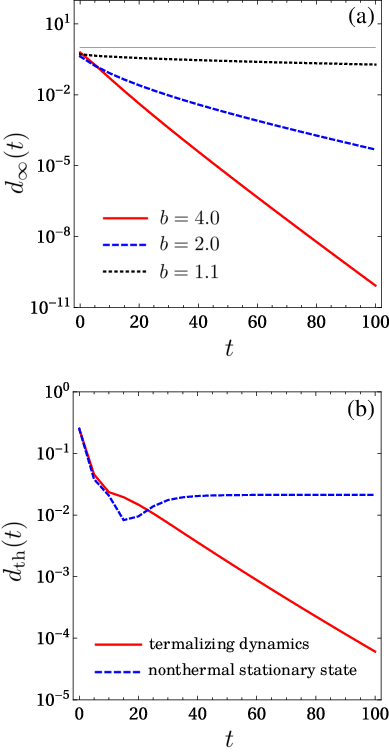
Figure 1: Equilibration and thermalization in the incoherent energy-space dynamics for equally spaced energies, illustrating exponential relaxation of populations toward the stationary (Gibbs) distribution and the effect of bias on relaxation times.
Temporal averaging yields robust equilibration diagnostics, while trace distance and thermal distance metrics quantify convergence rates and distinguish genuine thermalization from mere stationary population equilibration. With transition rates satisfying local detailed balance (p+(n)/p−(n+1)=e−β(En+1−En)), the stationary state is Gibbsian for arbitrary spectra; violation leads to nonthermal stationary distributions, confirmed numerically.
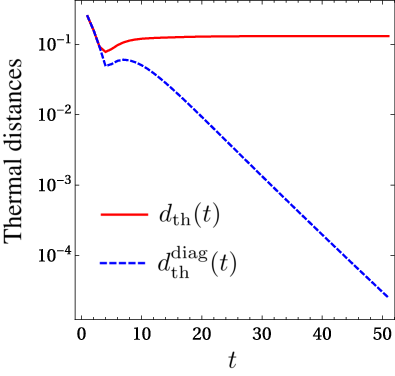
Figure 2: Thermal distance dth(t) (red) and dephased counterpart (blue) demonstrating that only genuine Gibbsian stationary distributions attain vanishing thermal distance; level-dependent rates induce persistent nonthermal deviation.
Collision-Assisted Quantum Walk and Structural Decoupling
Embedding the classical process into a unitary, collision-assisted quantum walk is achieved via coupling the energy ladder to three-level ancillas (channels for upward, downward, lazy transitions). The quantum map p−0 interpolates between incoherent classical (p−1) and coherent (p−2) regimes. The key result is structural decoupling: for initial states diagonal in the energy basis, population evolution is entirely classical and independent of p−3. Coherence is generated locally by boundary transitions (between ground and first excited states) and subsequently transported, but has no back-action on populations.
Explicitly, the reduced dynamics is:
p−4
where p−5 is the classical birth-death-lazy map, and the p−6-term injects coherence off-diagonally.
Equilibration at the population level proceeds as in the classical model, achieving Gibbs statistics when detailed balance holds. However, the full quantum state, driven by persistent, locally-generated coherence, does not converge to the Gibbs state unless p−7. The structural blockwise decoupling ensures the diagonal and off-diagonal sectors evolve independently.
Quantitative Analysis: Perturbative Bounds and Numerical Results
A perturbative expansion in p−8 quantitatively bounds the coherence-induced deviation:
p−9
where p00 is the purely classical thermal distance, and the cumulative boundary occupation governs the quantum correction. As p01, p02, so the asymptotic deviation p03 is p04 for small p05.
Numerical simulations confirm:
- Population relaxation and Gibbsian equilibrium are unaffected by coherence parameter p06.
- The thermal distance for the full state saturates at a finite value for p07, verifying nonconvergence.
- For small p08, p09 scales linearly with Φ0, matching perturbative prediction. At larger Φ1, nonperturbative effects emerge, but bounds remain tight.
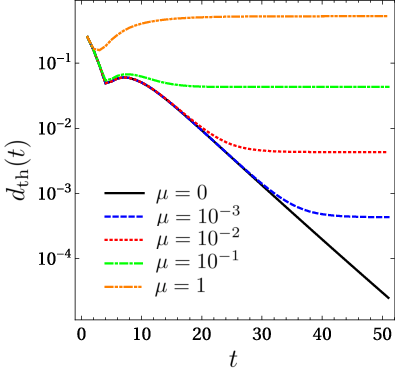
Figure 3: Time evolution of the thermal distance Φ2 across coherence parameter Φ3 values, with classical (Φ4) relaxation matching Gibbsian convergence and coherent cases exhibiting persistent deviation.
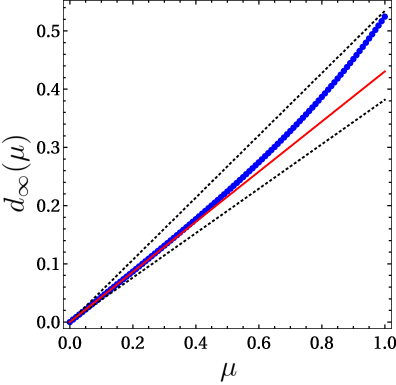
Figure 4: Asymptotic thermal distance Φ5 scaling linearly with Φ6, confirming perturbative analysis and analytical bounds; deviation from linearity signals nonperturbative regime.
Implications, Extensions, and Outlook
The structural decoupling identified has substantive implications:
- Practical: Thermal equilibrium of populations can be achieved independent of quantum state convergence, with coherence serving as an explicit nonthermal correction. This is critical for quantum simulation and algorithmic frameworks where population statistics suffice for thermodynamic predictions but coherence persists.
- Theoretical: The minimal framework exposes the distinction between classical transport-induced equilibration (energy-space mixing) and genuine quantum thermalization (full state convergence), emphasizing the centrality of structure and locality in decoherence and irreversibility.
- Future Directions: Possible extensions include continuous-time mapping, energy-conserving embeddings with explicit thermodynamic interpretation, and generalization to interacting graphs or ladders. The phenomena detailed may extend naturally to coin-based quantum walks and other discrete-time models, offering experimental accessibility.
Conclusion
This work establishes energy-space quantum walks as a rigorous and transparent paradigm to probe thermalization mechanisms in quantum systems. It demonstrates—both analytically and numerically—that classical population dynamics and quantum coherence can be categorically decoupled in the dynamics, yielding thermalization of populations without full state convergence. The persistence of nonequilibrium coherence is controllable and quantitatively bounded, illuminating the landscape wherein classical transport and quantum corrections coexist. This result invites a reevaluation of thermalization protocols, supports the modular understanding of quantum irreversibility, and opens fertile avenues for quantum thermodynamics and transport in synthetic dimensions.