- The paper presents a novel hybrid key distribution scheme that combines quantum (BB84) and KLJN methods to enhance key generation efficiency and security.
- It details three protocols utilizing asynchronous buffering and real-time gated modes to effectively synchronize the optical and wired channels.
- Simulations demonstrate that the hybrid protocols achieve a consistent secure bit rate in short-haul settings, outperforming conventional BB84 in throughput.
Hybrid Quantum-Statistical Physical Key Distribution for Short-Haul Infrastructures
Architectural Overview
The paper "Quantum Meets Statistical-Physical Secrecy: A Novel Hybrid Key Distribution Architecture" (2605.15247) introduces an innovative architecture that integrates Quantum Key Distribution (QKD) with Kirchhoff-law-Johnson-noise (KLJN) statistical-physical key exchange for secure short-haul communication. The system synchronizes an optical BB84-type QKD link alongside a parallel wired KLJN subsystem. The KLJN channel serves multiple roles: securely transmitting basis information, extracting additional key material, and, under specific protocols, generating raw secure key bits.
The hybrid approach is motivated by the complementary security features and bottlenecks of each mechanism. QKD delivers quantum-mechanically grounded secrecy but suffers from basis sifting inefficiency and vulnerability to optical channel imperfections. KLJN, leveraging thermodynamic noise statistics across a copper wire, is bandwidth-limited but provides information-theoretic security under idealized quasi-static operating conditions.
The proposed architecture exploits asynchronous buffered and real-time gated operational modes, allowing the KLJN subsystem to securely coordinate basis selection and supervise key generation with the QKD link. Synchronization, local mapping, and decision logic are tightly managed at both terminals, integrating classical post-processing for error correction and privacy amplification.
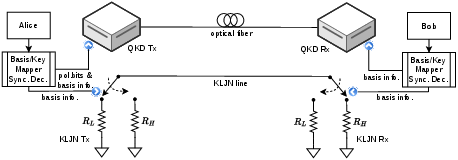
Figure 1: Diagram of integrated QKD (optical) and KLJN (wired) key distribution links, coordinated via local mapping and decision units.
Protocol Design and Operational Semantics
Three KLJN-assisted QKD protocols are defined, each uniquely leveraging the KLJN subsystem:
- Protocol I eliminates public basis disclosure and bit sifting by securely sharing basis information via KLJN, retaining only sifted QKD bits when bases coincide, and discarding mismatched cases without public discussion.
- Protocol II augments Protocol I by extracting secure key bits from the secret basis information itself on the KLJN channel. Since KLJN protects basis secrecy, the overlap occasions allow Alice and Bob to generate additional bits, increasing the net yield per transmission cycle.
- Protocol III employs a direct basis-to-resistor mapping, alternately generating secure bits from both coincident bases (QKD) and mismatched bases (KLJN), achieving one secure bit per interval under ideal KLJN bandwidth and timing constraints. This protocol operates strictly in real-time gated mode.
All protocols preserve QKD's unconditional security requirements by retaining classical post-processing (error correction, privacy amplification). Under ideal KLJN conditions, basis information remains secret from an eavesdropper; secure bits are derived both from quantum measurements and thermodynamic noise statistics.
The system incorporates rigorous modeling of both optical and classical physical channels:
- QKD Channel: Optical attenuation, detector efficiency (ηD), mean photon number (μ), and channel penalties (dark counts, misalignment error) are modeled via weak coherent pulse statistics. The expected gain and quantum bit error rate are analytically computed.
- KLJN Channel: The key bottleneck is the quasi-static wave limit, bounding noise frequency and bandwidth as BW=v/(20L), where v is the velocity in copper and L is transmission distance. Spatial multiplexing of multiple wire pairs and sampling overhead (N samples/bit) determine classical throughput.
- Synchronization: The system trigger rate fsys is throttled by the lower of the QKD laser or KLJN bit decision rate, with asynchronous burst-mode operation mitigating throughput limitations for Protocols I and II.
Normalized key rate (secure bits per pulse) and absolute throughput (bps) equations are derived. Protocols II and III achieve a baseline yield of $0.5$ bits/pulse independent of optical losses, with additional KLJN bits in overlap scenarios.
Numerical Results and Throughput Analysis
Simulation parameters conform to realistic telecom and copper infrastructure standards. Optical and KLJN parameters are set conservatively for metropolitan area network (MAN) ranges. The normalized key rate and secure throughput are analyzed as functions of optical transmission distance.
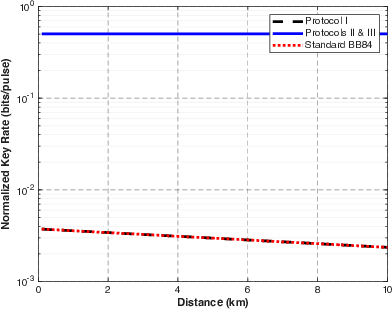
Figure 2: Normalized key rate versus distance, highlighting the efficiency plateau (>0.5 bits/pulse) for hybrid protocols II and III compared to diminishing BB84 performance.
Hybrid protocols II and III demonstrate a substantial normalized key rate advantage over BB84, maintaining consistent yield despite optical attenuation. This efficiency is attributed to gated synchronization, ensuring KLJN-generated bits anchor every transmission cycle.
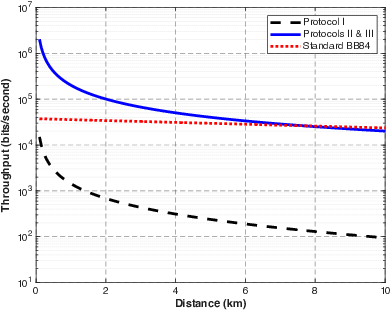
Figure 3: Secure throughput (bps) versus transmission distance, showing short-haul supremacy for KLJN-assisted protocols and crossover below BB84 at approximately $7.5$ km.
Spatial multiplexing enables hybrid protocols to excel in short-haul environments (μ0 km), providing throughput orders of magnitude higher than conventional BB84. However, as distance increases, quasi-static constraints throttle KLJN rates, causing throughput to decay inversely with distance and cross below BB84.
Practical and Theoretical Implications
The hybrid architecture has immediate applicability for data center interconnects, intra-city MANs, and mission-critical infrastructure requiring unconditionally secure, low-latency key distribution. In practice, the proposed protocols eliminate basis reconciliation overhead, increase per-cycle efficiency, and enable secure bursts of high-rate optical transmission. Theoretical implications include the elimination or reduction of public discussion channels in QKD and the potential for integrating advanced KLJN variants to extend operational range and neutralize wire resistance attacks.
Future directions identified in the paper include:
- Development of enhanced KLJN configurations to counteract wire resistance leaks and enable larger-scale deployment.
- Refined KLJN-aided protocols capable of total public discussion elimination from BB84, strengthening operational security.
- Comprehensive threat modeling to address combined quantum, classical, timing, and active adversarial attacks.
Conclusion
This paper proposes a robust hybrid QKD-KLJN key distribution scheme tailored for short-haul secure communications, rigorously analyzes three KLJN-assisted QKD protocols, and demonstrates strong throughput and efficiency gains within MAN and data center contexts. The architecture represents a step towards integrating statistical-physical secrecy with quantum cryptography, offering a secure, efficient, and scalable solution for next-generation network infrastructures. The path forward involves protocol refinement, adversarial modeling, and hardware optimization to achieve broader deployment and enhanced security guarantees.