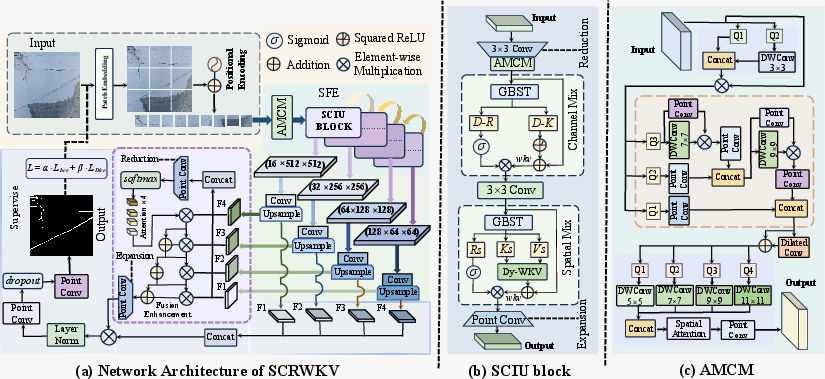
- The paper presents SCRWKV, which introduces a structure-calibrated Vision-RWKV model that achieves state-of-the-art crack segmentation with only 1.22M parameters.
- It employs a Structure-Field Encoder with a SCIU block and AMCM for multi-scale feature extraction, paired with a Cross-Scale Harmonic Fusion decoder for precise boundary reconstruction.
- Experimental results on diverse public datasets reveal notable improvements in F1 and mIoU while drastically reducing computational complexity for real-time UAV-based deployments.
Ultra-Compact Structure-Calibrated Vision-RWKV for Topological Crack Segmentation
Overview
The paper introduces SCRWKV, an ultra-compact segmentation network leveraging structure-calibrated Vision-RWKV for robust, topology-aware crack segmentation. Addressing the severe limitations of conventional CNN, Transformer, and Mamba-based methods on irregular, noise-intensive structural cracks, SCRWKV combines a compact architecture (1.22M parameters) with state space models extended through explicit topological calibration and noise suppression. The pipeline comprises a Structure-Field Encoder (SFE) backbone—centering on the Structure-Calibrated Insight Unit (SCIU) and Adaptive Multi-scale Cascaded Modulator (AMCM)—and a Cross-Scale Harmonic Fusion (CSHF) decoder. The network achieves efficient global and local modeling, yielding SOTA performance on multiple public benchmarks while maintaining orders-of-magnitude lower computational complexity and parameter count than competing frameworks.
Motivation and Problem Setting
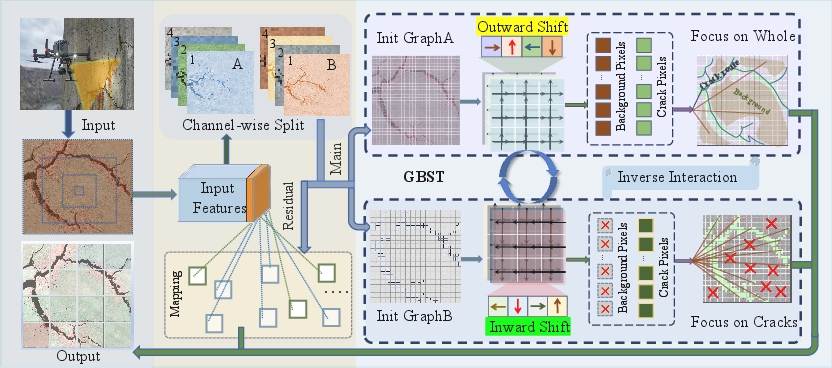
Conventional crack segmentation approaches (CNNs such as SFIAN/ECSNet, Transformers like DTrCNet/MFAFNet, and recent state-space models like Vision Mamba, CSMamba, SCSegamba) are fundamentally challenged by high intra-class topological variability and environmental noise. Flattening-based SSMs struggle to preserve geometric continuity, causing broken predictions on complex or branching cracks. Vision-RWKV architectures, while linearly efficient, lack mechanisms for dynamic spatial adaptation or instance-aware noise suppression and rely on fixed-path Q-Shift spatial interaction which cannot accommodate curvilinear structure. SCRWKV is proposed to synergistically address these deficiencies: it introduces explicit topology-driven spatial interaction and instance-adaptive decay, enforcing structural connectivity and robust denoising.
Model Architecture
Structure-Field Encoder (SFE) and SCIU Block
SCRWKV employs SFE as the backbone for hierarchical feature extraction, in which the SCIU block is central. Each SCIU integrates:
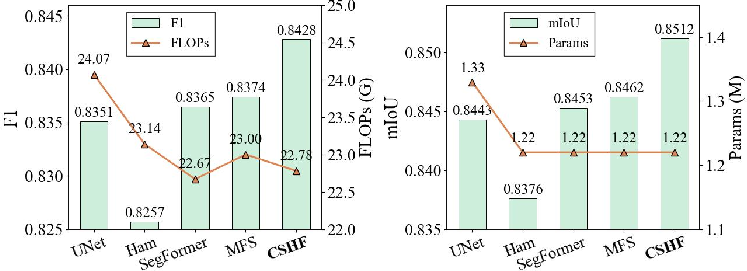
Figure 2: GBST schematic—features partitioned into outward/inward counter-propagating streams to maintain topological continuity across intricate crack manifolds.
Cross-Scale Harmonic Fusion (CSHF) Decoder
CSHF harmonizes multi-level features via scale-aware attention and soft gating, projecting backbone outputs to a unified semantic space and adaptively aggregating them using learnable scale embeddings and attention maps. This mechanism allows fine-grained detail to be merged seamlessly with high-level context for precise boundary reconstruction at negligible parameter overhead.
Experimental Results
SCRWKV is empirically validated on four diverse public datasets (Crack500, DeepCrack, CrackMap, TUT), each characterized by differing backgrounds, resolutions, and topological complexity. Evaluation is performed via Precision, Recall, F1, ODS, OIS, and mIoU.
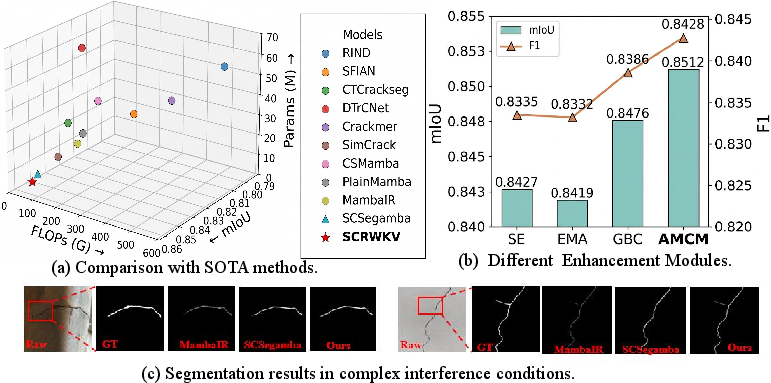
Figure 3: SCRWKV performance on multi-scenario TUT dataset vs. SOTA models, enhancement module ablations, and qualitative results under complex noise.
Quantitative Benchmarks
- On TUT, SCRWKV obtains an F1 of 0.8428 and mIoU of 0.8512 (vs. next-best SCSegamba, F1 = 0.8390, mIoU = 0.8479) with a parameter reduction of 56%, setting a new compactness-accuracy Pareto optimal.
- On DeepCrack, the SFE+SCIU stack with GBST and DSCD surpasses prior SSM models by 2.53% in F1 and 2.67% in mIoU.
Visual and Component Analyses
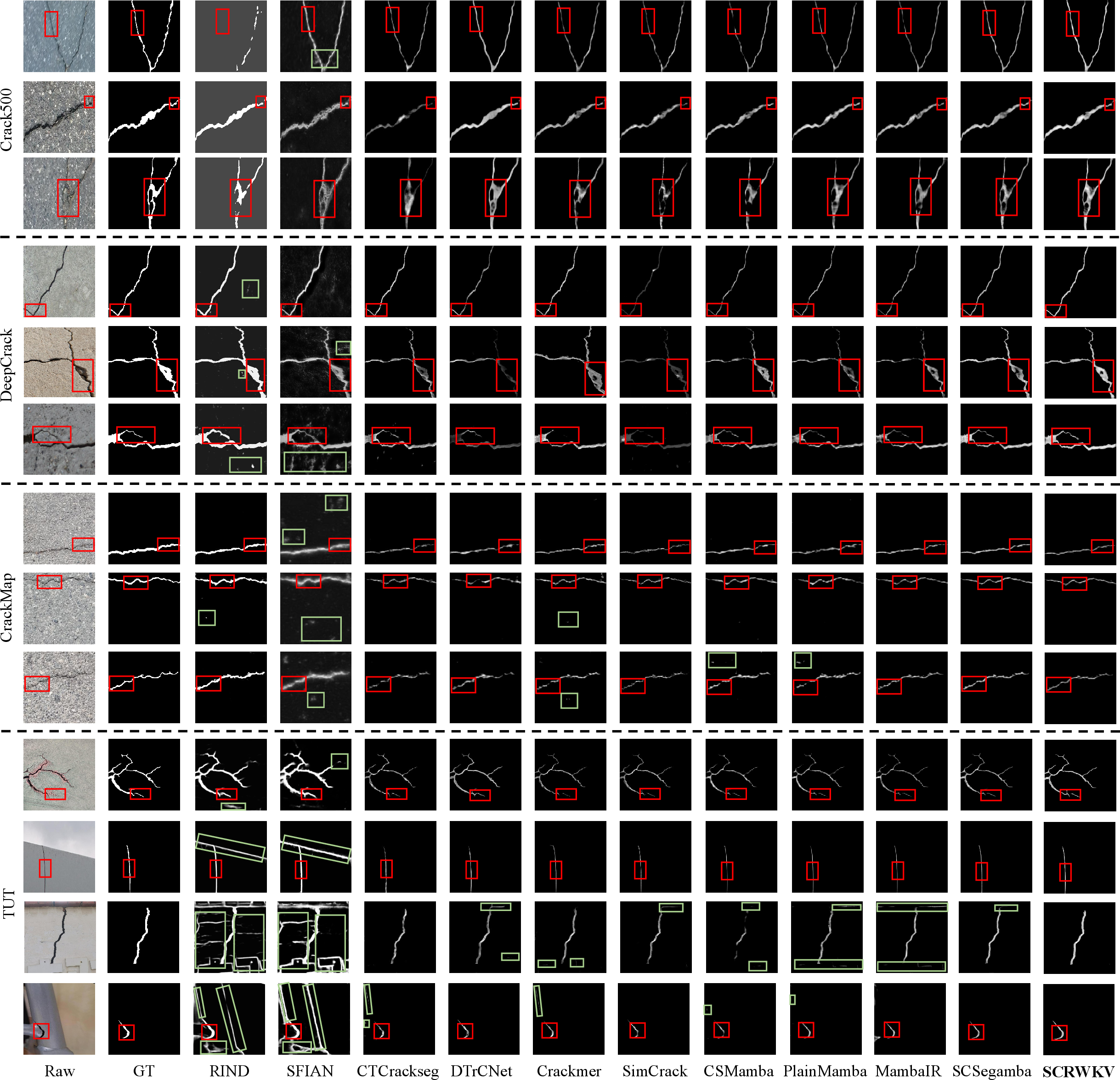
Figure 4: Visual comparison on TUT with 10 SOTA methods; SCRWKV yields superior crack continuity with minimal noise-induced misclassification.
Ablation studies isolate the contributions of AMCM, GBST, and DSCD. Inclusion of all three boosts mIoU by 1.2–1.7% over variants missing each, demonstrating their complementarity. CSHF outperforms all comparable lightweight heads. Detailed sensitivity and layer-depth analyses confirm the superiority of a 4-layer SCIU backbone for optimal accuracy/complexity trade-off.
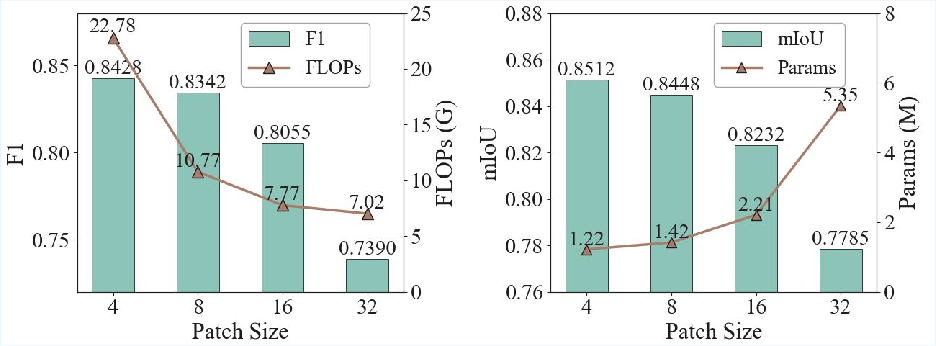
Figure 5: Patch size versus F1/FLOPs and mIoU/Params—finer patches (P=4) offer optimal detail preservation for crack segmentation.
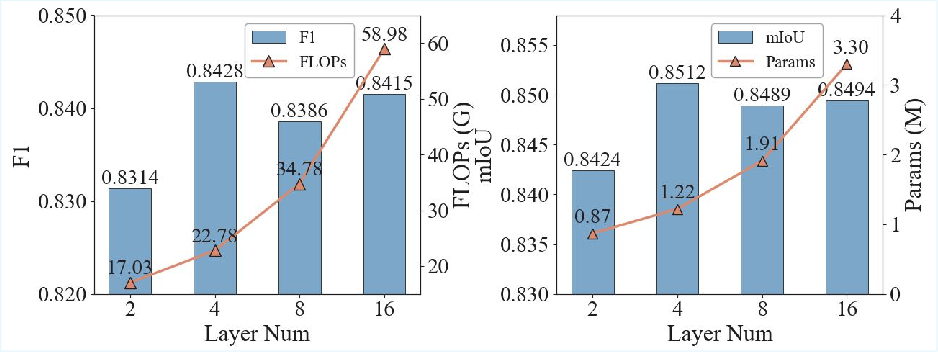
Figure 6: Layer number (SCIUs) versus F1/FLOPs and mIoU/Params—4 layers yields optimal performance, deeper networks suffer diminishing returns.
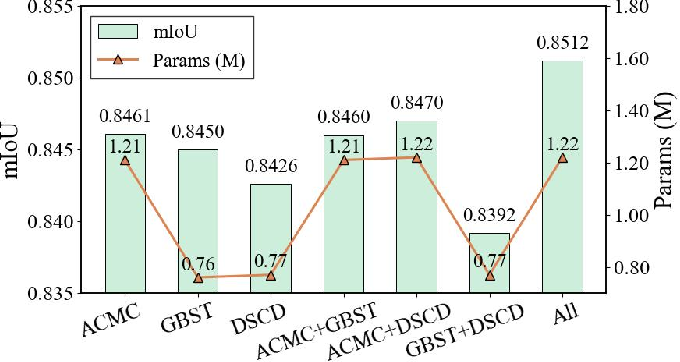
Figure 7: Params versus mIoU for SCRWKV submodules, illustrating efficient scaling of performance with component inclusion.
Deployment and Real-World Application
SCRWKV is validated in a real-world UAV-based crack inspection deployment. On a resource-constrained server, the model achieves real-time throughput (46 FPS, 0.0216s/frame), outperforming most SOTA models except DTrCNet (marginally faster but far less accurate). SCRWKV demonstrates stability under lighting/artifact variations and maintains crack continuity despite rapid scene changes.
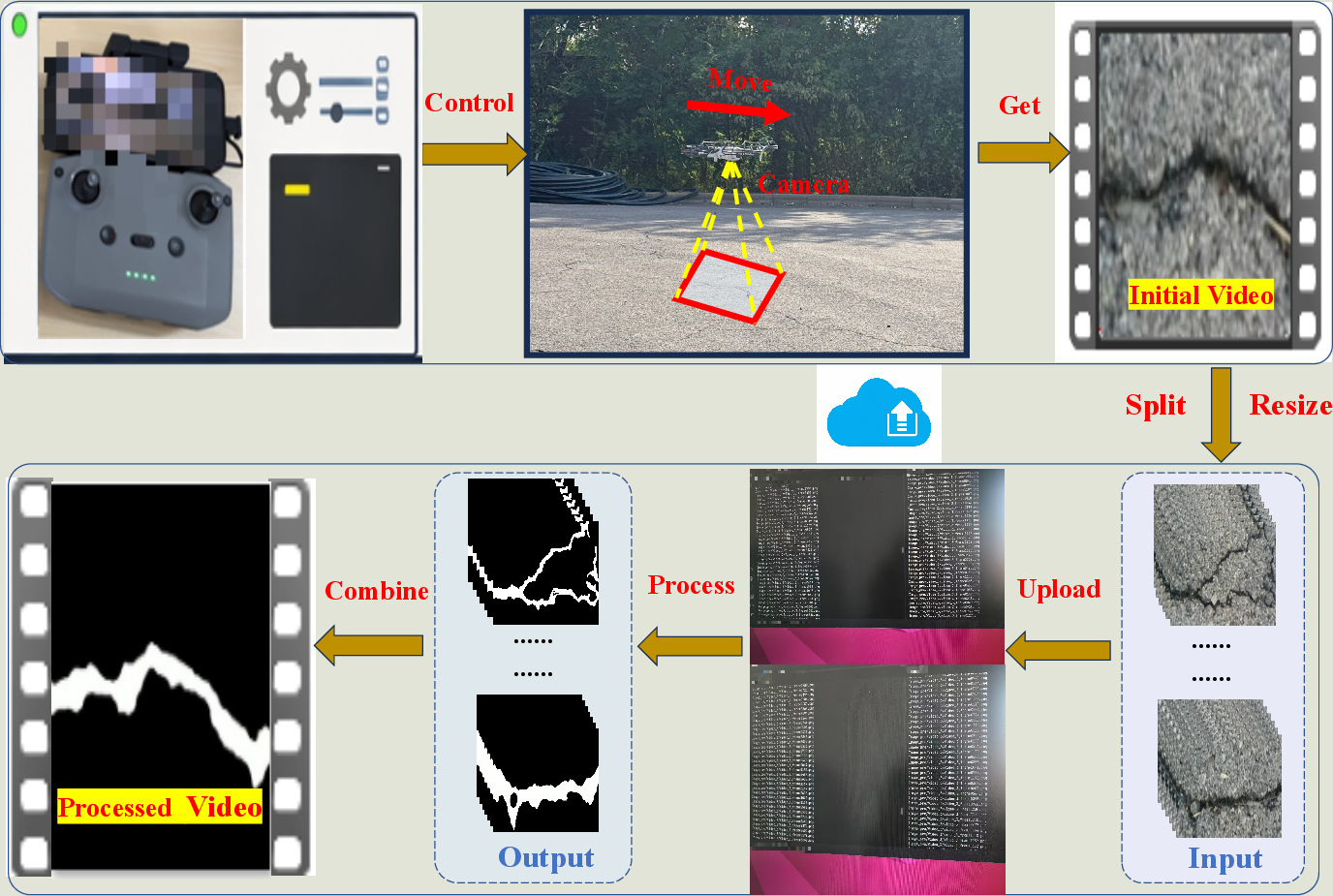
Figure 8: UAV deployment workflow; live video stream processed by SCRWKV for real-time crack segmentation in outdoor surface inspection.
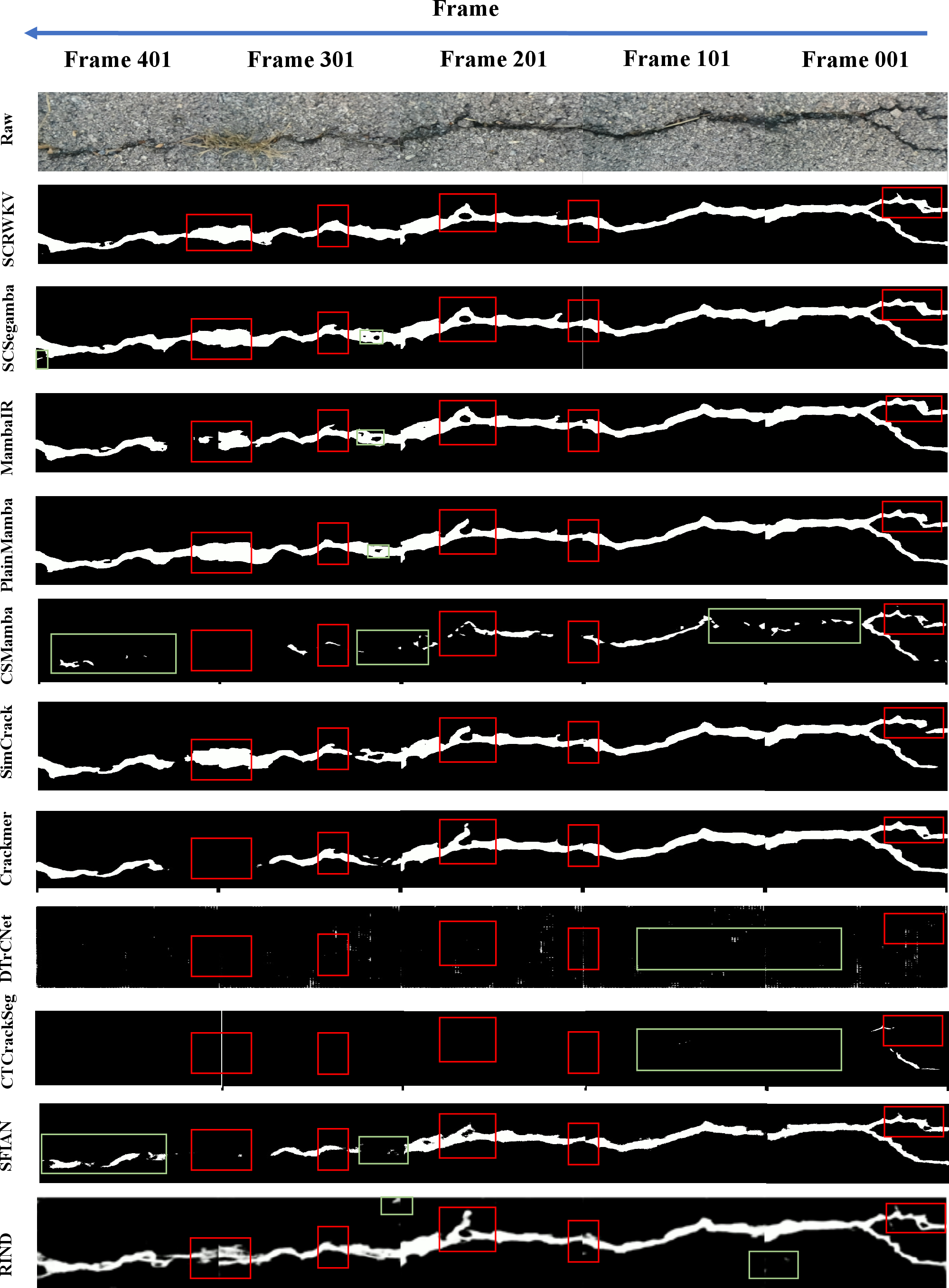
Figure 9: Video keyframe segmentation comparison—SCRWKV ensures coherent temporal mapping, suppressing noise and artifacts better than other methods.
Implications and Theoretical Contributions
The SCRWKV framework establishes a new reference design for topology-aware, efficient segmentation in domains characterized by high topological variance and dense noise (e.g., defect detection, biomedical imaging, fiber tracking). The explicit modeling of geometric continuity via GBST and instance-adaptive denoising through DSCD provide avenues for future SSM research, particularly for tasks beyond crack segmentation where structure and SNR vary dynamically. The approach further encourages marrying structural priors with parameter efficiency, enabling robust deployment on edge devices such as UAVs and robotics platforms.
Conclusion
SCRWKV redefines the efficiency-performance boundary for topological crack segmentation by synergistically unifying spatially aware state-space modeling, dynamic noise suppression, and ultralight architectural design. It achieves SOTA segmentation accuracy with the lowest known parameter cost among visual SSMs, supporting real-time edge deployment scenarios. These findings suggest that explicit spatial calibration and content-adaptive mechanisms are essential for resilient, scalable, and deployable vision models in resource-limited and noise-prone environments.