- The paper presents a novel protocol that teleports ergotropy nonlocally using surface-code quantum error correction and LOCC operations.
- It demonstrates exponential suppression of logical errors below the topological threshold, enabling effective energy transfer over macroscopic distances.
- The study identifies a continuous thermodynamic phase transition, establishing operational bounds and infrastructure costs for profitable ergotropy extraction.
Nonlocal Topological Maxwell Demon Teleportation of Ergotropy via Surface-Code Quantum Error Correction
Introduction and Motivation
This research advances the interface between quantum thermodynamics and quantum information theory by constructing a physically consistent protocol for nonlocal conversion of information into useful work—ergotropy—at finite temperature, leveraging the active protection afforded by surface-code quantum error correction (QEC). Unlike prior approaches such as quantum energy teleportation (QET), which are fundamentally restricted to near-zero temperature and bare energy transfer, this framework rigorously addresses finite-temperature regimes and ensures that only operationally extractable work is transferred over macroscopic distances.
Protocol Architecture and Operational Principles
The protocol employs a five-stage sequence in which Alice and Bob, separated by a macroscopic distance N, share a surface-code lattice of code distance L. Alice locally encodes ergotropy from her battery into the topological logical sector of the surface code, then transmits a syndrome record to Bob through a classical channel. Bob, upon decoding the syndrome, conditionally extracts ergotropy into his local battery by applying a unitary operation determined by minimum-weight perfect matching (MWPM) decoding. All operations are local except for the classical communication, satisfying LOCC constraints and strictly avoiding direct energy transfer through the quantum channel.
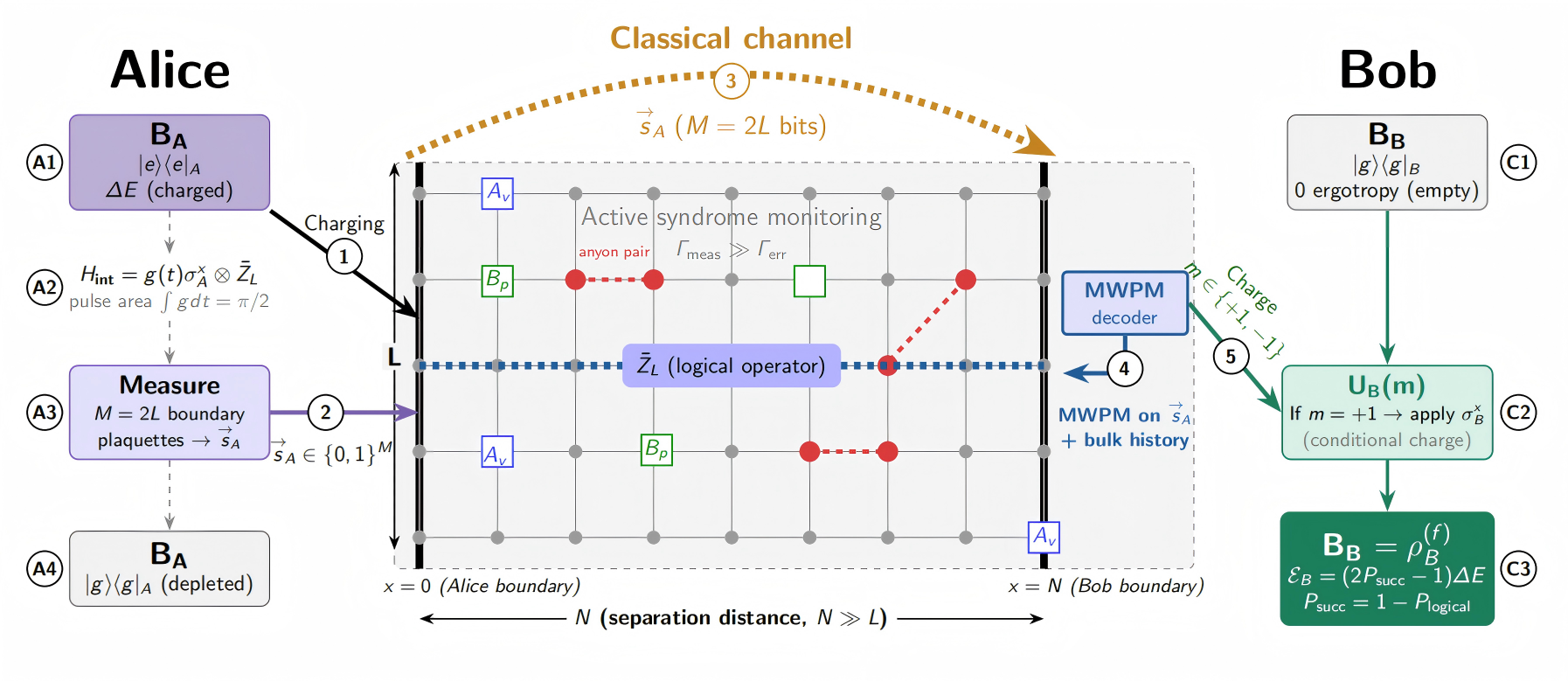
Figure 1: Five-stage protocol for ergotropy teleportation using a surface-code lattice as the nonlocal channel, with classical syndrome transmission mediating thermodynamic rectification.
The fundamental figure of merit is post-decoding ergotropy in Bob's battery, EB=(2Psucc−1)ΔE, where Psucc is the decoding success probability and ΔE is the energy cost of Alice's encoding operation.
Topological Protection and Error Correction Thresholds
A key technical achievement is the exponential suppression of logical errors below the code's topological threshold pth, allowing Psucc→1 as L increases, and thereby enabling direct, resource-efficient transfer of ergotropy even as physical separation grows. Notably, the protocol distinguishes between the topological threshold defined by QEC (pth) and a thermodynamic critical point pc—the latter being the error rate at which protocol costs outweigh ergotropy delivery, and which exceeds L0.
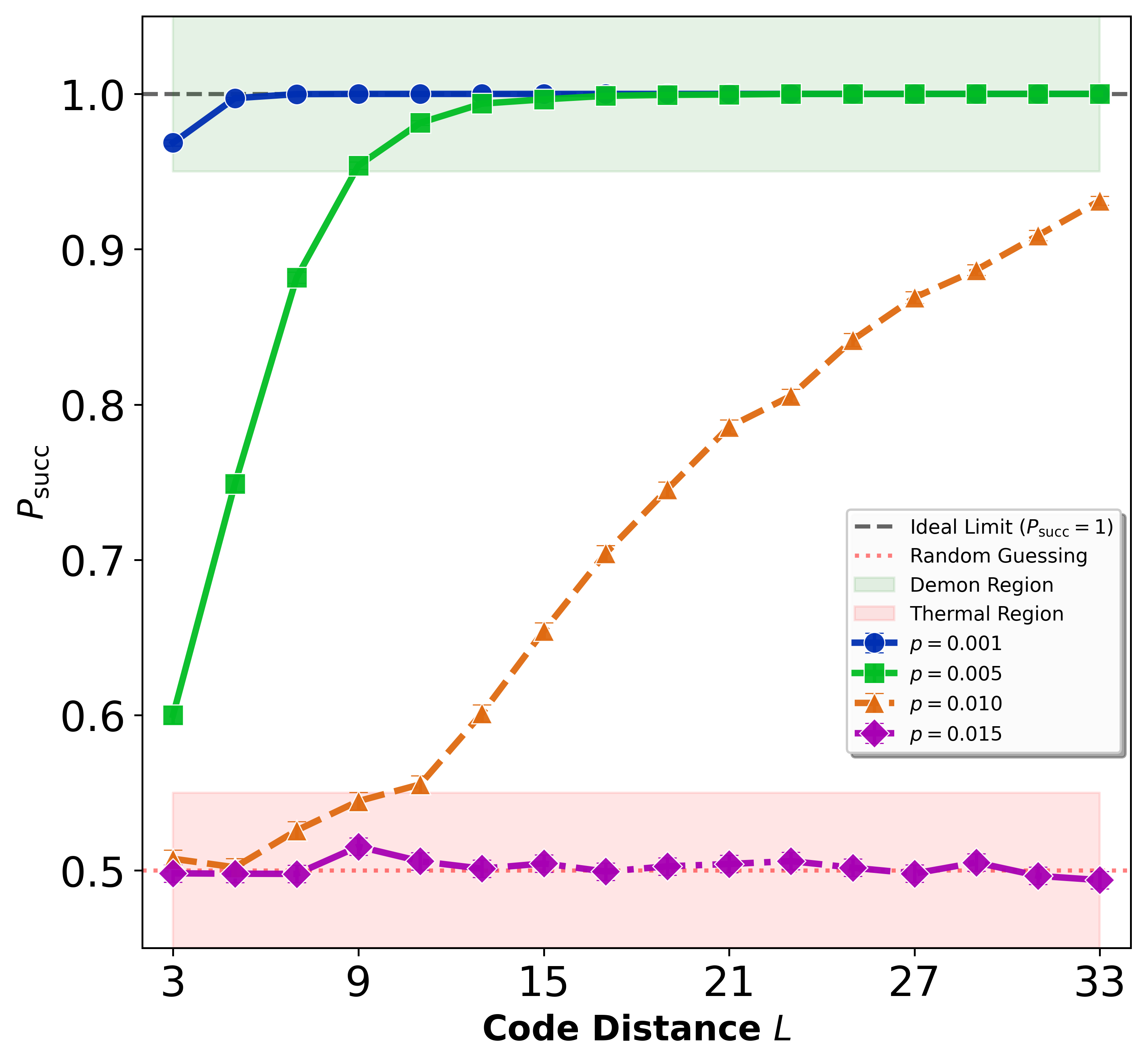
Figure 2: Decoding success probability L1 as a function of code distance L2 and error rate L3, confirming exponential suppression of errors below L4 and a regime of effectively lossless ergotropy transmission.
Thermodynamic Phase Transition and Cost Structure
The research identifies a continuous phase transition at L5, separating a "demon phase" (profitable ergotropy transfer) from a "thermal phase" (dominated by noise and cost). The infrastructure cost for maintaining a channel of width L6 over length L7 scales quadratically: L8, governed by the minimum number of syndrome cycles required by the relay of classical information at finite speed. This irreducible quadratic cost, enforced by relativistic causality, defines a thermodynamic horizon L9, independent of code distance EB=(2Psucc−1)ΔE0. The horizon demarcates the maximum feasible separation for profitable operation, and is robust to enhancements in code or decoder performance.
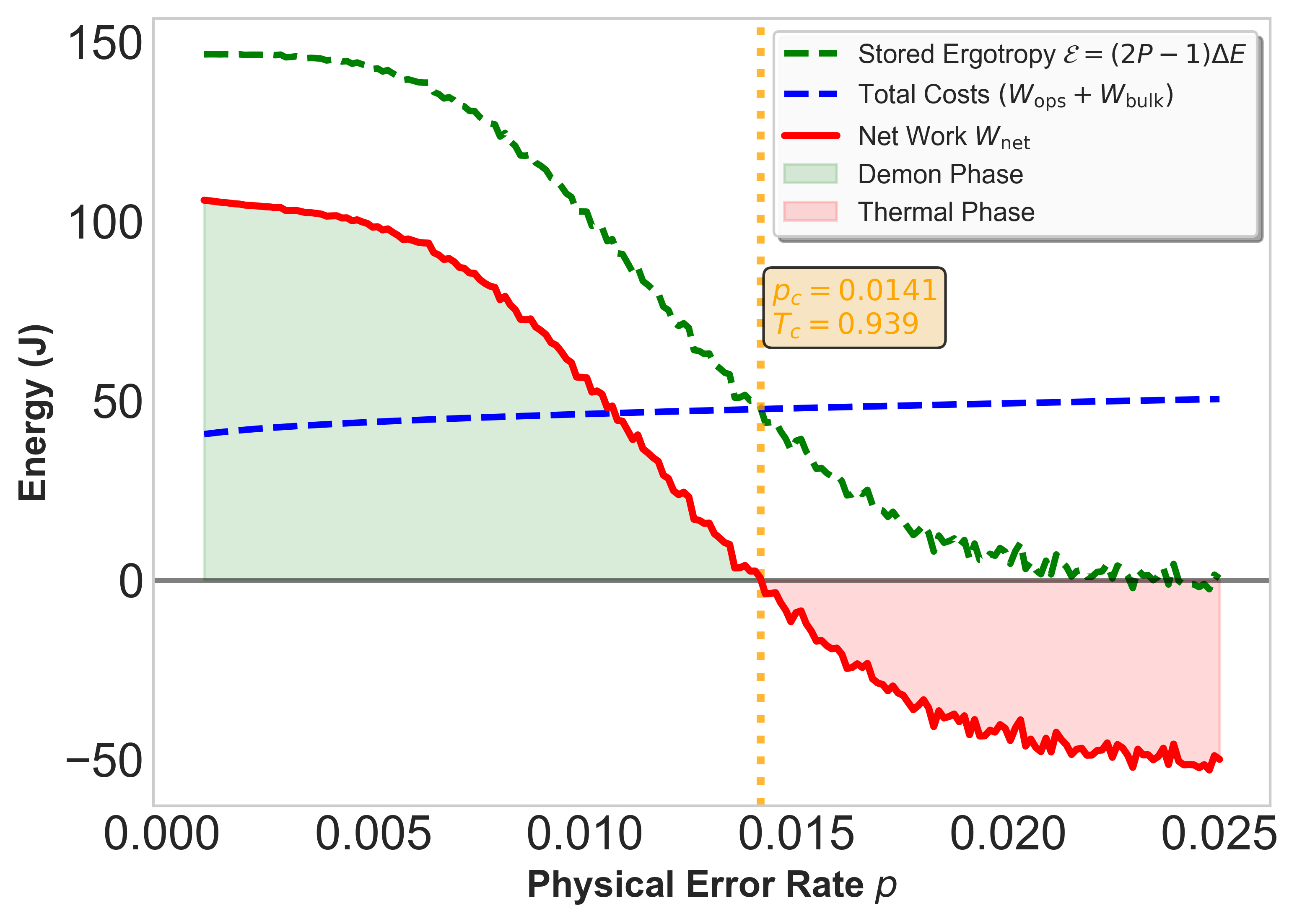
Figure 3: Demonstration of a continuous thermodynamic phase transition in net transferred ergotropy as a function of EB=(2Psucc−1)ΔE1, separating the demon and thermal regimes with distinct physical origins and operational implications.
Dynamical Stability and Necessity of Active Monitoring
Unlike ordered phases with system-size-dependent lifetimes, topological codes at finite temperature require active syndrome extraction to evade entropic instability. Without continuous monitoring and correction, the logical information (and hence stored ergotropy) decays exponentially within a few rounds, regardless of EB=(2Psucc−1)ΔE2.
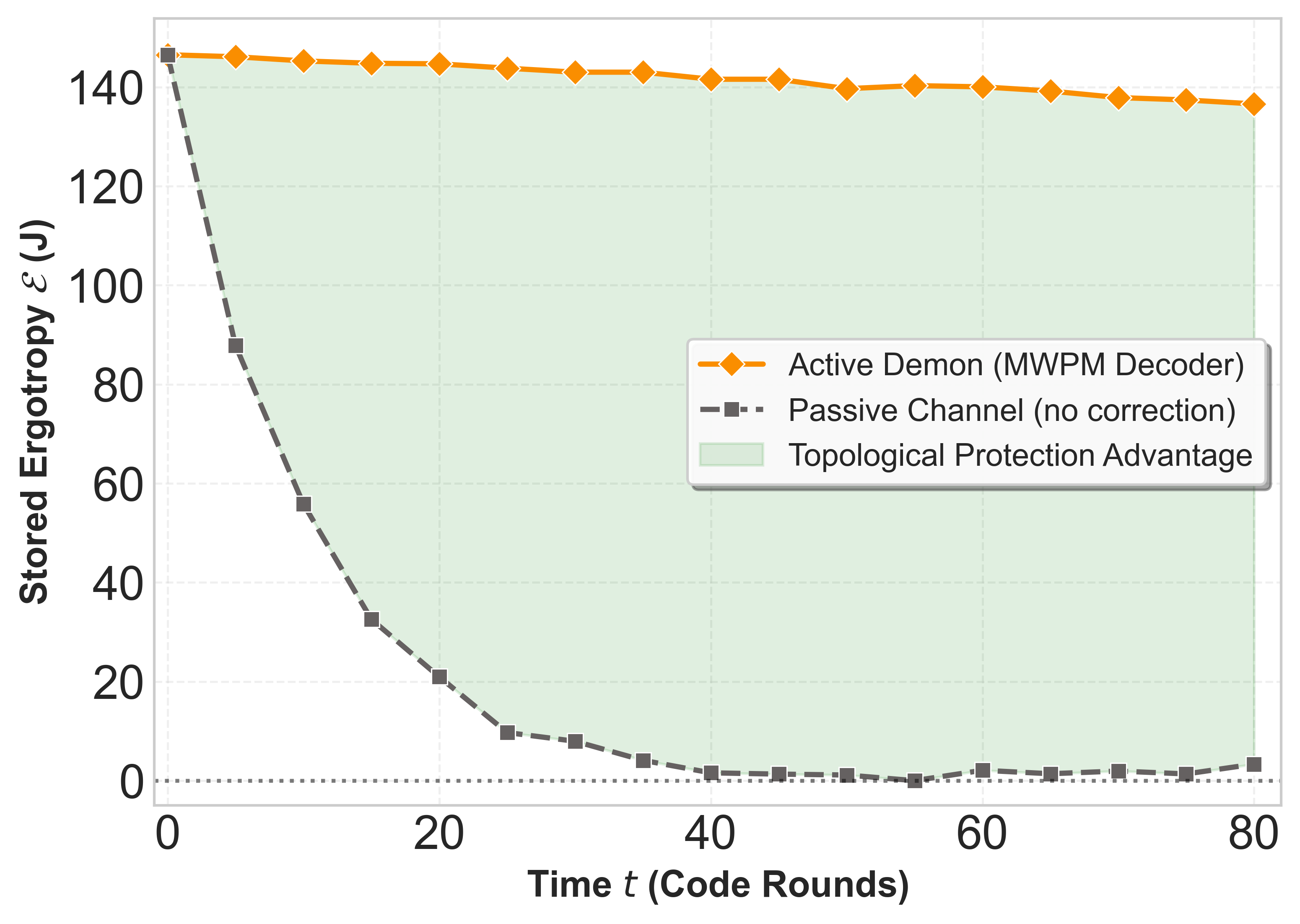
Figure 4: Temporal evolution of ergotropy with and without active error correction, illustrating rapid thermalization in passive schemes and stabilization with active syndrome measurement.
The protocol exposes a percolation-like transition in the efficacy of syndrome information transmission. Below a critical fraction EB=(2Psucc−1)ΔE3 of transmitted syndromes, the decoding graph loses connectivity and ergotropy extraction falls to zero, regardless of underlying code or physical layer performance. This establishes a minimum information requirement intrinsic to the spatial structure of quantum information and distinct from any decoder property.
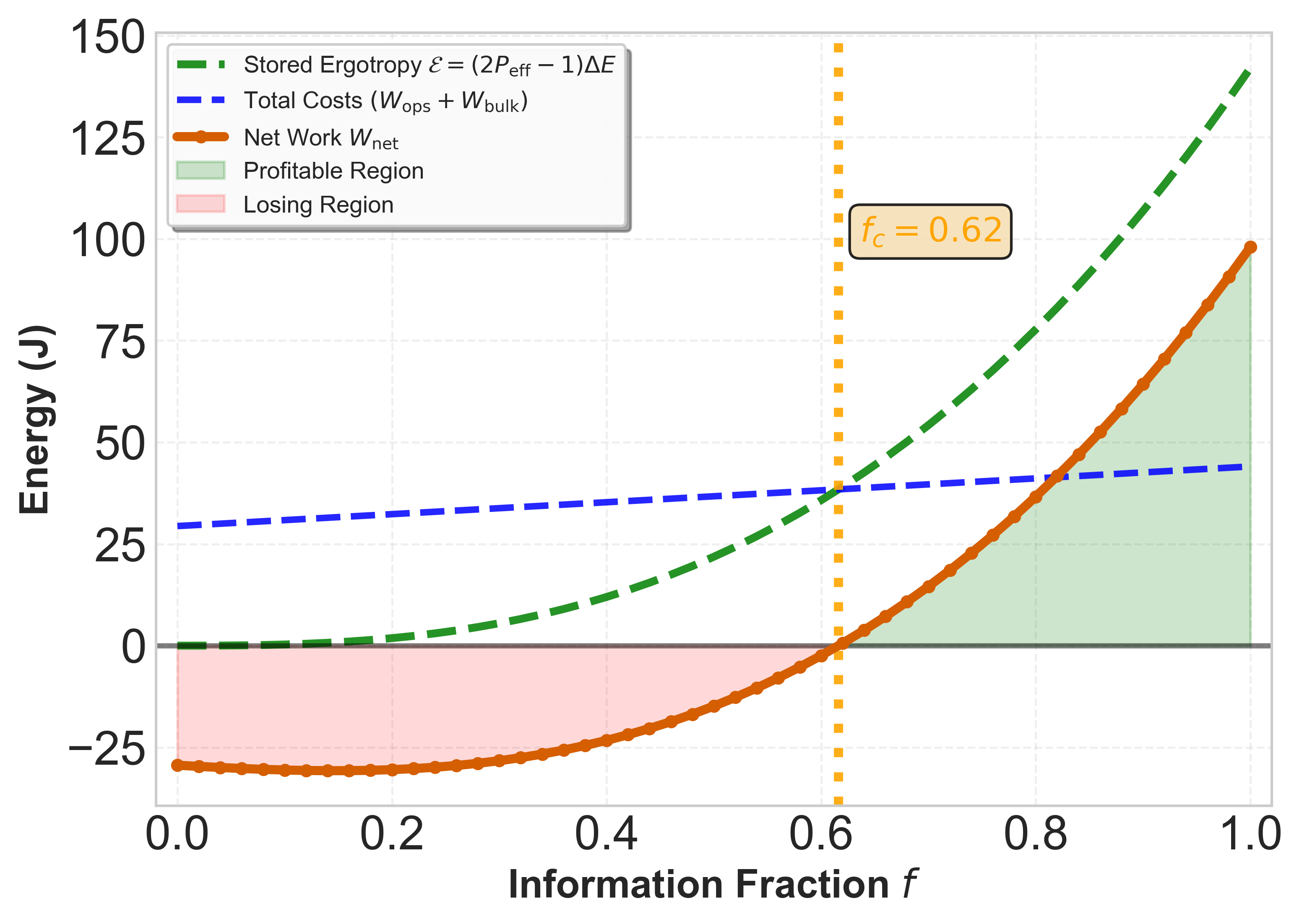
Figure 5: Dependence of extracted ergotropy on the fraction of syndrome information relayed, with a critical percolation threshold for operational viability.
Energy-Distance Trade-offs and Global Phase Diagram
Holding EB=(2Psucc−1)ΔE4 fixed, protocol ergotropy remains nearly constant with increasing EB=(2Psucc−1)ΔE5, but EB=(2Psucc−1)ΔE6 grows quadratically, causing net work delivery to cross zero at EB=(2Psucc−1)ΔE7. This geometric interplay sets a fundamental bound on channel utility.
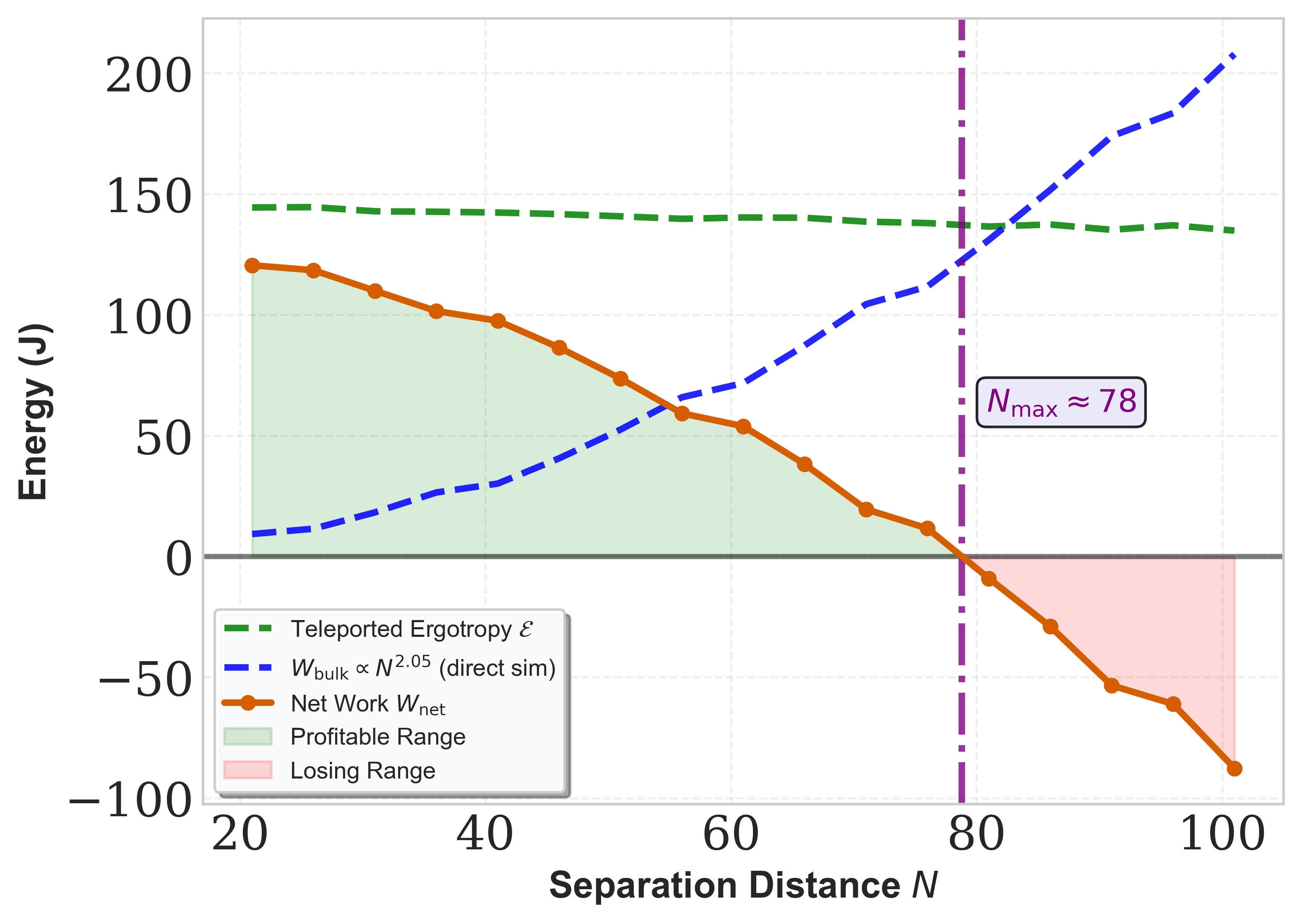
Figure 6: Scaling of ergotropy, infrastructure cost, and net work with distance EB=(2Psucc−1)ΔE8, showing a sharp thermodynamic horizon for nonlocal operation.
The operational space is summarized in a EB=(2Psucc−1)ΔE9 phase diagram, identifying the accessible domain for demon operation under current hardware and communication constraints.
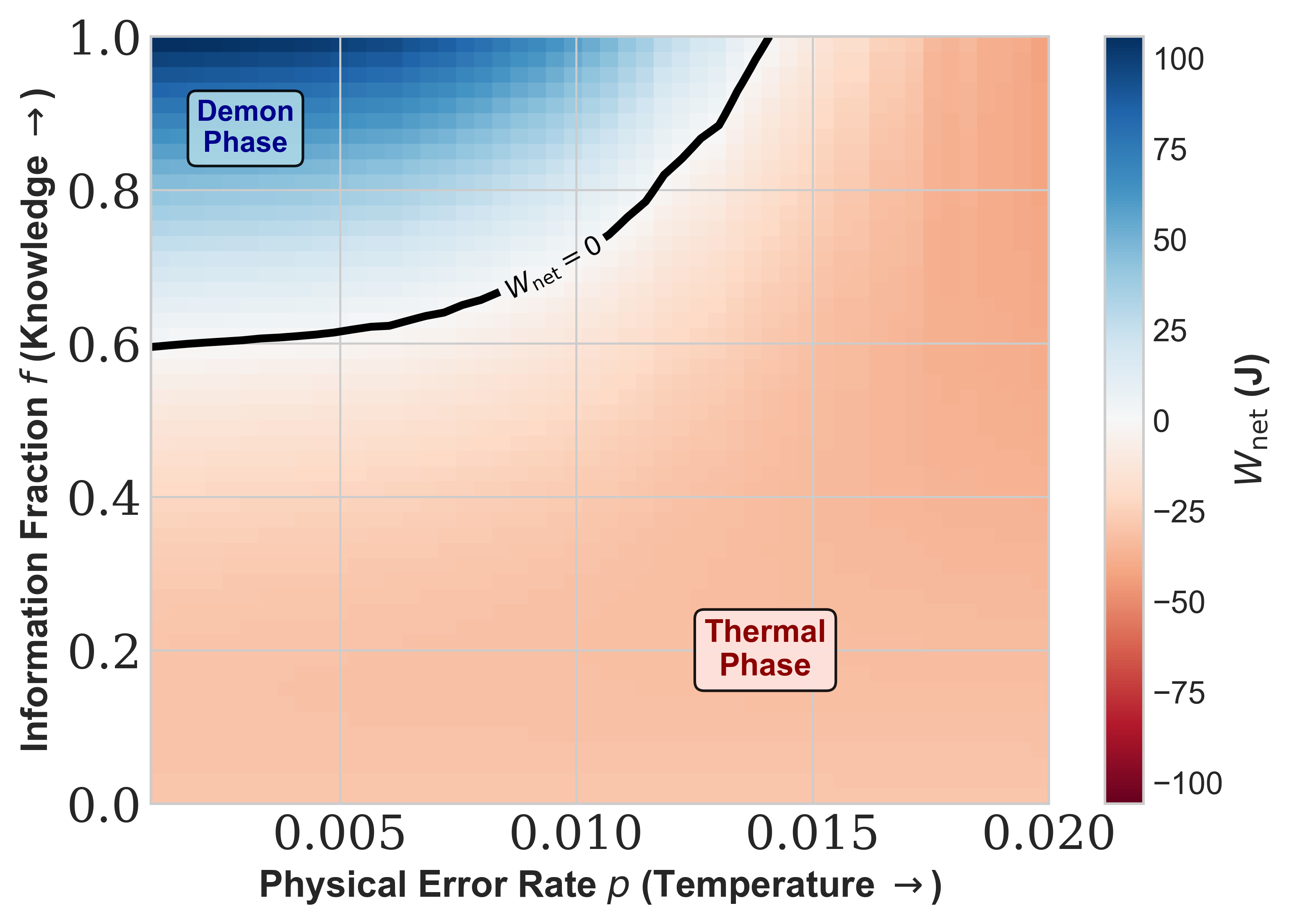
Figure 7: Global operational phase diagram in error rate Psucc0 and syndrome fraction Psucc1, unifying topological, thermodynamic, and information thresholds.
Implications and Future Directions
The protocol recontextualizes QEC not merely as a tool for fault-tolerant computation but as a thermodynamic resource enabling nonlocal conversion of information into useful work at finite temperatures. This approach circumvents the bare energy limitations of conventional QET and quantifies—through explicit phase boundaries and operational horizons—the new roles topological order and active error correction play in thermodynamics. Notably, the strictly quadratic scaling of the infrastructure cost with distance, enforced by fundamental causality rather than engineering limitations, is a pivotal theoretical insight.
Implications for practical realization are immediate: the protocol aligns with the operating capabilities of contemporary superconducting qubit platforms, with error rates and classical communication efficiencies placing the demon phase within achievable reach. Potential extensions include designing multipartite ergotropy distribution networks, investigating the complexity-theoretic contributions of decoders to the thermodynamic balance, and generalizing to other topological phases or quantum network architectures.
Conclusion
This research formally articulates and quantifies the nonlocal conversion of measurement information into operationally useful work, establishing quantum error correcting codes as robust thermodynamic channels at finite temperature. By rigorously linking causal, topological, and thermodynamic constraints, it sets the agenda for both foundational and applied investigations at the quantum-classical interface of information and energy transfer.

