- The paper demonstrates a quantum Szilard engine that models a Maxwell demon operating near a black hole horizon, linking quantum information and thermodynamics.
- It shows that external observers experience noisy, non-unitary dynamics through horizon-induced Hilbert space partitioning, which limits measurement fidelity and work extraction.
- Internal observers maintain unitary evolution and preserve the equivalence principle, thereby bridging quantum thermodynamics and general relativity in curved spacetime.
Introduction
The paper "Quantum Maxwell Demon at the Black Hole Horizon: Thermodynamics, Information, and the Equivalence Principle" (2605.09783) presents a rigorous quantum thermodynamic analysis of a Maxwell demon-driven Szilard engine operating in the curved spacetime near a black hole horizon. By constructing a fully quantum model with a two-level coherent demon and a single-particle working substance, the authors operationalize questions at the intersection of quantum information, thermodynamics, and spacetime causality. The study contrasts the measurement, feedback, and work extraction protocols from the perspective of an external observer versus an infalling demon, situating the results in the context of black hole complementarity, the equivalence principle, and contemporary quantum channel theory.
Model Construction: Quantum Szilard Engine in Curved Spacetime
The core setup employs a single particle in a one-dimensional chamber and a Maxwell demon realized as a quantum two-level system with an energy gap Δ. The chamber is modeled as an infinite square well of length L, provides discrete spatial modes, and the demon's memory state is initially thermalized at local inverse temperature βD (allowing for quantum-coherent off-diagonal elements in the memory). Both the demon and the chamber undergo free fall toward the black hole. The horizon functions as a causal boundary partitioning the Hilbert space into accessible (exterior) and inaccessible (interior) subspaces as the chamber straddles the event horizon.
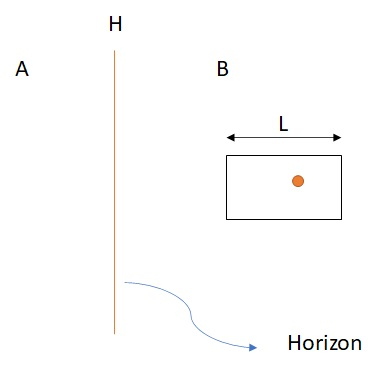
Figure 1: Szilard engine in curved spacetime, with the demon and chamber in free fall through region B, establishing initial conditions for horizon-crossing quantum measurement protocols.
The explicit Hamiltonian framework adapts to the presence of the horizon: after horizon crossing, tracing over interior degrees induces irreversible non-unitary reduced dynamics for the external observer, effectively rendering the accessible subsystem as an open quantum system governed by a Lindblad-type equation.
Measurement and Feedback Protocols Near the Horizon
The measurement procedure utilizes quantum-controlled unitaries (e.g., CNOT-type), correlating the demon's memory state with the spatial support of the particle's wavefunction. When the chamber is fully exterior, standard unitary dynamics allow perfect correlation and maximal work extraction. As the chamber crosses the horizon, compartmentalization of Hilbert space segments the accessible information.
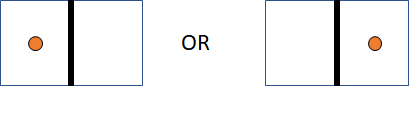
Figure 2: Partitioning the quantum chamber by an impenetrable wall, creating left and right Hilbert subspaces for position-dependent quantum feedback.
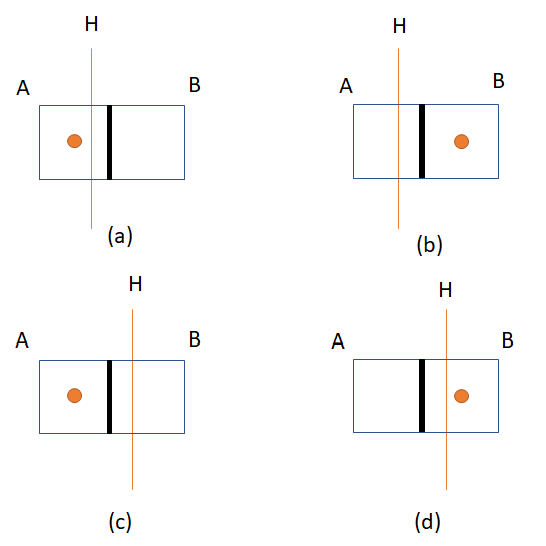
Figure 3: Four horizon-crossing configurations classifying particle, wall, and chamber regions with respect to causal accessibility during measurement.
For an external demon, the protocol results in imperfect measurement correlations: a fraction η of the particle's state remains accessible for feedback, while the rest is irreversibly lost behind the horizon. The demon's post-measurement state manifests as the output of a depolarizing channel with noise strength 1−η, where η is proportional to the spatial support outside the horizon. Explicitly, the maximum mutual information and extractable work obey bounds controlled by η:
Iext≤ηIglobal,WBH=kBTln2×C(η),
with channel capacity C(η)=1−H(21+η). These constraints manifest operationally as degraded measurement fidelity, reduced feedback efficiency, and diminished work extraction.
Equivalence Principle and Internal Observer Dynamics
For the infalling demon, protocol applicability is analyzed on spacelike hypersurfaces orthogonal to the demon's four-velocity. Once the demon and wall are inside the horizon, the entirety of the chamber's degrees of freedom lie within the demon's causal domain. Consequently, the reduced dynamics remain unitary, indistinguishable from the Minkowski spacetime Szilard cycle. There are neither Hilbert space partitions nor any requirement for information-tracing; all thermodynamic and quantum information processing quantities are locally defined and unaffected by the horizon. Landauer's principle and reversibility are preserved precisely as in flat spacetime, validating the equivalence principle at the operational quantum dynamic level.
Black Hole Complementarity and Operational Channel Theory
The operational difference between external and internal observers offers a concrete protocol-based realization of black hole complementarity. Global unitarity is maintained, but each observer's causal access yields distinct effective descriptions: external demons face non-unitary, noisy channel-induced dynamics, whereas internal demons retain closed, unitary evolution. The Hilbert space split echoes the ER=EPR correspondence—accessible/inaccessible quantum sectors function as entangled partners geometrically separated by the horizon, restricting observable correlations and thermodynamic capacities for the external observer but not for the internal one.
The depolarizing channel resulting from horizon-induced Hilbert space partitioning illustrates how spacetime geometry directly controls the capacity of quantum information channels and, thus, the physical limits of measurement fidelity and work extraction. This connection between geometry and quantum channel theory operationalizes entanglement monogamy and underpins observer-dependent thermodynamic efficiency in the presence of causal horizons.
Numerical and Analytical Results
While not explicitly reporting extensive numerical simulations, the paper provides analytical expressions for channel noise (as a function of η), measurement fidelity, work extraction, and information bounds. The claims are supported by explicit quantum state decompositions and channel capacity formulas, forming the foundation for future quantitative studies in analog gravity systems.
Implications and Future Directions
Practically, the model clarifies that local thermodynamic operations (e.g., Maxwell demon cycles) are well-defined even near black hole horizons, provided observer-dependent causal accessibility is considered. The horizon acts as an information-redistribution boundary—correlations are not destroyed but are rendered inaccessible to specific observers. This insight suggests protocols for analog gravity experiments (e.g., quantum-optical setups) to simulate horizon physics and test the geometric control of quantum channel capacity.
Theoretically, the approach bridges quantum thermodynamics, information theory, and general relativity, providing operational tools to address the black hole information paradox, complementarity, and monogamy issues. Extensions could address field-theoretic models, incorporate gravitational back-reaction, or explore connections with holographic complexity.
Conclusion
This paper operationalizes the interplay between quantum information, thermodynamics, and spacetime causality through a rigorous quantum Szilard engine model at a black hole event horizon. Horizon-induced Hilbert space partitioning constrains measurement fidelity and thermodynamic efficiency for external observers, while internal observers preserve the equivalence principle at the operational quantum level. These findings establish a foundation for observer-dependent quantum thermodynamic protocols in curved spacetime and highlight the geometric control of quantum channel capacity as a fundamental constraint linking information accessibility and physical work extraction.

