Published 14 May 2026 in hep-th, gr-qc, and hep-ph | (2605.14684v1)
Abstract: A consistent non-compact axion cosmology requires a non-periodic field, an effective field theory valid sufficiently above the inflationary scale, and a small non-QCD contribution to the potential that tilts the axionic vacuum landscape in order to trigger a timely domain-wall collapse. All conditions can be met by the dilaton -- the pseudo-Nambu-Goldstone boson of spontaneously broken approximate scale invariance.
The paper introduces a framework where a non-compact QCD axion emerges as a pseudo-Nambu-Goldstone boson from spontaneously broken scale invariance.
It employs a dilaton field, nonminimally coupled to gravity, to generate an exponential tilt in the axion potential and bias among QCD vacua.
The model predicts observable signatures such as a stochastic gravitational wave background and precise constraints on residual strong CP violation.
QCD Axion from Broken Scale Symmetry: A Technical Synthesis
Abstract and Motivation
This work establishes a framework in which a non-compact QCD axion emerges as the pseudo-Nambu-Goldstone boson of spontaneously broken, approximate scale invariance. The model leverages the dilaton field---arising from scale symmetry breaking---coupled nonminimally to gravity and logarithmically to the QCD topological density, generating the phenomenological features required for consistent non-compact axion cosmology. The analysis focuses on the consequences of such a setup, emphasizing the interplay between dilaton dynamics, vacuum selection, and cosmological defect evolution, while offering a theoretically robust mechanism for tilting the axion potential and biasing the vacuum structure.
Theoretical Framework
The model introduces a dilaton field χ, nonminimally coupled to the Ricci scalar and possessing a classically scale-invariant Lagrangian. The QCD topological term is coupled logarithmically to the dilaton. Explicit scale-breaking operators or integration constants induce non-QCD contributions to the potential, yielding a small bias among neighboring vacua after QCD confinement. The gravitational sector plays a pivotal role: scale invariance, once promoted to a quantum symmetry in unimodular or TDiff gravity, ensures that radiative corrections do not generate additional explicit scale-breaking terms when a scale-invariant renormalization is employed.
The crucial technical construction arrives upon transition to the Einstein frame: after a Weyl rescaling, the canonical field a (axion/dilaton) is related logarithmically to the compensator χ, with scale invariance manifesting as a (broken) shift symmetry. The Lagrangian assumes the form:
L=2MPl2R−21(∂a)2+faaQ−Λ4e−qa/MPl−2χ2ξMPl4
where fa depends on the coupling β, Λ and q encode the scale and slope of the explicit tilt, and ξ is the coefficient of the dilaton quartic.
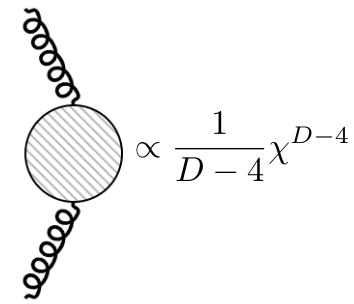
Further technical refinement addresses the geometric origin of logarithmic coupling to Q=8παsGμνbGbμν, which arises unavoidably if the renormalization scale in dimensional regularization is replaced by a0 (see (Figure 1)). The resulting effective operator after removing divergences is finite and logarithmically dependent on a1, and reflects the effect of weak CP violation.
Figure 1: Diagrammatic origin of the logarithmic dilaton-QCD coupling, showing how weak CP-violating quark/Yukawa dynamics induce a divergent CP-odd counterterm with two gluons; scale-invariant regularization turns this into a finite local operator proportional to a2.
Nonlinear Realization and Potential Structure
Scale invariance, once spontaneously broken, yields the canonically normalized axion through a3, rendering the low-energy theory approximately shift symmetric. The explicit breaking of scale symmetry, depending on its microscopic source, ubiquitously generates an exponential tilt for the axion:
a4
This exponential bias is generically present for all scaling dimensions a5 of the parent breaking operator. The sign and magnitude of a6 are dictated by a7 and the nonminimal coupling; typical values ensure that the shift symmetry breaking parameter a8 in the physically relevant regime of a9.
Gravitational topological densities (Euler, Pontryagin invariants) also couple logarithmically to χ0, leading to further possible exponential or oscillatory terms in the axion potential, though these are believed to be subdominant compared to the QCD-induced contribution under reasonable assumptions.
Phenomenological Consequences
The cosmological and phenomenological implications map precisely onto the non-compact axion scenario previously established. Inflationary fluctuations populate a wide ensemble of QCD vacua. After confinement, the full axion potential is:
χ1
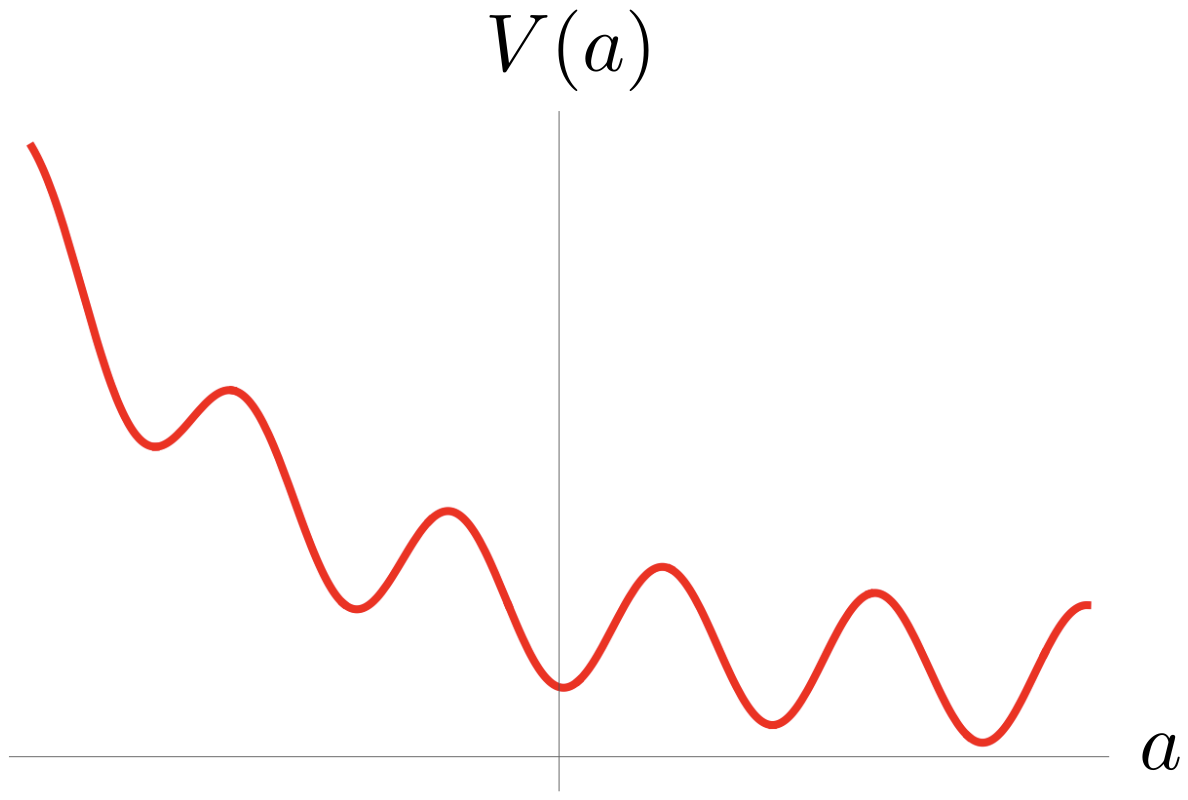
where χ2 is the axion mass. The exponential tilt (illustrated in (Figure 2)) lifts the degeneracy of QCD minima, ensuring the subsequent collapse of the domain wall network that would otherwise lead to a cosmological crisis.
Figure 2: Axion potential with a prominent exponential tilt, lifting the degeneracy of the QCD-induced periodic structure and shifting minima by a branch-dependent amount corresponding to residual strong-CP violation.
A critical phenomenological feature is that the exponential tilt inexorably leads to nonzero residual strong CP violation in the surviving vacuum:
χ3
This residual phase must comply with stringent experimental bounds on the neutron EDM (χ4), imposing constraints on the allowed combination of χ5, χ6, and χ7.
The energy splitting between neighboring vacua, essential for biasing and destabilizing the domain wall network, is directly tied to low-energy observables:
χ8
The exponential tilt provides a more predictive bias than previously studied quadratic forms, yielding a narrower allowed window for χ9. Successful cosmology requires that inflationary fluctuations span many QCD branches, that the bias is sufficiently large for walls to annihilate before BBN, and that the effective theory remains valid during inflation.
The model's realization through the Higgs-dilaton scenario with unimodular gravity is particularly economical, both generating the required potential structure and accommodating inflation. The approximately shift-symmetric structure protects the axion from radiative destabilization, and the framework remains agnostic as to the ultimate UV origin of the explicit tilt, be it matter loops, gravitational dynamics, or integration constants.
The exponential potential, central to this analysis, is also relevant for alternative axion cosmologies (scaling axions) in which the pre-QCD evolution is altered by a dominant runaway term. However, the focus herein is the subdominant exponential acting as a bias, not as the primary driver of axion dynamics.
Conclusion
This analysis demonstrates that the dilaton arising from broken scale invariance, when embedded in a scale-invariant and nonminimally coupled gravitational theory, naturally supplies the field content and potential structure required for viable non-compact QCD axion cosmology. The logarithmic QCD coupling is compelled by quantum consistency and the structure of CP violation, while explicit scale breaking generates a universal exponential tilt. These ingredients solve the domain wall problem, set a predictive window for residual strong CP violation, and lead to distinctive, concurrently testable signals in EDM measurements and gravitational wave observatories. This framework unifies gravitational, axion, and cosmological sectors under the aegis of scale symmetry and its breaking, pointing toward fertile ground for future phenomenological and model-building investigations in high-energy and cosmological physics.
“Emergent Mind helps me see which AI papers have caught fire online.”
Philip
Creator, AI Explained on YouTube
Sign up for free to explore the frontiers of research
Discover trending papers, chat with arXiv, and track the latest research shaping the future of science and technology.Discover trending papers, chat with arXiv, and more.