- The paper extends classical knot invariants by developing explicit Wirtinger-type quandle presentations for surface knots in arbitrary 4-manifolds.
- The paper utilizes banded unlink diagrams to establish an isomorphism between diagrammatic and topological quandles, enabling precise bridge number calculations.
- The paper demonstrates that quandles can distinguish surface knots with identical knot groups, paving the way for new families of invariants in 4-manifold topology.
Quandle Presentations of Surface Knots in 4-Manifolds and Bridge Numbers
Introduction and Context
The study of surface knots in 4-manifolds fundamentally relies on distinguishing surfaces up to isotopy within complex ambient topologies. The classical knot group, as the fundamental group of the knot's complement, is insufficient as a complete invariant: distinct surface knots can share isomorphic knot groups. The advent of the quandle, introduced by Joyce and Matveev, provided a richer algebraic framework tailor-made for capturing the essential features of codimension-two knotting. While combinatorial, Wirtinger-type presentations of quandles are well developed for surfaces in S4, computations in arbitrary 4-manifolds are hindered by the limitations of classical diagrammatics.
This paper extends the computational frontier by developing explicit Wirtinger-type presentations for the fundamental quandle of surface links in arbitrary 4-manifolds using the framework of banded unlink diagrams. Notably, the author demonstrates that the induced diagrammatic quandle recovers the full topological fundamental quandle, yielding new applications: explicit calculations of bridge numbers for large classes of surface knots in generalized ambient spaces and the construction of infinite families of knots with identical knot groups but distinct quandles.
Diagrammatic Presentations and Main Theoretical Results
The crux of the approach is the careful adaptation of banded unlink diagrams, originally constructed by Hughes, Kim, and Miller, to formulate the quandle presentation in any 4-manifold with an explicit handle decomposition. Each surface is represented as a triple (K,L,v), where K is the ambient Kirby diagram, L is an unlink in the exterior of K, and v is a set of bands specifying the "movie" of the surface through the Morse function.
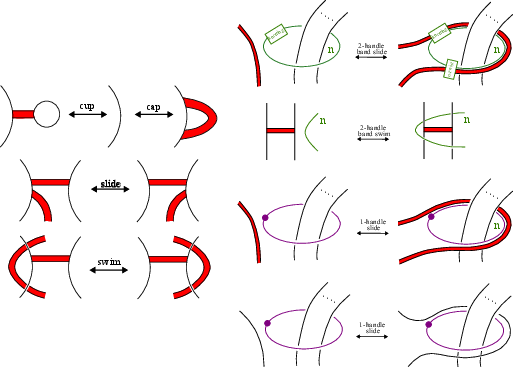
Figure 1: Typical sequence of band moves—local diagrammatic transformations—that generate isotopies of embedded surfaces.
The main theorem asserts that for a banded unlink diagram D of a surface link S, the constructed diagrammatic quandle Q(D) is isomorphic to the topological fundamental quandle Q(S). This isomorphism is established by constructing mutual quandle homomorphisms using noose-based path classes for the explicit encoding of quandle elements. Relations are diagrammatically justified via the geometry of the surface/handlebody decomposition and algebraically verified against the path groupoid of the surface exterior.
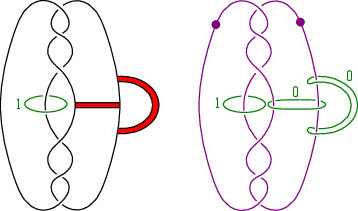
Figure 2: Left — Banded unlink diagram of the connected sum of the spun trefoil and (K,L,v)0 in (K,L,v)1; Right — the associated Kirby diagram of the surface exterior.
The presentation includes:
- Primary generators, labeling arcs in (K,L,v)2
- Operator generators, encoding the handles of the ambient 4-manifold
- Primary relations, deriving from classical crossings and bands
- Operator relations, induced by the underlying 1- and 2-handle structure
Writers provide explicit combinatorial prescriptions for all relations using the augmented quandle formalism. The operator group of the quandle coincides precisely with the knot group obtained from the Kirby diagram of the surface exterior.
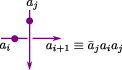
Figure 3: The 1-handle crossing relation, which underpins the combinatorial encoding of the operator group from the banded unlink diagram.
Applications: Bridge Numbers and Distinguishing Power of Quandles
The extended quandle framework immediately enables computation of quandle (kei) colorings and quantitative invariants for surfaces in general 4-manifolds. Analogously to classical bridge numbers for knots in (K,L,v)3, the bridge number of a surface knot in a 4-manifold corresponds to the minimal decomposition via trisections and Morse data. Utilizing quandle colorings, the paper establishes both lower bounds on the bridge number and presents explicit infinite families of surface knots with prescribed bridge number in an arbitrary 4-manifold (K,L,v)4 without 1-handles.
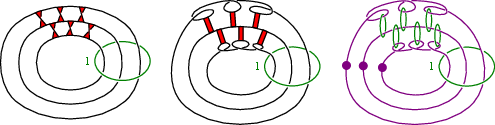
Figure 4: Left — Banded unlink diagram for (K,L,v)5; Middle — bands in blackboard framing; Right — Kirby diagram of the exterior, with all 2-handle framings 0.
Using the developed machinery, several key results are enabled:
- For any (K,L,v)6 and (K,L,v)7, there exist infinitely many non-isotopic, homologous surfaces with bridge number (K,L,v)8 in (K,L,v)9.
- Direct generalization of Sato and Tanaka's K0 results to nontrivial ambient topologies, yielding new infinite families distinguished by their fundamental quandles despite sharing the same knot group.
The constructive method for quandle colorings is tightly coupled to the combinatorics of the diagram, reinforcing that higher-order algebraic invariants enable explicit enumeration far beyond group-theoretic arguments.

Figure 5: Local combinatorial primary relations arising from under- and over-crossings in the diagram.
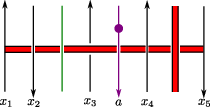
Figure 6: Example of a nontrivial band relation encoding conjugacy in the operator group.

Figure 7: Operator relation derived from a 2-handle attaching link; crossing information is combinatorially extracted from the diagram.
Distinguishing Surface Knots with Isomorphic Knot Groups
The paper addresses the classical failure of the knot group as a complete invariant by constructing explicit families of surface knots with:
- Isomorphic knot groups,
- Non-isomorphic fundamental quandles.
Via connected sums with algebraic curves and manipulation of banded diagrams, such phenomena are generically extended to surfaces embedded in any 4-manifold without 1-handles (local surfaces) and to certain non-null-homologous surfaces, e.g., in K1. The extension of Tanaka's results with explicit invariants (the quandle type, coloring numbers, etc.) gives rise to a precise classification up to quandle isomorphism while retaining group isomorphism.
Implications and Theoretical Impact
The explicit diagrammatic presentation for the fundamental quandle in arbitrary 4-manifolds provides an algorithmic path to investigate surface knotting phenomena outside K2. The methods consolidate and extend the computational topology of surfaces, allowing systematic enumeration of invariants, bridge numbers, and explicit construction of distinguishing examples.
With practical applications including the computation of quandle colorings, determination of bridge numbers, and the classification of surface knots up to finer equivalence relations, this framework sets a new baseline for computations in geometric 4-manifold topology. The insight that operator relations are readily extracted from the handlebody structure opens avenues for studying how ambient topology constrains surface knot invariants.
Looking forward, this approach raises natural questions for further research: the complexity of quandle presentations in specific families of 4-manifolds, the behavior of quandle (co)homology in this setting, and the possibility of new invariants obtained via quandle-theoretic constructions. It also suggests systematic extensions for the study of links, knotted graphs, and general codimension-two embeddings in 4-manifolds.
Conclusion
This paper rigorously establishes a methodology for computing the fundamental quandle of surface links in arbitrary 4-manifolds using banded unlink diagrams and extracts Wirtinger-type presentations. Through explicit construction and combinatorial encoding of handlebody data, it provides a toolkit for understanding and computing powerful invariants beyond classical knot groups. The results yield new infinite families of surface knots with prescribed bridge numbers and the sharp distinguishing power of quandles, bridging a gap in the algebraic study of surface knots beyond the 4-sphere.