- The paper establishes that every embedded 3-manifold in S5 admits a bridge quadrisection, generalizing classical bridge positions.
- It employs a novel diagrammatic framework using four trivial tangle diagrams to encode embeddings and compute topological invariants.
- The work introduces an algorithmic isotopy procedure, providing practical tools for analyzing high-dimensional knot theory and 5-manifold topology.
Bridge Position of 3-Manifolds Embedded in the 5-Sphere: A Technical Assessment
Introduction and Motivation
The paper "Bridge position of 3-manifolds embedded in the 5-sphere" (2604.12182) provides a comprehensive generalization of diagrammatic techniques for representing higher-dimensional knots and links, specifically addressing the lack of analogous tools for encoding embeddings of 3-manifolds in S5. The authors systematically develop a bridge decomposition theory for such embeddings, extending classical bridge position concepts for knots in S3 and bridge trisections of surfaces in S4 to the setting of 3-manifolds in 5-space. A central feature is the introduction of bridge quadrisections, explicitly constructed using four trivial tangle diagrams organized with compatibility and reconstructibility conditions.
Diagrammatic Framework and Bridge Quadrisections
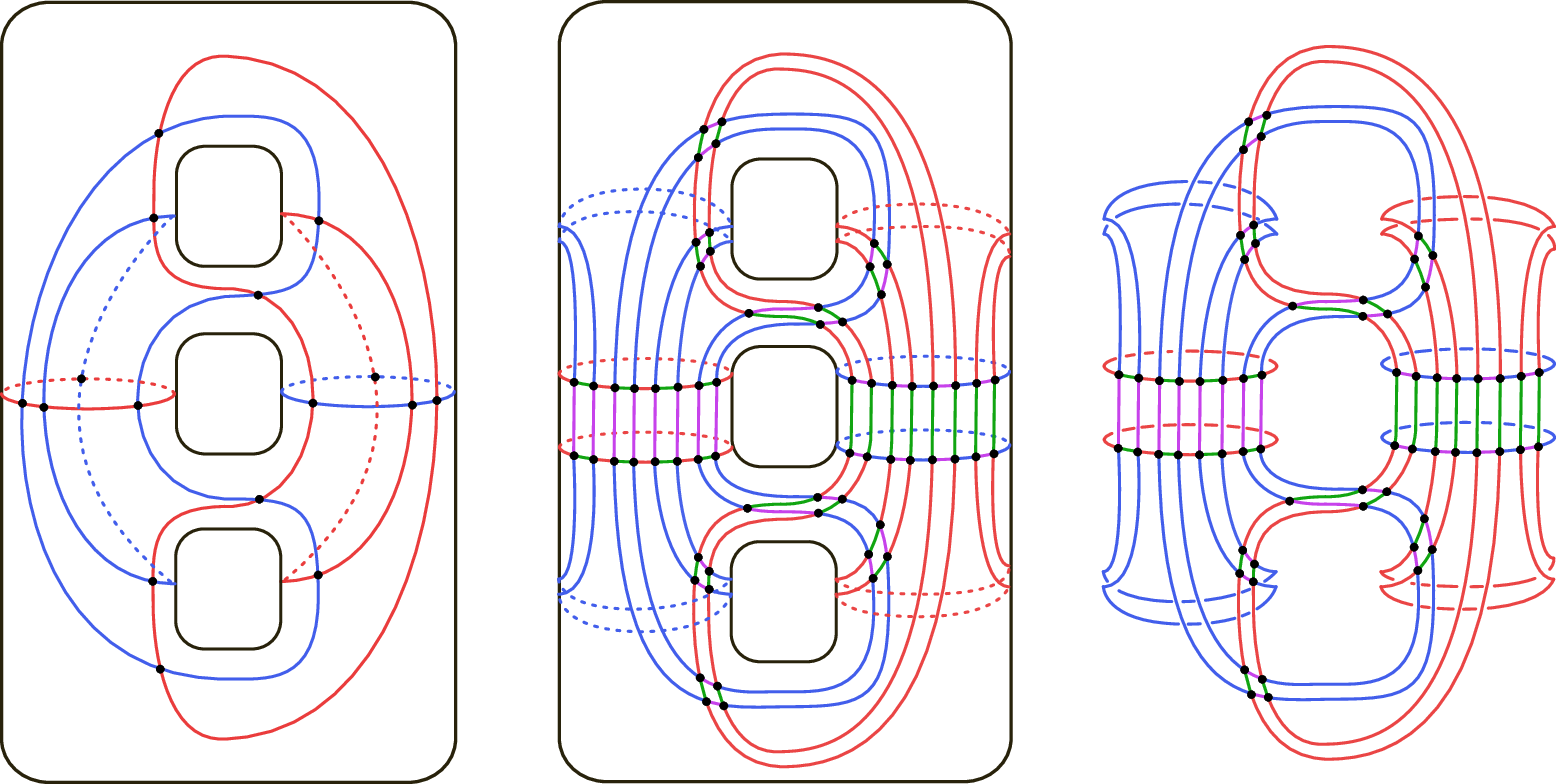
The work builds upon the machinery of quadrisections in 5-manifold topology (cf. Aribi, Courte, Golla, and Moussard), which decompose a 5-manifold into four 1-handlebodies. The authors utilize the trivial quadrisection of S5 to define a bridge quadrisection for an embedded 3-manifold Y⊂S5, effectively encoding the embedding by a quadruple (T1,T2,T3,T4) of trivial tangles. Significantly, this construction generalizes the triplane diagrams for surfaces in S4. The compatibility conditions are both local (each pair forms a trivial link) and higher-order (triples define bridge trisections of unknotted 2-spheres in S4), ensuring that the quadruple encodes all topological data of the embedding up to ambient isotopy.
The reconstructibility of Y from its bridge quadrisection is formalized in the primary existence result: every embedded $3$-manifold in S30 admits a bridge quadrisection. The data reduce the study of embeddings up to isotopy to combinatorial properties of tangles and their associated diagram moves.
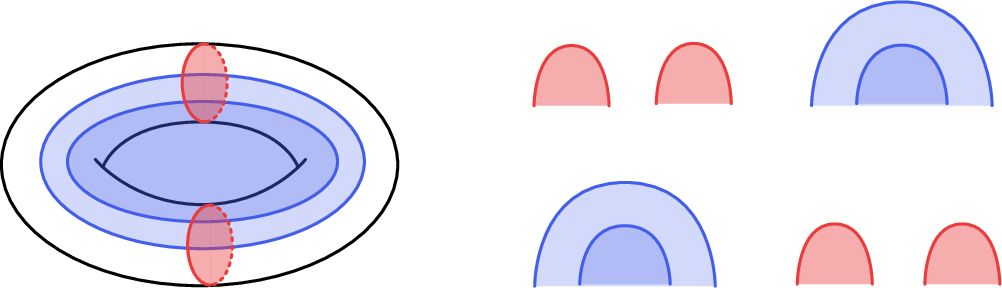
Figure 1: Schematic depiction of a Heegaard complex for S31 (left), and the intersection of S32 with the four sectors of the genus-zero S33-section of S34 (right), with compressing disks visualized in cross-sectional 3-spheres.
Key Constructions and Existence Proof
A major technical contribution is the algorithmic procedure isotoping an arbitrary embedding into bridge position. The process involves:
- Bringing the 3-manifold into relative Morse position so that the equatorial S35 divides it into two 3-handlebodies.
- Constructing a Heegaard complex for the embedded manifold, encoding the handle data via compressing disks in S36.
- Placing the Heegaard complex in bridge position with respect to the genus-zero quadrisection, enabling its representation via the four compatible tangle diagrams.
- Verifying that the quadrisection fully determines the embedding up to isotopy, leveraging uniqueness theorems for trivial tangle fillings and abstract perturbation calculus.
A formal existence theorem is established, filling a major gap in the field by showing the universality of the bridge quadrisection framework for high-dimensional knot theory.
Explicit Examples and Applications
The authors supply multiple classes of explicit examples, demonstrating the flexibility and effectiveness of their diagrammatic calculus:
Diagrammatic Moves, Uniqueness, and Invariant Computation
The framework supports a calculus of moves on bridge quadrisection diagrams resembling those in classical knot theory. Notably:
- Interior Reidemeister moves and mutual braid moves correspond to isotopies of the embedded 3-manifold.
- Introduction of 3-manifold perturbations, which adjust the bridging data while maintaining the underlying isotopy class.
A conjectural uniqueness result is formulated, positing that any two quadrisection diagrams of isotopic 3-manifolds are connected by a finite sequence of explicit moves. This highlights both the expressive power of the calculus and a pathway toward automated manipulation and classification of high-dimensional knots.
Furthermore, the diagrammatic framework enables computation of fundamental invariants, such as the homology of branched covers, directly from tangle data. The approach generalizes techniques previously available only in dimension four and the authors implement these computations algorithmically.
Theoretical and Practical Implications
From a theoretical perspective, this work formalizes the combinatorial reduction of the knotting problem for 3-manifolds in S42 to diagrammatics, opening avenues for new invariants, classification results, and connections to 5-manifold topology. Practically, the results provide constructive tools for generating and manipulating explicit examples, as well as for computational approaches in high-dimensional knot theory.
The bridge quadrisection diagrams also serve as a bridge (in a technical sense) to branched covering constructions and could underlie progress on high-dimensional analogs to Moise's conjecture and embedding problems.
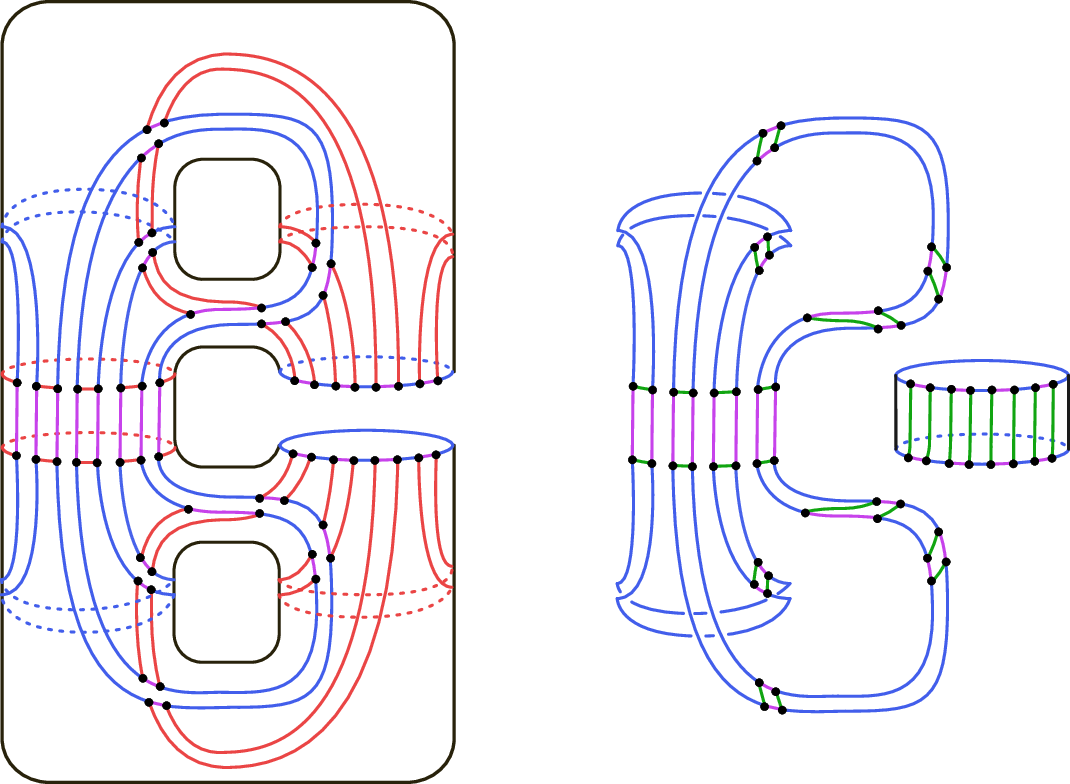
Figure 3: Tangles referenced in the computation of branched covering invariants, highlighting the operational versatility of quadrisection diagrams.
Conclusion
This paper advances the study of high-dimensional knotting by endowing the embeddings of 3-manifolds in S43 with a practical, combinatorial, and universally applicable diagrammatic language. The extension of bridge decompositions and associated calculus to this setting is a substantial step in the synthesis of diagrammatic and handlebody techniques, and provides new tools for theoretical and computational exploration of 5-manifold topology and knotted submanifolds. Future work will likely address the conjectural uniqueness, effective movesets for isotopy, further development of computable invariants, and applications to the topology of branched covers and contact/topological field theory connections.