- The paper introduces averaged accessible information (AAI) as a scalable alternative to Holevo information for probing quantum information scrambling.
- It employs the classical shadows protocol to efficiently estimate local subsystem purity, ensuring robust statistical guarantees.
- Numerical validations across different models demonstrate that AAI reliably captures dynamics from ballistic spread to localization.
Introduction and Context
Scrambling—the delocalization of initially local quantum information throughout a many-body system—remains fundamental in understanding quantum thermalization, chaos, and ergodicity breaking. Standard measures such as the out-of-time-order correlators (OTOCs) and operator spreading have advanced both theoretical insight and experimental access. Another key concept is the Holevo information, which quantifies the maximal classical information extractable through optimal measurements on local subsystems. While theoretically rigorous, the operational difficulty of optimal measurement limits the experimental utility of Holevo information.
This paper introduces a paradigm shift: quantifying scrambling via "averaged accessible information" (AAI), an operational and scalable metric rooted in what can be efficiently measured—specifically, purity of local subsystems—through the classical shadows protocol and random local probes (2605.13691).
Definition and Analytical Structure
The averaged accessible information, χ2, is constructed as a R\'enyi-2 analog to the Holevo information, capturing the average information gain from randomized (Haar-measure) measurements:
χ2(t)=Q2(2ρ1(t)+ρ2(t))−2Q2(ρ1(t))+Q2(ρ2(t)),
where Q2(ρ)=log[2/(1+Tr(ρ2))] and ρi(t) are local reduced density matrices corresponding to different initial conditions. This construction connects randomized measurement outcomes with R\'enyi entropic properties, providing a rigorous, nonlinear function of subsystem purity, bypassing the need for full state tomography or optimal observable selection.
The paper proves several properties of Q2:
- Strict Positivity and Additivity: Q2 is positive, additive, and Schur-concave.
- Mathematical Concavity: Q2 is strictly concave over the convex set of density matrices, contrasting with the non-concave behavior of the standard quantum R\'enyi-2 entropy.
The derivation leverages both direct spectral expressions and contour integral representations, establishing equivalence between the randomized accessible-information approach and established mathematical structures in quantum information theory.
Efficient Experimental Access: Classical Shadows Protocol
The classical shadows protocol efficiently estimates Tr(ρA2)—the purity of any local subsystem—via randomized Pauli measurements and post-processing. A single set of random measurements suffices to reconstruct purities for all relevant subsystems, enabling high-throughput AAI estimation.
Robust statistical estimators such as "median-of-means" further enhance the protocol's reliability against outlier-induced errors, providing strong probabilistic guarantees for finite measurement budgets.
Numerical Validation and Convergence
The theoretical equivalence between Haar-random averaging and Clifford group (unitary 3-design) sampling is established. Simulations demonstrate convergence of χ2 using finite Clifford circuit samples, confirming the robustness and feasibility for practical quantum hardware.
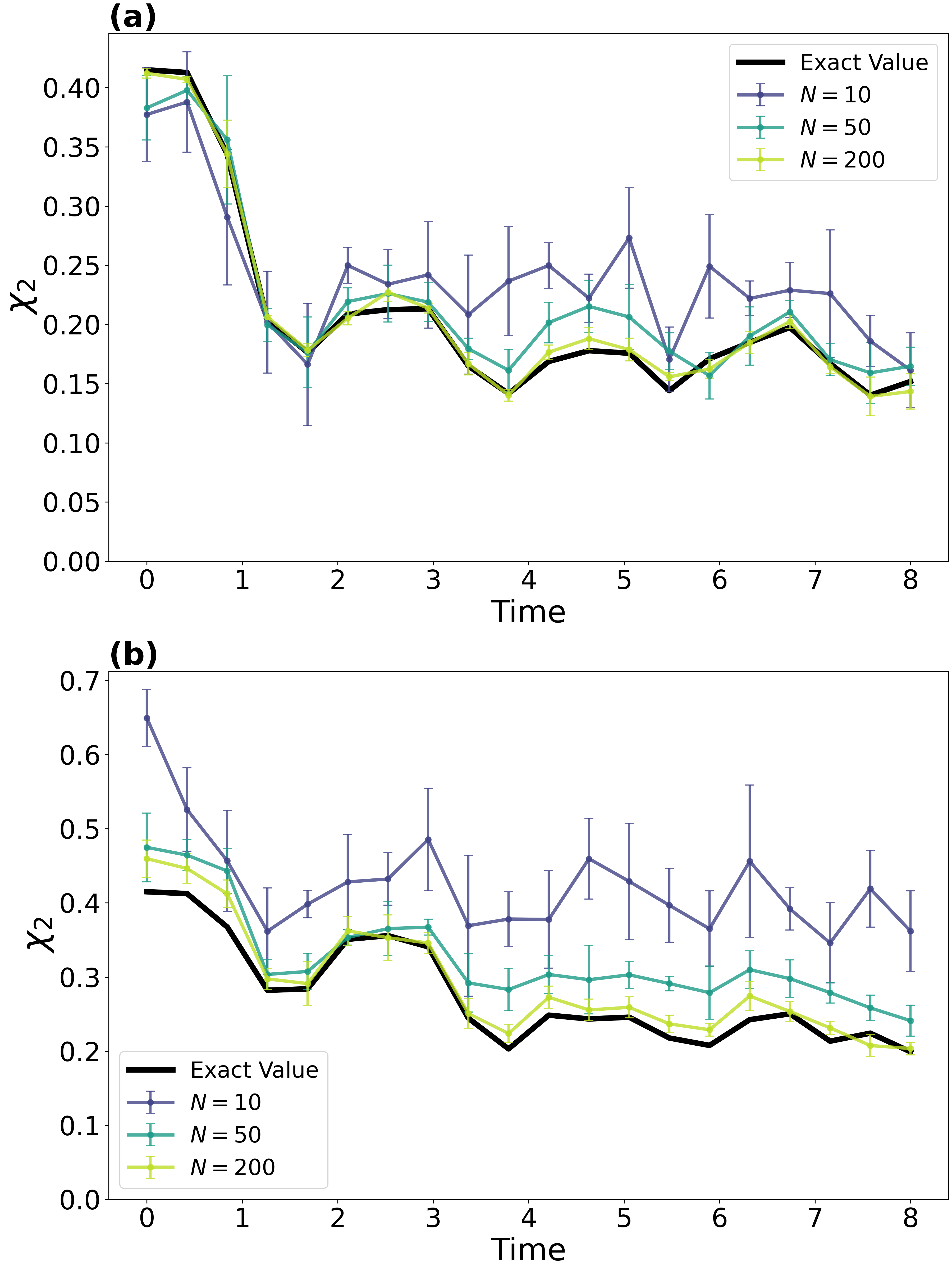
Figure 1: Convergence of AAI (χ2) via random Clifford sampling in the PXP model for subsystem sizes χ2(t)=Q2(2ρ1(t)+ρ2(t))−2Q2(ρ1(t))+Q2(ρ2(t)),0; statistical estimation approaches the analytical result as the number of unitaries increases.
Information Scrambling in Quantum Many-Body Systems
Comparative Scrambling Dynamics
The framework is systematically applied to four paradigmatic models:
- Mixed-field Ising Model (MFIM): Nonintegrable system with confinement.
- Transverse Field Ising Model (TFIM): Integrable model with ballistic transport.
- PXP Model: Constrained system exhibiting quantum many-body scars.
- Many-Body Localization (MBL): Strongly disordered, non-ergodic regime.
Spatiotemporal analysis resolves local information propagation and identifies distinct phases: light-cone growth and saturation (MFIM, TFIM), persistent revivals (PXP), and information freezing (MBL).
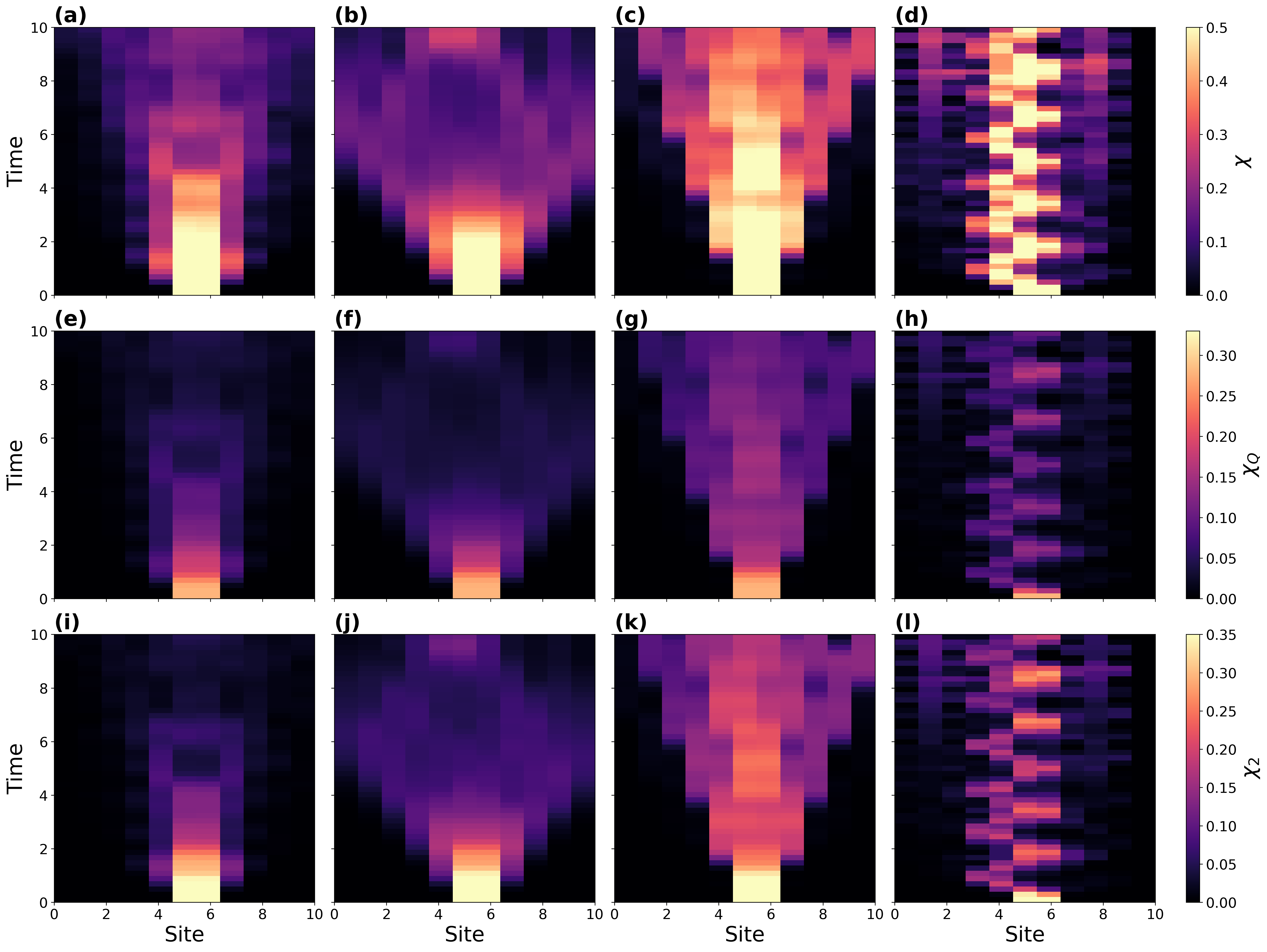
Figure 2: Spatiotemporal plots of information scrambling for four models; rows show Holevo information, subentropy, and averaged accessible information χ2(t)=Q2(2ρ1(t)+ρ2(t))−2Q2(ρ1(t))+Q2(ρ2(t)),1, with close correspondence between χ2(t)=Q2(2ρ1(t)+ρ2(t))−2Q2(ρ1(t))+Q2(ρ2(t)),2 and χ2(t)=Q2(2ρ1(t)+ρ2(t))−2Q2(ρ1(t))+Q2(ρ2(t)),3.
The AAI metric χ2(t)=Q2(2ρ1(t)+ρ2(t))−2Q2(ρ1(t))+Q2(ρ2(t)),4 reproducibly captures the physical signatures associated with each dynamical regime, aligning closely with the ideal (but experimentally inaccessible) Holevo information.
Robustness of Classical Shadows in Complex Regimes
Direct comparison between classical shadow estimations and exact dynamics confirms the method's accuracy even in nonergodic scenarios, including persistent oscillations (PXP scars) and disorder-induced localization (MBL).
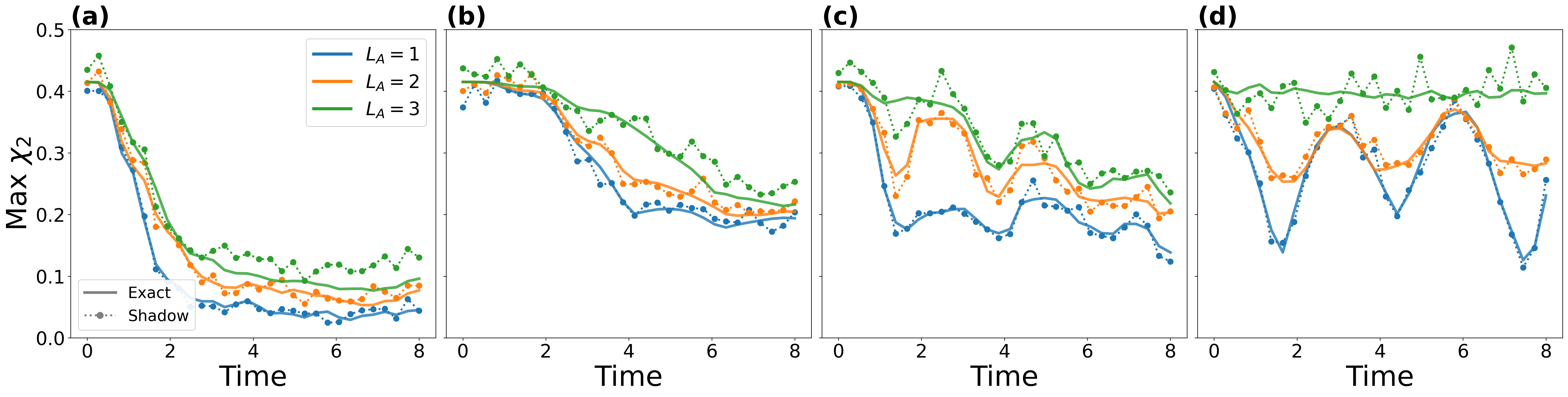
Figure 3: Comparison of exact and shadow-predicted maximal χ2(t)=Q2(2ρ1(t)+ρ2(t))−2Q2(ρ1(t))+Q2(ρ2(t)),5 dynamics for various subsystem sizes in different regimes, demonstrating high quantitative agreement.
Localization and L-bit Dynamics in MBL
Exploring the MBL phase, the paper provides direct evidence for strict localization of information via comparison between dynamics restricted to a local subregion and those in the full chain. The overlap of local AAI dynamics confirms confinement on short and intermediate timescales, in line with the emergent l-bit (local integrals of motion) picture.
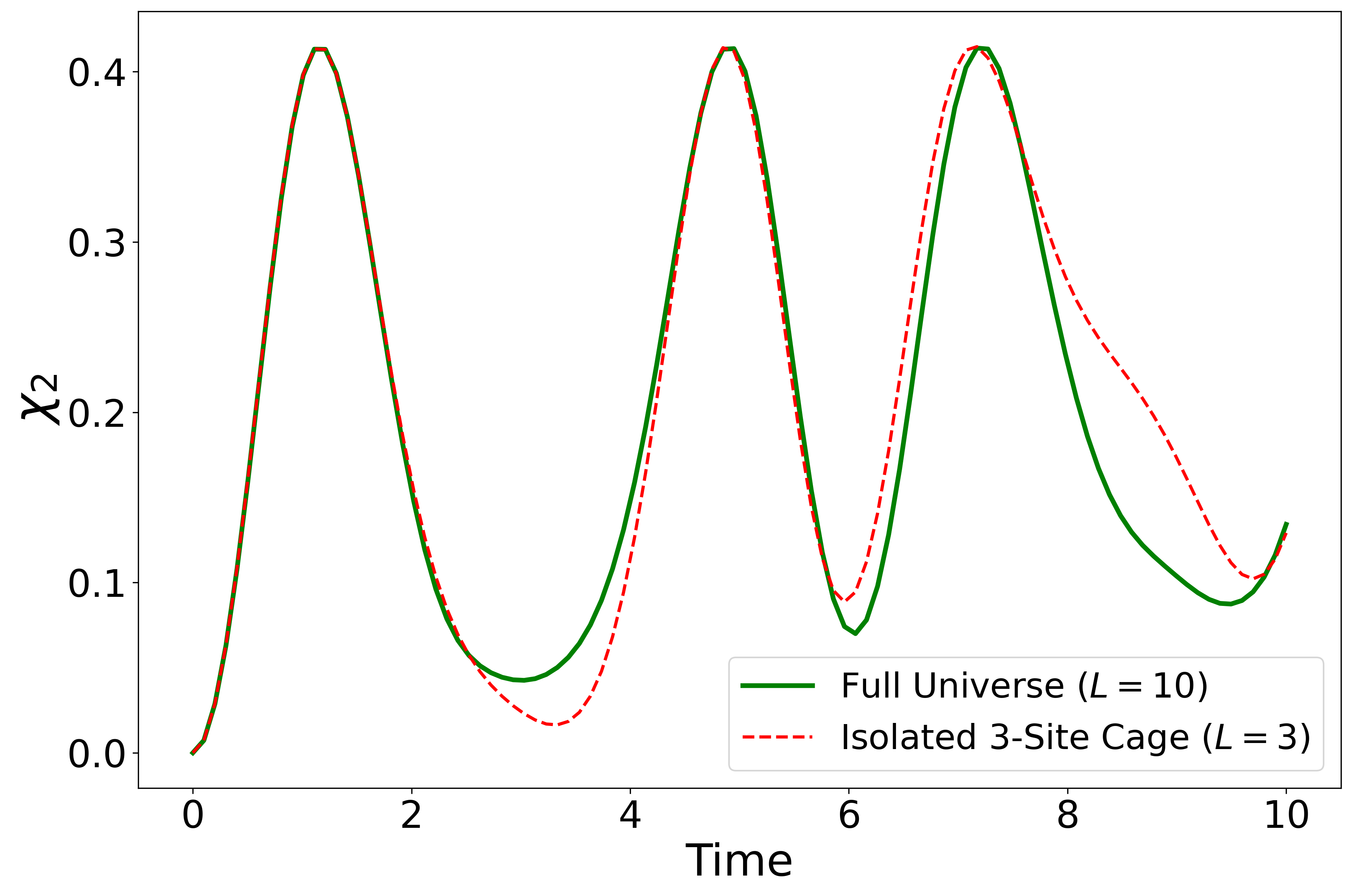
Figure 4: Dynamics of AAI in the MBL phase for both full and locally isolated regions, demonstrating confinement of information and locality of l-bit dynamics.
Implications and Future Directions
The establishment of AAI as a robust and operational probe of information scrambling bridges the gap between theoretical upper/lower bounds (Holevo information, subentropy) and experimental realization. The framework provides a scalable path for characterizing quantum chaos, thermalization, and nonergodic behavior in programmable quantum platforms, with minimal requirements on measurement design.
Notably, χ2(t)=Q2(2ρ1(t)+ρ2(t))−2Q2(ρ1(t))+Q2(ρ2(t)),6 distinguishes regimes associated with confinement, ballistic spread, weak ergodicity breaking (scars), and localization, providing a multidimensional diagnostic tool for quantum information dynamics. The strict concavity, operational purity-based computation, and compatibility with classical shadows suggest significant advantages over prior entropy-based methods.
Future directions include:
- Extending the framework to multi-partite settings, quantifying higher-order scrambling and multipartite entanglement.
- Application to driven, open, or dissipative systems, where non-equilibrium effects are prevalent.
- Integration with real-time quantum hardware for benchmarking near-term quantum simulators and error-protected devices.
Conclusion
Averaged accessible information, computable via local randomized measurements, establishes a rigorous, efficient probe of quantum information scrambling in many-body systems. Its purity-based formulation, validity across models, and agreement with established informational measures forecast broad applicability in quantum simulation, chaos diagnostics, and foundational investigations in quantum information dynamics.
(2605.13691)

