- The paper presents a comprehensive analysis comparing donor, acceptor, gate-defined hole, and gate-defined electron qubit platforms in germanium.
- It details experimental and numerical trade-offs including Stark tunability, strain sensitivity, and phononic crystal integration for enhanced coherence.
- It highlights gate-defined hole spin qubits as the most mature platform, offering high-fidelity control and promising scalability for quantum processors.
Comparative Assessment of Germanium-Based Spin-Qubit Modalities
Overview and Context
This paper presents a comprehensive technical comparison of four germanium (Ge)-based spin-qubit modalities: donor spin qubits, acceptor spin qubits, gate-defined hole spin qubits, and gate-defined electron spin qubits (2605.13680). Ge is emerging as a versatile semiconductor platform due to its mature processing, access to spin-free isotopes, small carrier masses, high mobility, and strong, tunable spin--orbit coupling. The paper systematically analyzes materials physics, qubit encoding mechanisms, dominant decoherence channels, control paradigms, device architectures, and scalability prospects.
Ge’s suitability as a qubit platform arises from its access to both conduction-band electrons (L-valleys, with complex anisotropic effective masses and multivalley degeneracy) and valence-band holes (spin-$3/2$ heavy-hole/light-hole manifold at the Γ-point, valley-free). Isotopic purification (73Ge depletion) and zone refinement yield spin-quiet environments and ultra-low impurity densities, which are critical for coherence and reproducibility. Strain and interfaces play central roles: they can either be engineered for favorable band structure or introduce uncontrolled disorder, with electron modalities particularly sensitive to valley-orbit effects and hole modalities to strain-induced spin-orbit coupling.
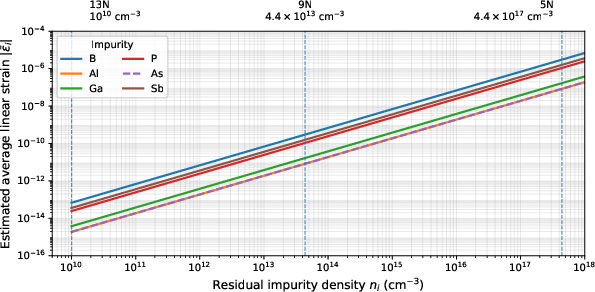
Figure 1: Estimated average linear strain in Ge as a function of impurity density for representative donor/acceptor species, highlighting the critical impact of purity on background strain and qubit uniformity.
Phonon coupling modulates both spin and charge states; phononic crystal engineering can suppress undesired relaxation channels and enable hybrid architectures with tailored acoustic modes.
Donor Spin Qubits in Ge
Donor spin qubits encode quantum information in the spin of an electron bound to a substitutional donor (typically P, As, Sb). Atom-like confinement and strong Stark tunability offer high reproducibility and large electrical addressability. The L-valley conduction band introduces multivalley complexity and extended wavefunctions, easing spacing constraints while complicating control/variability. The dominant decoherence channel is spin-lattice relaxation, enhanced by Ge’s strong spin--orbit interaction. Experimental studies report T1 times on the order of $0.6$ ms at B0=0.44 T and T=0.35 K; coherence becomes T1-limited in isotopically enriched Ge [Sigillito2015].
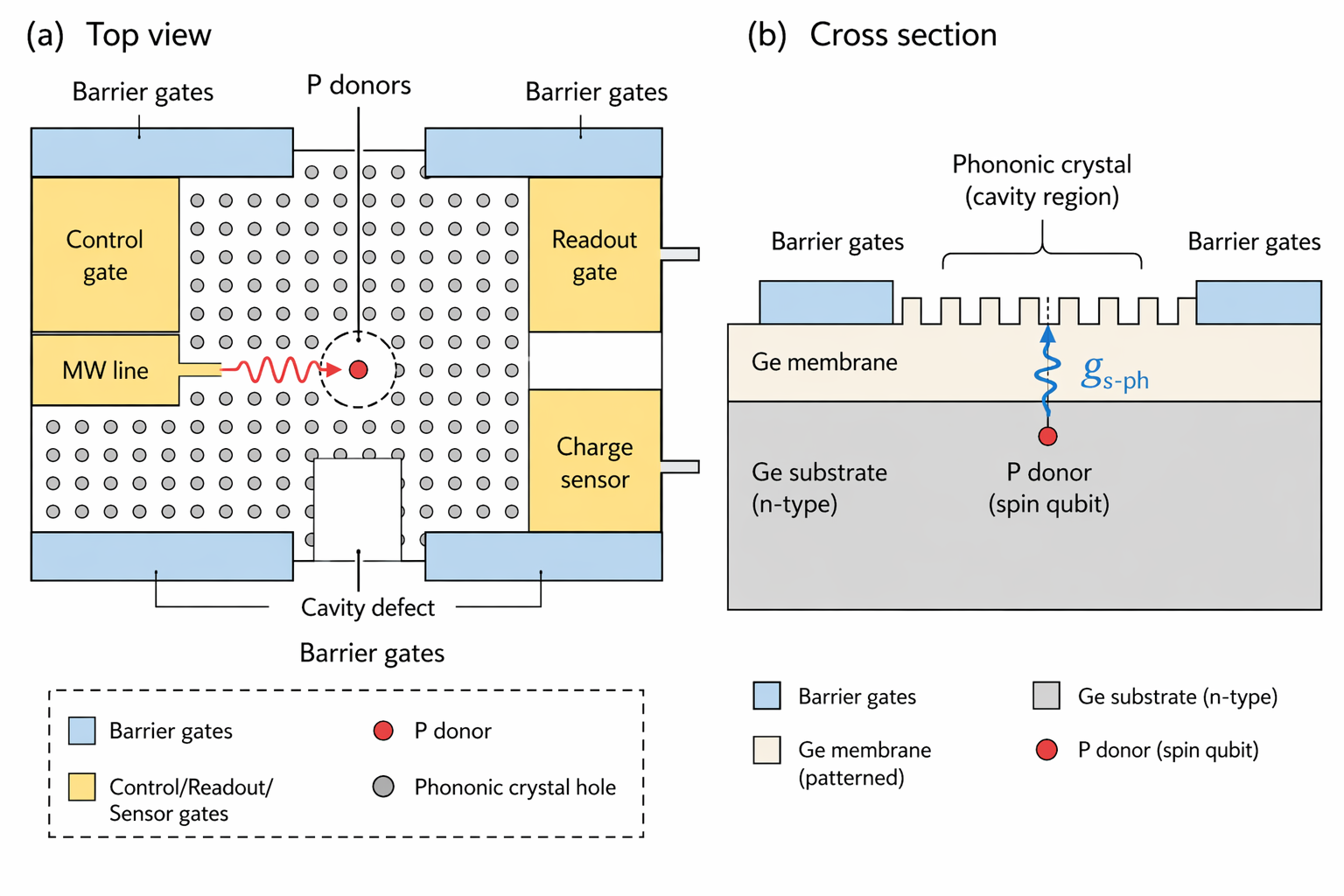
Figure 2: Architecture schematic for a Ge donor-spin platform embedded in a phononic crystal, illustrating bandgap engineering for coherence protection and phonon-mediated coupling.
Strong numerical results include tunable Stark shifts exceeding ensemble linewidths and the possibility of phononic crystal integration to suppress one-phonon decay and permit long-range coupling [Smelyanskiy2014DonorGePhononic]. However, deterministic donor placement, valley-orbit sensitivity, and integration complexity remain challenging.
Acceptor Spin Qubits in Ge
Acceptor qubits employ a valence hole bound to an acceptor impurity; these qubits inherit spin-$3/2$ physics enabling quadrupolar interaction, electric tunability, and pronounced strain sensitivity. Interface effects split the fourfold ground state into electrically tunable Kramers doublets, facilitating EDSR and protected operation points. Acceptor qubits theoretically bridge atom-like reproducibility and electrical control, with strong coupling to strain and possibility for phononic integration.
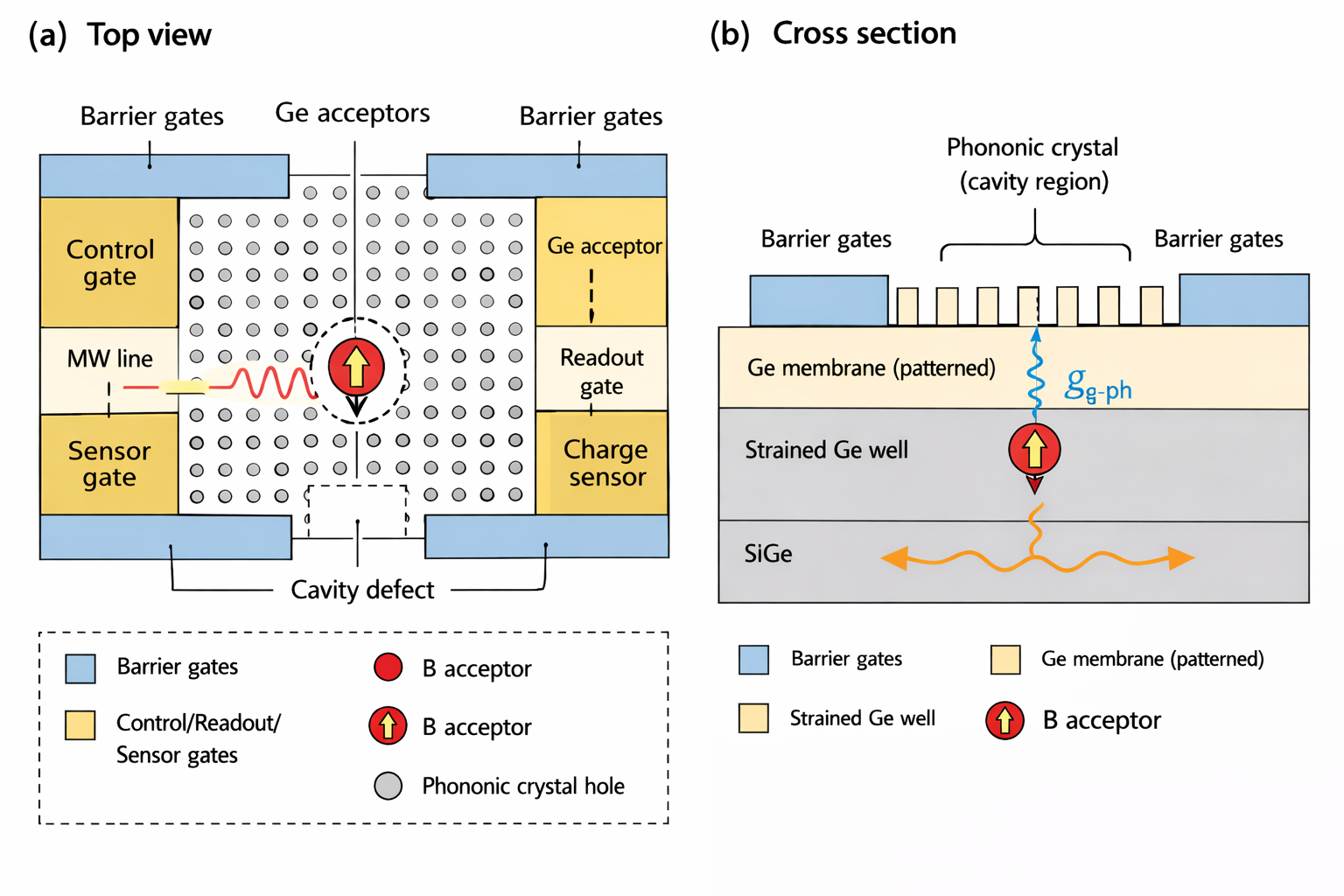
Figure 3: Schematic of a Ge acceptor-spin platform integrated with a phononic crystal, enabling both electrical and strain-mediated control over the spin-Γ0 manifold.
Numerical and theoretical analyses indicate that strain gradients as low as Γ1 nmΓ2 can enhance hole-spin Rabi frequencies by an order of magnitude [AbadilloUriel2023StrainSOI]. Nonetheless, central-cell, interface, and strain-induced spectral sensitivity—combined with residual hyperfine interaction from the dopant nucleus—pose significant reproducibility issues. Experimentally, Ge acceptor qubits lag behind their Si counterparts and Ge hole qubits.
Gate-Defined Hole Spin Qubits in Strained Ge/SiGe
Gate-defined hole spin qubits in strained Ge/SiGe heterostructures constitute the most mature Ge qubit modality. Electrostatic gates confine hole spins in a two-dimensional channel, enabling fast all-electrical control via strong and tunable spin--orbit coupling. Pauli blockade, EDSR, and exchange gates allow multiqubit operation; sweet-spot bias tuning suppresses charge-noise sensitivity while maintaining rapid manipulation.
Strong experimental milestones have been achieved: single-shot readout [Vukusic2018], two-qubit logic with fidelities Γ3 [Hendrickx2020Fast], four-qubit processors [Hendrickx2021FourQubit], and sweet-spot operation above 1 K with Γ4 gate fidelity [Hendrickx2024Sweet]. Quantum shuttling and scaling to 10-spin arrays with robust local control have been demonstrated [John2025, vanRiggelen2024].
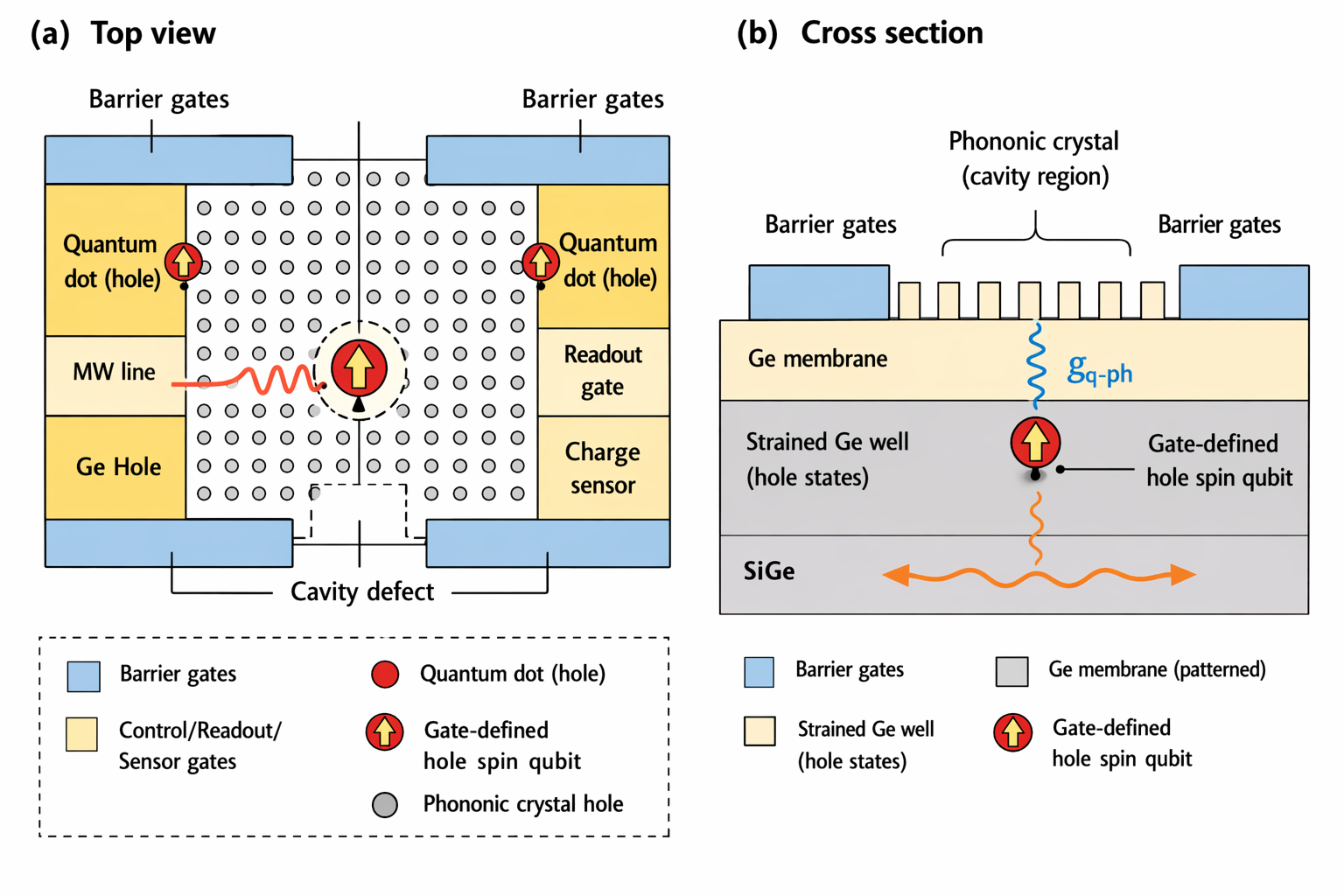
Figure 4: Device schematic for a gate-defined Ge hole-spin qubit platform integrated with a phononic crystal cavity, showing EDSR control and engineered acoustic environment.
Integration of phononic crystals is now a credible pathway for dissipation engineering and local acoustic mode coupling, potentially enabling hybrid architectures with tailored Γ5 via bandgap suppression of phonon-mediated relaxation [Mei2025QST].
Gate-Defined Electron Spin Qubits in Ge
Gate-defined electron spin qubits encode quantum information in spin-Γ6 electrons confined in Ge/SiGe quantum dots. Conceptually simpler than hole qubits, electron qubits are compatible with well-established Si quantum-dot architectures. However, they inherit Γ7-valley degeneracy, anisotropic masses, and intervalley mixing, which severely complicate device physics, spectral uniformity, and reproducibility. Electrically tunable Γ8 tensors and valley engineering have been explored, but no strong numerical or circuit-level results matching hole-qubit achievements have been reported.
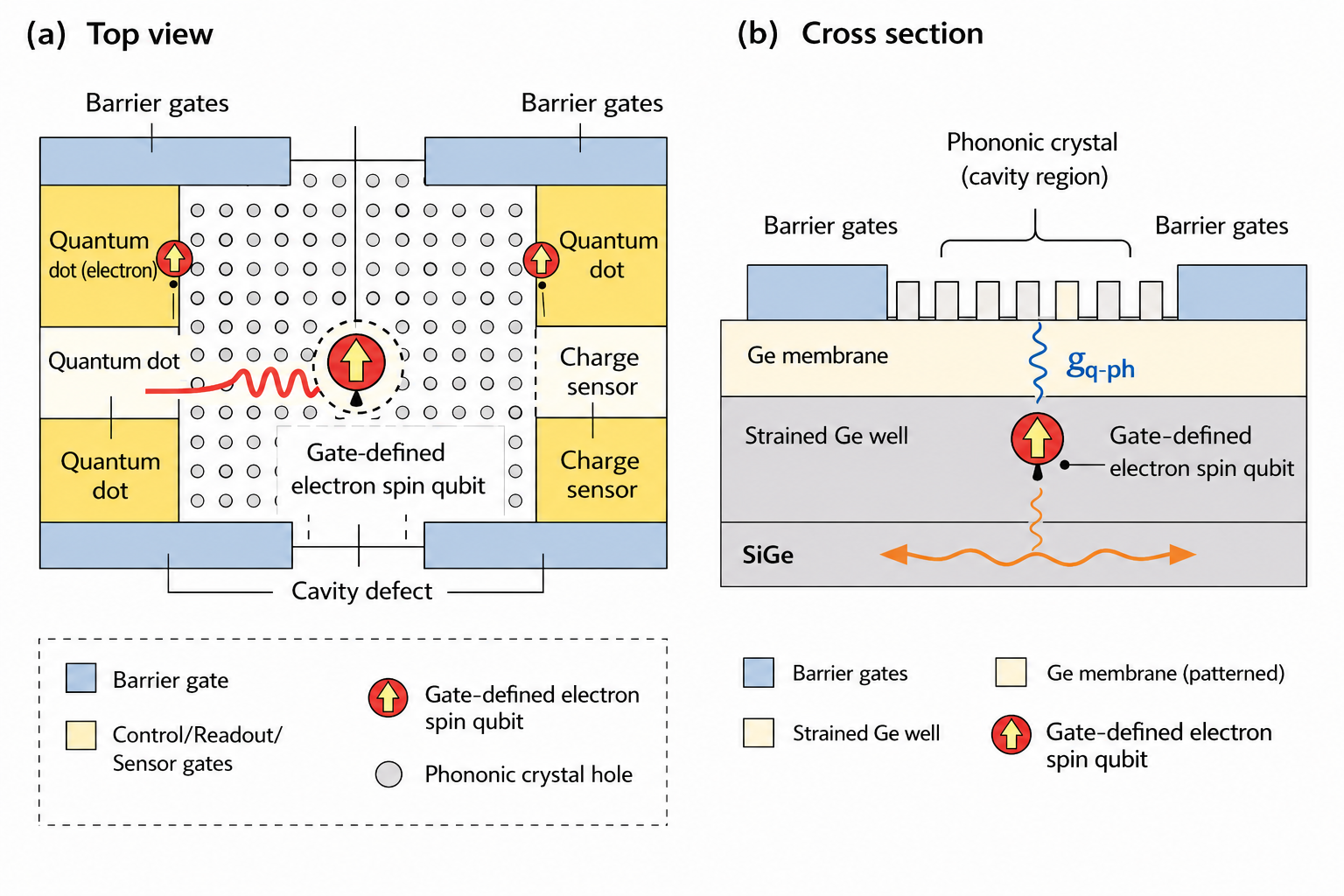
Figure 5: Schematic for a gate-defined Ge electron-spin qubit platform with phononic crystal integration, highlighting acoustic bandgap engineering for suppression of relaxation and possible hybrid coupling.
Currently, gate-defined electron qubits in Ge are scientifically attractive but experimentally immature, with uncertain paths to scalability or reproducibility.
Cross-Modality Trade-Offs and Implications
A structured technical comparison reveals key outcomes:
- Donor qubits: Atom-like, strong Stark tunability, but limited by spin-lattice relaxation and multivalley band structure.
- Acceptor qubits: Spin-Γ9 hole encoding, quadrupolar and strain tunability, but highly sensitive to central-cell and interface environment and not yet mature in Ge.
- Gate-defined hole qubits: All-electrical control, valley-free band structure, strong system-level scalability and demonstrated multi-qubit hardware; sensitivity to charge noise and 730-tensor anisotropy that is mitigated by special bias points.
- Gate-defined electron qubits: Simple encoding, but experimental challenges due to 731-valley complexity render them less viable than hole qubits at present.
Ge supports a layered qubit ecosystem. For processor-oriented scaling, gate-defined hole-spin qubits are most advanced, while donor and acceptor modalities are compelling for hybrid memory, sensor, and transducer architectures. Phononic crystal engineering is a crucial cross-platform axis, governing relaxation, coherence protection, and coupling design.
Future Directions in Ge-Based Quantum Technology
Priorities for future work include:
- Advancing deterministic donor placement and hybrid phononic integration.
- Establishing reproducible, interface-engineered acceptor qubits and benchmarking their quadrupolar physics.
- Scaling gate-defined hole qubits in clean, low-noise strained Ge/SiGe with robust 732-tensor control, shuttling, and high-fidelity multi-qubit gates.
- Exploring gate-defined electron qubits to identify regimes where 733-valley physics can be an asset, not a liability.
A realistic roadmap is layered: gate-defined hole qubits as the scalable processor core, donor and acceptor qubits for memory or hybrid connections, and phononic engineering as a systems-level enabler for dissipation control and coupling.
Conclusion
Germanium offers a genuinely diverse qubit ecosystem, with distinct advantages and liabilities across donor, acceptor, gate-defined hole, and gate-defined electron modalities. Among these, gate-defined hole qubits presently represent the clearest route toward scalable, high-fidelity, and hardware-efficient quantum processors, supported by strong numerical results and robust experimental demonstrations. Donor, acceptor, and electron platforms provide valuable complementary and exploratory pathways—especially for hybrid architectures, quantum memory, and sensor applications. The theoretical and practical implications are profound: Ge’s band structure, materials purity, and compatibility with phononic engineering will continue to shape the future of scalable quantum information processing architectures.

