- The paper demonstrates that strain engineering, via precise alloy composition control, effectively tunes Andreev spin qubit states in Ge heterostructures.
- It develops a detailed 6-band k·p model reduced by Schrieffer-Wolff transformation to capture key heavy-hole and light-hole behaviors.
- Electrical gating is shown to be more effective than flux-driving for qubit manipulation, providing actionable design principles for scalable S-Sm systems.
Strain Engineering of Andreev Spin Qubits in Germanium
Introduction
This work provides a comprehensive theoretical and numerical investigation into the potential of germanium (Ge)-based hybrid superconductor-semiconductor (S-Sm) systems for implementing Andreev spin qubits (ASQs) using strain engineering. Exploiting the tunability of bandstructure and spin-orbit (SO) phenomena in Ge heterostructures, the study develops a rigorous multi-band k⋅p theory, refines effective low-energy models, and numerically evaluates Andreev bound state (ABS) spectra and qubit control metrics. The implications for scalable, high-coherence superconducting spin qubit systems in group IV platforms are discussed.
Multi-band Theory and Strain Tuning in Germanium Heterostructures
The electronic structure is modeled by a 6-band k⋅p Hamiltonian encompassing heavy-hole (HH), light-hole (LH), and spin-orbit split-off (SO) states, incorporating Luttinger-Kohn terms, bulk SO coupling, epitaxial strain, and out-of-plane electric fields. The authors systematically explore two paradigmatic heterostructures: SiGe/Ge/SiGe (compressive/relaxed) and SiGe/GeSn/SiGe (tensile/unstrained), providing explicit parametrizations for all alloy compositions. Strain is used as a critical knob to modulate subband splittings and transition the ground state character between HH and LH regimes.
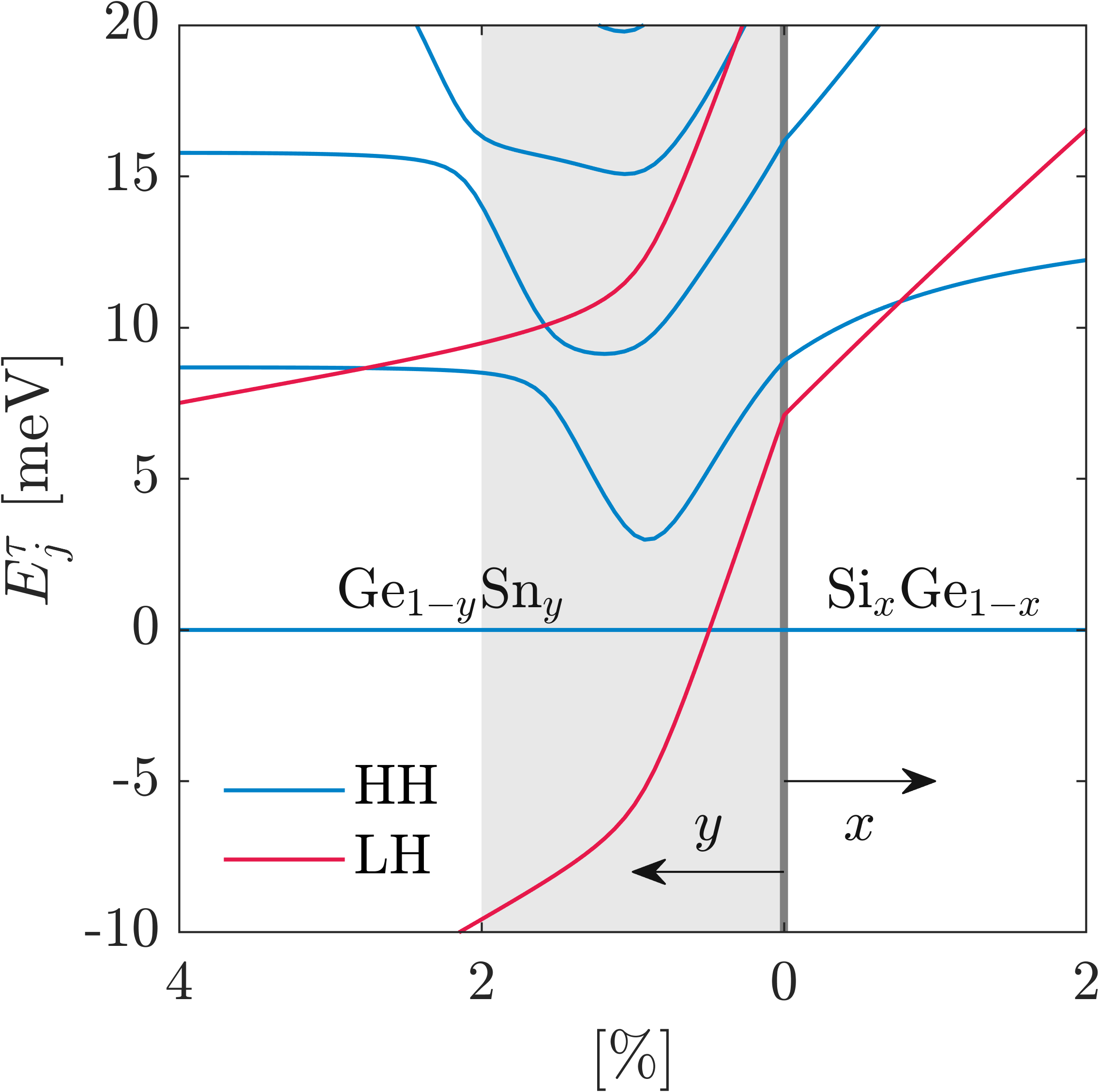
Figure 1: Ejτ energies as a function of Si (x) and Sn (y) content, referencing the HH ground state and marking the region of HH–LH ground state crossing.
The calculations reveal a pronounced sensitivity of the ground state and subband splittings to alloy composition. The shaded region in Figure 1 (excluded from further analysis) poses challenges due to HH–LH state crossing, which complicates low-energy Hamiltonian reduction and qubit addressability.
Effective Low-Energy Hamiltonians and Validation
Using Schrieffer-Wolff-Transformation (SWT) perturbation up to second (x-case) or first (1-y-case) order in k∥, the full 6×6 Hamiltonian is downfolded onto a reduced subspace capturing the relevant low-energy sector. The effective Hamiltonian thus derived retains accurate dispersions for both compressive (HH-like) and tensile (LH-like) cases.
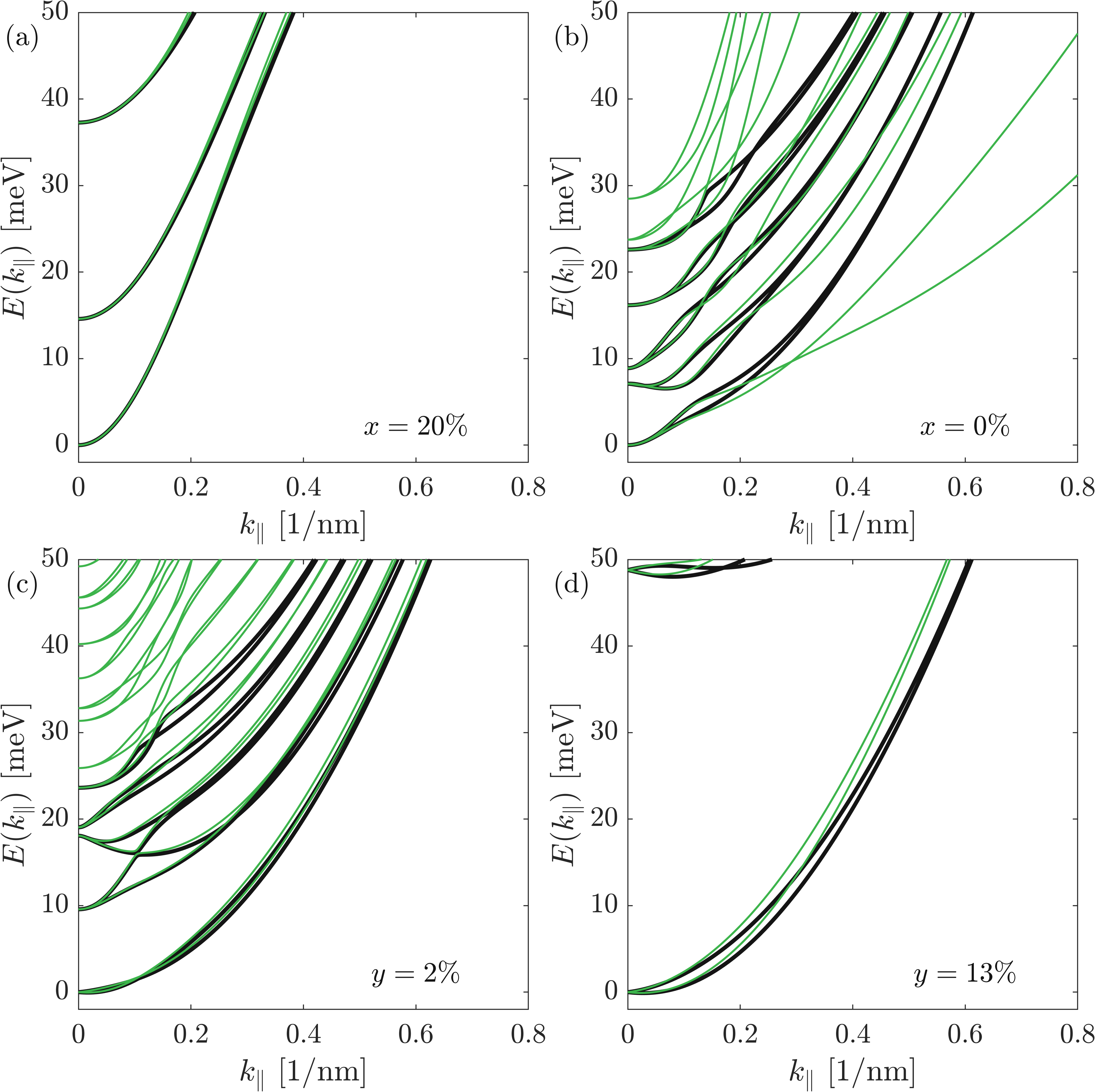
Figure 2: Comparison of full $400$-dimensional k⋅p diagonalization and effective Heff models for various strain configurations.
The close correspondence of the effective and full model shown in Figure 2 justifies the truncation and provides a practical tool for further quantum transport and ABS calculations.
Tunability of Spin-Orbit Interaction and Fermi Velocity
The study further quantifies the Rashba-type SO coefficients (k⋅p0) using higher-order perturbation theory. The strain and composition dependence is assessed, highlighting the distinct behavior in the HH (compressive) and LH (tensile) regimes: linear, cubic, and mixed k⋅p1-dependent SO terms can be selectively enhanced via heterostructure design. Fermi velocity splitting between SO bands is also calculated as a function of alloy content.
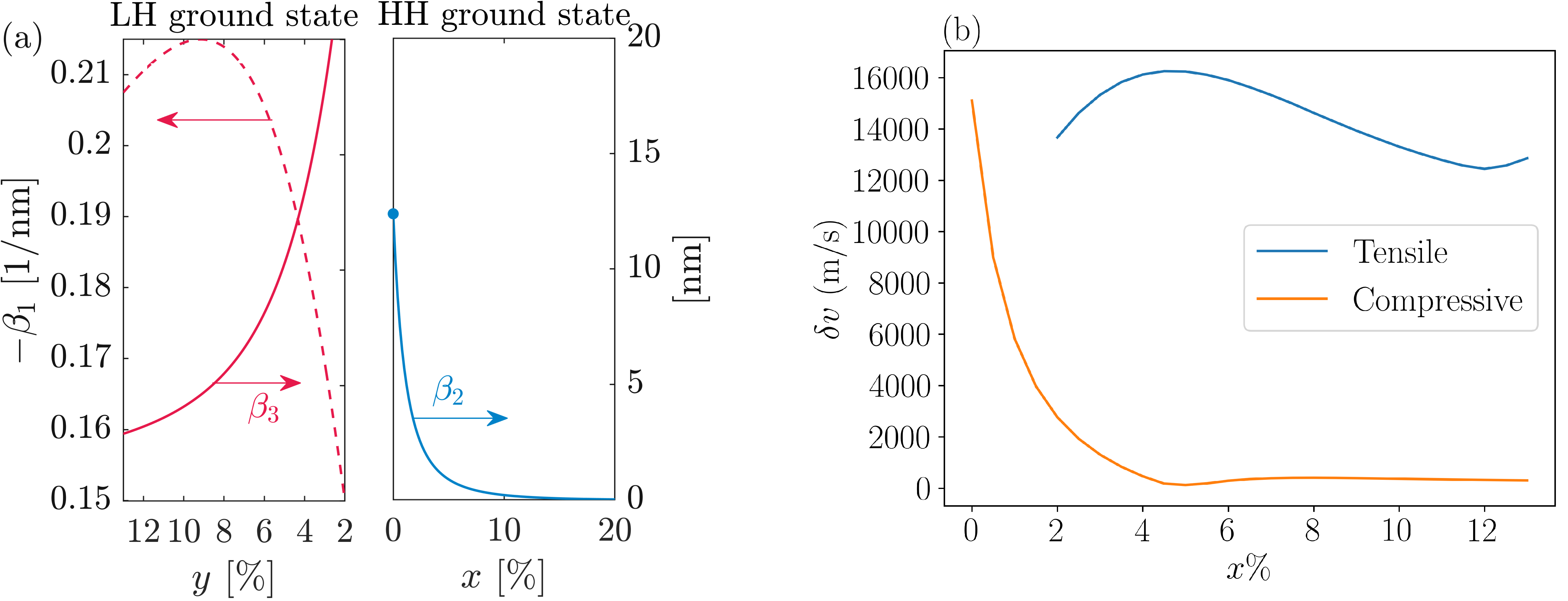
Figure 3: SO coefficients k⋅p2, k⋅p3, and k⋅p4 as functions of Sn and Si content, with associated maxima in Fermi velocity splitting.
The results indicate strong material tunability, which is essential for optimizing both spin splitting and electric control of spin states.
Modeling Andreev Bound States in Proximitized Ge Junctions
The effective Hamiltonian is discretized to simulate finite-size Josephson junctions (JJs) with proximitized s-wave superconducting regions separated by a normal Ge-based 2D hole gas. The bandstructure, ABS spectrum, and chemical potential range for single Andreev doublet occupation are carefully mapped. The spatial extent of the superconducting regions is set to be several times the coherence length derived from bandstructure calculations, minimizing finite-size and boundary artifacts.
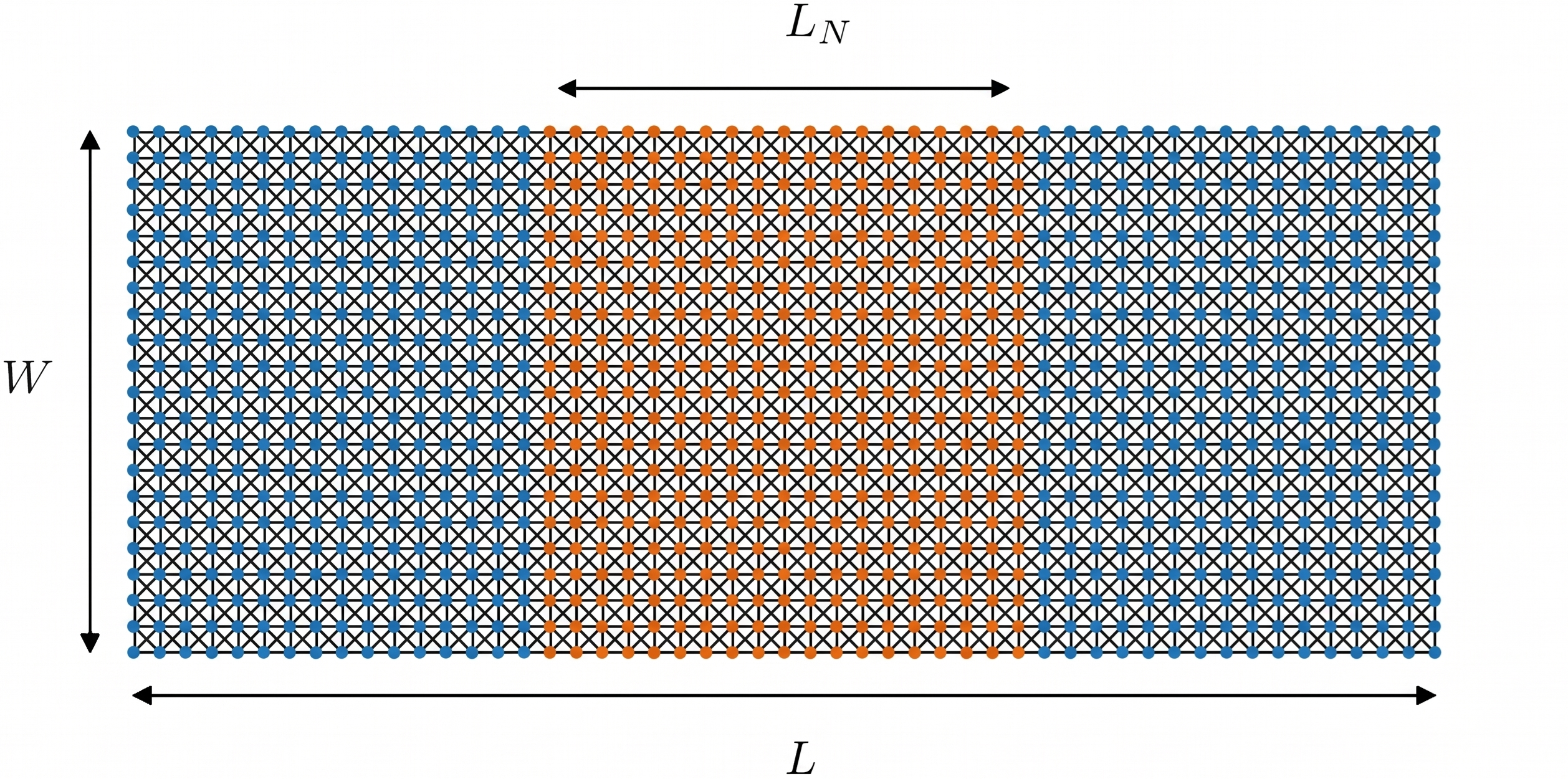
Figure 4: Geometry of a Ge-based Josephson junction with normal and superconducting regions.
A semi-analytical Bohr-Sommerfeld approach is also adopted to estimate the ABS energy-phase relation, revealing the explicit role of Fermi velocity and hence SO-induced splitting:
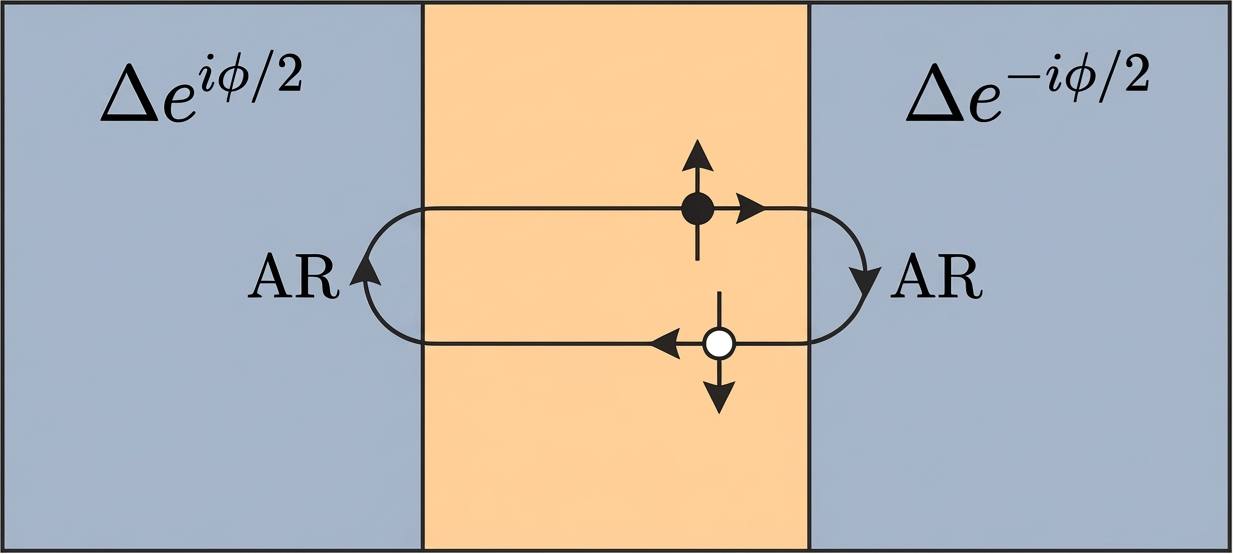
Figure 5: Schematic of closed quasiparticle trajectories forming Andreev bound states in the junction.
The energetic separation and controllability of the spin-split ABS doublet are governed by the interplay between SO coupling and electrostatic tuning, supporting robust ASQ operation.
Qubit Control via Flux and Symmetry Considerations
The off-diagonal matrix elements k⋅p5 responsible for coherent qubit rotations under flux-driving are evaluated. Symmetry analysis demonstrates that such driving is forbidden in a perfectly symmetric device, necessitating the introduction of a transverse asymmetric potential to activate transitions. However, the calculation shows that the flux-induced transitions are significantly weaker than electric dipole-driven mechanisms, indicating that electrical control remains the dominant and more efficient modality for Andreev spin qubit manipulation.
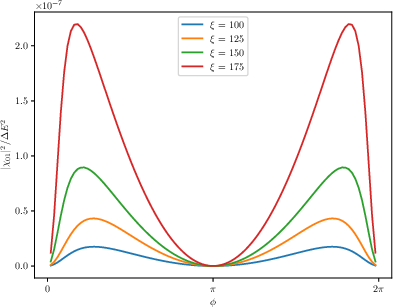
Figure 6: Phase dependence of off-diagonal elements of k⋅p6 in the presence of transverse symmetry breaking.
Discussion and Implications
This work delivers a detailed quantitative foundation for strain-engineered superconducting spin qubits in group IV semiconductors. The demonstrated tunability of g-factors, SO parameters, and Fermi velocities, together with practical design guidelines for single-moded Andreev doublet operation, underscore the viability of Ge for scalable hybrid S-Sm quantum processors. The explicit links between heterostructure design, symmetry, and qubit control metrics open new avenues in quantum-coherent device engineering, leveraging the established CMOS compatibility of Ge platforms.
On the theoretical side, the formalism provides a template for generalizing to arbitrary compositions, dimensions, and field orientations. Practically, the methodology is pertinent for optimizing both next-generation quantum-dot-based and Andreev-bound-state-based qubit devices. The insights on the limited efficacy of flux-driving further motivate approaches prioritizing gate-based high-fidelity control.
Conclusion
By synthesizing rigorous multi-band theory, effective model reduction, and numerical transport analysis, this study establishes the key parameters and mechanisms underpinning Andreev spin qubit operation in strained and unstrained Ge heterostructures. The findings provide actionable design principles for next-generation hybrid superconducting-semiconductor spin qubits with electrical addressability, capitalizing on the rich tunability afforded by strain and alloy composition in group IV architectures.

