- The paper proposes a holistic, distribution-centric identifiability condition for ATE that generalizes and weakens traditional graphical criteria.
- It instantiates the condition under both deterministic and non-deterministic selection, demonstrating improved unbiased ATE estimation.
- The study introduces a three-stage estimation strategy validated through synthetic and real-world datasets, including biobank data.
Holistic Identifiability of Causal Effects under Selection Bias
Introduction and Motivation
Selection bias fundamentally challenges causal inference from observational studies by violating the assumption that collected data represent the target population. This issue is pervasive in biomedical and social science domains, such as biobanks (e.g., UK Biobank, All of Us), where participation correlates with factors like socioeconomic status (SES) and health, leading to so-called "healthy volunteer bias." As a result, standard estimators for the average treatment effect (ATE) yield incorrect conclusions about the effect of interventions on the full population, as opposed to only the observed sub-sample. The study "Towards a holistic understanding of Selection Bias for Causal Effect Identification" (2605.13430) addresses the central and unresolved question: under what general conditions is the ATE identifiable from data subject to arbitrary selection mechanisms?
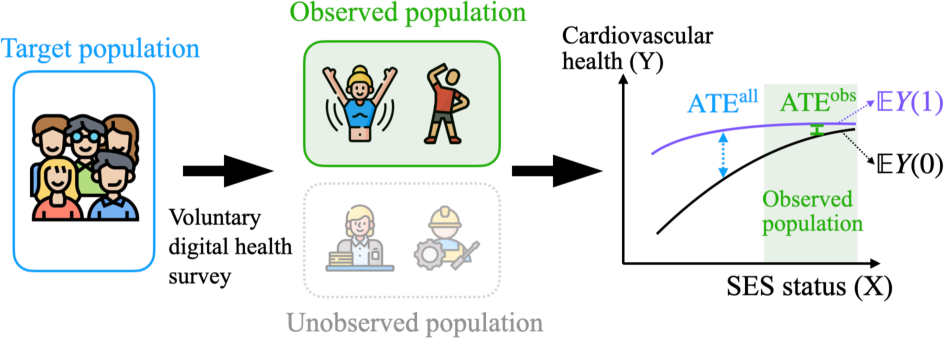
Figure 1: Illustration of selection bias—SES influences survey participation, distorting observed ATE estimates (ATEobs≪ATEall).
Existing frameworks, typically based on graphical causal models (DAGs) or restrictive distributional assumptions (e.g., additive noise, non-Gaussianity), only partially answer this question and often require explicit modeling of the selection mechanism. This paper proposes a holistic, distribution-centric identifiability condition for ATE that encompasses and extends previous results. The authors' conditions are necessary and sufficient, strictly weaker than established graphical criteria, and provide guidelines for practical estimation in the face of realistic, complex selection biases.
The study adopts the potential outcomes framework. The covariates X∈Rd, treatment T∈{0,1}, and response variables Y(0),Y(1) jointly define the statistical environment. Crucially, the observed data come from a selected sub-population, indexed by a binary indicator S; only units with S=1 appear in the sample. The observational density is thus P(V∣S=1) for V=(X,Y,T), with the goal to infer the ATE in the full underlying population: τP=EP[Y(1)−Y(0)].
Selection is modeled as a general probabilistic function s(x,y,t)=P(S=1∣X=x,Y(t)=y,T=t), allowing it to depend arbitrarily on covariates, treatment, and outcomes. This generality permits the inclusion of outcome-dependent, treatment-dependent, or covariate-dependent selection—cases that defeat many established identification techniques.
Main Theoretical Contributions
General Identifiability Condition
The authors' primary result is a necessary and sufficient condition (Condition~2 in the paper) for when X∈Rd0 is identifiable from X∈Rd1, given classes of possible propensity scores, covariate-outcome distributions, and selection probabilities.
Condition: For any two compatible tuples X∈Rd2 and X∈Rd3 with different ATEs, the corresponding observed selected data distributions X∈Rd4 must differ (i.e., the mapping from observed selected data to ATE is injective over the model classes). Equivalently, non-identifiability is only possible if distinct full-population ATEs produce exactly the same observed selected data distribution due to selection.
This condition abstracts away from the specific mechanism or location of selection (e.g., colliders, descendants in the DAG), requiring only a distributional property—the ATE is identified if any variation in the unselected populations that yields a different ATE inevitably manifests as an observable difference in the selected sample.
Concrete Distribution Family Instantiations
Two core propositions instantiate this condition under practical modeling classes:
- Deterministic Selection: If selection is a deterministic function of observed variables (i.e., hard truncation), and the covariate-outcome distribution is sufficiently regular (e.g., exponential family with smooth log-densities), then ATE is identifiable via techniques from truncated statistics.
- Non-deterministic Selection: For a wide class of light- and heavy-tailed distributions (Gaussian, Laplace, Pareto, Log-Normal), and selection probabilities strictly bounded away from zero, ATE identifiability holds even under non-deterministic, outcome-dependent selection.
These results surpass those obtainable via traditional DAG or additive noise framework identifiability, which only cover special cases (e.g., outcome-dependent selection with non-Gaussian additive noise). The authors unify and strictly generalize prior graphical and semi-parametric criteria.
Relationship to Existing Graphical and Distributional Criteria
The paper rigorously connects its condition to graphical criteria (backdoor, selection-backdoor, outcome-dependent identifiability) and shows that those arise as special cases under stronger assumptions about the selection mechanism. In general, graphical criteria are restrictive, often requiring explicit knowledge of the selection's location in the DAG and its structure (i.e., whether selection is a collider, or only outcome- or covariate-dependent), and do not cover many practical settings.
By removing the need for pinning down the source of selection bias, the new condition both strictly contains and extends these graphical results. This unification enables identification in cases with overlapping selection mechanisms or unknown DAGs, provided the positivity and regularity constraints are met.
Estimation Algorithms and Experimental Evaluation
Given identifiability, the authors propose a three-stage estimation strategy for ATE under selection bias:
- Support Restriction: Identify the domain where the propensity score is bounded away from zero/one (i.e., effective overlap holds).
- Selection Bias-Corrected Modeling: Fit the outcome model X∈Rd5 and the selection probability X∈Rd6 within this domain, either via maximum likelihood estimation (MLE) or score matching augmented with a regularizer to minimize the selection effect.
- ATE Computation: Estimate the ATE by integrating over the (recovered) population distribution.
The correction for selection bias leverages recent advances in estimation from truncated and selected samples, e.g., using extrapolation from observed truncated regions to the whole support [daskalakisStatisticalTaylorTheorem2021]. Regularization ensures identifiability up to constants, handling the indeterminacies intrinsic to estimation under selection.
Empirical Results: On synthetic datasets with both deterministic and probabilistic selection, their bias-correction methods (MLEX∈Rd7 and score matchingX∈Rd8) yield unbiased or dramatically less-biased ATE estimates, outperforming IPW and polynomial regression baselines.
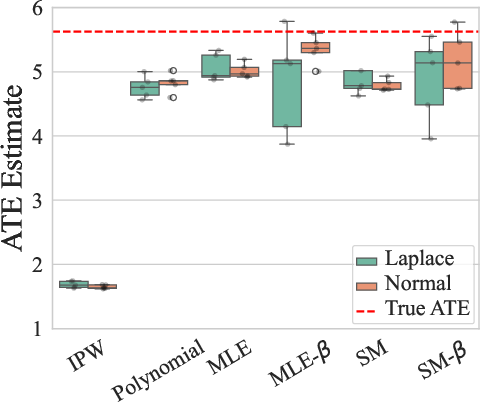
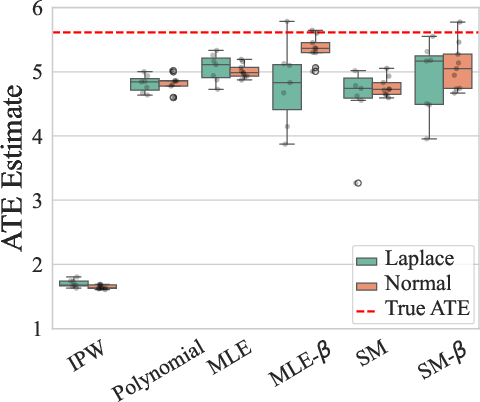
Figure 2: Bias-corrected estimators (MLEX∈Rd9, SMT∈{0,1}0) eliminate ATE bias across additive noise scenarios.
On the large-scale All of Us biobank, their approach substantially reduces ATE bias relative to simple estimators, even under weak overlap and complex selection—a setting where no other method applies.
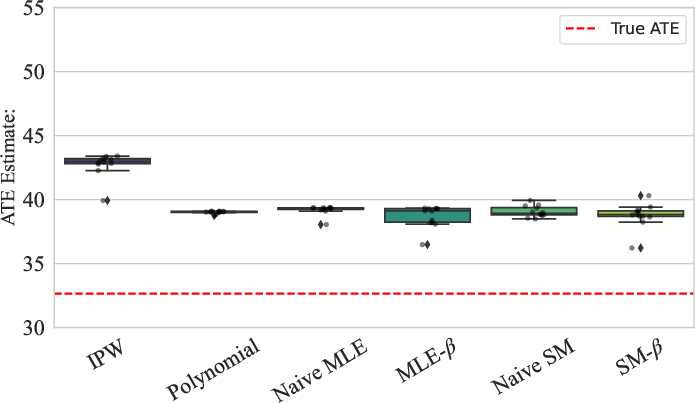
Figure 3: On real-world distributions (All of Us), bias correction significantly reduces—but does not entirely eliminate—ATE error, reflecting real-world challenges posed by poor overlap and complex selection.
Visualization of estimated distributions confirms that debiased models more closely capture the underlying true data generation process.
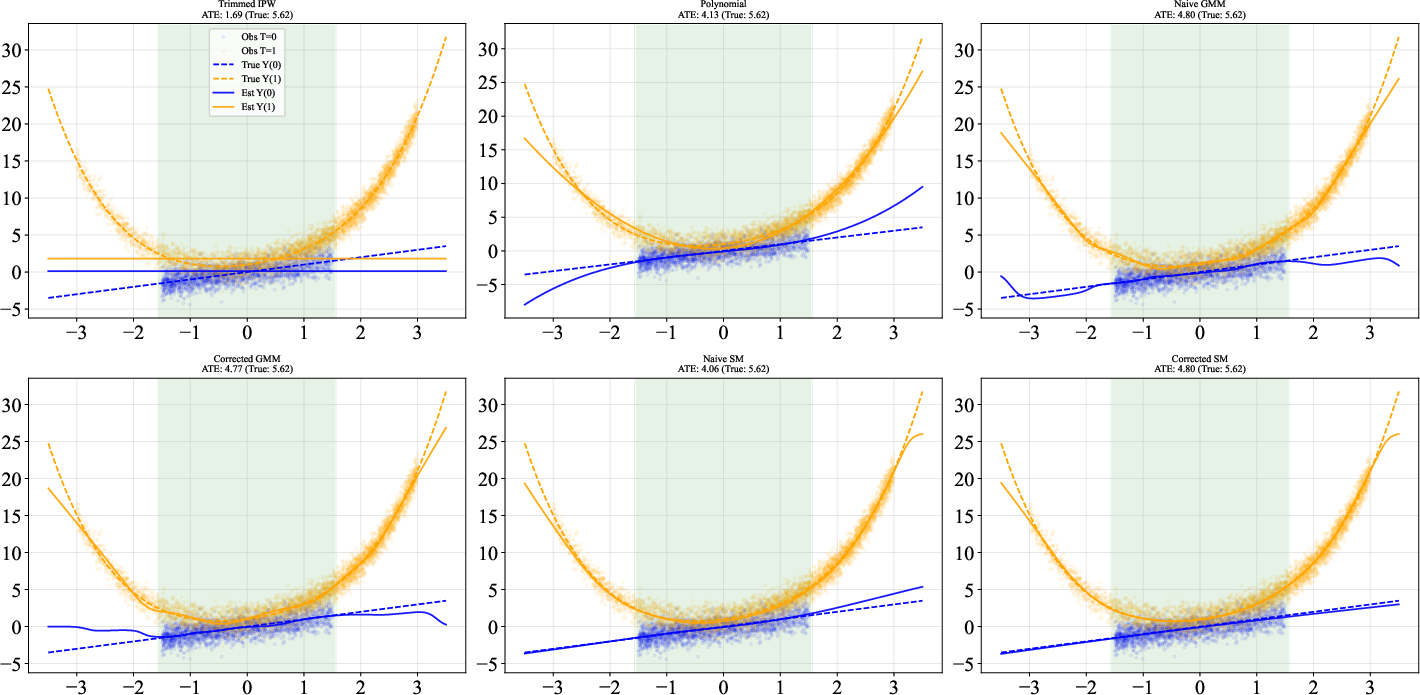
Figure 4: Corrected estimators better recover the true underlying mean across the support, evident in distribution visualizations.
Performance is robust across a range of noise settings including heavy-tailed log-normal outcomes.
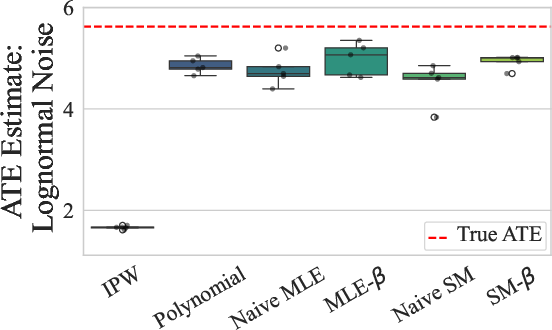
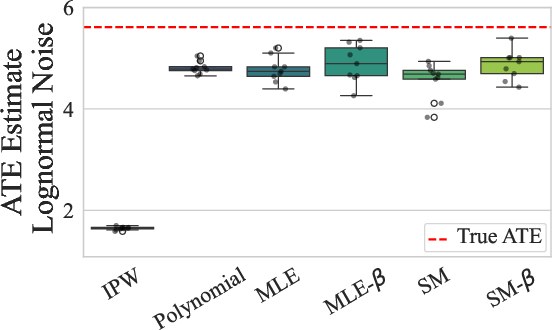
Figure 5: Log-normal noise poses challenges for ATE recovery, yet bias-corrected estimators match true ATE substantially better than naive methods.
Practical and Theoretical Implications
Significance for Causal Inference
- Stronger identification: The framework allows consistent ATE estimation in settings with selection mechanisms unamenable to standard graphical analysis or where the selection process is partially/entirely unknown.
- Empirical tractability: The identifiability conditions can be empirically validated via estimation, without knowing the underlying DAG—a crucial property for analyzing complex, real-world biobank, health, and economic datasets.
- Foundation for new debiasing algorithms: The separation of selection bias correction into its own estimation problem (distinct from confounding bias) paves the way for robust, modular methods in causal machine learning.
Limitations and Future Research Directions
- Distributional regularity: The conditions rely on regularity assumptions (e.g., positivity, smoothness, tail behavior) that may be violated in practice, especially with highly discrete or sparse data.
- Estimation in weak overlap: Real-world estimation performance suffers in the presence of very low propensity scores, as seen in the All of Us example, indicating a need for novel regularization or robust extrapolation schemes.
- Extensions: Future work could seek further relaxation of the required distributional assumptions, extension to multiple treatments or continuous exposures, and integration with active experimental design (e.g., sample selection with identifiability guarantees).
Conclusion
This work delivers a holistic, necessary and sufficient condition for ATE identifiability under arbitrary selection bias, subsuming and extending prior graphical and distributional results. By disentangling the logic of causal identification from the specifics of selection mechanisms, it offers both a theoretically complete and practically actionable answer to a central question in causal inference. The analytic and algorithmic developments herein serve as a springboard for improved unbiased estimation in large-scale, systematically unrepresentative datasets widely encountered in modern machine learning and empirical sciences.