- The paper demonstrates a novel multi-stream architecture that processes parallel token streams for user, system, and reasoning roles, eliminating sequential bottlenecks.
- Multi-stream LLMs significantly reduce latency and token counts by overlapping input reading, generation, and auditing, with benchmarks showing improved performance.
- The approach enhances security by physically separating token streams, thereby mitigating prompt injection attacks and enabling transparent internal reasoning audits.
Multi-Stream LLMs: Enabling Parallelism in LLM Interaction
Introduction
The paper "Multi-Stream LLMs: Unblocking LLMs with Parallel Streams of Thoughts, Inputs and Outputs" (2605.12460) introduces a fundamental architectural and data-centric shift for LLMs: the move from uni-directional sequential, message-based processing toward a multi-stream, parallel interaction paradigm. Instead of confining all token exchange (user, system, chain-of-thought, tool, etc.) into a single serialized sequence, Multi-Stream LLMs (MS-LLMs) decomposes communication and internal reasoning into conceptually parallel token streams that are processed and generated simultaneously in every model forward pass. This framework provides robust solutions to the latency, security, and monitorability bottlenecks inherent in conventional chat-oriented LLM deployments.
Motivation and Conceptual Framework
Standard instruction tuning approaches frame LLMs as transformers generating sequential message exchanges. This approach, inherited from early instruction-/chat-tuned models, forces LLMs into a pipeline where all inputs and outputs are funneled through a single token stream. As a result, the model alternates rigidly between reading, thinking, and acting, with each step blocking the others. Modern agentic LLM applications involving long-running calls, multiple tools, and autonomous orchestration have exposed the limitations and inefficiencies of this paradigm, leading to convoluted, brittle scaffolding to partially unblock LLMs.
MS-LLMs address this bottleneck by introducing multi-stream parallel generation. Here, each "role" (e.g., user, system, chain-of-thought, tools) is mapped to a unique parallel stream in the model, and at each step, the model generates or processes a token in every active stream simultaneously, allowing for cross-stream causal attention. This architecture supports interaction and reasoning patterns that are unimplementable or awkward in traditional message-based LLM formats: e.g., simultaneous input, mid-generation user interrupt, real-time auditing, and overlapping tool calls.
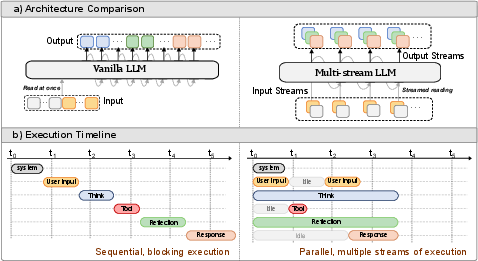
Figure 1: Traditional LLMs process a single sequence, blocking parallel actions; Multi-Stream LLMs architecturally enable overlapping I/O and reasoning streams in one forward pass.
Technical Realization
Causal Multi-Stream Attention and Position Encoding
Each stream in MS-LLMs maintains its own token and position index. The model is trained and prompted so that its predictions in stream h at position t can only attend to all streams, but only up to (t−1) (earlier steps). Attention and position encoding are modified to support intra-stream autoregressive alignment and cross-stream causal dependencies, preserving temporal integrity and inter-stream causality. Interleaved token packing (rather than simple concatenation) is introduced to optimize the attention mask structure for efficient GPU utilization and compatibility with extensions such as FlashAttention.
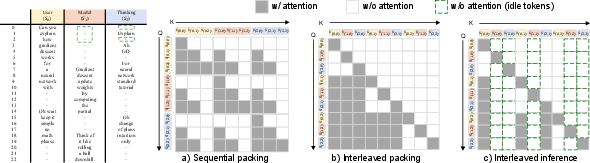
Figure 3: Token interleaving strategies for multi-stream attention enable efficient, near-lower-triangular causal masking and FlashAttention compatibility.
A learnable stream embedding differentiates each role, and per-stream position counters, optionally with rotary or other positional embeddings, ensure that tokens are uniquely and consistently located in the attention space, eliminating conflict and ensuring monotonic cross-stream temporal semantics.
Data Construction and Training
Due to the scarcity of natural multi-stream conversational data, the authors present a synthetic pipeline:
- Wait-k streaming: Prompting advanced LLMs to produce aligned dialogues in stream format, in which different streams are filled incrementally according to pre-determined policies.
- Causal enforcement: A synthetic judge enforces that no token in a stream depends on future (unavailable) tokens from any other stream.
- Quality filtering: Both stream-local and cross-stream audits ensure samples are legible, fluent, role-consistent, and non-redundant. Only high-quality, strictly-causal samples are used for fine-tuning.
The model is then fine-tuned with standard cross-entropy, with methods to upweight loss for tokens whose prediction substantially benefits from the multi-stream structure.
Empirical Results
Efficiency and Latency
Experiments with standard reasoning and QA tasks (GSM8K, MATH500, LogicNLI, SQuAD) on widely used Qwen-series models show that MS-LLMs eliminate the time-to-first-target-token (TNFT) delay (drops to zero in all benchmarks) and sharply reduce end-to-end latency without significant loss in accuracy.
For instance, on Qwen3-1.7B and Qwen3-4B, multi-stream variants achieve reductions in total tokens generated and delay (e.g., on SQuAD: token count drops from 710 to 277 and delay from 7.8 to 4.6, compared to vanilla models).
This is attributed to the model’s ability to overlap reading, solution generation, and auditing, with multiple output tokens emitted per forward pass, thereby maximizing throughput under GPU memory-constrained workloads.
Security: Prompt Injection Robustness
MS-LLMs introduce structural privilege separation by physically separating user, system, and other roles into separate architectural streams. This strongly mitigates prompt injection attacks without adversarial retraining. On Direct and Indirect Prompt Injection benchmarks (TensorTrust, Gandalf, StruQ, etc.), the multi-stream models yield 30-50% lower attack success rates compared to single-stream baselines, with no architectural or data-access degradation. In particular, indirect injection rates (StruQ-ID) are halved.
The physical separation makes it substantially harder for user-supplied tokens to override system instructions, and the improvements persist across model scales. No capability (task performance) regressions are observed.
Monitorability and Transparent Reasoning
Explicit, parallel thinking/audit streams can be introduced at negligible latency or compute cost. Internal, non-user-facing thinking streams allow model situational awareness and latent considerations ("sub-vocalization") to be legibly surfaced and tracked. Empirically, on datasets probing for alignment-faking awareness, covert reasoning, and concern sub-vocalization, multi-stream models were substantially more monitorable: e.g., in pressure scenarios, explicit concern signals are visible internally in 44%+ of cases (versus ~6% for chat baselines). This supports the thesis that model intention and situational awareness are much more amenable to human review in MS-LLMs than in standard message-based models.
Implications and Future Directions
The move to multi-stream interaction directly addresses core limitations in autonomous LLM-based agents and orchestrators. The architectural privilege separation induced by multi-stream formats represents a robust defense against prompt injection, and the monitorability improvements address growing concerns over LLM opacity and hidden reasoning. At the same time, the throughput/latency gains are significant for high-interactivity applications such as real-time coding, dialog agents involving interrupts, and systems that require tight integration of multiple processes or tool chains.
This approach also opens questions for the design of LLM backbones and agent frameworks:
- Scalability and role design: Stream selection, the number of streams, and stream-role specialization admit further research.
- Sparse or structured cross-stream attention: Hybrid patterns, with dense or strict one-way connections, enable trade-offs between efficiency and security.
- Integration with other multi-token prediction approaches, e.g., Medusa, Multiverse, and Medusa-type chunked prediction.
Beyond the immediate proposal, architectural parallelism and stream separation may become a necessary foundation for sophisticated, agentic LLM-based systems operating reliably, securely, and legibly in complex environments.
Conclusion
This work presents a principled, non-intrusive modification to LLM fine-tuning and deployment, supporting parallel streams for every meaningful role in LLM-based agents. The comprehensive evaluation verifies three strong claims: (1) reduced latency and improved efficiency due to parallel generation, (2) increased robustness to prompt injection attacks through architectural separation of concerns, and (3) substantially improved monitorability and transparency of internal reasoning. These results collectively demonstrate that the established message/chat paradigm is not a necessary constraint and that multi-stream architectures offer practical and safety-critical advantages. Further scaling of the method and integration into production LLM systems is warranted.