- The paper introduces a real-world dataset capturing handover, beam management, and timing advance metrics for AI-native mobility in 6G.
- The paper details rigorous data collection using commercial devices in diverse urban mobility scenarios across Chennai.
- The paper presents granular insights into handover dynamics, beam management patterns, and timing advance correlations to enhance AI/ML model training.
Enabling AI-Native Mobility in 6G: A Real-World Dataset for Handover, Beam Management, and Timing Advance
Introduction
The transition towards AI-native cellular networks in 5G-Advanced and 6G amplifies critical demands on radio access networks (RAN), especially for robust mobility management under diverse mobility scenarios. Classical handover (HO), beam management (BM), and timing advance (TA) procedures are increasingly inadequate for highly dynamic, dense deployments and high-frequency bands. AI/ML-based methods offer promise for optimizing mobility, but widespread reliance on synthetic datasets undermines model relevance and real-world robustness. The referenced paper "[Enabling AI-Native Mobility in 6G: A Real-World Dataset for Handover, Beam Management, and Timing Advance]" (2605.12453) introduces a publicly available, real-world dataset captured from a commercially deployed 5G network across heterogeneous mobility modes, with detailed logs suitable for AI/ML training and evaluation.
Dataset Creation and Experimental Methodology
The dataset was collected in Chennai, India, over several months, employing commercial user equipment (Samsung A53 5G) linked via USB to a laptop running QXDM. Actual routes spanned various urban contexts and modes of mobility, including pedestrian, bicycle, car, bus, and train, with average speeds ranging from 4.5 to 65 km/h. The opportunistic episodic capture strategy yielded approximately 117,390 measurement reports, supporting comprehensive spatiotemporal diversity.
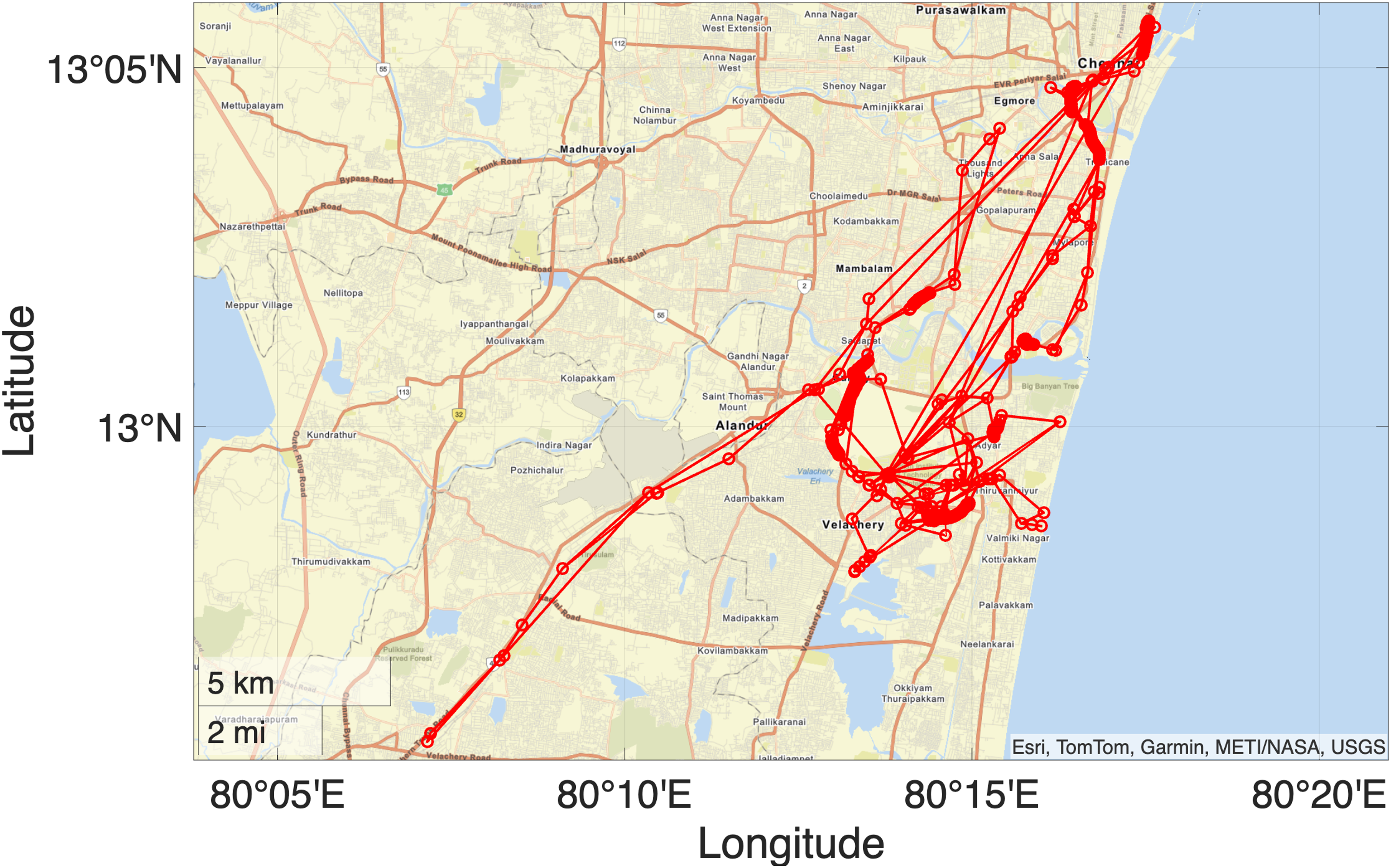
Figure 2: Measurement campaign visualized on Google Maps, with the red track indicating diverse mobility coverage.
Each data sample captures:
- Timestamp, GPS location
- Physical Cell Identity (PCI) for serving and neighbor cells (pseudonymized)
- Detailed RSRP, RSRQ, beam-level SSB indices (serving cell), and best beams for neighbors
- Filtered mobility procedure metrics (moving averages)
- TA events and associated RACH triggers, SSB IDs
- Radio measurement periodicities and protocol context
Diagnostic logs were systematically extracted, pre-processed, and parsed using QCAT and custom Python scripts. The workflow ensures rigorous reproducibility and includes all necessary metadata for benchmarking AI-native mobility management models.
Exploratory Data Analysis
Channel Measurement Statistics
UEs typically observed at least two cells in 96% of measurement reports. The range of measurement periodicities reflects real-world mobility and sleeping patterns, avoiding artifacts of synthetic environments.
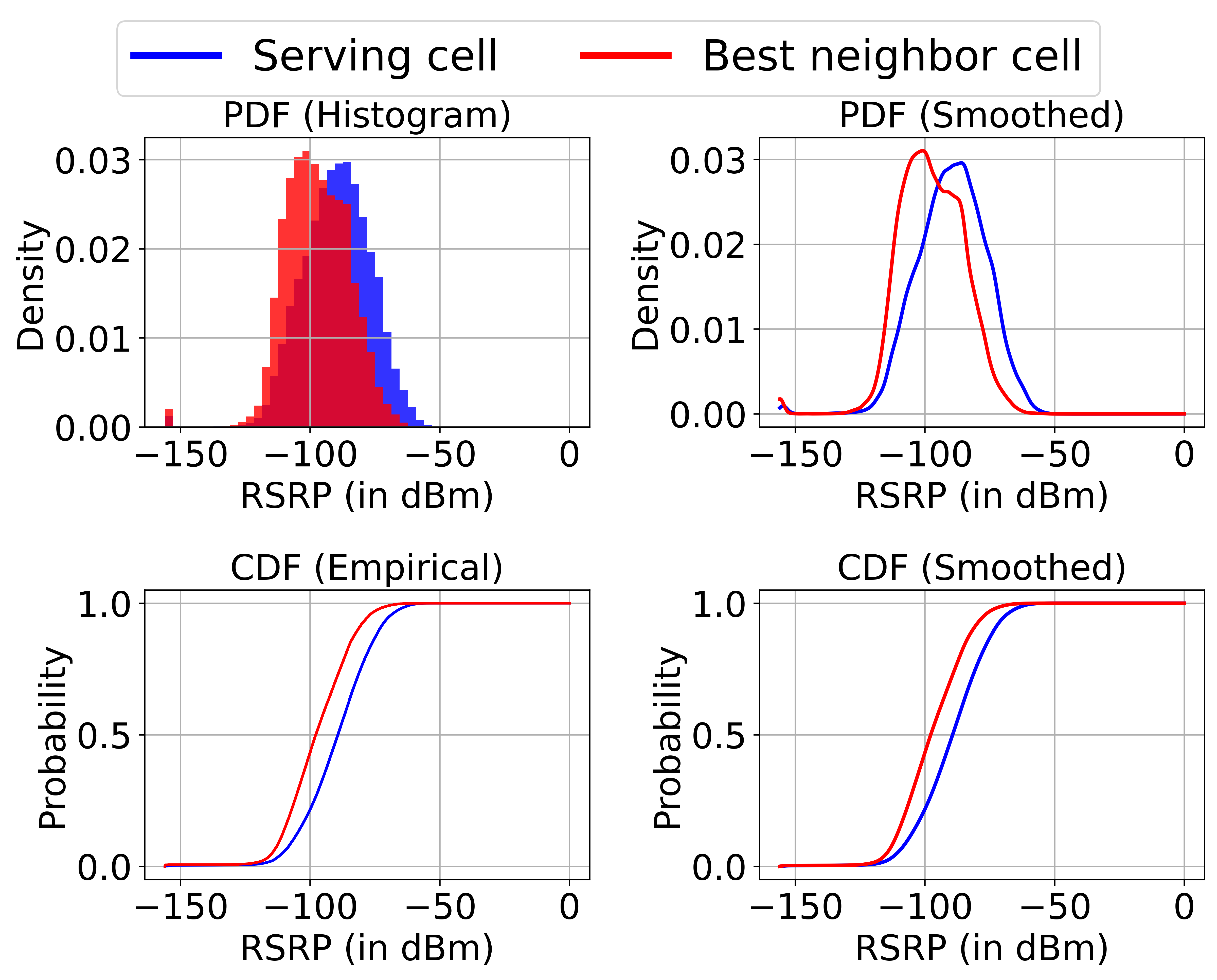
Figure 4: Distribution of serving cell and best neighbor RSRP across the dataset.
Analysis shows that 80% of serving cell RSRP measurements exceed -100 dBm, indicating generally strong 5G coverage and suggesting high data reliability for downstream ML tasks. The RSRP CDF aligns closely with leading US network benchmarks for T-Mobile and outperforms others in coverage, confirming environmental diversity.
Handover Dynamics
The dataset captures both successful and unsuccessful HO events, with explicit records of 1546 A3-type handovers, as defined in 3GPP TS 38.331, using RSRP as the primary trigger. The data exposes typical mobility challenges such as ping-pong effects, hysteresis-timed transitions, and policy-driven deviations between trigger conditions and actual HO execution.
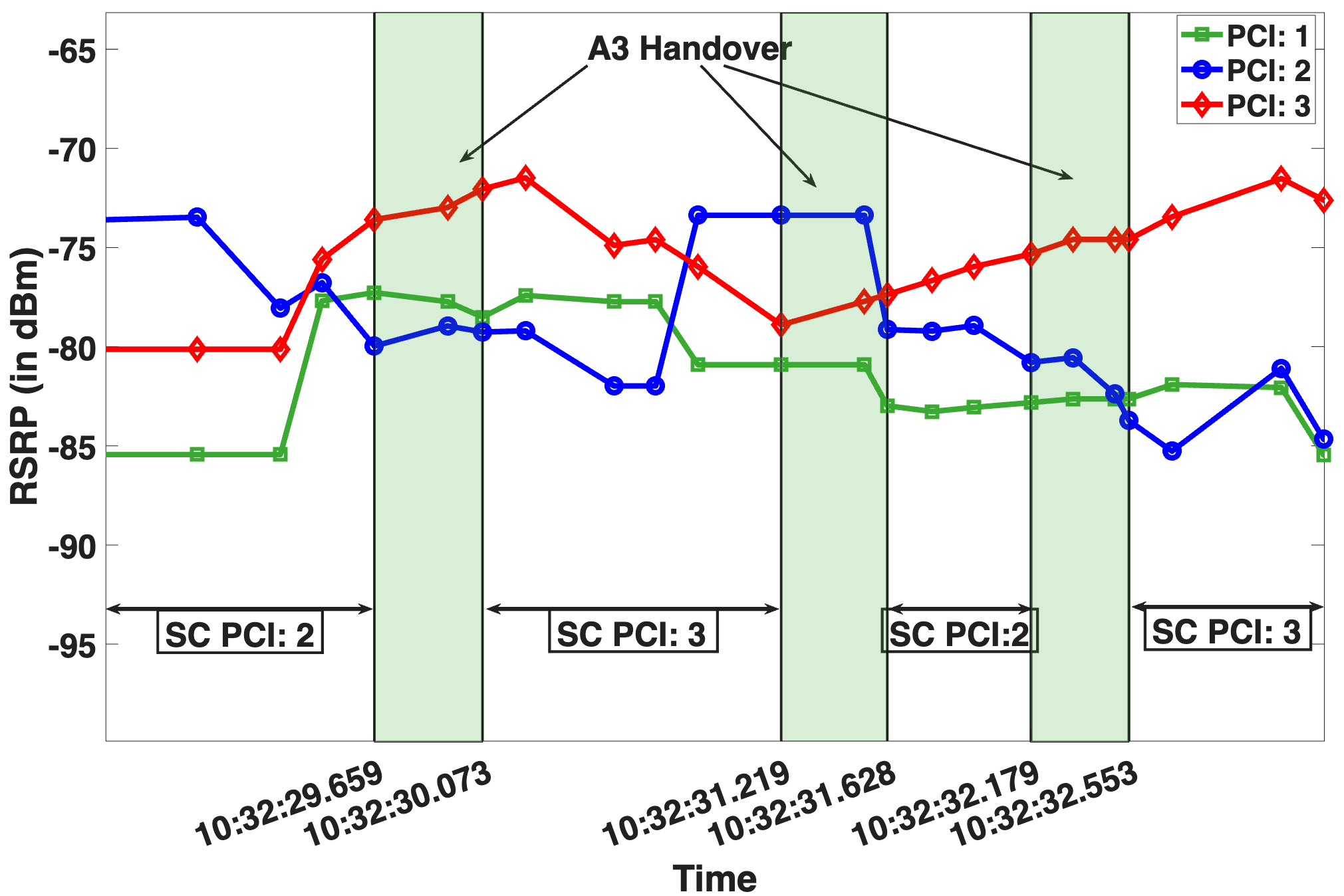
Figure 1: Example A3 handovers—multiple serving cell changes, highlighting both transitional behaviors and ping-pong effects.
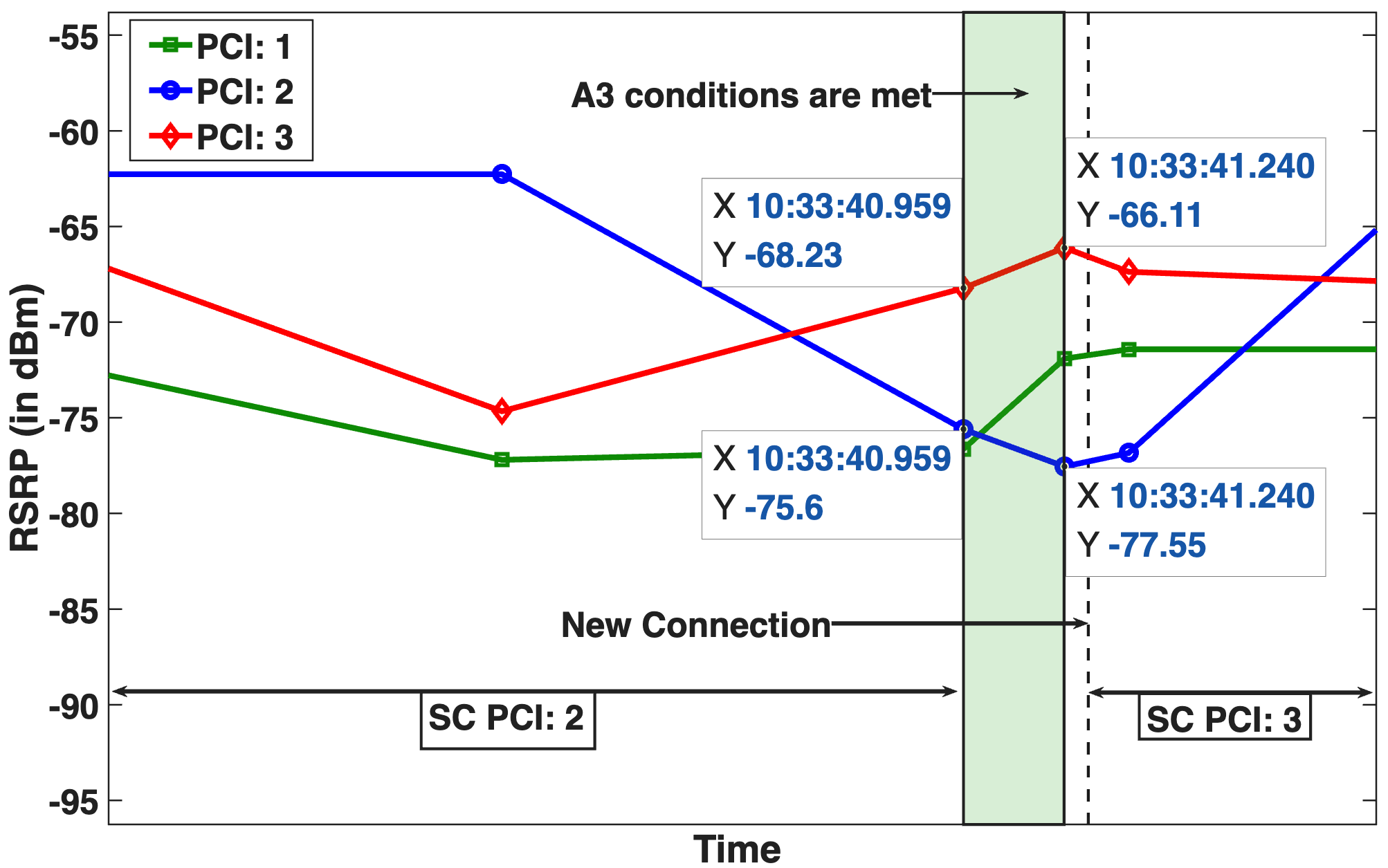
Figure 7: Sample of unsuccessful handover: A3 conditions are met, but serving cell remains unchanged, reflecting higher-layer policy influences.
These detailed, label-rich traces create a foundation for benchmarking classifier- or reinforcement learning-based handover predictors in future 6G research.
Beam Management Patterns
The inclusion of multi-beam SSB measurements per serving cell allows investigation into beam-level mobility. On average, UEs measured approximately 3.65 beams per cell, furnishing realistic insight into the distribution and dynamics of beam switching.

Figure 9: Example of beam switching based on RSRP thresholds; vertical lines indicate beam switch events.
This granularity is rarely available in public datasets and enables new ML research into beam selection, stability, and prediction algorithms for highly directional mmWave/sub-THz links.
Timing Advance and Spatial Correlations
TA is released in direct association with RACH, MAC CE, and PDCCH grant events, capturing both cell-level and sub-cell-level uplink synchronization. Targeted experiments on the IIT Madras 5G testbed confirmed an empirical correlation between TA and UE-gNB distance, with larger TA corresponding to increased range or poorer RSRP (contingent on propagation environments).
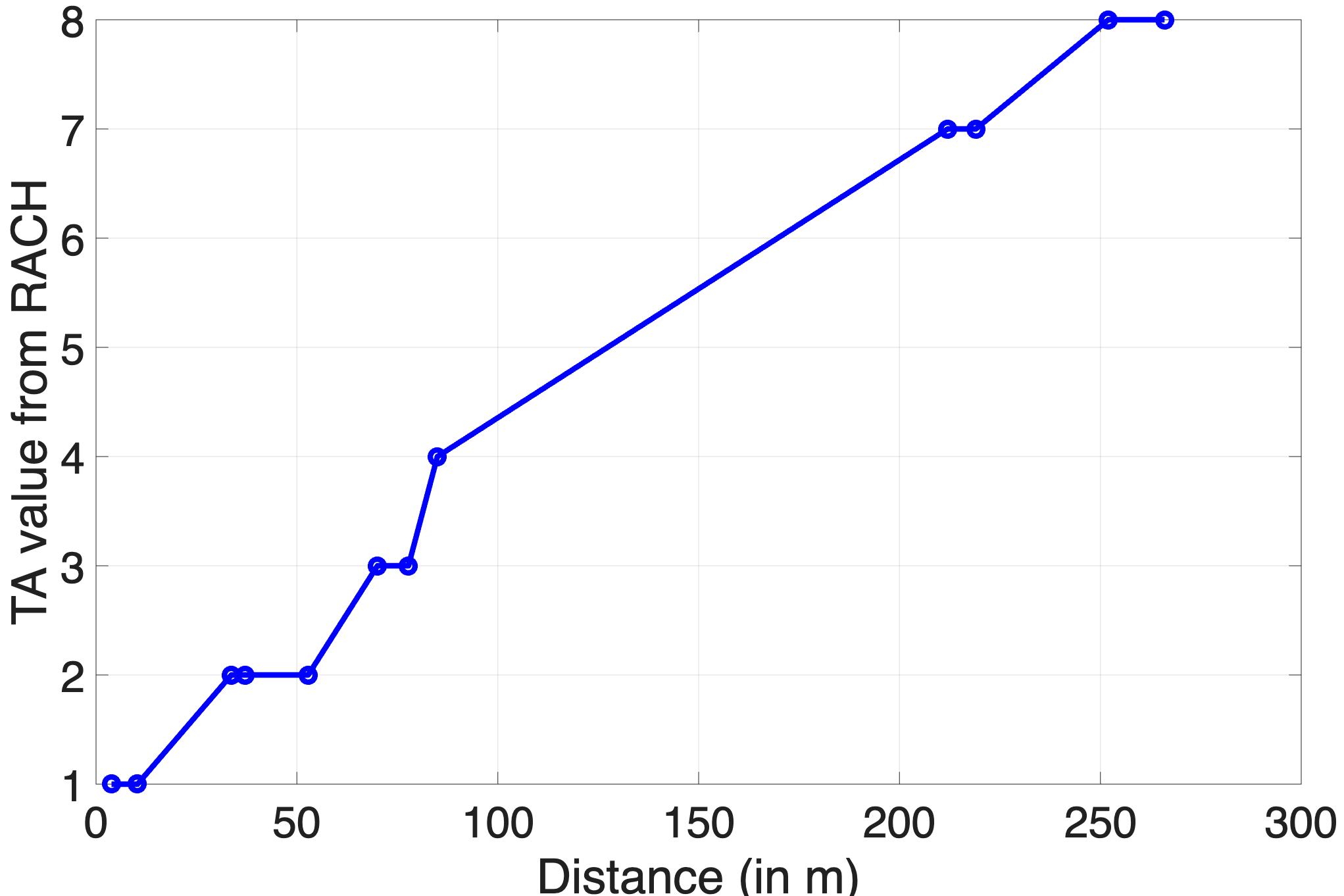
Figure 3: Linear correlation between UE-gNB distance and RACH TA measured in controlled testbed conditions.
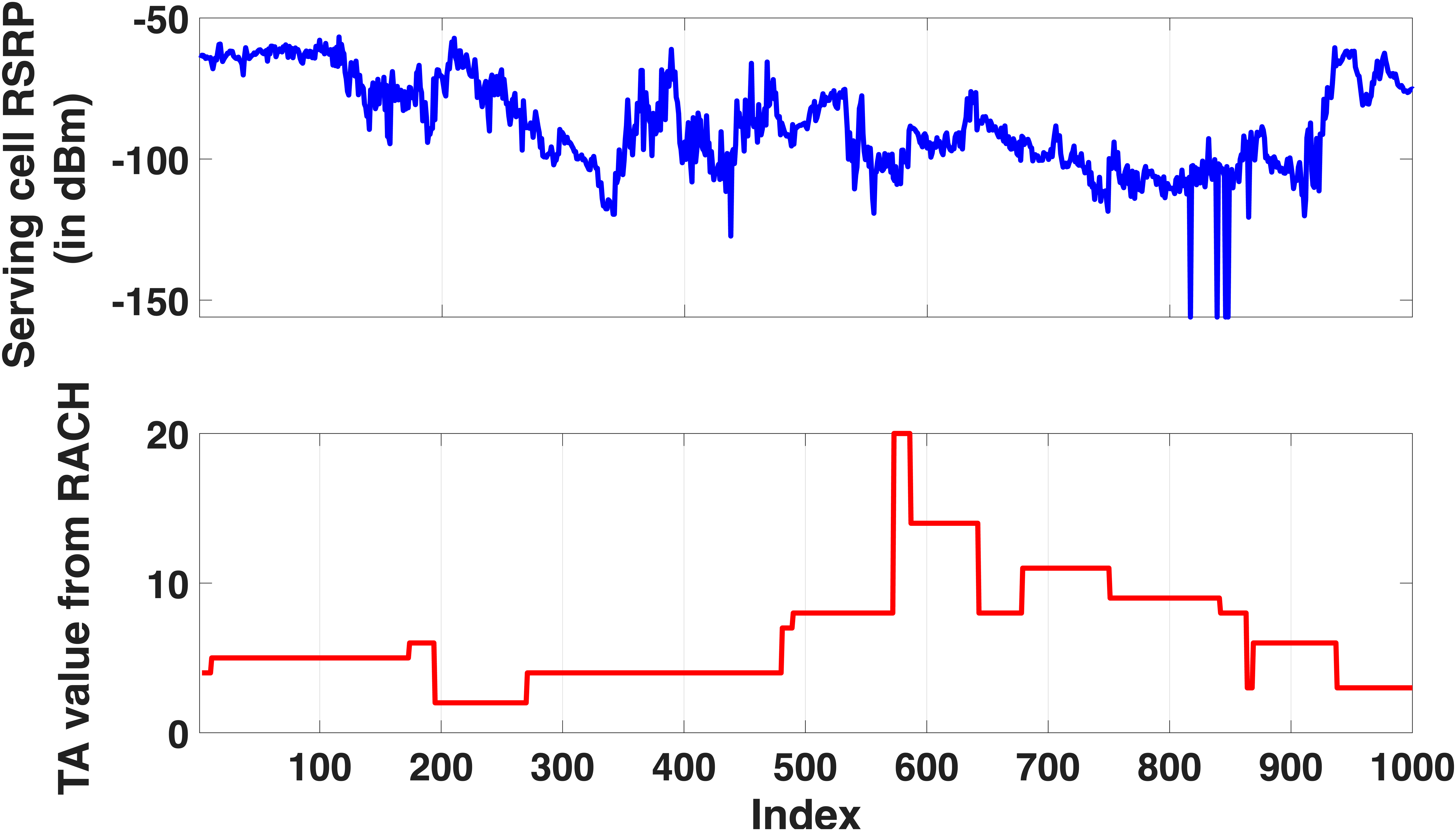
Figure 5: Joint temporal traces of serving cell RSRP and PRACH TA—high RSRP coincides with lower timing advance.
This supports the use of the dataset for training models to predict TA as an auxiliary signal for early uplink synchronization and low-latency HO.
Implications and Use Cases
The dataset addresses previously unmet requirements for feature-rich, UE-side, real-world log data with fine-grained annotation. Explicit practical use cases include:
- Supervised and RL-based handover/beam management policy learning under realistic noise and event imbalances
- Training ML models for RSRP prediction at both cell and beam levels, with external verification against ground-truth signals
- Multi-modal mobility state inference by combining location, beam, and RSRP statistics
- TA prediction and early synchronization for low-interruption L1/L2-triggered mobility (LTM), in line with 3GPP Release 18/20 aspirations for AI-native RANs (2605.12453)
- Cross-layer benchmarking and reproducibility, fostering robust, generalizable advances in 6G mobility management
Limitations and Future Directions
While this work provides a comprehensive foundation, practical deployment environments, hardware heterogeneity, and network policy diversity remain sources of variability. Extending data collection to additional frequency bands, wider geographical settings, and multi-vendor deployments would further improve generalizability. Future releases might also include uplink metrics, application-layer throughput, and packet-level traces to enable holistic cross-layer learning.
Conclusion
This paper delivers a rigorously documented, real-world, multi-modal dataset for AI-native mobility in 5G-Advanced and 6G. The dataset’s granularity—covering HO, BM, and TA events—addresses critical gaps in prior mobility research, supporting reproducible development and benchmarking of AI/ML models for next-generation mobile networks. Immediate implications include the enabling of TA-aware HO prediction and beam management, while future work anticipates expansion to broader bands, configurations, and network contexts to accelerate empirical AI-for-6G research.