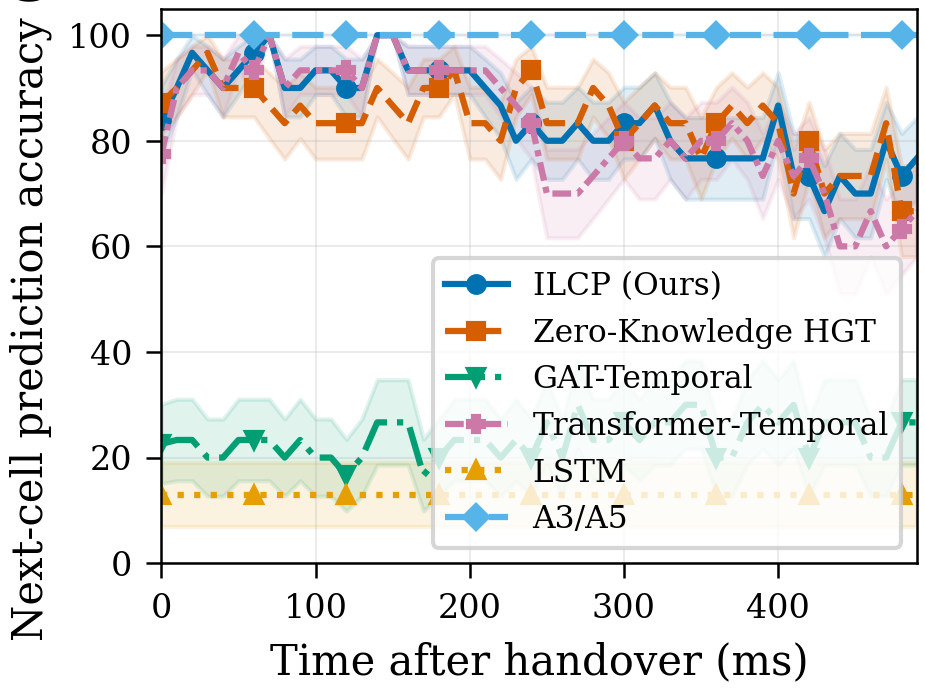
- The paper introduces ILCP, a protocol that compresses and transfers per-UE recurrent states via a 128-byte payload to overcome the post-handover cold start in 6G networks.
- It demonstrates significant improvements with an average +5.1 percentage point gain in next-cell prediction accuracy and a complete elimination of ping-pong handovers.
- The protocol maintains robust performance under measurement impairments and meets real-time constraints, enhancing AI-driven mobility management in heterogeneous RANs.
Inductive Latent Context Persistence for 6G RAN Mobility: Formalism and Evaluation
Introduction
The transition to dense, heterogeneous 6G Radio Access Networks (RANs) poses significant challenges for mobility management. Existing standards (A3/A5 rules) employ only user equipment (UE) measurements for handover (HO) decisions, yielding suboptimal adaptability under measurement variations and missing predictive context. Recent advances using graph neural networks (GNNs) and recurrent models have increased spatial-temporal fidelity, yet all existing approaches discard the per-UE recurrent state at the HO boundary, forcing the target cell to rebuild context solely from post-HO measurements—a cold-start penalty detrimental to network KPIs, especially ping-pong HOs and HO failure (HOF) rates.
This work introduces Inductive Latent Context Persistence (ILCP), a learned, latent context synchronization protocol. ILCP compresses and transports the per-UE recurrent state across gNBs over the standard Xn interface, addressing practical constraints by constraining the payload to 128 bytes. Performance is demonstrated on a Vienna 4G/5G drive-test dataset, highlighting statistically significant improvements in next-cell prediction accuracy and a complete elimination of ping-pong handovers compared to strong GNN and Transformer baselines. Additionally, robust training renders ILCP more stable under substantial measurement impairments than rule-based or non-transfer neural approaches.
System Architecture and Problem Definition
The RAN is represented as a dynamic, heterogeneous graph comprising UE nodes, gNB nodes, measurement edges encoding radio metrics (RSRP, RSRQ, SINR), and Xn neighbor edges representing the static gNB topology.
Each step involves:
- A heterogeneous-attention encoder (fθ) producing spatial embeddings from the graph.
- A GRU (rϕ) constructing temporal state vectors per UE.
- Candidate-cell scoring and selection using the current hidden state and candidate cell embeddings.
The cold-start problem is formalized as a domain shift at handover: the target-side recurrent state is re-initialized, losing historical information, which leads to degraded HO accuracy and increased instability immediately following HO. The cost is quantified as the accuracy gap between warm (oracle state transfer) and cold (re-initialized state) predictors.
The design objective is to bridge this gap with only a constant-size Xn message under real-time constraints.
The ILCP Protocol
ILCP introduces a latent state synchronization protocol:
- State Compression: The per-UE 128-dimensional GRU hidden state is compressed via a jointly trained β-VAE into a 32-dimensional latent, corresponding to a 128-byte FP32 payload.
- Transport and Decoding: The latent vector is appended to the Xn Handover Request.
- Target-side Adaptation: On the target gNB, the latent is decoded and combined with the new local context via a learned, gated MLP and LayerNorm, forming the new initial state for post-HO inference.
- Downstream Prediction: The updated temporal state is used for candidate cell selection as before.
The protocol is fully compatible with tight RAN real-time constraints (tested at 7.7ms p99 inference per HO on standard hardware) and fits within existing message size limitations.
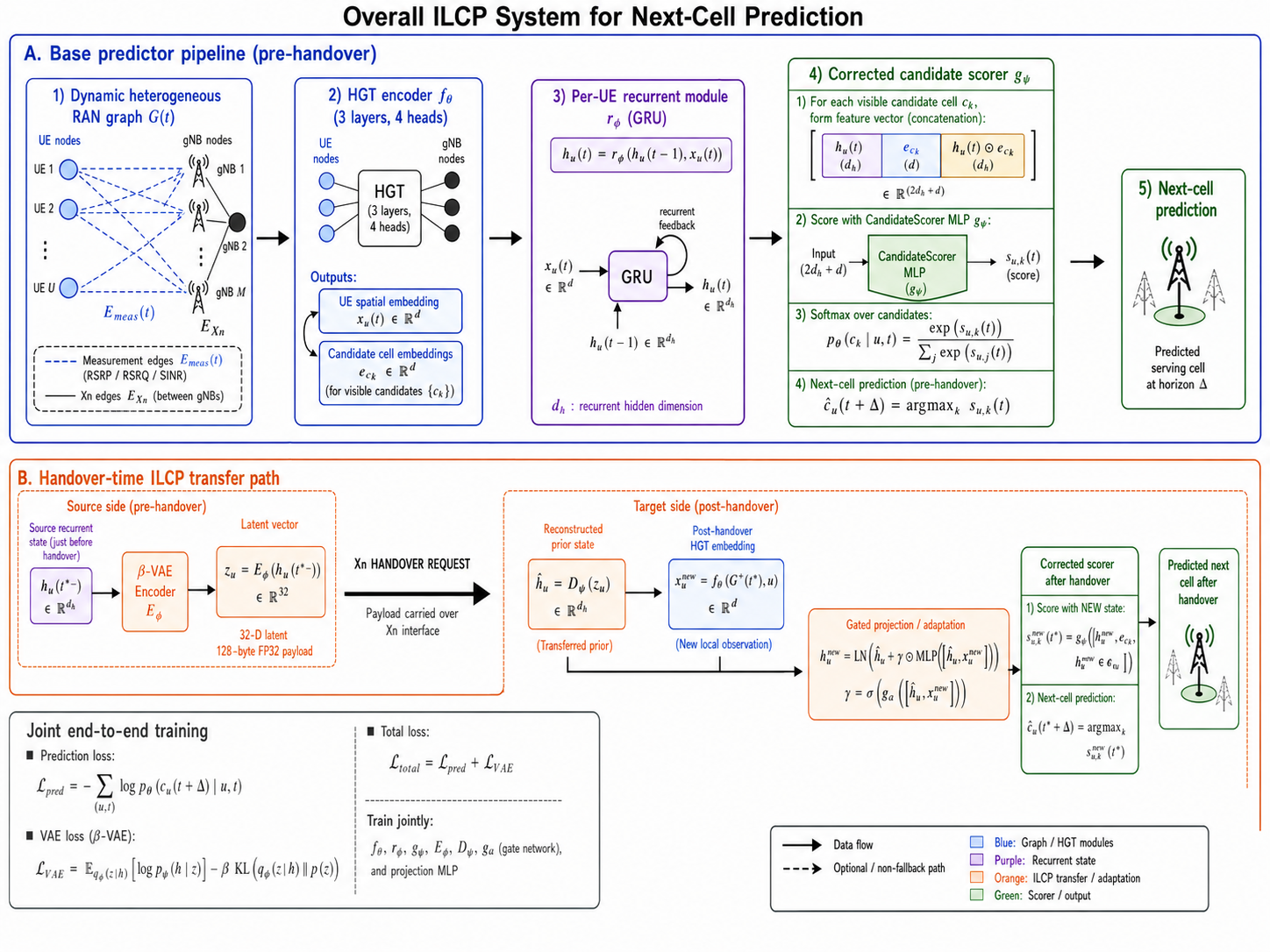
Figure 1: System Diagram depicting source-side state encoding, latent compression, transport via Xn, and target-side latent adaptation for ILCP.
Experimental Results
On the Vienna drive-test consisting of 31 handovers in the test split:
Robustness to Measurement Perturbation
ILCP was evaluated against realistic measurement impairments, including substantial shadow fading (σs up to 12 dB), random NLOS blockage, and SSB-burst sparsity. With robust training—where models are trained to recover reference decisions in the face of noisy inputs—ILCP sustains HOF rates in the 10–13% range. In stark contrast, the measurement-only A3/A5 baseline's HOF increased from 1.1% to 57–65% under the same perturbations, demonstrating its fragility outside clean conditions.
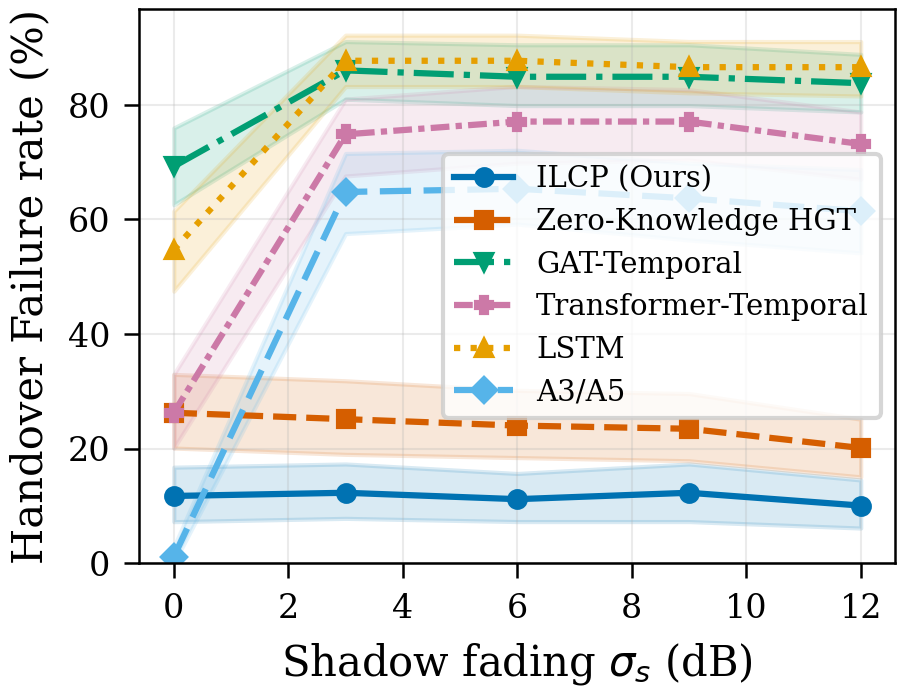
Figure 3: Vienna HOF under shadow-fading perturbations: Robust ILCP remains stable (∼12%), whereas A3/A5 drastically deteriorates under moderate shadowing.
Analysis of Design and Implications
The explicitly heterogeneous dynamic GNN backbone (using an HGT) is critical—sequence-only architectures and relation-agnostic GATs demonstrate much lower predictive power. The use of a joint end-to-end β-VAE ensures dimensional compression retains only task-relevant information, enabling efficient, accurate transfer within message size budgets.
The elimination of ping-pong HOs by ILCP directly addresses a longstanding operational pain point, especially as cell footprint shrinks and measurement and topology variability increase. Moreover, by decoupling the learning process from rule-based label alignment via robust augmentation, ILCP generalizes more effectively to real-world, noisy deployments.
From a theoretical perspective, this work recasts HO as an inductive domain adaptation problem, requiring dynamic realignment of the state-space across boundary events. The learned latent synchronization (with adaptive gating) formalizes a principled, extensible pathway for memory transfer in graph-based recurrent contexts.
Limitations and Future Directions
Current empirical validation is limited by public dataset scope—more extensive traces, especially with variable topology and a wider array of operationally optimal serving cell labels, would further solidify conclusions. Additionally, richer node features, diverse mobility patterns, and distributed, multi-vendor testbeds are necessary for a complete assessment.
Future work could extend latent state transfer to more generalized cross-domain memory transfer mechanisms, integrate additional context from physical/network layers, and leverage simulator-generated optimal policy traces to decouple from legacy rule-based label bias. There is also an opportunity to explore continual learning extensions and further integrate robustness to unpredictable environment shifts.
Conclusion
ILCP offers a formally grounded method for persistent, efficient context transfer at HO boundaries in next-generation RANs. By enabling rapid context recovery and robust, stable mobility control under operational noise, ILCP closes a longstanding cold start gap and sets the stage for more reliable distributed AI-native mobility management in dense 6G deployments. Its lightweight protocol, strong empirical gains in HOF and ping-pong rates, and principled approach to cross-node state synchronization have immediate practical and theoretical significance for future AI-driven network automation.
Reference: "Inductive Latent Context Persistence: Closing the Post-Handover Cold Start in 6G Radio Access Networks" (2605.00593)