- The paper introduces a query-optimal simulation of non-Hermitian Hamiltonians using bivariate quantum signal processing, attaining information-theoretic lower bounds.
- It employs a Multivariable-QSP circuit with separate oracle access to Hermitian and anti-Hermitian components to encode the Dyson series efficiently.
- The approach achieves significant query reductions and minimal ancilla overhead, paving the way for scalable quantum simulations with controlled postselection.
Simulation of Non-Hermitian Hamiltonians with Bivariate Quantum Signal Processing: An Expert Perspective
Introduction and Motivation
The simulation of non-Hermitian Hamiltonians is central to numerous physical and computational scenarios, including Lindblad no-jump dynamics, quantum optics with gain and loss, complex absorbing potentials in atomic/molecular/orbital (AMO) simulations, as well as quantum algorithms for ground state preparation, partition function estimation, and imaginary-time evolution. Despite their prominence, simulating non-Hermitian dynamics efficiently and with controlled postselection overhead has been a longstanding challenge, especially when considering block-encoding models and separate oracle access to Hermitian and anti-Hermitian parts.
Courtney presents a general, query-optimal quantum simulation algorithm for non-Hermitian Hamiltonians Heff=HR+iHI with HR Hermitian and HI⪰0, leveraging a bivariate extension of quantum signal processing (QSP) designed to operate in the separate-oracle model. This technique encodes the interaction-picture Dyson series as a polynomial on the bitorus T2, realized in hardware via a structured Multivariable-QSP (M-QSP) circuit. The theoretical bounds are shown to be tight and saturate information-theoretic lower bounds in both query and postselection cost.
Theoretical Framework and Algorithmic Construction
Oracle Model and Problem Definition
This work formulates the simulation using independent access (separate oracles) to block-encodings of the Hermitian (R) and anti-Hermitian (I) components. In many practical AMO or Lindblad settings, this reflects the physical structure, where, for example, R encodes coherent evolution and I dissipative processes, each with distinct spectral properties and ancilla requirements.
A central technical challenge addressed is the implementation of the non-unitary propagator e−iHeffT, retrieved as the (0,0) block via ancilla postselection.
Query and Postselection Lower Bounds
A two-layer "Postselection Barrier" is established: the first, arising from quantum unitarity and contractivity, limits the success probability to at most HR0; the second, tighter bound is induced by the polynomial structure of block-encoding algorithms, requiring normalization by HR1, and yielding
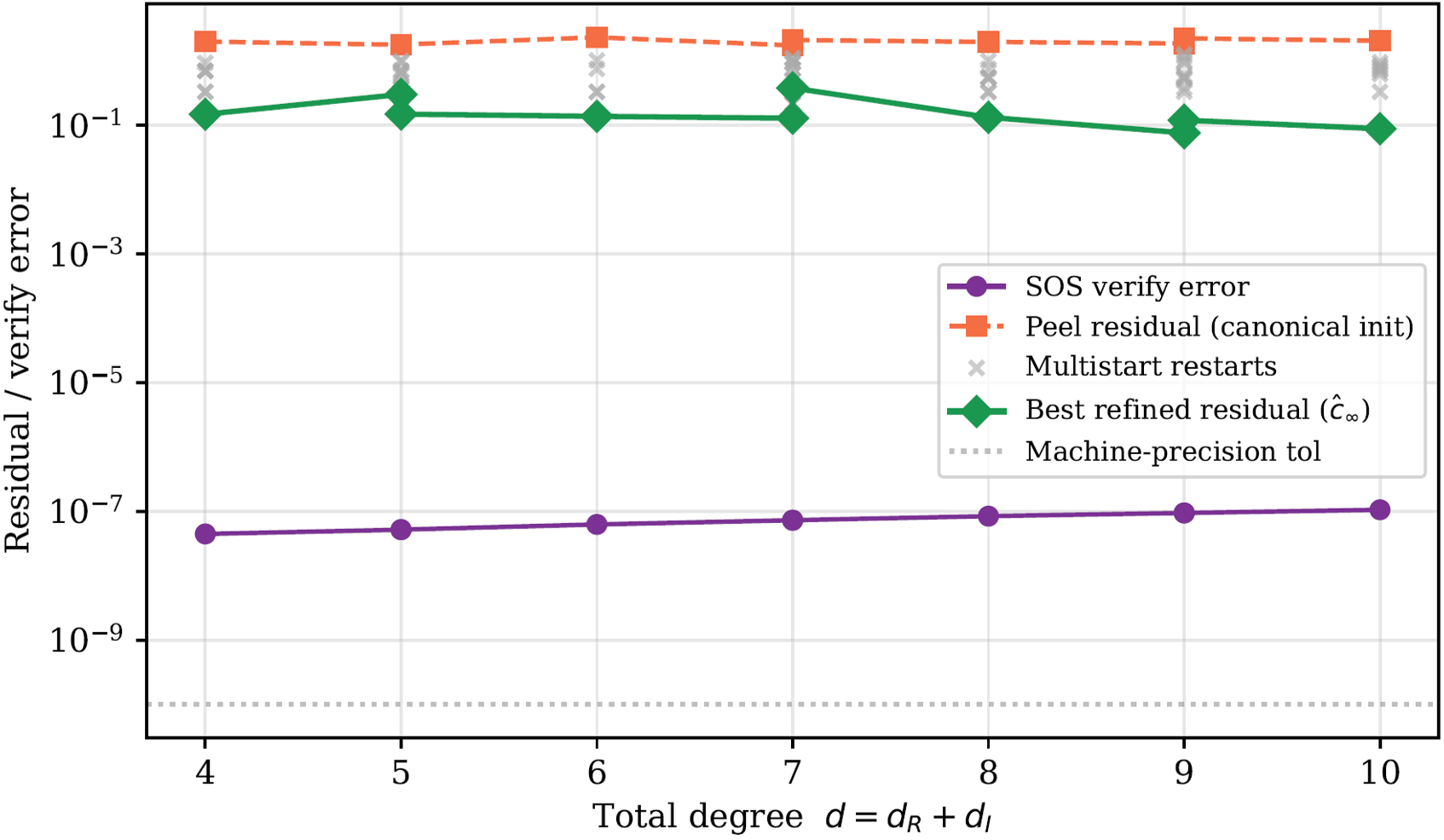
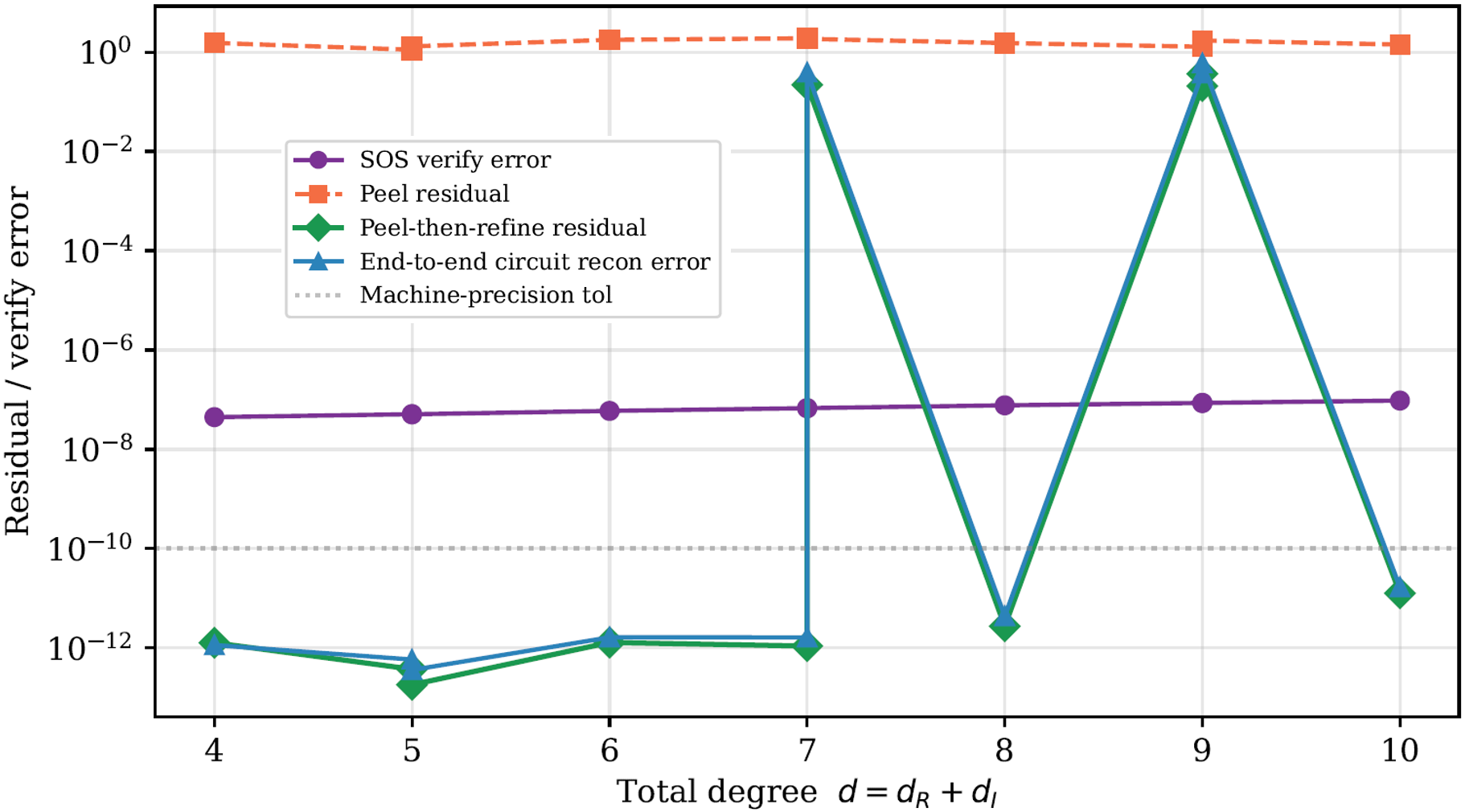
Figure 1: "Residual" on both panels denotes the relative HR2 norm HR3, illustrating algorithm-target polynomial approximation fidelity.
HR4
Additionally, an information-theoretic lower bound for the number of queries is derived:
HR5
The lower bound is tight and matched by the author's M-QSP construction in the separate-oracle model.
Bivariate Quantum Signal Processing (M-QSP) and Spectral Factorization
Bivariate Polynomial Encoding of the Dyson Series
The interaction-picture approach factors the non-Hermitian evolution as HR6, with HR7 a time-ordered exponential involving only HR8 in the interaction frame. The Dyson expansion's Taylor coefficients naturally map to a bivariate polynomial in the walk operator phases HR9, corresponding to HI⪰00 and HI⪰01.
A major technical advance is the construction of M-QSP circuits—an ordered product of controlled-walk operator and rotation gates—that realize such bivariate polynomials with precise control over degree, leading coefficients, and normalization. The mapping relies crucially on a block-encoded implementation of both operators in independent ancilla registers.

Figure 2: The bivariate M-QSP circuit HI⪰02 implements the interaction-picture Dyson polynomial via interleaved HI⪰03 (for HI⪰04) and HI⪰05 (for HI⪰06) queries, interspersed with optimal HI⪰07 rotations on the QSP ancilla.
Sum-of-Squares Spectral Factorization on HI⪰08
Scalar spectral factorization (Fejér–Riesz theorem) in one variable does not generalize: for most bivariate trigonometric polynomials HI⪰09, there does not exist a scalar T20 s.t. T21. The author sidesteps this, applying degree-preserving sum-of-squares (SOS) factorization. For the class of polynomials arising from the M-QSP circuit, the required SOS rank is shown to be T22, yielding a dramatically reduced ancilla requirement—two qubits, independent of the polynomial degree.
Regularization by a small factor T23 ensures strict positivity, removing zero-locus obstructions and enabling efficient factorization and circuit construction.
Efficient Classical Angle-Finding and CRC Property
A major bottleneck in multivariate QSP previously was the stable, efficient recovery of circuit parameters (angles) for scheduled queries to non-commuting signal operators. This paper resolves this by proving a constant-ratio condition (CRC): at each recursive degree-reduction step, the ratio of leading coefficients of the target and complementary polynomial remains constant, independent of the other variable, even for non-commuting T24 and T25.
As a result, rotation angles can be deterministically and efficiently computed via recursive "block peeling" or fast Fourier optimization. The total classical complexity is T26, where T27 and T28 are the polynomial degrees in T29 and R0.
Progressive Algorithmic Improvements
Three algorithmic variants are presented and benchmarked:
- Lorentzian Interaction-Picture (LIP): Each segment’s evolution is realized via a Lorentzian ancilla and postselection, requiring R1 queries and R2 intermediate postselections.
- Dyson LCU: All segments’ Taylor expansions are aggregated via an LCU with a single postselection, achieving R3 queries.
- Bivariate M-QSP: The full Dyson series is implemented as a single M-QSP circuit, attaining optimal query complexity R4 and achieving the postselection barrier with a single shot.
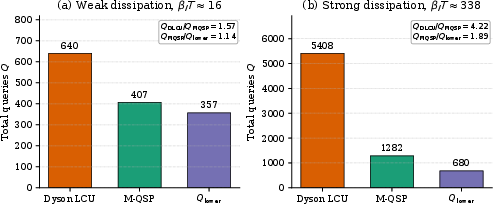
Figure 3: Query counts for the Eckart-barrier benchmark (R5, R6), showing total oracle-query complexity for Dyson LCU, M-QSP, and the theoretical minimum.
Numerical Benchmarks and Comparative Analysis
Benchmarks on the canonical Eckart barrier system demonstrate:
- In weakly dissipative regimes, M-QSP provides a significant query reduction (factor R7–R8) over segmented Dyson LCU methods and closely tracks the theoretical lower bound.
- In strong-dissipation regimes, the advantage is even larger due to the absence of a R9 segmentation penalty.
- The postselection probability is fundamentally limited by I0, a cost incurred regardless of polynomial or integral simulation paradigm.
Theoretical and Practical Implications
Contradictory/Strong Claims:
- The query complexity matches the information-theoretic lower bound to within a I1 factor.
- The block-encoding-induced postselection overhead is proven to be unavoidable within the polynomial signal-processing framework.
- The sum-of-squares requirement for achieving the complement is universally I2 within this construction, irrespective of system size or simulation duration.
Broader Implications:
- The results illuminate the role of oracle modeling in quantum simulation—separate-oracle access enables additive query scaling and improved physical interpretability.
- Extensions to time-dependent Hamiltonians, higher-order M-QSP, and potential hybridization with fast-forwarding (APS-type) algorithms are open and promising directions.
- The framework generalizes to diverse simulation settings with structurally distinct coherent and dissipative components.
Conclusion
This work establishes the first tight, structure-exploiting query complexity bounds for simulation of non-Hermitian dynamics in the separate-oracle model, and delivers a quantum circuit construction (bivariate M-QSP) that realizes these bounds via efficient classical precomputation coupled to a minimal postselection protocol. The analysis clarifies the landscape of achievable complexity in relation to physical modeling choices and spectral structure, resolving long-standing barriers in multivariable quantum signal processing and spectral factorization.
References:
Courtney, J.M. "Simulation of Non-Hermitian Hamiltonians with Bivariate Quantum Signal Processing" (2605.12450)
Figure 1: The I3 residual between the M-QSP-generated polynomial and the truncated Dyson target, illustrating the convergence regime and the off- and on-manifold error structure.
Figure 2: The schematic of the bivariate M-QSP circuit I4 with interleaved I5 and I6 queries, structured according to the Dyson block schedule.
Figure 3: Query counts for the Eckart-barrier benchmark (I7, I8), showing total queries for segmented Dyson LCU, M-QSP, and the theoretical lower bound, demonstrating substantial reductions through M-QSP query-optimality.